


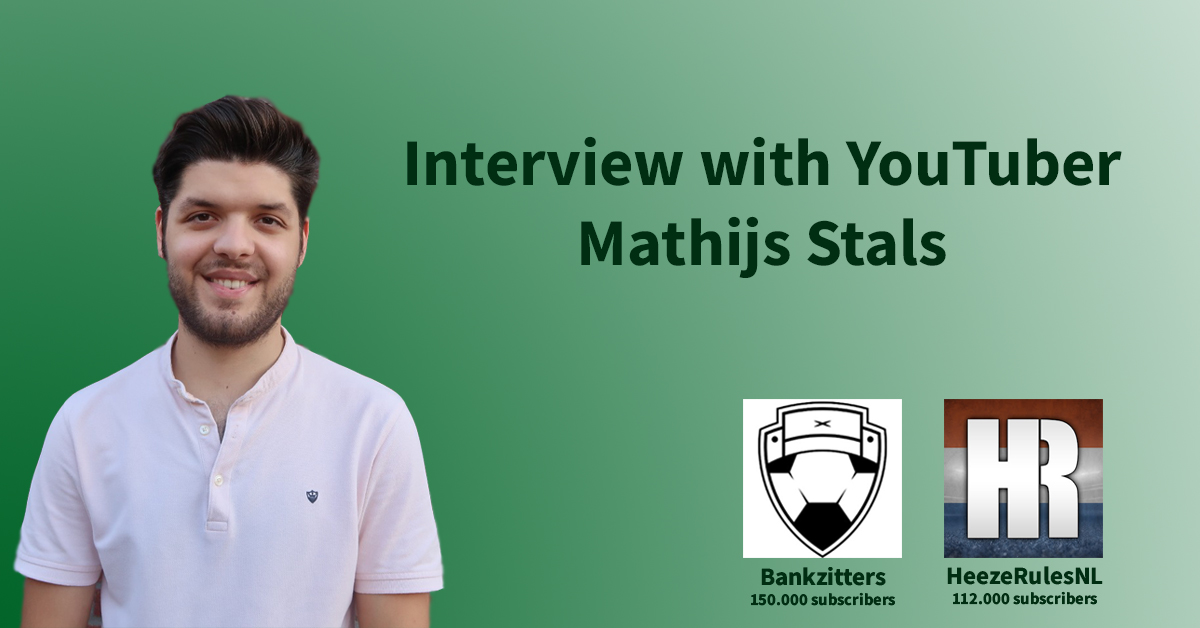
Maybe you know him from the YouTube-account the Bankzitters or his own channel HeezeRules NL: YouTuber Mathijs Stals. The 22 year old FIFA-YouTuber is currently studying at Tilburg University. He did his Bachelors in Global Law and this year he’s studying for a Masters degree in Law and Technology. With over 110.000 subscribers, he can be called a YouTube phenomenon. He tells us about his experience in the world of YouTube and gives some insight into the mysterious financial part. How did your career as a YouTuber start? When I was 14 years old, I had a bet with my dad: if I would get a B+ for my math exam, my dad would give me a recorder. Eventually I got an A- and that meant the beginning of making videos. In the beginning I only had around 50 views per video, but at that age I wasn’t doing it for the money nor the fame. My purpose of making videos is to help people, and I still feel that way. Money is just a nice extra. How did your channel grow since the beginning? It’s a bit like the snowball-effect: the growth keeps becoming greater. Views quickly went from 100 views to a 1000 views. I was lucky because I started in the booming phase of YouTube in the Netherlands. In the area of gaming it went crazy in 2014. At the beginning there were only 2 or 3 other FIFA-YouTubers but now there are 7 big FIFA-YouTubers and a few smaller ones. There have been a lot of spikes in growth. In 2017 my account went from 20.000 subscribers to 100.000 subscribers. Because of my Exchange I did not do much with YouTube but currently my account is growing to 120.000 subscribers. “It has become a bit of a concept: you can name the Bankzitters without even mentioning the people who belong to it.” What are the Bankzitters and what is the impact from this channel on your channel? Together with seven FIFA-YouTubers from the Netherlands we started Bankzitters. Every week, we post a video which are not all focused on football. Because of Bankzitters, my own channel has grown enormously. Without the Bankzitters we individually wouldn’t be where we are today. We’re continuously filming together and seen in shots. It has become a bit of a concept: you can name the Bankzitters without even mentioning the people who belong to it. How does your average working week look like? Usually I make 5 to 7 videos per week, whereas one video takes around three hours to make. Besides that, you have to keep your other Social Media accounts (Instagram, Twitter, Snapchat) up to date. You also have to generate ideas for new videos you want to make which takes up quite some time. My week consists mainly of coming up with ideas, executing them, writing scripts and filming it until it becomes something nice. You can compare it with a fulltime job. I’m not necessarily working 40 hours a week but you have to keep being relevant and that causes lots of stress as well. You can’t really work in advance, so you can’t just take a few weeks off. Of course, I’m also studying at the moment, but this can be combined quite well. I also worked at a law firm for half a year for 20 hours per week. However, combining working at a law firm, Youtube, University and still maintaining social life isn’t doable. What can you tell us about the financial picture of YouTubers? With Youtube you often work with MCN (Multi-Channel Networks for YouTube content creators). They arrange everything, from copyright infringement to payment. The payment of YouTube comes from advertisements that Google puts next to a video. MCN receives the money from the ads and pays a certain percentage, depending on the number of views of that month. If there are more advertisements, you receive a higher percentage. This is the reason why I make more money in December compared to other months. During the December month with Saint Nicholas and Christmas, companies want to sell more, so they advertise more as well. Moreover, if you make videos above 10 minutes, you can put an ad in your video that will result in more money. Youtube has a certain algorithm that prefers videos of a longer duration because that means people will watch for a longer time and Google can earn more money on advertisements. “Through the years this has become a lot more lucrative. At the moment you get around 2 to 3 times more as much as you would get a few years ago.” Per thousand views you get a certain amount that varies from 2 to 10 dollars but this excludes tax. Through the years this has become a lot more lucrative. At the moment you get around 2 to 3 times more as much as you would get a few years ago. I used to get a few hundred euros for two videos with half a million views. Currently I would earn more because more businesses focus on the power of Social Media marketing. With 500.000 views a month you can compare it to a parttime starter job at University level, so 1.000 to 1.200 euros. Do you also have sponsors because of your channel? You can connect with sponsors but I’m not a really big fan of that. However, it is a bit of thing around YouTubers. I do get a large part of my salary from campaigns. For instance, I worked alongside the KNVB (Royal Dutch Football Association) and the Albert Heijn. Setting up a sponsor is possible through MCN but it becomes more of a trend that the sponsor goes directly to the content creator himself. How does your YouTube future look like? I will definitely continue working on my own channel and with Bankzitters the focus is on the making of a certain concept. Soon we will go on holiday together with
News from the Department of Finance
Firms can protect their employees against layoffs during adverse industry shocks. In return, employees receive lower wages. Such implicit contracts work out – as long as employees have enough political clout. Board-level employee representation has re-entered the political agenda. Even countries that have traditionally been skeptical about giving employees better representation and more say in corporate decision-making now discuss board-level employee representation. Prime minister May suggested changes in this direction in the UK in 2017, and Senator Warren has introduced a legislative proposal to the same end in the US in 2018. While the political debate continues to be heated and controversial, rigorous academic evidence is scant. In a recent empirical study, Christoph Schneider, Assistant Professor for Corporate Finance, together with his co-authors E. Han Kim (University of Michigan) and Ernst Maug (University of Mannheim), analyze board-level employee representation in Germany and argue that labor participation in the company’s management facilitates risk sharing between employers and employees. “Thus, losing their job as a consequence of economic stress is a widespread fear among employees.” Human capital arguably represents the largest source of risk in the world of work. During economic recessions, employers might be forced to downsize their workforce in order to maintain their current position in the market. Thus, losing their job as a consequence of economic stress is a widespread fear among employees. Economic theorists have long argued that optimal risk sharing would involve an implicit contract, an arrangement in which employees receive employment protection in exchange for lower wages, which they would accept as an insurance premium. However, it is unclear how firms could commit to such an arrangement, in which they uphold employment even during economic downturns. In addition, workers must be willing to compensate firms for the job guarantees they receive from their companies. Christoph Schneider and his co-authors argue that codetermination is such an institution that allows firms to make credible commitments, which workers are willing to honor through lower compensation as a quid pro quo. Codetermination enforces the implicit contract The authors use plant-level data from Germany, which is ideally suited for such an analysis. The country was at the forefront of labor representation starting in the 1970s and is about average in terms of employment protection rights in the OECD. Since 1976, so called parity-codetermination has been in place. This means that 50 percent employee representation on supervisory boards is required by law, for firms that have a workforce of 2,000 employees or more. The analysis covers data for the years 1990 to 2008. The study investigates whether employment and wage insurance is provided and if so, whether it has an influence on the firm’s performance. The study’s results indicate that in case of parity-codetermination, two groups of employees are indeed successfully protected: white-collar and skilled blue-collar workers benefit from the arrangement. These workers profit from an employment protection that employees in non-parity companies do not receive. For unskilled blue-collar workers however, not even parity-codetermination does the trick. The authors attribute the unfortunate position of this group to the fact that it is never represented on supervisory boards. Unskilled blue-collar workers, about 20 percent of the work force, participate in the elections of board representatives, but their interests do not appear to be represented sufficiently well, so as to enforce implicit contracts, which emphasizes the importance of participation in governance. Shareholders do not profit, only skilled workers capture the gains. The study reveals that employees with higher educational qualifications, a group that largely overlaps with white-collar and the skilled blue-collar workers, accept lower compensation of 3.3 percent when they work for a parity-codetermined firm. In exchange, the group benefits from employment insurance and the company can put the savings aside for a potential recession phase. Inevitably, this finding leads to the question whether this is enough to overcome downturns. Do parity-codetermined companies survive periods of recession? Do shareholders even profit from the implicit insurance model? Or does the employment insurance stemming from parity-codetermination put the firms in a bad financial position in the long run? Christoph Schneider and his co-authors find that in fact, compared to non-parity firms, economic shocks hit parity firms particularly hard. But the savings from the wage concessions seem to compensate the loss. The study analyzes the companies through the whole business cycle, including different states of the economy, and finds no long-term differences in performance and valuation between parity and non-parity firms. However, this means that workers profit from employment insurance, while shareholders are not rewarded with any gain. The authors draw the conclusion that, therefore, firms will not voluntarily install labor representation in their governance structure. Regulatory intervention might be needed when the employment insurance should be spread. Kim, E H., Maug, E. and Schneider, C. (2018). Labor representation in governance as an insurance mechanism. Review of Finance, 22, 1251-1289.
The Business of Football
Which salary do you think you will earn as a starter on the job market after graduating from university with a Master’s degree? Most students have probably done some research on starting salaries and concluded that three thousand euros a month would be a nice salary to start with. However, nowadays this is an irrelevant amount for top athletes. Especially within the football industry, these high salaries and insane sponsor contracts are a normality rather than an exception. Recently, it became clear that Brazilian superstar Neymar receives an amount of 375000 euros for just waving to supporters in the stadium. In addition, he receives ‘a little extra’ of two million euros for not criticizing the actions and decisions of his own coach. It is ridiculous to conclude that an average Dutchie has to work about forty years in order to earn the same amount of money Neymar receives yearly based on his bonuses. Thus, the world of top sports has become a billion euro industry, yet is this a positive trend? To look more closely at the huge amounts of money in the football factory: Kylian Mbappe, the 19 year old French superstar, earns around 17.5 million euros a year. This is a daily pay of a whopping 50.000 euros, most graduated master students of accounting and finance would accept a sum of money like that as a yearly salary in a heartbeat. However, the amounts haven’t always been that high. In 1995 the total accumulated transfer fees summed up to just above 400 million euros, nowadays that has easily increased tenfold. To make a comparison, Johan Cruyff was considered the best player in the world in the seventies and received during his time with Ajax around 95k in guildens, the former Dutch currency. To convert this to euros, this would be approximately 43k. Even when taking inflation into account, it’s absolutely ridiculous to conclude that the daily payment of Mbappe is higher compared to the yearly payment of Cruyff. This bizarre development in the world of football has several causes. The major cause is the fact that clubs have access to higher amounts of capital through an increase in TV- and sponsor revenues. Sports channel Sky Sports paid the ridiculous amount of seven billion dollars for the broadcasting rights of three Premier League seasons. In addition, a political decision in 1995 caused that clubs were not required anymore to pay transfer money for a player whose contract has ended. This ‘Bosman-arrest’, as it is called, has led to a major increase in the amount of transfers and salaries. It seems that there is no hold on this development. “However, nowadays they have to deal with new players in the market, such as Chinese football clubs. Thus, there is a competition going on which will be decided by the club with the deepest pockets.” Additionally, the rise of China as a major player in the football industry has contributed to the high amounts of capital on the transfer market. Football players who have finished their career in the European top leagues and who still want to earn some quick money, are happily welcomed in China. Take the example of Carlos Tevez: a few years ago, he used to earn about forty million euros yearly when playing for Shanghai Shenhua. This means a weekly pay of 770000 euros. European football clubs once had no competition regarding historical successes, fame and capital. However, nowadays they have to deal with new players in the market, such as Chinese football clubs. Thus, there is a competition going on which will be decided by the club with the deepest pockets. Nowadays football players are not being bought merely for their skills in football. The purchase policy of a football club can be compared to a company investing in new projects, with the focus purely on maximizing profit. An example of a good investment is the transfer of Cristiano Ronaldo from Real Madrid to Juventus. The transfer fee of 112 million euros was earned back in a few days just by the increasing sales of the merchandise. Moreover, the stock of Juventus went through the roof and increased 50 percent at the moment it became clear that Ronaldo was coming to Juventus. In the current era footballers can be seen as brands and because of that they are becoming the most important factor in the investments of the club. We might ask ourselves whether the insane amounts in today’s football industry are somewhat extravagant. On the one hand, football clubs can be seen as players in a market and thus act according to supply and demand. On the other hand, the development can be seen as a ‘bubble’ which will ultimately burst since an unrealistic amount of money is being spent on players and contracts. This argument is agreed upon by some players in the industry itself as well: Mbappe, mentioned earlier, recently criticized the insane amounts of money in today’s football industry. The teenager, originating from a modest family, has a lack of understanding for the current expenses of clubs. Nevertheless, he became one of the most expensive players in the world last year after a transfer of 180 million euros. Eventually only time will tell if the bubble will burst or that the recent trends will continue. For this moment, if you can play a decent game of football, you can always try to join a Chinese club in a lower league. Who knows, after a year you might return with hundreds of thousands of euros more in your bank account, which will immediately solve your student loan debt issues as well.
Interview with Begga Berben – Regional Manager at ING Real Estate Finance
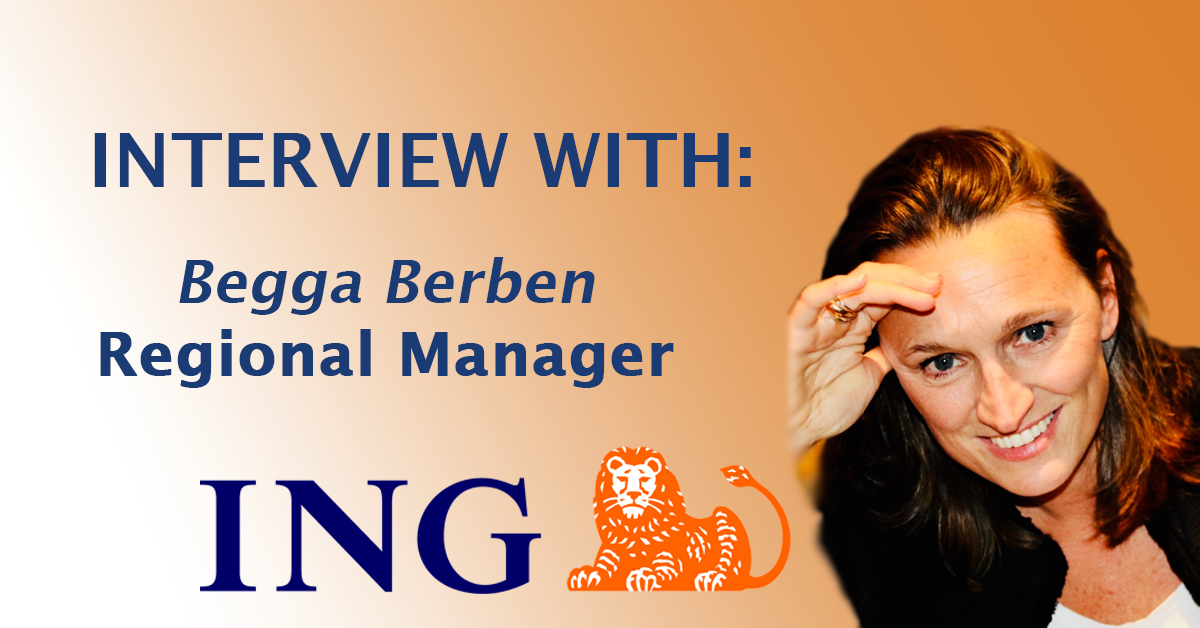
The business world is becoming increasingly aware of the importance of sustainability. But how does the transition process towards a ‘greener’ portfolio work? And what advice could be given to people starting their careers? We talk to Begga Berben (41), Regional Manager at ING Real Estate Finance. What can you tell us about your background and career path? I grew up in a small village in Belgium, went to an international school for ten years and spent last year of high school studying in Italy. I studied law in Leuven, Barcelona, and later in Leiden. After having worked at Loyens & Loeff for a couple of years as a lawyer, I started working for ING. Working at the Legal department of ING in Amsterdam, I was supporting various commercial departments in legal matters. After 3,5 years I joined the global mid corporate department at ING, a more strategic role with international scope. In 2009, I took on the role as Company Secretary to the Board of ING Group. At that time, the bank just received 10 billion of State aid, operating in the midst of the financial crisis. This was a very challenging but interesting period in my career. History was being written and it was an crucial time for the financial system. For my next role we moved with the family to New York. My children – being 9,7 and 3 at that time – started at the American School without speaking a word of English. It took a few months for them to get up to speed. As for me, I started working at the ING Financial Institutions department which was a new world to me, the front office in the Institutional business. I was relationship manager for the American banks and investment managers. When our oldest daughter was about to start high school we returned to the Netherlands. We missed certain aspects of the Dutch daily life and the Dutch way of life. Four years ago I started my job as Regional Manager of ING Real Estate Finance in the South of the Netherlands. Besides that role, I spent quite some time following the developments on the innovation side of the real estate business, a lot is happening in this field. What service does ING Real Estate Finance provide? We finance professional clients that buy real estate as an investment. We focus on long-term relationships and have a global footprint. In the Netherlands, the different ING REF regional offices work very closely together. Innovative concepts or ideas about new products are shared amongst each other and we try to translate those to our business. Apart from financing the real estate portfolio of our clients, we try to help them to make their real estate portfolio future proof. Therefore ING Real Estate developed a plan whereby we assist our clients in making their real estate more sustainable. This topic becomes increasingly important now that as of 2023 all office buildings in the Netherlands will require at least an A, B or C-energy label. Our clients can approach our partner, Corporate Facility Partners, with the request to perform a scan of their portfolio. CFP will indicate which measures can be taken at what cost level in order to upgrade their portfolio towards a better energy label. Furthermore, our clients can get access to an energy robot, an application that measures the energy usage of their real estate. Clients can also seek subsidy advice through another partner (Van Draeckeburgh). Last year we financed a major redevelopment of the old Philips territories in Eindhoven, Strijp T, with 80,000 square meters of building space. The majority of these buildings had an F-label. After finalizing the project, our client was able to obtain an A or even AAA label. Together we were able to restore a substantial piece of cultural and industrial heritage. This gives a sense of fulfilment. Strijp T currently functions as a magnet for innovation which the next generation wants to be part of. Sustainability proof and next generation proof. Mission accomplished I would say. ”Many started realizing that money can be earned with a “green” product. Besides, not participating is not an option anymore.” Regarding sustainability, you already touched upon the implementation of new legislation. Do you think people or companies approach you solely because of this legal change, or possibly also from an ethical standpoint as well? I think the level of awareness with regard to sustainability is developing very quickly. Four years ago, sustainability was definitely part of the agenda, but not yet top of mind. Over the past years the topic has become increasingly more important. We have noticed that people started to develop a sense of responsibility with regard to the next generation. Many started realizing that money can be earned with a “green” product. Besides, not participating is not an option anymore. Developments often go hand in hand with legislation and local initiatives. These initiatives should not be bound by borders and as the topic is universal and extremely relevant it should remain high on all agendas. Do you have any tips for students starting their careers? I would say: stay close to yourself, close your eyes, jump, and be surprised. You will enjoy the journey. Planning everything doesn’t always make sense. Of course, giving some direction to your career won’t hurt, but a lot is dependent on what and who crosses your path. I did not always choose the easiest path but it provided me with challenges from which I learned. I often got surprised by positive twists and turns and got tons of energy and learned a lot from the people I met in different roles. As to making decisions on new or future roles, I always tried to make sure that I kept learning somehow in combination with “giving back”. “When was the last time you did something for the first time” is a quote by John Maxwell of which I thought often. There is so much to see, to
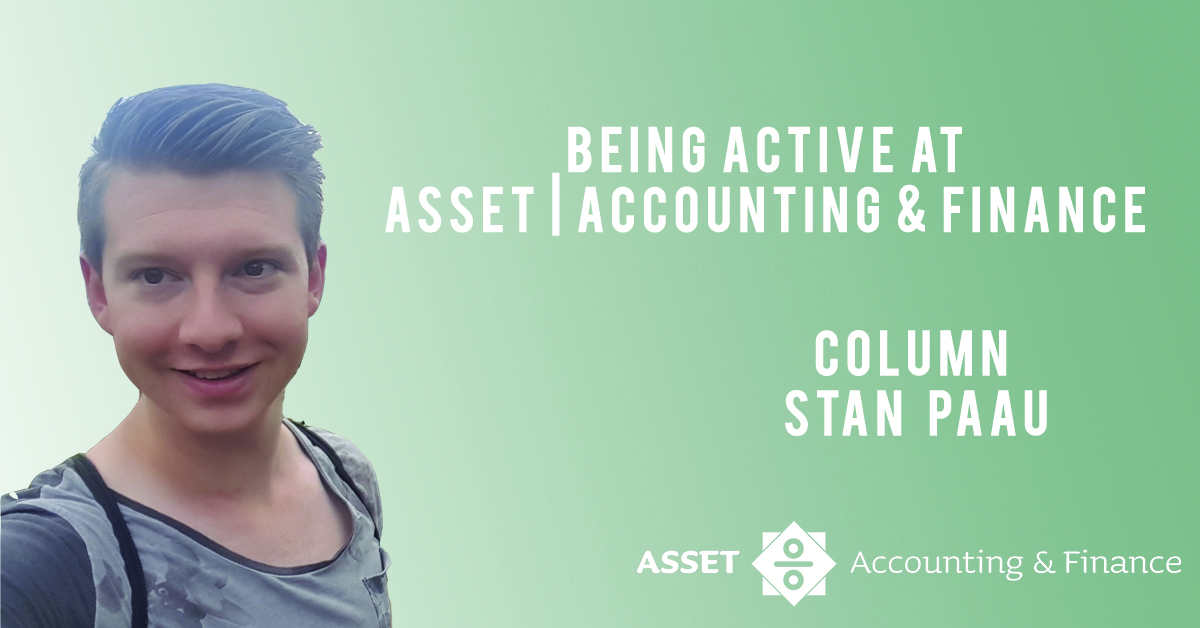
Being active at Asset | Accounting & Finance – Column Stan Paau
My name is Stan Paau, and I am 21 years old. Recently, I obtained my BSc in Business Economics, and have been a member of Asset | Accounting & Finance for two years now. In this column I will explain what it is like to be an active member of Asset Accounting & Finance. In June 2016 I started with the Investments Committee. I felt drawn to this committee, as it puts the theory of the subjects Finance 1 & 2 into practice. A&F Investments is an investing club where about 25 members manage a portfolio. As analyst of this committee you pitch your ideas to invest in funds, in order to gain experience in investing and to learn about investing strategies and valuing companies. After being active for two years I am now fortunate enough to hold the position of External Affairs officer in the board of the committee. While this sounds fairly specific, I quickly started getting involved in the activities that Asset | Accounting & Finance organizes. The informal activities grant you the opportunities to get to know a fun and diverse group of people who share the same interests as you. During a casual drink or formal activity, an active members day where we all do something fun together, or during a cantus where the association is present, the mood is always good, even if you know few people! Through committee members or the board, you start getting to know people quickly. Asset | Accounting & Finance is an open organization: everyone is welcomed with open arms on the casual drinking nights and cases of hierarchy, prominence or hazing do not take place. The combination of a fun, informal group and building your future, is a combination that creates value for every active member!” Obviously, partying is not the only thing we do in this association. Asset | Accounting & Finance grants you various opportunities to become active next to your study, and to become familiar with companies that might become your next employer. Examples of such activities are the Accounting Expedition, the Financial Business Dinner and the FinanceDay. As a result of attending such activities, you get an insight in the fields of the companies are operating in, and whether it interests you or not. And the companies are definitely interested in you as well! Companies such as Duff & Phelps, Rabobank, First Dutch or Deloitte, are waiting for you. In addition, it is possible to obtain an internship or starting job as a result of the foundation you build by attending these events. Even more fun is to organize an event like this. Next to being External Affairs officer at Investments, I am active as Vice- Chairman of the Finance Expedition Committee. This committee organizes a three-day event in Amsterdam, which deals with the pillars of Finance: Risk Management, Corporate Finance and Asset Management. Two companies a day are visited by students selected by the companies based on their CV. Even though this might sound specific and formal as well, the vibe within the committee and during the meetings is informal. We discuss the important affairs seriously but like to enjoy a drink together and don’t say no to a committee-event. The responsibilities you have as an active member vary, depending on the committee you join. However, in each committee it is important that you complete your tasks as discussed, and that you actively participate in delivering quality during the activities. This way you can make a difference in a fun way by doing something enjoyable, fascinating or interesting for yourself, fellow students and other members of Asset | Accounting & Finance. In the two years that I have been member of A&F, I have learned that it has been an excellent decision to join this association. It opens doors to the student life with a fun group of people while you are doing something that interests you. In addition, I have learned how to work together with other people, and how to put your knowledge into practice. In short, on the one hand I see Asset | Accounting & Finance as an awesome group of students who want to make the most out of their time at university by becoming active and go on a journey together. On the other hand, I see Asset | Accounting & Finance as a huge first step in getting in touch with the countless employers that are waiting for you. The combination of a fun, informal group and building your future, is a combination that creates value for every active member! Are you interested in becoming active at Asset | Accounting & Finance? Have a look at the website or send a mail to vice-chairman@asset-accountingfinance.nl!
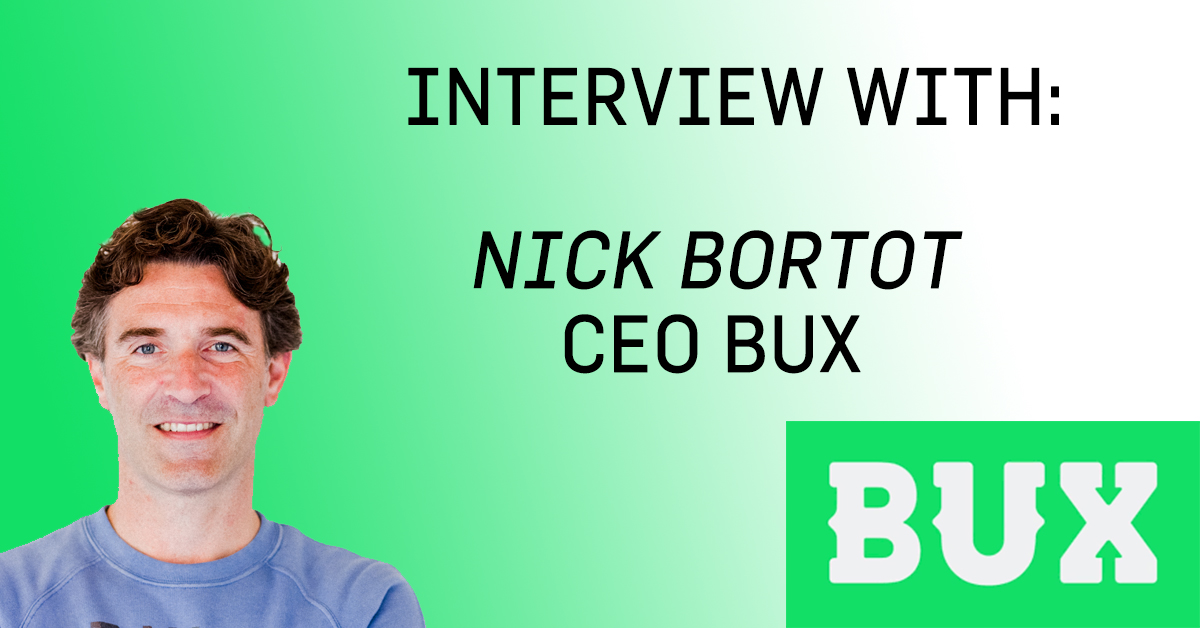
Interview with Nick Bortot – Founder and CEO BUX
Can you tell us something about yourself and your career? Yes of course! I studied business administration and then political science. This was mainly because I did not know what I wanted to do back then. After my studies I started working at Citibank, which was the largest bank in the world at the time. I did not like working there because it was far too big. During my time at Citibank I have been in America for a while. It was the ‘90s, I already had an affinity with investing and I saw that the internet was growing rapidly. In the US there already were a few online brokers, but not yet in Europe. I became very excited about it because it is a combination of both the internet and investing. Then I met two guys who wanted to start an online broker for themselves and they asked me if I wanted to participate. That was the beginning of BinckBank. I have worked there for more than 12 years. Binck grew very fast and when I left the company we had more than half a million customers and a market value of more than a billion. I had a great time at Binck, but at a certain point I wanted to do something different. In my lifetime I have spoken with many investors, but also with people who were interested in investing but who did not yet invest because they thought it was too complicated. I have always found of that second group an interesting one. I thought to myself: let’s go and make something that gives everyone the opportunity to trade. I am fascinated by the stock exchange and I like to share that fascination with other people. My idea was to come up with a product that makes access to the exchange super simple, cheap, but ultimately fun. Trading is not only about making money. It is also interesting, fun and exciting. That is why we did not want to set up an ordinary financial brand, but a brand that communicates in a completely different way and that in particular focuses on young people. That has become BUX and I have been working on that project for five years now. How did you experience the transition from working at a large corporation to starting your own company? I had been involved in the early years of Binck, so I already knew the startup life. It felt like your own business because all of us were very involved. I do have to say it is a big change when you manage a department of 700 people and then you suddenly are at home, all by yourself, working on your laptop in order to come up with a plan. In the end I do see myself more as an entrepreneur. What does your working week usually look like? It’s impossible to answer that question in a simple way. In any case, I try to be in meetings as little as possible and I am at the office five days a week. We do not often see our customers, because we do everything by using our app. Because of that we do a lot within the company: for example working out strategies and ensuring that they are carried out. In addition, I am responsible for general management, marketing and recruitment. We hire many software developers, but also new employees for the marketing and support department. We are looking for good people who fit our culture. I think it’s very important that everyone likes his or her job. I believe that if you hire good people who are happy, they will create beautiful things for customers. This way our customers will also become happy and ultimately also the shareholders. What is your strategy for further growth? At this moment we are working on new apps and we are expanding the reach of our current app. We are now doing business in 9 countries, but in many of those countries we still have to work on brand awareness. Our main goal is to bring in more users. In addition, we are working on an app for trading stocks. We want to create a brand with BUX that offers all kinds services that revolve around the stock market and investing, whether it is for short-term trading or for long-term investments. We have even been working on a crypto app. Unfortunately, it is impossible to do everything at once. The stock market app now has our highest priority and for the time being we will only be available via mobile apps. “Also look for a good team, because that’s where it all starts. Nobody can do everything, so find one or two partners who are good at something you are less good at so that you are extremely good together.” What is the biggest setback that you had to deal with and how did you deal with it? You constantly have setbacks, but they are all challenges that you can overcome. One of the founders of Binck once said to me: “Entrepreneurship is going from one problem to the next”. After some time and experience you will learn to deal with it. What do you value most in your work? I feel good when colleagues and customers are happy and I love to make beautiful things with the team. I also really like it when we are mentioned in the media in a positive way. Of course I’m also interested in the numbers. It is still a measure of how well you are doing. We are not yet making a profit however. You always have to strive for it in the long term, but growing is more important to us right now. What do you think about the competition between BUX and, for example, Binck or DeGiro? We are complementing each other at the moment. There are many people who, for example, hold a stock portfolio at Binck and at the same time
