

Paul Verhagen is CFO and member of the board of Fugro, an exchange traded multi-billion euro company that investigates earth surfaces and the seabed. He has also been employed as financial director in multiple divisions of Philips. After graduating in treasury, he combined a traineeship at Philips with classes to become a registered controller, after which he quickly built up an international career. We asked him how he experienced this. You managed to become a regional businessline CFO at Philips in 6 years. How did you work your way up so quickly? I started a traineeship at Philips, because I could start with my postmaster register controller at day one there. The deal was that in the first 6 years, I would work at 3 or more different positions at least. After the traineeship I got a chance to go abroad, something which I had been lobbying for from the start. I got to go to Taiwan as regional controller for the division components. At Phillips, there is a career leadership programme, where they will discuss how you function twice a year. If show a good performance, you can go up in the ranks. By continuously working complicated jobs and putting down good results, whilst enjoying my job, I was able to quickly get higher up. In my career there have been a lot of logical steps. Looking back, I did a lot of high-profile jobs, and by realising good results, you get ahead, especially at Phillips. What does it take from someone to fulfil an important position in a large corporation? In the first place you need a lot of ambition and perseverance. It is fun to do, but it can also be rough. If you have a partner, you both have to fully commit to it. For example my wife also completed a university degree and gave up a good job to join me in an adventure abroad while slowly building our family. You have to be able to always fully commit yourself to your job, because the days can get long, and you often work 24/7. You also have to constantly put down good results. I have seen a lot of people leave in my career, and often enough this was voluntarily. Because you put a lot of your time into your job, you have to make choices. This is especially true if you are working internationally. I spend 95% of my time on my family and my work. This means that I can still sustain relations with my closest friends, but with others, contact dwindles. What does life as an expat look like? In China we lived in a city with 6 million inhabitants, where only 200 were foreigners. We got a lot of attention there, and our first child even became a photo model. These are really nice things to experience, for which you don’t get a chance in the Netherlands. Beyond that, we lived there like we live in the Netherlands. We joined a sports club, had friends and in the weekends, we went out. Did you perceive cultural differences when doing business? Regarding business, the differences are not that great. In the end, they want to make money in China, just like in the Netherlands. As long as you treat everybody with respect and from the heart, you come a long way. What did stand out was that you don’t ask people tough questions during important meetings, to try to be clever and make them lose face, unless you are the boss. It is more customary to speak to someone after the meeting and tell them some of the things they said were not right. Furthermore, relationships are really important. A lot of decisions are made during business diners. If you live there for a while, you will grow into it. What does the job of CFO entail? I try to create value for shareholders and other stakeholders. I’m the financial consciousness of the company. I make sure that the balance sheet looks good, that we have a good financing structure and that we are prepared for future scenarios regarding cash flows and result developments. Doing that, we can manage risks effectively. Furthermore, it’s a real people job. I spend a lot of time in meetings and I’m constantly guiding, coaching and developing people. As you grow in a company, these things start getting more important. You are as good as your people are, so also selecting the right people is important. How would you describe the way the board of directors works together? It is very much like in other teams, but in the board of directors, you work with a group of people that have all been successful in their decisions up to that point in their career. This creates the risk that you think all your decisions are going to work out, and it gives everybody a strong opinion. This mix of strong personalities makes the work really interesting. It gives a lot of depth to discussions. Since we all want the best for Fugro, we eventually make decisions together with that in mind. The best for Fugro, does that mean the best for its shareholders, or for Fugro in its entirety? Shareholders are important, but in the Netherlands, you have a fiduciary duty to act in the best interest of all stakeholders. Employees, customers and shareholders are all important parties. In Great Britain and the USA, this is a bit different. There, shareholders are more important. In practice this leads to a difference in how fast you can realise changes in a company. In the Netherlands, a reorganisation lasts 6 to 12 months, while in the USA it’s a matter of weeks. How important is the stock price of Fugro for you? The price of our share is an important indicator for our performance. Up until 2013 we were doing great, but 2014 was a rough year. That was also the year I joined the company, but I
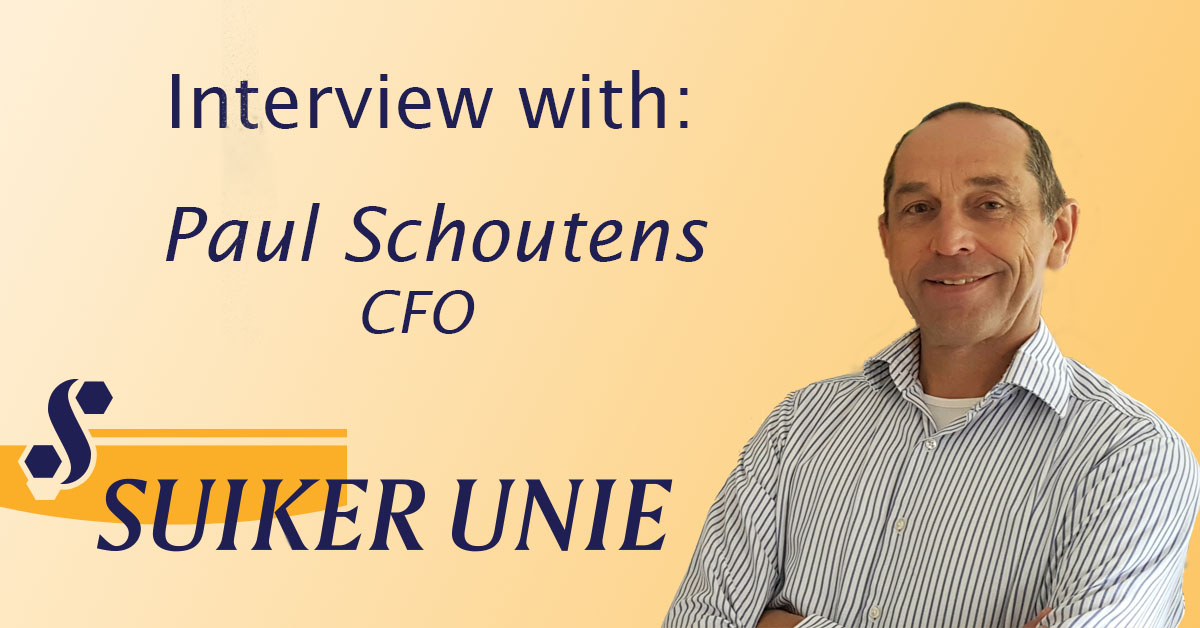
Interview with Paul Schoutens, CFO of Suiker Unie
Everybody knows that sugar is a vital ingredient in practically every diet. But what is the story behind one of the largest sugar manufacturers in Europe. And what is it like to be CFO of this manufacturer? We talk to Paul Schoutens, CFO of Suiker Unie. Can you tell us something about your background? Like many of you, I studied Business Economics at Tilburg University. During the final months before graduating university, I was offered the opportunity to do my final project at food producer LiGA. Here I was tasked to make an analysis of the multiple production-information streams, and configure a cohesive unit. Subsequently, I started working for the Central Body of Rates Healthcare in Utrecht. Based on the activities a hospital was performing we had to set budgets and determine the rates they could charge the insurance companies. Back then, I had about 25 general hospitals under my management. However, I didn’t have many career opportunities within this position, so I didn’t have to think twice when I saw a job offered by Suiker Unie as Information Analyst. IT systems became increasingly important in those days (beginning of the 90’s), and it became clear computer systems would be a vital part of the organization. Since most of these technologies were still in their infancy, as an information analyst, I had a lot of space to automate and optimize processes. I have been CFO of Suiker Unie since 2000. In this position I am responsible for the finances, automation of processes and IT within the company. I gained some management experience, and this position offered a great opportunity and substantial responsibility. What are some concrete tasks you carry out as CFO? Most importantly, accounting has to operate on point. Debtors, creditors, declarations, payments, etc. In addition, we are continuously looking for opportunities to integrate and optimize processes. Of course, we have our employees for that, but in the end, I am responsible for the results. Suiker Unie runs a campaign operation, which means we have to produce as much quality sugar from the available beets as possible in the period September-January. This requires some production planning, but our ERP system assists us very well with that. Furthermore, I am involved in the reporting of the business operation. This varies from constructing budgets to the yearly constructing of the three-year-operating plan. Throughout the year we determine whether everything is performing according to plan, and what we have realized until then. Lastly, I am working a lot with the Controlling department. We have access to a couple controllers who function as business partners, and assist us with several subjects related to commercial-, production- and agricultural matters. Whenever we decide on a certain investment, we consult with these partners whether it’s viable or not. ”Last October, the quotas for sugar producers was lifted. This decision was of huge influence on the market.” Moreover, we are looking a lot at the future. In teams we work on various business cases with a long time horizon. Multiple future scenarios are assessed: ‘Which projects are worth an investment? What will be the management of the future?’. As a member of the board I am heavily involved in constructing the future of the company. Among other things, the strategy and future vision are often discussed. Last October, the quotas for sugar producers was lifted. This decision was of huge influence on the market. All of a sudden, we are dealing with a market production increase of 20%, coupled with a large competition and higher dynamism on the market. Currently, we are working on a strategy for 2020/2025 which works nicely in the different environment. It is up to us to respond to this change efficiently and retain or even improve our position. We are operating smoothly at the moment, but the competition is looming. As CFO, you are involved in every part of the business, and that makes the job fun. What has changed in your time as CFO? In the 18 years I have been CFO of Suiker Unie a lot has changed. For instance, in 2007 we bought the sugar division of competitor CSM, and in 2009 we took over the German sugar producer Anklam. Especially the acquisition of the CSM’s sugar division was extensive, as it was our only competitor in the Netherlands. The acquisition was thoroughly investigated by the Netherlands Competition Authority (NMa), to determine whether if it was acceptable. Ultimately, the acquisition received a green light, because the main competition in the market is on the European level. The integration of the new division went well in general, since there were a lot of similarities. We tried to achieve as much synergy as possible by integrating CSM’s processes in our systems. Naturally, some unpleasant matters were part of the acquisition, like the closing of some departments. Luckily, we managed to organize this in a very social manner. ”We have the largest factories in Europe on average, which has resulted in an excellent competitive advantage.” In addition, as I touched upon briefly previously, the removal of the quotas for sugar production, which has a major influence on us. I am of the opinion that we anticipated this change well. For example, we expanded our producing capabilities of our factories in Groningen and Dinteloord. Like I said earlier, we are a running a campaign operation, which means we have to maximize production of quality products in a small-time window to lower our marginal costs. An expansion as such is quite an investment, so we have utilize our increased capability. Because of our great preparation we had the optimal starting point at the moment of removal. We have the largest factories in Europe on average, which has resulted in an excellent competitive advantage. We are conducting business in a market with a homogeneous product, so marginal costs are the key. Are calls for a healthier lifestyle a threat for Suiker Unie? Of course, the promoting of pursuing a healthier lifestyle has an influence
AkzoNobel Struggling Against Headwinds
After merger plans came off the table at the end of last year, AkzoNobel (Akzo) has not been in the news much. It seems the company is quite happy to maintain the status quo, after massive upheaval during 2017. Most developments last year were of a negative nature. Shifts in the company’s management, the pressure from Akzo’s shareholders, a takeover threat from PPG, and the failure to takeover Axalta itself saw Akzo not improve its position, a view shared both by the media and investors. Questions would have been raised in the minds of investors. AkzoNobel Circling the Drain Based on recent news, it would seem that Akzo is in a downward spiral. Last year, Elliott Capital, a major investor in the chemicals giant, reacted negatively when Akzo refused to seriously talk about a potential takeover bid from PPG. Elliott Capital even forced Akzo to appear at the Dutch Enterprise Chamber. The hedge fund raised even its stake to about 9% to have more influence on Akzo. Nevertheless, this increase in Elliot’s investment position did not help, as the hedge fund lost the court case against Akzo, and the takeover attempt was dismissed out of hand. Elliott has since reversed direction by decreasing its investment position in Akzo by 4%, now holding only a 5% share of the company. Other major and loyal investment firms like Tweedy Brown, Columbia Threadneedle and Causeway also decreased their portfolio position. Was this as a consequence of Akzo’s decisions over the past year or was it just a coincidence? It has not been all bad news for Akzo’s shareholders, though, as the company has also taken decisions that have benefited its investors. The firm has distributed a so-called super dividend, worth around €1bn. Furthermore, the company also sold its specialist chemical subsidiary to the Carlyle Group, a US private equity firm, and GIC, a Singapore-based investment firm. The potential gain from selling the chemical division is expected to be around €7.5bn. The majority of this will flow to shareholders by the end of the year as a combination of increased dividends and share buybacks. Regulatory approval is expected by the end of 2018. Akzo has outlined some ambitious targets for 2018. The company wants to reach a profit margin of 15% by the year 2020, with a target of 10%-12% in 2018. Targeting small and middle-sized companies in takeovers will have a positive effect on reaching its profit margin targets. Still, a lot of investors ask the question of how the company is going to realise this growth? Thierry Vanlancke, CEO of Akzo, in March 2018 said: “We want one integrated chain of suppliers, one business planning and one integrated manufacturing process.” He believes that M&A practices, leading to an integrated company, will allow Akzo to reach their lofty targets. Akzo has approached Oliver Wight, a British advisory company, to support the company with its integration plans. Though this is a positive step, Mr Vanlancker, appointed at the end of 2017, still has a lot to do to win the trust of institutional investors. Many still question the feasibility of growing profit margin to of 10% for 2018 and 15% for 2020. Whether or not Akzo reaches its profit margins goals depends on the success of its M&A practices. In 2017, Akzo acquired Disa Technology, Flexcrete and Powdertech to further diversify its business portfolio. However, the company has so far failed to realise the necessary returns on these acquisitions. At the moment, it seems that investors are not confident in Akzo’s ability to fulfil its promises. 2018 Q1 Results The first quarter of 2018 further confirms that Akzo is in a bad position. Revenues decreased by approximately 8% and the bottom-line results showed a decrease of 28%. This drop was partly due to falling sales in the marine and oil industries, as well as rising raw materials cost. In response to these high costs, the CEO stated: “We are ramping up our pricing initiatives and have implemented various cost discipline measures to deal with higher raw-material prices.” The company also experienced negative foreign currency effects, as foreign currencies decreased against the euro. This all added up to a decreased profit margin, from 8.8% to 6.8%. This is quite some from distance from the 2018 targets. Impact on Share Price One would expect to see the bad results reflected in Akzo’s share price. The graph below shows Akzo’s share price development over the past months: Source: MarketWatch Before the Q1 results were announced on the 23rd of April, the price per share was €77.23. It decreased slightly in the immediate aftermath of the announcement to €74.25. However, Akzo’s share price experienced somewhat of a recovery and, at time of publication, has a value of €75.60. This is already an increase of over 1.50% from its post Q1 2018 announcement low. In short, it seems the doubts some have is already taken into account when valuing the company. Akzo’s share price has fluctuated between €70-€80 over the past year. Conclusion Akzo has been in a tough situation over the past years, with some investors raising concerns about its direction. After the underwhelming Q1 2018 results, the main question is whether or not Akzo is able to deliver on its targets? Although Mr Vanlancker mentioned that he expected headwinds during the first period of 2018, it will be interesting to see if these disappear as 2018 continues. These headwinds will have to reverse direction quickly, and support a rise of at least 3.2% in the profit margin in the company is to reach its goal. It has not been plain sailing for the chemicals company so far, but it may look to benefit from a change in the prevailing winds.
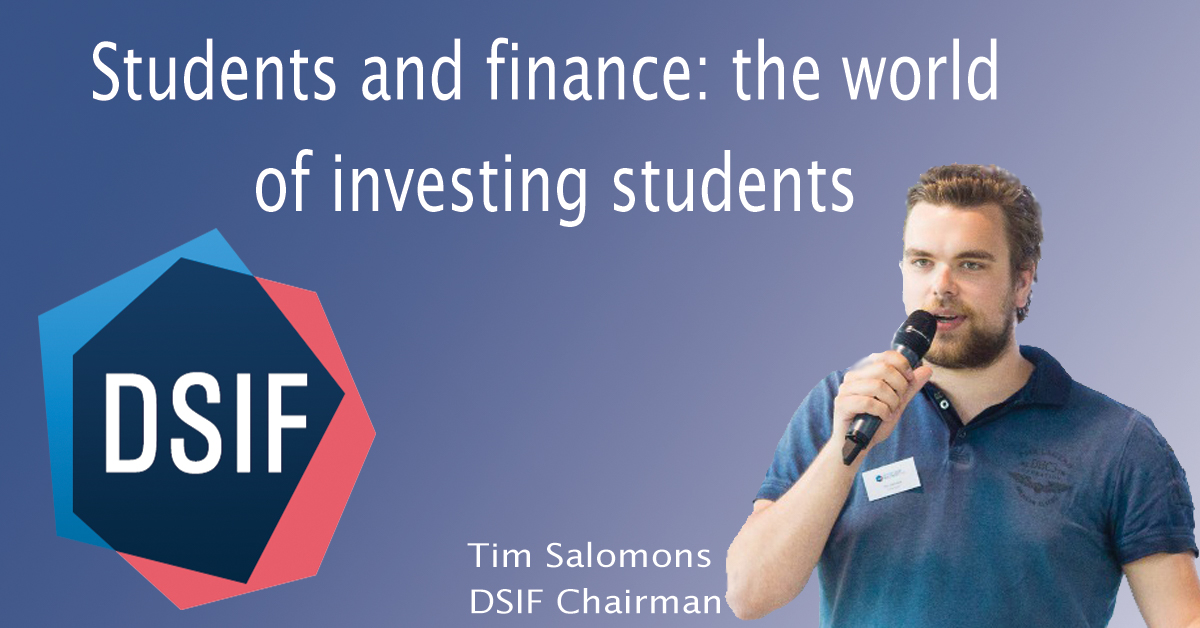
Students and finances: a look into the world of investing students
Students and finances, for many a combination doomed to fail. Students are often depicted as partying, binge-drinking, unguided projectiles whom are solely interested in spending their borrowed government funding. But we, the Dutch Student Investment Fund (DSIF) from Twente, are trying to demonstrate that students and money can be a very valuable combination. We do this by gathering funds from investors, and subsequently finance startups of fellow students. With this article I want to tell you who we are, what we do and try to show you how venture capital funds look at startups. DSIF is the first investment fund in Europe ran by students. Roughly two years ago the concept of investing students crossed the pond from the United States, and in Twente the initiative arose to establish something similar. On April 7th, 2016 the founding of DSIF was a fact, and students hit the road with a total budget of 300.000 euros, to support entrepreneurial students. We are able to do this by issuing convertible loans, with a maximum of 50.000 euros to startups founded by students, recent graduates and PhD students of the University of Twente and Saxion. “Of course, investing in this early phase exposes us to certain risks, because it is difficult to determine the potential of a startup at this point in time.” DSIF is an open-ended fund, which means that investments stay in our fund for an undetermined amount of time, and operates mainly in very early stages of students’ startups. Which is right away our competitive edge, since this pre-seed phase is something that even the most renowned venture capital funds don’t dare to invest in. Naturally, conducting business in this early phase exposes us to certain risks, because it is difficult to determine the potential of a startup at this point in time. To minimize the extent of this exposure we conduct an extensive due diligence. Between the first moment of contact with a student entrepreneur and a specific proposal for financing, we follow a process with a couple of steps. Students who walk in with just an idea will receive assistance with constructing a viable business plan. We often use the Business Model Canvas as a basis, since this model provides a fairly complete picture of what an entrepreneur wants to accomplish, how they want to act, and how they envision commercializing their idea. After successfully mapping, tweaking and pitching the business plan by the entrepreneur, a term sheet is constructed which details how much the entrepreneur will receive in funding and under which conditions. Of course, the business plan contains a lot of presumptions and estimates of the entrepreneur in terms of market size, revenues, costs, et cetera. Therefore, DSIF always performs an extensive due diligence, in which we determine whether we agree with the presumptions of the entrepreneur, whether his target group will actually be interested in the product, and whether we believe in the potential of the startup. After the due diligence is successful, a definite financial agreement can be made. “With a little guidance from our senior board we, as students, try to support the entrepreneurs in our surroundings.” Now, what are some important variables we (and other venture capital funds) pay attention to when estimating the potential of a startup? Of course, I cannot mention everything we assess in the estimation, but here are a couple items we come across most often: – Scalability. A scalable startup can relatively easily grow in revenue, without having the costs increase at the same rate. For example, many software products are scalable, because an endless number of licenses can be sold, without exponentially increasing development- and maintenance costs. – Market potential. Of course, it is important that a market exists for the product/service that the startup is selling, including the size of this market, but we have to take other things into consideration as well. For example, does the revenue model of the startup fit within the market it is serving, or do competitors that threaten the revenues of the startup already exist? – The team. Within a startup, you require multiple disciplines to carry out the business plan successfully. In the early stages, a complementary team plays an important role in the potential of the startup. For example, at a company with a technical product requires people with technological expertise, and in addition people with commercial capabilities who can sell the product. – Distinctive capabilities. How can a startup differentiate itself from existing players in the market? And how can it retain this distinctive capability? Possibly by issuing patents of IP rights, but startups can also choose different strategies to retain their competitive advantage. As you have probably noticed in this article, investing in startups is very complex, and lots of factors play a role in the decisions that have to be made. However, to us this does not mean that we should leave investing to the renowned venture capital funds. With a little guidance from our senior board (3 professionals in an advisory role) we, as students, try to support the entrepreneurs in our surroundings. DSIF started in Twente, and another group of students in Amsterdam recently founded ASIF. However, a lot of opportunities and demand still exist for these kinds of funds in other student cities. And who knows, Tilburg might be next!
Investment Night 2018: “Times do change, but the hunger for Alpha doesn’t”
Our hunger for Alpha “Alpha is used in finance as a measure of performance. Alpha, often considered the active return on an investment, gauges the performance of an investment against a market index or benchmark which is considered to represent the market’s movement as a whole[i]”. View this definition as a metaphor. Where we, as committee, actively want to outperform the previous editions of Investment Night (benchmark). Everything has a start, so let us go back to the beginning. In the beginning of.. The committee was formed and roles were divided. The next step was to come up with a theme. Every member had his vision and perspective how ‘The Night’ should look like. It did not take long, before we saw the opportunity to combine the ideas into one marvellous topic: various investment strategies through time. To cover the different strategies, we needed a panel of speakers. Call to action In order to realize our wild hopes and dreams, we needed speakers and partners. For every strategy, we constructed a list of potential companies and allocated these companies to the committee members. Before we knew, we had all our desired speakers. Our panel consisted of an active investor, a passive investor, a technical analyst and an ESG investor. A tougher challenge was our search for a suitable chairman of the day. We had a concrete view on the role of our chairman of the day. This made it even more difficult. After a couple of months, and many calls later, we had our ideal chairman of the day: Esther van Rijswijk. From this moment on, we could start with brainstorming about ‘The Night’ in detail. ‘The Night’ We had several key ingredients for the sixth edition: interaction, debate, a tight schedule, informative presentations and finally some entertainment. Moreover, our theme had to become recognizable during ‘The Night’. For us it was important that our theme and matching slogan stood out. Therefore, we needed a cheeky chairman of the day. By her hand, we could generate debates and discussions. Without promotion, something terrible will happen… Nothing! Before we could start with promoting, we needed promotion materials. After hours and hours of designing, our materials were finished and the promotion period could start. As I mentioned earlier: we are hungry for alpha. Thus, our goal was to receive more registrations than the previous edition. The first week we had a huge number of registrations and we were even dreaming off a bigger stage. Unfortunately, the registrations started to stagnate and we thought that we would not made it. Luckily, the last week many people registered and with a smashing number of 213 registrations, we set a new record. Something we, as committee, are proud of. ‘The Night’ in practice Finally, the day we marked in our agenda arrived. May the first: Investment Night. It was show time. Everything was prepared, and we could only hope that Investment Night would turn out the way that we wanted it to. The big question was: do the key ingredients come together? In hindsight, I can say yes! By the using Mentimeter, we created interaction and debates. Check. People had a laugh. Check. The schedule was tight and we had no delay. Check. We discussed the four investment strategies and showed how they create Alpha. Check. In my opinion, ‘The Night’ as whole was a big success! HUMBLE. Once again, I would like to thank the speakers, the audience and our partners for this amazing night. This would not have been possible without the coordinator and my committee members. Therefore, I would like to thank Iris Uijttewaal, Guido van Poppel, Tom van Arendonk and Dax Tops for everything they have done. And for myself, Teun Onstenk, I am very proud that Investment Night 2018 was a success. [i] Source: Investopedia.com

And when certain circumstances are met it will flourish like never before: A&F Investments First Quarter
The weather isn’t always perfect. The sun does not shine every day, sometimes it’s raining, at other times there is just too much wind, and sometimes the sun even shines too much. All of these different circumstances are opinions of someone towards the weather. And just like on the financial markets, every condition can be great for anyone. It just depends on how prepared you were for each one. Although it was not a quarter most people in the financial world had expected, it sure did wake everyone up. With a good ending for 2017, the market started with an interesting first quarter containing a sell-off in both February and March. At the end of the first quarter the S&P 500 fell with 1.60%, the Eurostoxx 600 was down 4.70% and the MSCI World dropped with 1.80%. And even though these are not the best performances the market has seen in a while, A&F Investments can still say that it is on the right track. “The extra insights gained during better times have prepared us to cope better with the market when less fortunate times came around.” Interesting times call for interesting decisions. We started off this last quarter with acquiring a stake in Philips NV. The clear path that this company is willing to take after restructuring itself is seen as an interesting feature in this company, who next to creating value for individuals also seeks to create value for the company itself. After this decision, we dived more into the aerospace industry. Shortly after taking profit from Aercap Holdings we decided to still keep some exposure in this industry. Forecasting that the demand for traveling by aircraft will keep increasing every year, we have spotted a good opportunity to buy some shares in The Boeing Company. This company proved to be the most interesting one in the duopoly with Airbus SE, and next to producing airplanes it also operates in other segments that keep it diversified. Moreover, the wave of mergers and acquisitions also caught up with us. After having Gener8 Maritime for quite some time in our portfolio, this company has been acquired by a competitor at the start of the quarter. As a result of this acquisition, we benefited from a good premium on top of the share prices. Besides regular meetings, every quarter we have a strategy meeting. During this meeting, our Risk Team presented some interesting topics ranging from bonds to commodities that they have analyzed thoroughly. Their analyses fit perfectly with our strategy to keep focusing on the sustainable growth of our portfolio. Due to this, we have taken a position in ETFS All Commodities. Next to diversifying our portfolio, investing in commodities is also a lot different than investing in equities and it definitely fits the purpose for us to learn as much as possible from managing our portfolio. The best investment decision that we have made this last year was investing in knowledge. The extra insights gained during better times have prepared us to cope better with the market when less fortunate times came around. With the tremendous growth in our members’ capabilities, we have no doubt that we will keep combating future market shocks. With these roots fully embedded in our foundation, we aim to be prepared for any circumstances that may arise in the future. And once our preferred circumstance comes around, the returns of A&F Investments will flourish like never before.
