

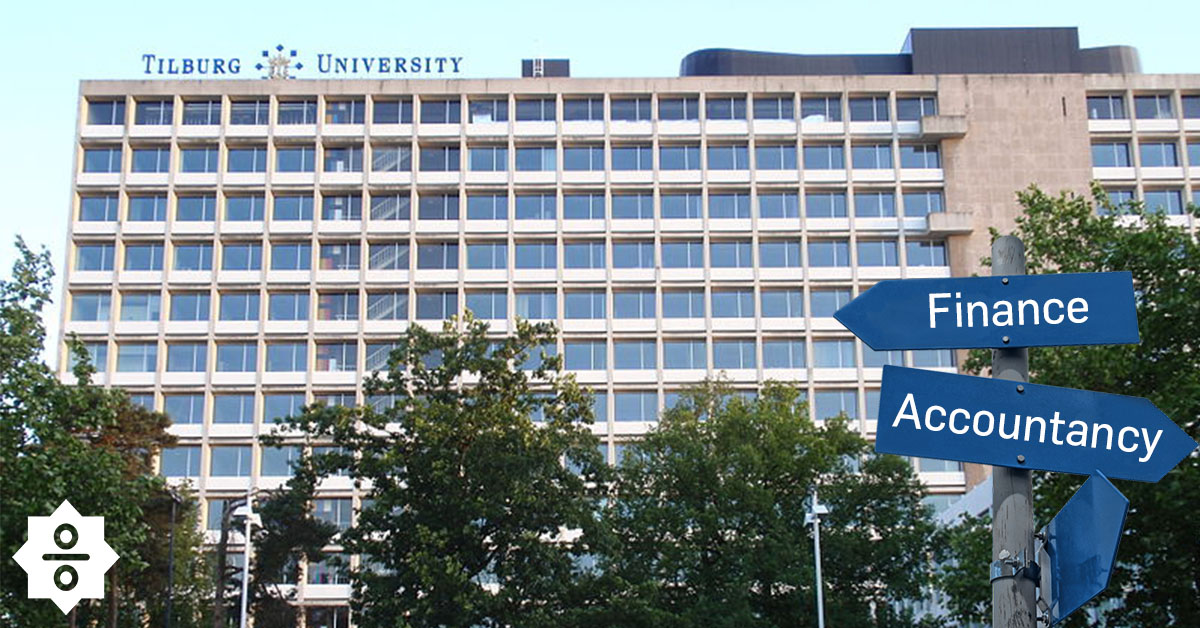
Picture: Ron Maijen For the Dutch version, click here It’s that time of the year again when all students are starting to think about what to study and where to study. There are so many choices and so many cities that offer the same study, which makes it a very difficult choice for most students. Hence, to lighten this burden a bit up, current students of MSc Finance (Boris de Bie) and MSc Accountancy (Emil & Kevin de Veer) have given their thoughts about the program that they are following at Tilburg University. MSc. Accountancy – Emil & Kevin de Veer When we had to make the decision to choose a masters to study, we were both really hesitant on choosing Accountancy. We really had the idea that it would all be about bookkeeping and reconciling balance sheets the whole time, but were surprised to find out that it was a lot more than that! “Not only do I feel like they are preparing you to become an excellent chartered accountant or controller, but they also teach you how you can master the financial language of the world. “ Emil: After I found out about this, I applied in no time because I knew that this was exactly what I wanted to do. With mandatory courses such as Empirical Methods in Accounting and Financial Statement Analysis & Valuation, I immediately knew that this masters program was on another level in the accounting world. Not only do I feel like they are preparing you to become an excellent chartered accountant or controller, but they also teach you how you can master the financial language of the world. You really realize that you are being taught A-class material when after following most subjects, they start to fall in line with each other. Valuing a company and using accounting to help you make better investment decisions is something that this masters program also offers. Thus, also a part of Finance is included. Another course that I really admired was Management Accounting. The reason for this is because it does not only teach you how to read financials as a manager but also how you could better manage your company with the use of accountancy. Kevin: What surprised me at being different in this program was the use of ‘Tweets’ (from the social media platform of Twitter) during the course of Management Accounting. We had to construct tweets as summaries from papers in the most creative way to resemble the meaning and context behind the paper. This different way of teaching is one of the factors that contributes to the quality of the program that master accountancy brings with it and one that helped surpass my expectations of this program. The quality of the program is also sustained by the in-depth material that is covered in courses Advanced Auditing and Empirical Research in Accounting. In these courses they cover recent papers in the field of accountancy that teach you how to think about the accounting profession from another perspective than just from the regular activities. An example would be discussing recent developments in the United Kingdom where consultancy and accountancy are going to be split apart. Why are they doing this and what are the pros and cons of this development? By gaining an extra insight in the field of accountancy itself, you will develop a stronger foundation. This helps you to decide in which accounting areas to specialize yourself in the future, so you will get the most out of your accountancy career. MSc. Finance – Boris de Bie Choosing a master’s degree was one of the most difficult choices that I had to make at the end of my bachelor’s degree in Business Economics. I was often told that the Finance master’s degree was one of the more challenging master’s degrees. This was because the bar was set quite high for this master’s degree. Now that I am halfway through my master’s, I can speak from my own experience that it indeed requires a lot more work compared to my bachelor’s, but more importantly, you also get a lot more knowledge and satisfaction out of it. “With a CFA qualification you demonstrate, among other things, that you have knowledge of analyzing, understanding and applying of investment instruments. “ Within the Finance Master’s, I follow the CFA (Chartered Financial Analyst) track, which focuses on financial management and investment analysis. This may sound a bit abstract, but the bottom line is that the courses that you follow offer a good preparation (+/-70%) for the CFA exam. With a CFA qualification you demonstrate, among other things, that you have knowledge of analyzing, understanding and applying of investment instruments. This is an internationally recognized qualification, which can be very useful when applying within the finance world. Courses that are specifically highlighted in the CFA track are courses such as Investment Analysis, Financial Analysis and Investor Behavior. These prepare you very well as a potential player in the investment world. Derivatives Securities & Risk Management is an elective course that fits in well with this, whereby different forms of securities are treated. Within the CFA track you have, in addition to a number of compulsory courses and just like in the regular Finance master, also a choice between different courses. However, the choice with the CFA track is somewhat more limited compared to the regular program.
Is It Time To Panic? – A&F Investments Third Quarter
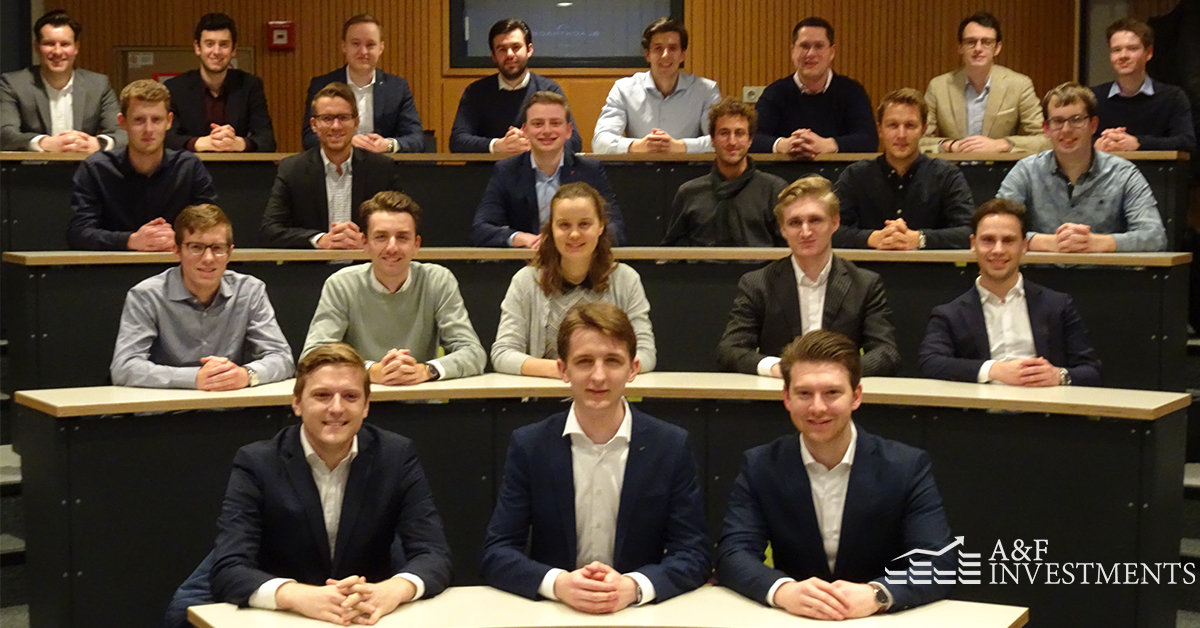
If you look at the recent world developments, you cannot deny there are a whole lot of problems. Look at our neighbours; Boris Johnson has taken over the command of the United Kingdom and is leading Britain to leaving the EU on the 31st of October. Mario Draghi, head of the ECB, predicts a long period of low economic growths and is keeping the interest rates artificially low. His successor Christine Lagarde will, with high probability, continue his policies. These choices are not without dispute. The head of both ING as the Dutch Central Bank have criticized the ECB for its low interest rate policy. On the other side of the Pacific Donald Trump might be ousted from office if the impeachment inquiry continues. Furthermore, the Trade War between China and the US is continuing, oil ships are taken hostage, oil processing plants bombed and the riots in Hong Kong are also going through for the fifth month so far. One would think these situations are enough to warrant a negative sentiment on the stock market. ‘The only logical move seems to sell everything.’ Despite all of it, the stock markets have risen last quarter. A&F Investments also kept a level head. Especially in periods of chaos it is important to stay critical and sharp. Look at your stocks and ask yourself, what is the impact of these events on this company? For most companies, the consequences are low. As long as you don’t have a large exposure to the UK and the US, it is rewarding to stay invested. Especially with the low interest rates, which draws more people to the stock market rather than to saving. A stock market bust is always possible, but remain calm and estimate the value of your holdings. If anything, it is always possible to buy more! A&F Investments only executed two transactions last quarter. Firstly, we sold our shares in Flow Traders. We bought Flow Traders as an insurance policy against volatility, as this company earns more when markets move and the volume is higher. However, the company did not move enough to satisfy this strategy, so we sold our shares. Secondly, we bought a few shares of Takeaway.com. This company is relatively new on the market and we believe it is a winner in the food delivery market in Europe. A market that is growing quickly. We believe the company can benefit from network effects as long as they stay the leader in Europe. A&F Investments had a return of 3.5% last quarter. We outperformed the S&P500 with 2.5% and the AEX with 0.2%. A great result! In September, we actively promoted the committee and as a result we have welcomed 18 highly motivated members to the group. The committee is now operating at full capacity, with our maximum number of thirty students. Moreover, we started a cooperation with a Norwegian student investing committee, with the goal of exchanging information and contacts. Finally, we will welcome FDI for a guestlecture upcoming quarter. The upcoming year seems very promising for A&F Investments!
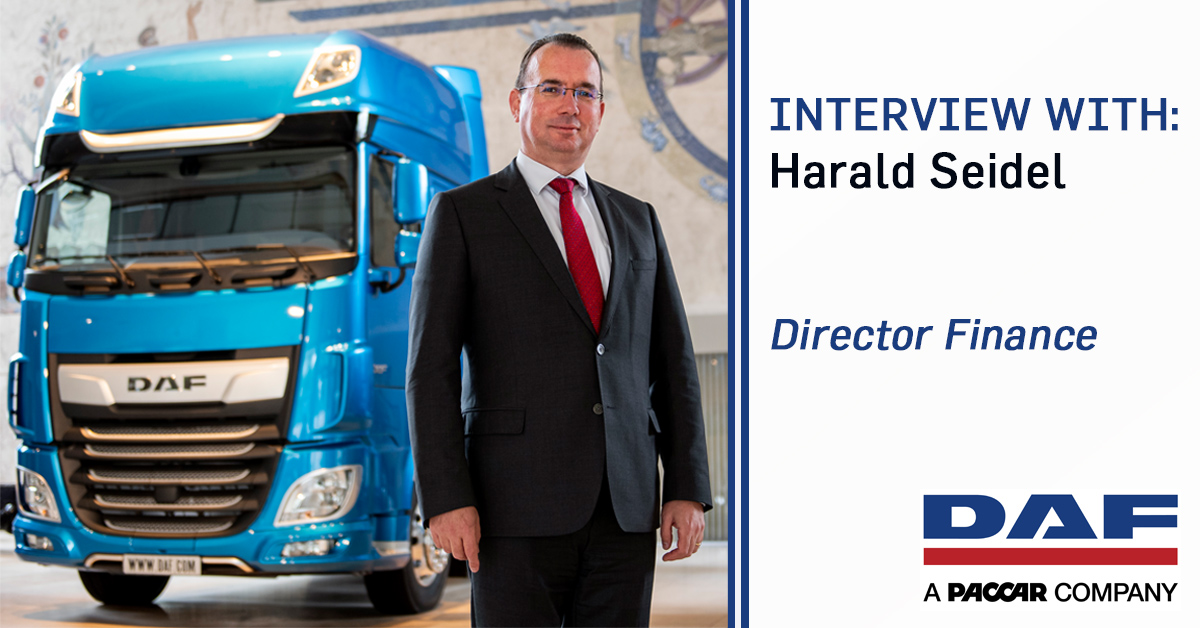
Interview with Harald Seidel – Director Finance at DAF Trucks
What does your job entail as Director Finance? How do you successfully manage a good balance between a busy profession and your private life? Harald Seidel, Director Finance at DAF Trucks, tells us about his background and work and gives some words of advice to students. Could you tell us a bit about your background? I graduated from Tilburg University, but that was a while ago. I studied Business Econometrics because I found it interesting how the theory would translate into practice in the business world. After finishing my internship, I started working as a financial analyst at Phillips. I held that position for several years and from there I became a management consultant. I have done many different projects and that is how I got into the controller profession. I first started working at KPN Telecom in The Hague, and then finally I ended up at DAF Trucks in 2001. Can you explain briefly what type of company DAF is? DAF was founded in 1928 by two brothers. They started off with trailers and have added trucks later on. In the past year, DAF has grown to become the second largest truck manufacturer in Europe. However, it is important to mention that DAF’s business goes beyond producing trucks: we deliver complete transport solutions and the production of trucks are only part of this – it is also about financial services, repair and maintenance contracts, you name it. And trucks are becoming increasingly sophisticated. The world of transport is evolving and we are working on promising technologies such as electric drive and autonomous driving. DAF is a company where much work is being done in the field of innovation, renewal and internationalization. That makes working at DAF both interesting and challenging. “It is important for our customers to say: once a DAF, always a DAF.” What does DAF do to remain competitive? And what are the most promising opportunities? The big opportunity that lies ahead is to continue to offer the best transport solution for our customers. We do not focus so much on who our competitors are. It is important for our customers to say: once a DAF, always a DAF. We do not always have to be at the forefront and we do not always want to be at the forefront, but we must keep up. Therefore, we are also working on developing sustainable solutions for the future. Last year, we were able to present three prototypes of an electric and hybrid-powered truck and the first ones are already driving on the road. We are very proud of that. You are the financial director at DAF Trucks. What does your work week look like? What does your position as financial director entail? The role of the financial director impacts many different levels. The most important thing is to ensure that we report good and reliable financial figures. This is only one aspect, because of course it is also about ensuring that all processes behind those figures are properly guaranteed. After all, quality is essential for DAF. In addition, we also think it is very important that everyone working within Finance & Control form an integral part of the business. For example, the controller of product development knows in detail what is currently happening in the department. We always say: the business and the controllers are actually two hands that have to work very well together to achieve the best result. How would you describe the cooperation within the management of DAF Trucks? We have a board meeting every Tuesday morning. During this meeting we keep each other informed of what is going on and we ensure that we are all aligned. Then we let specialists inform us about the status of important projects and we discuss numerous topics with each other. We also know how to get in touch with each other outside meetings. Everyone has their own responsibility, but we all stand with the same company. DAF’ers help each other! This also holds true at management level. “If you think you know how it is all put into place in that position, then it is time to move on to do something else because there is still so much to learn.” How do you deal with the balance between work and private life? A signal for me to know when it is not going well is when I get home and I am still busy with work. Making time for relaxation, sports and my family is very important to me. When I started at DAF I had a stationary computer, so I was not able to work at home afterwards. Nowadays everyone has a laptop and an iPhone, which means that you are available 24/7. Due to the fact that we are an international company, I could just read my mails all day long. When they start working in the United States, it is then 6pm here. So, you have to make an effort to stop working on time. You also need time to recharge and to be fresh again in the morning in order to make the right decisions. What is the most important thing you have learned during your career and studies? I think the difference between being right and being treated as if you are right. You could have made such a good analysis or such a good equation, but above all, you have to come to a solution as a group. If that does not work out, you cannot use the correct equation you made yourself. During my study of Econometrics, I learned to bring a complex problem to the essence in a formula, a sharp analysis or a conclusion. These are skills that you acquire during your studies. What you learn to a lesser extent is how you as a group come up with solutions. I learned that later during my career; so in practice. Do you have any tips for the current generation of students? Firstly, do not go for
What happened last quarter? Q1: a recap
The first quarter of the new academic year is already in the past. In these first few months, multiple activities took place, related to both Accounting and Finance. This article will look back on these activities, with the chairman of each committee telling their story. They will discuss their personal experience on the process of these activities, from the start, the preparations, to the end, the actual event. Financial Business Dinner – September 26, 2019 *By Pieter Coenen* After working hard for the last 9 months, the Financial Business Dinner took place on September 26. The most important job for the committee was to find 15 firms that were eager to be a part of this dinner. Besides finding the firms, looking for an appropriate location for the dinner was necessary. After taking multiple locations in consideration, our choice fell on the same location as last year, restaurant “Hofstede de Blaak”. In order to prepare the students for the dinner, we offered an etiquette workshop prior to the dinner at Bonheur. After we confirmed the location, the firms and the workshop, we were ready to start the promotion. To promote the event in a different way than just giving out flyers, we extended a goodie together with each flyer. Besides the goodies and flyers, we had to design a poster. Once this was finished, the registrations were ready to be opened. After a period of intensive promoting, we were able to get many applicants for the dinner. When the registrations closed, we were ready to send the CV’s of the students to the firms. We received the firm’s preferences of certain students and then we had to figure out how to match these in the four courses of the dinner. When we finally solved this puzzle, the students and firms received the email with all the information about the dinner. ”The most important job for the committee was to find 15 firms that were eager to be a part of this dinner.” The day started at half past three with the workshop in etiquette. This taught the students the specific etiquette rules regarding a dinner. After this workshop, the committee welcomed all the students and firms and we were ready to start with the dinner. After each course a bell rung as a sign for the students to move tables, to eat the next meal with another company. After the dessert, I gave an expression of gratitude as the chairman of the committee, and Allard van Hees, the chairman of Asset | Accounting & Finance gave his speech of thanks afterwards. The evening ended with a closing drink, where the students got the opportunity to speak to the firms that caught there eye. Looking back on the Financial Business Dinner I feel proud on this successful edition of the event. I want to thank the fifteen participating firms, Accuracy, Achmea, DAF, Eiffel, Fagro, First Dutch Innovations, FrienslandCampina, Johnson&Johnson, Jumbo, Mars, Parcom, Pepsico, Rembrandt Fusies & Overnames, Van Oers Corporate Finance, and Zanders. Beside the firms, I want to thank my fellow committee members, and in particular the coordinator Steyn van Poppel for their help. Audit Activity – September 30, 2019 *by Wouter Janssen* After a little more than eight months of preparation, the very first Audit Activity took place on September 30, 2019. After careful consideration, the committee decided to organize a cocktail workshop. We thought this was the perfect way to be active in an informal way and to be able to network in the meantime. In addition, it was decided to end the evening with a dinner at Bistro St. Sjaak. In the meantime, the day of the Audit Activity was approaching, the goodie was being designed, the participating companies were announced, the promotional material was made, and the students were informed in advance about this new event. The participating companies during this edition were: De Beer, Govers, Mazars and Bakertilly. ”After a little more than eight months of preparation, the very first Audit Activity took place on September 30, 2019.” In the afternoon of September 30, the committee, followed by companies and students, gathered at Café Stoffel, where the cocktail workshop would take place. The enthusiastic CoCo employees taught us all sorts of interesting facts about cocktails, while the participants in the meantime enjoyed a welcome cocktail. After this, the students were divided between the four companies and the workshop started. A taste and smell test was carried out in succession, after which the participants could make and taste their own shots. After everyone had finished their shot, it was time to make their own cocktail. This turned out to be a test between the teams, as the team that could make eight cocktails the fastest could win a prize. The winning team eventually left with eight shake cups. After the workshop it was time for a dinner at St. Sjaak. Here too, the participants had the opportunity to network with the participating companies. During three courses, the participants enjoyed dishes such as shrimp croquettes and black halibut. After the dinner there was a short drink and the evening ended around 9 p.m. In retrospect, as chairman of the committee, I look back on a successful afternoon and evening. Hereby I would like to thank my fellow committee members Shanti and Thomas as well as the coordinators Daniek and Nina for their effort in recent months. I also want to express my gratitude to De Beer, Govers, Mazars and Baker Tilly. Finally, I want to thank the participating students for their presence. Perhaps until the next event!
Sustainable Investments – A column by Tim Foesenek
Sustainable investing seems to have gained a lot of popularity over the past years. Many investors want their money to be used in a responsible way and institutions are expected to take sustainability into account for a significant part of their portfolio. But what exactly is meant by sustainable investing? If you search the internet for “sustainable investing”, you will most likely find climate related investments for the most part. There are many funds in the Netherlands that engage in making energy use more efficient and thereby reduce the emission of CO2. Quite a logical consequence of the political attention of the topic lately. The concept of sustainable investing is however more than that. Banks have offered sustainable saving accounts and funds for decades, many of which focus on ethics too. They, for example, refuse to invest in the weapon industry, in child labor or in polluting firms. The return of those responsible investments is generally a bit lower. The idea of sustainable investing thereby seems giving up a part of your profit to guarantee a better future for the entire world. But is this lower return actually the bill of goodwill, or is it the result of a risk averse investing strategy? Sustainability could also refer to the future stability of your portfolio in the latter scenario. Investing is inherent to the desire to make money, otherwise it would be donating. Moreover, the increased popularity of sustainable investing seems to be largely caused by the fact that opportunities such as green investments became more lucrative. “The idea of sustainable investing thereby seems giving up a part of your profit to guarantee a better future for the entire world.” Looking at the example of child labor: the profit margins of a clothes factory with children working is probably higher than those of a fair-trade competitor. In general, this means a higher return, but this comes with a higher risk in my opinion. I estimate that the former firm has a higher business risk because of changing regulations or defamation than the latter. As a result, unsustainable firms involve a higher non-systematic risk. Moreover, sustainable firms are usually more transparent, which causes investor trust. From this perspective, there might even be a difference in beta, rather than in alpha such as sustainable investing often implies. The expression “impact investing” is used more frequently nowadays. It is the philosophy to really chase a goal with an investment. Look at it as an active variant of sustainable investing. For instance, you could take a position in a polluting firm so that you can use your voting right to make it more ecofriendly. In fact, your portfolio does not have an actual impact by refusing to invest in such a firm, because it is likely that someone else will do so anyway. I think sustainability is of great importance and I am glad to see that the financial world contributes to a better future. It is hard to determine if this is caused by pure goodwill or by safe investing strategy, but let’s assume it is a combination of both. In any case, it is good to see that it is possible to make money in a fair way. This article is not purposed to provide arguments or advice, just as food for thought.
We Learn Best When we Learn Together – A&F Investments Second Quarter
It was a beautiful year for A&F investments. Now that we are heading into the summer, it is time for a review of the past quarter and year. We have no reason at all to complain. A&F Investments has bought stocks in amazing companies, and sold, had informative guest lectures and we were invited for a company visit. And last but not least, we beat the European indices last year! “All in all, we created space for new good ideas and we are heading into the summer with a clean portfolio.” Let’s first take a look at the transactions of the past quarter. At the beginning of the quarter we sold Galapagos and Consumer Staple ETF. We only sold a part of Galapagos, because their medicine Filgotinib had positive results, so we could cash in some profit on our large position. We lost our interest in the Consumer Staple ETF and its performance was lackluster. To replace it, A&F Investments bought a coffee ETF. The price of coffee is historically low and due to the poor weather conditions in South-America we expect the coffee price to rise. Furthermore, we bought Robeco Fintech ETF to take advantage of the Fintech trend. We took profit on our oil ETF as well, because we didn’t see any more room for it to increase in value after the strong run it had. Finally, we sold our stocks in Kion and Red Hat and closed the positions in the European and Pacific ETFs. Our position in Kion was too big, so it was partially sold. We sold Red Hat because it had reached the take-over bid price of IBM, and there was no more room for a further rise in price. We had held the Pacific and European ETF for a long time, but it added, to our opinion, little value to our portfolio. All in all, we created space for new good ideas and we are heading into the summer with a clean portfolio. (A&F Investments vs. AEX) To finalise, we got to follow an interesting guest-college of First Dutch and enjoyed an inhouse day at IBS Capital Allies that we concluded at restaurant Loetje in Amsterdam. We ended the quarter with our usual strategy meeting, where we gained knowledge on Real Estate and took a good look at our portfolio. To celebrate the end of the year, we held a pubquiz in De Nachtwacht and toasted to the past year. As we are heading into the summer, this means we also have some leaving members. We wish the leaving members a great deal of luck with their internships, masters and further careers! On the other side, we welcome our new members into our group.
