



For the Dutch version, click here Earlier this year, the editors of Faces Online have published a reconstruction of the events surrounding the coronavirus. The lockdown measures are slowly relaxing, but the consequences of the corona crisis will be felt in society for a long time to come. The CPB and the DNB predicted at the beginning of June that a deep recession is inevitable. The economy is expected to shrink by 6.4 percent this year, twice as much as the credit crisis in 2009 and a historical low. It is clear that the current 1.5 meters society is affecting the catering sector, but what about the other business sectors? In this article we analyse the Accountancy and Financial sector, among others, and also reflect on the status of large Dutch companies. “An important difference with the previous major crisis is that the origin is now outside the financial sector and the financial buffers at banks are considerably higher than they were during the previous crisis.” The Financial sector (banks and pension funds) The banking sector is at the heart of this crisis as an aid provider for all sectors. With bridging loans and deferral of redemption and interest it is trying to help companies and consumers overcome the corona crisis. An important difference with the previous major crisis is that the origin is now outside the financial sector and the financial buffers at banks are considerably higher than they were during the previous crisis. This does not alter the fact that banks are becoming more cautious when issuing loans. Therefore, the acceptance criteria have been tightened in the second quarter. The purpose of the stricter criteria is to protect banking institutions against bad loans, which are at the expense of profitability. Though, the profitability was already under pressure due to low interest rates. The Dutch Central Bank does not expect the banking sector itself to run into problems in the moderate scenario. Only in the severe scenario, banks will be hit by a sharp recession, but they will still be able to fulfill their role as financial intermediaries. The pension funds have also been severely affected by the corona crisis. The decrease in the value of their investments have caused pension funds’ already vulnerable capital position to deteriorate further in the recent months. The policy coverage ratio, the yardstick for the current financial position of pension funds based on the average coverage ratio of the past twelve months, fell to 98 percent. This means that it is below the temporary statutory minimum of 100 percent. As a result, pension funds do not have sufficient assets to meet the mandatory benefits they have agreed on with its members. This can be remedied by either increasing contributions or reducing pension benefits. Fortunately, it seems unlikely to get this far, as a new pension agreement is about to be signed. In this pension agreement, the coverage ratio and actuarial interest will disappear. As a result, there will no longer be any promises for future benefits, which means that there will no longer be any shortfalls. Large Dutch companies The coronavirus also has a major impact on multinationals on Dutch soil. An example of this is the oil giant Shell. The combination of plummeting oil prices and the reduction in fuel consumption due to the coronavirus led to a drop in turnover of no less than 28% in the first quarter. That same quarter, Shell’s profits halved, forcing the company to reduce its dividend spending, for the first time since the Second World War(!). The decline in dividend spending is a bad sign for Shell, as liquidity was still reasonably good. It therefore deliberately reflects a rather negative picture for Shell’s future. A homegrown multinational where the corona crisis seemed to have a positive impact on is Unilever. Unilever has the ideal product portfolio, with sales of food, personal care and cleaning products. Due to the massive hoarding in the first weeks of the crisis, you would have expected the laundry and food group to have made a good start. However, this turned out to not be the case, as the sales figures for quarter 1 were roughly the same as in the previous year. The underlying reason for this is the fact that Unilever saw a decline in turnover as sales to catering suppliers stagnated. It is the sales to these consumers where they gain their highest margin. Lastly, a big player among the Dutch multinationals is the chip machine manufacturer, namely ASML. The corona virus had a major impact on the financial figures that the company had reported. The turnover in Q1 decreased by roughly 1.6 billion compared to the previous quarter in 2019. This was mainly due to the postponement of deliveries of the chip machines. Fears that transport would no longer be possible later also played a role for customers. The Accountancy sector The Accountancy sector appears to be one of the sectors that is quite capable of coping with the impact of COVID-19. Nevertheless, some of the largest accounting firms have prepared to withhold partner payments in an effort to mitigate the financial impact of the coronavirus pandemic. It is only one measure envisaged among the ‘Big Four’ accounting firms – KPMG, Deloitte, PwC and EY – and medium-sized firms BDO and Mazars, to withhold cash if clients’ fees decline. Top Accountancy firms are also looking into the possibilities of a temporary postponement of rules and legislation. These include the mandatory rotation of accountancy firms, counting physical stocks and filing accounts. Here, they argue that the coronavirus outbreak has created ‘unprecedented challenges’ for the accounting firms. However, it appears to be that most firms are healthier in terms of liquidity compared to previous years and decades, mainly due to some major divestments and cash savings. Finally, this sector seems to be more likely to be affected in the long term by the major pandemic developments since the beginning of 2020. This means that the effects are currently only
High Frequency Trading: COVID-19 Edition
For the Dutch version, click here Introduction Ever since Michael Lewis released his famous book ‘Flash Boys’ back in 2014, High Frequency Trading (HFT) has been a topic often discussed by investors. Although this is not a fairly new form of trading (some argue that it began in the 1930s), a lot of people and especially many retail investors are still not acquainted with this concept. This has left retail investors and people unfamiliar with the financial markets often questioned during the COVID-19 pandemic. What is High Frequency Trading? And what is so special about it during the COVID-19 pandemic? In this article Faces discusses with professional insight from Quirien Raat what High Frequency Trading is all about and what implications it has for the market during COVID-19. High Frequency Trading High Frequency Trading (HFT) is a type of algorithmic financial trading strategy that traders use to try to gain ‘alpha’. It is a strategy where devices and algorithms try to be the fastest in executing an order. This is where high volumes and low margins come into play. HFT does not only capture arbitrage in the market, it also helps to keep the market less volatile and provides liquidity to the market. Furthermore, HFT is a type of strategy used within market making. A company that continuously buys and sells shares at a listed price is considered a ‘market maker’. Even though the main emphasis of HFT is on speed, a market maker does not necessarily have to be fast. They can execute their orders manually and still be profitable. Nevertheless, the theory of HFT can sometimes be a little hard to understand in just one sitting. Thus, in order to gain more insight into this, it is important to take a look at a practice scenario of HFT. Flow Traders Quirien Raat, alumnus of Tilburg University and currently trader at Flow Traders N.V., guides us through the world of HFT at Flow Traders. Flow Traders was established in 2004 by Jan van Kuijk and Roger Hodenis and has since grown into an entity with a market capitalisation of approximately € 1.5 billion (per May 2020). Although many people know that Flow Traders is an active player in the HFT-market, this is actually not their primary activity. Flow Traders can be considered more as a market maker and executes multiple strategies as a market maker, of which HFT is one. As a market maker, Flow Traders mainly focuses on the so-called Exchange Traded Products (ETP). The best known of these are the Exchange Traded Funds (ETFs). These are the ‘trackers’ of the market. The AEX, for example, is an index of the Dutch market of which many ETFs are created and distributed. This implies that the value of the ETF should be in line with the sum of the value of the underlying shares, but this is seldom the case. Hence, how does Flow Traders respond to this as a market maker? Quirien mentions the following: “Flow Traders ensures that the market is efficient and is brought back into balance. We do this by providing a bid and sell price at all times around the actual value of an ETF.” Though, this might stir up questions such as: what’s it like to keep the market in balance during the COVID-19 period? How does Flow Traders deal with such volatile fluctuations? COVID-19 To date, 2020 must have been one of the most frantic years in modern history. Revenues have declined to levels never seen before and the unemployment rates around the world has been reaching new records. In addition to this, COVID-19 has had a huge impact on the stock market, especially at the start of the outbreak when many investors experienced a huge sell-off. With so much uncertainty and volatility on the market, this is exactly where Flow Traders comes into action as a market maker. “During such a highly volatile market, the price of the underlying stocks and related ETFs fluctuates enormously”, says Quirien. “Even in such situations, investors still want to keep trading. However, everyone wants to sell their securities and this causes the prices of ETFs to sink. Though, Flow Traders has the ability to then buy these ETFs, split them up and subsequently sell the shares separately. This then leads to the case that some people will still buy these stocks separately, thus preventing the ETFs from becoming worthless. Shortly, by continuously displaying bid and sell prices to the market for ETFs, volatility is curbed and this market then remains in balance.” This operating mechanism has led Flow Traders to realise a high operating result last quarter. Yet, one might assume that this would have been due to an increase in trading on the market. However, according to Quirien,it is not only due to the higher volumes in the market. “It is also due to the larger margins created by the increased volatility and uncertainty on the market.” “We don’t invest in stocks that ”add value”. We don’t keep a portfolio and our business model isn’t about having a long-term vision.” But if the market plummets, doesn’t Flow Traders’ market positions cause a negative operating result? No, this is not the case. Due to the fact that Flow Traders hardly holds positions for a long period of time, they are hardly sensitive to price changes in equities. “We don’t invest in stocks that ”add value”. We don’t keep a portfolio and our business model isn’t about having a long-term vision.” HFT is an essential part of market making during the COVID-19 period. Though, it is certainly not the case that everyone could easily start implementing this strategy in a short period of time. First of all, you need a large amount of capital to invest in top-of-the-line devices that can run your algorithms at an extraordinary speed to make sure that you are (one of) the fastest traders on the market. Next, according to Quirien, you would also need a special license to act as a market
Interview with Marc Zinnemers – Chief Financial Officer (CFO) at LeanIX
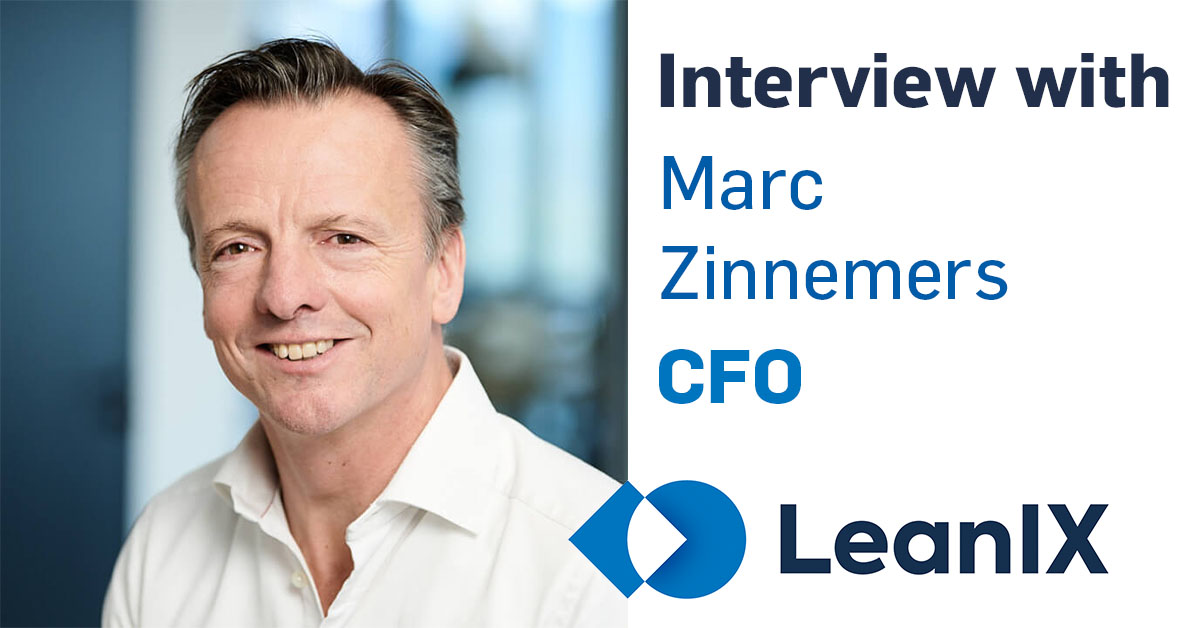
For the Dutch version, click here Nowadays, data is ubiquitous. Based on data, new possibilities and insights can arise within a company. Furthermore, IT is an important success factor for almost every organization, even within the finance and accountancy industry. Thus it’s not surprising that SaaS (Software as a Service) companies are on the rise. So, what is it like to work for such a company? In this interview, Marc Zinnemers, Chief Financial Officer (CFO) at LeanIX, provides insight into his career from Business Economics student to CFO of a software company. He guides us through the growth story behind LeanIX and shares the vision of the company. Marc concludes with some rather important tips for students. Can you give us a brief glimpse of your career? I completed both my bachelor and master programmes at Tilburg University, at the time still referred to as the Catholic University of Brabant (KUB). I followed the Bachelor of Business Economics and a Master’s program in Finance, respectively, and during my study period I was also active at Integrand. At that time, the military service was still in force, so after finishing my Master’s in Finance, I was in military service for another year. Furthermore, I fulfilled various roles at software companies such as Exact Software, i2 Technologies and RES Software. On October 1, 2019, I joined LeanIX, an innovative software company. Over the course of my career I have mostly been confronted with hypergrowth, a doubling of a company’s growth year over year. Hypergrowth is something I really enjoy working on, because of the energy it brings to an organization. Besides, I like expanding and developing new teams. Can you describe how you rolled into the position of CFO? That’s a good question. After all, there is no defined path to such a position as CFO and I have never aimed at the position of CFO as the ultimate goal for myself. Above all, I have had different positions and a wide range of tasks. Within my career, for example, I have been active not only in accounting and finance, but also in operational, personnel and legal affairs. Personally, operational business processes have always caught my attention, and from here I have gained a broader insight into the bigger picture and not only into the financial branch of the company. I assume this broad foundation has ultimately ensured that I have been entitled to the position of CFO. Can you explain what type of company LeanIX is? LeanIX is an international software company founded in 2012. They had derived their business plan from work they previously carried out for the IT department of a global logistics service provider. They saw a gap in the market. This was where multinationals struggled to get a complete insight into the architecture (processes, systems and applications) of the company. LeanIX provides insight into the IT landscape for multinationals, think of a Google Maps in the fields of ICT. LeanIX maps out the landscape, shows which applications are running and which business processes are supported by them. Furthermore, LeanIX creates insight into the associated risks that large multinationals are exposed to. Nowadays, LeanIX has offices in Boston, United States and Hyderabad, India. Does LeanIX suffer from competition? The sector in which LeanIX operates has been around for 30 years. On the one hand, there are players who have been in the sector for a long time. These players have developed a lot of functionality but have not innovatively grown alongside with their customers. On the other hand, there are a few companies that do something similar, but they, just like LeanIX, have only been around for a few years. In addition, there are several companies keeping track of this manually in Excel and Powerpoint. In my opinion, competition is always good to have and it keeps you extra focused. “However, our long-term vision is not focused on growth because we see growth as a result.” What is LeanIX’s long-term vision? At LeanIX, we are at the start of a wonderful growth process. On January 1, 2019, LeanIX only had 90 employees. When I started as CFO six months ago, we employees at LeanIX and at the moment we have 225 employees. But we are also experiencing upward trends in other areas. This trend is reflected in the doubling of the turnover, but our customer base has also grown from 100 to 270 customers in one year. However, our long-term vision is not focused on growth because we see growth as a result. Instead, our focus is on innovation, having a satisfied customer base and increasing the use of our software within our customers’ companies. In addition, we want to make the shift from an international company to a global company, which means that our software is used all over the world and not solely in specific parts of the world. What does the cooperation within the management board of LeanIX look like? Despite the fact that I would like to call the cooperation between the LeanIX management intense, we only sit around the table together for two hours a week. As the LeanIX management, we apply OKR (Objectives and key results) principles. We have five objectives, which we set at the beginning of every quarter. An objective is an ambitious target since we want to achieve a specific goal, such as “Become market leader in Enterprise Architecture Space”. We translate this objective into key-results, such as turnover and customer satisfaction. In this way, for each objective we set three business outcomes that we, as LeanIX, want to achieve that quarter. We report these results on a weekly basis and monitor the progress within our company and adjust them regularly. Could you give us some insight into a working week of yours? Is it possible to separate work and private life? Our headquarters is in Bonn, Germany. Our other offices are situated in Boston, USA and Hyderabad, India. I live in the area of Tilburg. I’m used
What happened last quarter? Q3: a recap
The third quarter of this academic year has been a remarkable period. The Coronavirus has halted some events and also forced Tilburg University to close its doors. Nevertheless, before these tumultuous times, several successful A&F events took place this quarter. In this article, the chairmen of the committees share their experiences of organizing their event. CityTrip 6-9 February, 2020 *By Martijn de Roover* From our first meeting in September onwards, we met weekly to organize the first A&F CityTrip. Despite the fact that the plane would only take off on February 6th, we had to hurry as travel and accommodation had to be booked in time. After we had chosen Sofia as our destination and booked the activities, we were ready for it! On the 6th of February, we travelled to the capital of Bulgaria with 15 students. There, we started discovering the local culture through a traditional Bulgarian dinner. The next morning, we took another good look at the Bulgarian culture during a city tour. We not only experienced the beautiful buildings and interesting history, but also the freezing temperatures and cold wind in Sofia. We also got acquainted with the nightlife in Sofia through a pub crawl. On Saturday morning, we started with a cat-and-mouse game through the streets of Sofia. After this it was time for a 1.5-hour travel to ski resort Borovets, which we explored on our snowmobiles. In the evening we explored the nightlife of Sofia for the 3rd and last time. After a successful last night, it was already time to return to the Netherlands on Sunday. In the middle of storm Ciara, we flew back and fortunately landed safely on Eindhoven airport. The reactions on return were solely positive. We as a committee look back with great satisfaction on the trip and the organization of this trip. We are particularly pleased that our choice for more active activities in addition to the more standard city trip activities worked out well. This was the first A&F CityTrip, but definitely not the last! FinanceDay – 18 February, 2020 *By Nina Thomas* We proudly look back on the sixth edition of the FinanceDay and through this blog I would like to tell you more about it. This year we were able to welcome accuracy, Duff & Phelps, FinanceIdeas, First Dutch Innovations, Marktlink and PGGM; a fine combination of the various pillars that finance has to offer. “Whereas one case uses complex datasets for the analysis, another case uses a fictional festival to translate it into practice.” As a summer external it was my honor to organize this day and so at 8 am I was ready to make the preparations. However, time management still remains a point of improvement, because despite the generous planning, the first company was suddenly in front of me while I was still walking around in my socks. Something with a ‘mild morning rush hour’: This can happen of course… A little later the students came in and the day could start. Whereas one case uses complex datasets for the analysis, another case uses a fictional festival to translate it into practice. An aspect that often remains underexposed during the study. This approach shows students how things work in practice. This helps them discover which pillar and work appeals to them the most. Information that can be of added value later on. The lunch, on the other hand, gave more insight into the different work atmospheres and company cultures, so that at the end of the day students walked out with a more complete picture of what each company has to offer. Finally, I would like to thank the companies and students for their contribution and enthusiasm. It has been a real pleasure and I am looking forward to the upcoming editions. Master Experience Days – 2-3 March, 2020 *By Nina Thomas* Where A&F offers job orientation with the FinanceDay, we also organize the Master Experience Days (MEDs) via Asset. During these days, students can orientate themselves on the masters of TiSEM by means of cases and presentations. As Asset | Accounting & Finance, it is, therefore, logical that we take on the organization for the MED Accountancy and MED Finance. For MED Accountancy, EY, KPMG, NBA and PwC were present. The NBA gave insight into the future perspectives after the Master Accountancy and the Big Four introduced students to auditing. By means of a fictitious audit case, students had to perform a risk analysis and analyze checkpoints. In other words, an instructive and relevant introduction to auditing. MED Finance had two separate cases, each with its own focus. Rembrandt Fusies & Overnames (Mergers & Acquisitions) dealt with a quiz on valuation, while students with a case of CapitalMind were working on financial numbers to get to a valuation. Again, it was a relevant introduction to (potential) tasks of your future career. All in All, I think students have gained more knowledge about the masters and maybe even got closer to a choice of study. Accounting Expedition – March 10-11, 2020 *By Melanie Sanders* That it has been a remarkable quarter, certainly applies to the Accounting Expedition. After a successful edition of the AccountantsDay, we started with a lot of energy with the preparations for the Accounting Expedition. With each weekly meeting we came closer and closer to March 10th and 11th, the dates on which the event would take place. The hotel in the heart of Eindhoven was booked, the promotional material was ready and the schedules for the lecture talks were ready. Now all that was left was the promotion and recruitment of the students. After an intensive promotion period we were able to communicate the CV’s of the interested students with the participating offices. “Despite this disappointing outcome, I think we as committee can still be proud of our achievements.” Unfortunately, we soon had to deal with the measures taken concerning the Corona virus. It started with a phone call from which it appeared that a limit of
COVID-19 & the financial markets: big wins, big losses
Over the past few months the coronavirus has become the main topic in each conversation. In January it started as a concept in Wuhan, China, far away from us Europeans. Currently, it is heavily affecting our economy in Europe and you are asking yourself what we used to talk about. How did all of this happen? In this article, the editors of Faces-Online give a reconstruction of events in the past few months. They analysed the spreading of the virus from Asia towards Europe and the effects that these events simultaneously have had on the stock exchange. December 2019 – January 2020 The coronavirus started in the Wuhan region in China in December 2019. It all started as SARS-CoV-2 (coronavirus). This virus could cause the disease COVID-19. Even though president Xi already knows about the outbreak at this current point in time, the virus was not disclosed to the world. At the beginning of January, the first messages of the new virus in China were disclosed. At first, the news was barely spread by the international media. Together with the World Health Organisation (WHO), the Chinese authorities have started to investigate the coronavirus. Worldwide, the first measures were taken to prevent the further spreading of the virus. From January 22 onwards, the daily number of infections and deadly victims are shared by the governmental channels, so the foreign media also gets a more clear image about the dangers of COVID-19. On January 22, in total 580 infections are determined and announced, of which 571 in China. Financial markets: From the 21st of January and onwards, stock exchanges in China show red numbers in fear of the consequences of the Coronavirus. As a result, stock markets in Europe are also falling, as many companies have interests in companies that are affected by the measures in China. Naturally, the manufacturers of air cleaners and other protection products such as mouth masks are on the rise. Moreover, Japan’s Azearth made a price jump of over 16 percent and Airtech Japan Thickness jumped 8 percent. January – February 2020 Coming to the end of January, the first Europeans are brought back from the Chinese region and epicentre: Wuhan. On the 31st of January, the first infections were detected in Rome, Italy. Besides, worldwide the number of infections is increasing: on February 3 approx. 14,500, of which 350 deadly victims. Even though there is an exponential growth in the number of infections in China, there is still air traffic going on between China and western countries. This caused, together with the unprepared approach of the EU member states, the virus is able to spread fast in countries like Italy. Financial markets: The mild stock market downturn in January falls into thin air as soon as we arrive in February. The Chinese exchanges have remained closed for a few extra days after the annual closing around Chinese New Year. After China’s stock markets first reopened in 10 days, investors saw their share price open almost 9% lower. This as a result of the ever growing number of contaminations. Although the month starts quietly in Europe and there seems to be a recovery of the AEX, a big crash took place after the weekend of 22 & 23 of February. After a major blow on Monday, investor confidence seems to be ebbing further and further away in the week of February 24. Between Friday February 21 and Friday February 28, the AEX price dropped by no less than 12.7%. March 2020 March 9th, 2020 – Italy announces emergency measures, there is corona pain on the stock exchanges and oil prices plummet when Saudi Arabia starts a price war. This results immediately in a decrease of the oil prices with 25%. Saudi Arabia wants to force Russia to participate in the OPEC-plan to reduce the oil production. For OPEC countries and OPEC ally Russia, the price war is a big financial smack. In the meantime, the situation in China has stabilized, the exponential trend is limited and the number of new infections is decreasing. Financial markets: In March, the February stock market trend continued stubbornly. Because the virus is now starting to affect European countries personally, confidence in the stock market seems to be sinking even further away. In addition, the oil price is also dropping sharply, causing shares like Royal Dutch Shell to suffer a double blow, leading to an enormous collapse of the oil giant on the stock market. March 11th and 12th, 2020 – Three huge developments regarding the virus. Firstly, the WHO has officially proclaimed the worldwide coronavirus as a pandemic. This means “worldwide spreading disease”. Simultaneously, the American president Donald J. Trump announced an entry ban for 26 European countries, starting on Friday night: March 13. Lastly, the Dutch government is giving a press conference. It is advised that everyone should stay inside as much as possible, events with more than 100 people are cancelled and it is advised not to travel to other countries. Later that day, Universities close, like Tilburg University, their doors for lectures and exams. Financial markets: The AEX and Wall Street experienced the worst day since 1987 due to the corona pandemic on Thursday 12 March. For the AEX, it was a ‘blood-red day’ with the leading Amsterdam Index closing at no less than 11 percent. The Dow-Jones index closed 10 percent lower. Also, other European indices experienced an all-time low. Italy and Spain, the most affected countries in Europe, lose 17 and 14 percent. When US President Donald Trump instituted the entry ban for Europeans on March 12, it led to disastrous consequences for airlines. KLM-Air France’s share price plummeted by more than 14 percent. Budget airlines such as EasyJet and Ryanair were also hit hard and lost about 7 percent. March 16th and 17th, 2020 – Again, a historical event in the Dutch history. The Prime Minister of the Netherlands gives a speech to its nation, for the first time since the oil crisis in 1973. In his
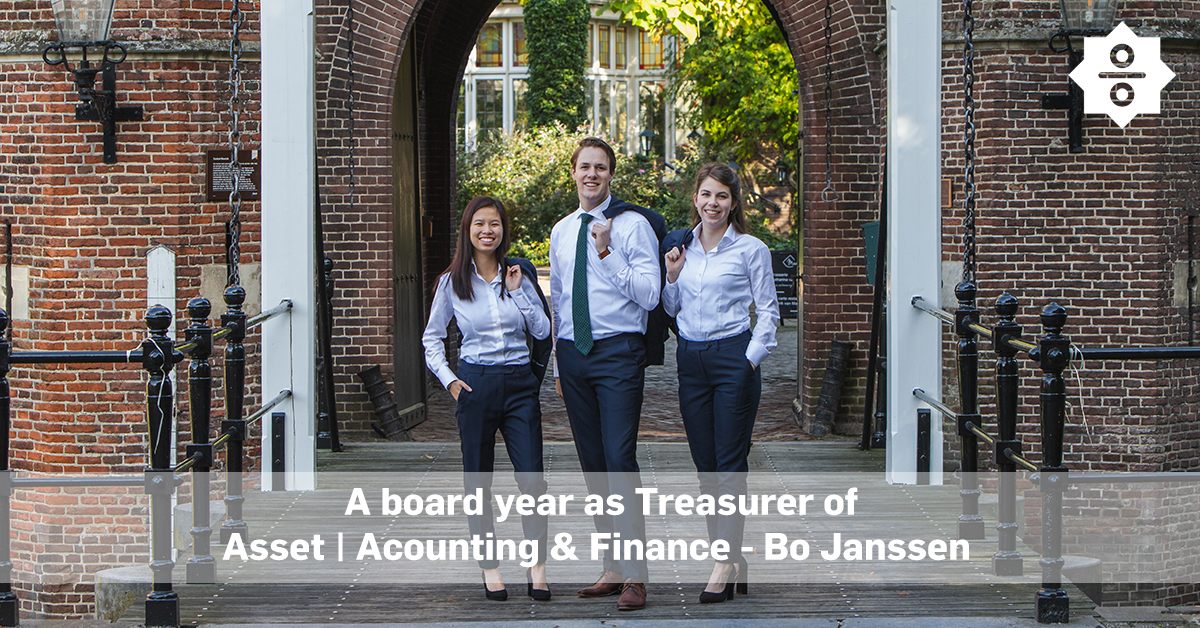
A board year as Treasurer of Asset | Accounting & Finance – Bo Janssen
For the Dutch version, click here As Treasurer, it is Bo’s responsibility to control the finances of Asset | Accounting & Finance. Besides that, she coordinates the Activities, Alumni, CityTrip, and Investment Night Committee. In this article, Bo describes what it means to be the Treasurer of Asset | Accounting & Finance and how she has experienced her board year so far. Why did you choose to do a board year at Asset | Accounting & Finance? When I started with my Bachelor Business Economics in Tilburg, I didn’t know a lot of people here. Because of that, I decided to become Active at Asset. I started by joining a committee at Asset | Marketing and because I enjoyed this a lot, I decided to join Asset | Accounting & Finance (A&F) as well. I considered doing a board year for quite some time, as I really enjoyed my time at A&F and wanted to boost my CV. Although I had not fully decided yet on which master I wanted to follow, Accounting and Finance seemed very interesting fields to me. To orientate better on which master to follow and to get in contact with firms in these fields, I decided to apply for the position as Treasurer of the board of A&F. What does your year look like and how is the experience so far? This year really feels like it’s flying by and when I look back, I already have great memories of the things we’ve done so far. The application procedure for the summer positions started in April. When I found out I was going to be the new Treasurer, the announcement couldn’t come soon enough for me and it was really hard to keep my plans for this year a secret. After the announcement, the transition period started in which I learned what tasks I was going to have as Treasurer. Because most departments within Asset switch boards in the summer, you start with a large new group in the Esplanade building in August. During the Announcement and Constitution Drinks, you will get to know your fellow board members of other departments, which will create a nice atmosphere at the rooms of Esplanade. When my board year started in the summer, I was still very busy organizing the studytrip to South Korea together with the StudyTour Committee. With the start of my new function, my responsibility and the number of tasks increased considerably and for some time I questioned if I could sufficiently do all tasks simultaneously. Eventually, this turned out fine and it came in quite handy that as Treasurer I had the overview of all the expenses and credit card usage during the StudyTour. However, I had to watch out for keeping the A&F card and my personal card apart while doing this. After a couple months already, the application of new board members was a discussion topic in our weekly board meetings. I felt like we had just started, so the idea of a new group coming was not on my mind yet. Therefore, it felt quite strange to me to look at a new Candidate Board with whom we were going to form the new board. Now that we have just started with the new board members, I realize how quick this year is passing by. Half a year has already passed, and suddenly we are the ‘older’ half of the board and soon we will start to look for the people who are going to replace us. Nevertheless, I do like this semi-annual board switch. The new board members bring in fresh ideas and I’m convinced we will make the upcoming semester a great success! What are your tasks as Treasurer of A&F and what does your day look like? As Treasurer you mainly focus on the financial situation and the administration of the association. To do this well, you must be able to communicate well with your fellow board members and the treasurers of the various committees. As Treasurer, you also meet with the auditing committee every quarter. They audit your financial administration and advise you about the financial situation of the association. This range in different tasks makes it quite difficult for me to describe what an average day looks like. Something that takes place every day is the fulfillment of my task list. At the start of every week, I set up a list of things I want to achieve the upcoming week and most of the days I start with the tasks that are on this list. What did you learn so far in your board year? Besides the responsibilities I have as a Treasurer, I also coordinate several committees. I really like brainstorming with the committees about setting up certain events and then working towards them. In this enjoyment I notice that it is quite hard for me to only coordinate the committee without taking on tasks myself as well, but I am currently working on finding my balance in this. Because you’re focused on various events, you’re always working on several tasks simultaneously. To keep these various tasks running, you must have a good overview of this. Additionally, I find it important to remain my own social life besides my board activities. Although it can be quite hard to plan this out, I think I’m getting better at it. Moreover, I am still undecided about which master to pursue. Initially I thought I had made up my mind, but lately I’ve started to doubt again. Therefore, I am happy that I postponed my masters’ choice and still have some time to orientate to find out what I find interesting. The events that A&F organizes significantly helped me with this. Due to these events, I met several companies and got a much better overview of the job possibilities that lie ahead. What is your greatest accomplishment? My committees! I enjoy working on our events with my committee members and I enjoy seeing everyone again at
