


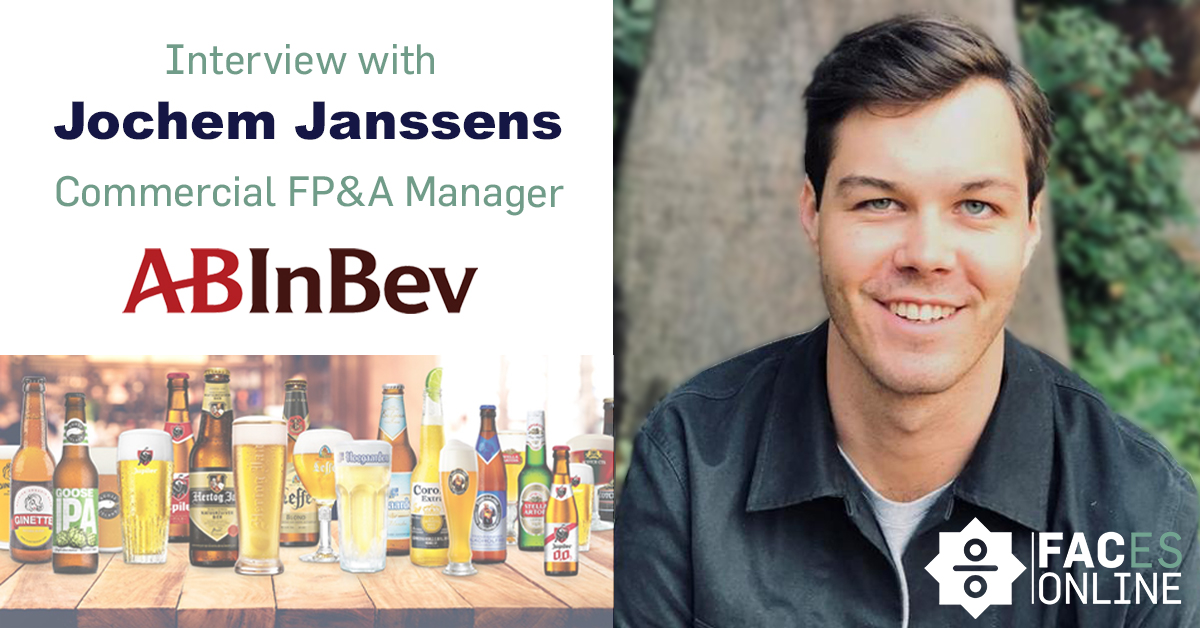
For the Dutch version, click here Jochem Janssens has been Commercial Finance, Planning & Analysis Manager at Brewery AB InBev for the past six months. AB InBev is one of the world’s largest players in the field of beer brewing, mainly known for many famous brands, including Hertog Jan, Jupiler and Corona. In this interview, he tells more about his career and the impact of COVID-19 on AB InBev. Can you tell something about your career? I was born in the Netherlands, but when I was two months old, I moved abroad with my family. Most of my life I have lived abroad, including Singapore, Dubai and England. I lived in Singapore for eight years and spent my high school life there. After that, I moved to Canada for three and a half years to earn a bachelor’s degree from McGill University. During my Bachelor of Commerce I got the opportunity to do three different internships in three summers. First at Unilever, then at IndusInd, a bank in India, and my third internship was at BBDO, at a Canadian branch of the American marketing company. After these internships, I joined AB InBev in 2018 as a Global Management Trainee What kind of impact did growing up in many different countries have on you? Meeting many different people from different cultures has brought me the most value. However, nowhere in the world does it feel like home and your friends are spread all over the world, which makes it socially more difficult. Living abroad has its pros and cons, but I gained a lot from the many life experiences. I know who I am, what I want and which norms and values I want to apply in my life. How did you experience the transition from studying to working? The biggest difference was that as a student you have much more control over what you do with your time. When you start working for a company you have to adapt to the norms and values that prevail in a company. Some organizations are much more flexible than others. I am a social and interactive person, that is why I like team sports. I have the same feeling in my work, working together with a large team on a subject, I like that a lot. The special drinks you produce, which people enjoy very much in a social environment. That’s one of the best things about working for a beer company. What attracted you to do a traineeship at AB InBev? The traineeship I did at AB InBev is an intensive ten-month program, where you learn a lot about the different departments in the company. You do projects in supply, sales, marketing and e-commerce. That was a fantastic learning experience for me, because it gives you the opportunity to see various sides of a company up close and you see how all the departments come together. “The special drinks you produce, which people enjoy very much in a social environment. That’s one of the best things about working for a beer company.” What does your work as a Commercial Finance (FP&A) Manager look like? In my role as Commercial Finance Manager I’m actually the spider in the web. I’m certainly not the central point of the company, but mainly the person who brings everything together. My specific role is financial planning & analysis, which means that I am responsible for reporting the financial figures of the Dutch company. My role consists of two parts. I work in a cycle that starts in the first week of the month with booking all costs and revenues of the previous month. After that, I start analyzing the performance of the previous month. Then I switch to the forecast part, in which I work together with the hospitality industry and retail sales directors to determine their forecast for the rest of the year. Then you bring together the analysis of the past month and the forecast for the upcoming months, with which you will build a forecast together. This forecast shows you what the company can expect for the coming year and this will be adjusted every month. In order to make the forecasts as accurate as possible, data from different departments is needed, in other words, a good collaboration. What effect will the current crisis with COVID-19 have on Beer Brewery AB InBev? We are a company that works with two major channels, namely the hospitality industry and the retail industry. Those two are always the balance for us in the company. The impact of COVID-19 has mainly affected the hospitality industry, where a lot of restaurants and bars had to close down. This means that people have only limited opportunities to consume beer. This is very painful for us, because the hospitality industry is a segment on which we rely very much in terms of performance. One ray of hope, however, is that a lot of consumption from the hotel and catering industry has flowed on to retail. For us, it was important to find ways to support entrepreneurs in the hospitality industry during the crisis. This often concerns an individual, namely an entrepreneur who has set up his own business. Approximately 10% of our hospitality relationships have a rental construction with us. Besides, we are not owners but intermediate tenants, we do not own any premises ourselves. To accommodate our tenants during this crisis, we have offered them a discount on their rent. In addition, we offered them to return the already sold tank and cask beer and to credit them on their next order. Who are AB InBev’s main competitors? Not only in the Netherlands, but also in the rest of the world, that is of course Heineken. Certainly when it comes to beer, but I think it is always nice to work as an AB InBev employee in our competitor’s largest home market. You are the underdog and you have to compete against the bigger brewer. I think, if you

A successful application: what does a recruiter pay attention to?
For the Dutch version, click here Nowadays it is very important to make a good impression with your resume. How do you make your resume and motivation letter stand out? Which activities are recommended to do next to your studies? Three recruiters, Lisa (WVDB Adviseurs Accountants), Lisette (Nielen Schuman) and Wouter (PwC) share their views. What do they pay attention to? And to what extent do their opinions differ? Find out in this article! What makes a resume good? Both Lisa, Lisette and Wouter find clarity very important in resumes. First of all, Wouter indicates that many students nowadays have fancy resumes with colors and visuals, but sometimes at the costs of the clarity of the resume. “A recruiter actually wants to be able to see at a glance who you are and what you have done,” says Wouter. Wouter’s advice is to look at LinkedIn to see how your digital resume is presented. However, Lisa thinks that you should present a resume in an unusual way. “You have to make it personal and eye-catching, but keep it businesslike. You can think of color, icons or symbols”. According to Lisette, it’s the trick to find the balance between telling what’s important, but also keeping it clear and organized. “Think about what skills, knowledge, and experience are important for the specific job and let these be highlighted on your resume.” Lisa adds that you should, if relevant, briefly point out what your tasks and responsibilities were and what successes you have achieved. “Possibly supplemented with a short profile sketch and a representative photo.” Both recruiters do indicate that you should be careful not to make your resume too long, i.e. no longer than 1 or 2 pages. “Also, not superfluous: check your resume on layout, spelling, and grammar”, Lisette adds. However, Lisa and Lisette have different opinions about the chronological order of your experiences in your resume. According to Lisa, a clear structure of experiences consists of years in chronological order. However, Lisette has a different opinion about this: “Write things like your education, internships, work experience and/or extra-curricular activities per section in a-chronological order, so your most relevant experience at the top”. “It’s not just about the experiences, but also about the choices someone has made.” What makes a CV distinctive? According to Wouter, it is important that you put things on your resume that have added value to your current individual profile. “Make sure you are critical about this, because too much information might cause a recruiter to be distracted from the things that really add value. You could describe what you have done in addition to your studies, what extracurricular activities you have participated in, whether you have studied abroad and whether you have done any volunteer work”. Lisette believes that a resume/CV stands out when you see that someone is interested in the field. It’s not just about the experiences, but also about the choices someone has made. A resume can already give a nice insight into whether there is a fit with the organizational culture. For example, you can look at the kind of organizations where you have worked or done an internship, but also what hobbies and interests you have. How you come across in your motivation letter also counts. In addition, she expects at least one relevant internship, side job or participation in a committee, investment club, case day or other matters that show the interest in corporate finance, if you want to apply at a company like Nielen Schuman. It is therefore important that your choices show that you are interested in the field, have specific experiences, and have developed relevant skills. What does a good motivation letter contain? Lisette thinks a good resume is important, but she indicates that a good motivation letter is just as important. If your letter does not show a strong motivation or if it is badly written, you may still be rejected. According to Lisette, your letter should show that you’ve really thought about why you’ve chosen a field of study and what interests you specifically about the company you’re applying for. In addition, she thinks it is important that you further explain what you have done so far in order to develop the right skills for the open position. Again, check your letter for spelling and grammar. It is advised to ask someone to read your letter and give feedback. “Your future employer is particularly looking for a student who has made choices for a reason, with a certain goal. So, think carefully about what YOU want and why you want it.” What are good extracurricular activities to do next to your studies? At the beginning of the bachelor’s phase, Lisa recommends that you first strike the right balance between study and private life. “Often at the start of your academic year, you have to get used to a new environment, a (possible) student residence, and a lot of new information.” As you come to the end of the first academic year, or have just started your second year, she would advise you to orientate yourself further and further and look for a possible continuation of your studies in the direction that suits you best. Wouter advises you to be active during your studies at a study association in order to further explore your network, but also your field of study. “Be even more active in the final years of your bachelor studies, because that can be decisive for your future internships during your master’s degree. Go to as many events as possible from Asset | Accounting & Finance, the university or to organizations that organize events themselves. Ask a lot of questions and experience where you feel at home.” If possible, Lisa would definitely recommend a board year. “During a board year you develop personal skills and get in touch with various offices. This provides a good basis for forming a picture of the diversity of possibilities after graduation”. According to Wouter, however, it is very important to
The green mask of ‘sustainable’ organizations
For the Dutch version, click here Sustainable investments have gained more and more ground within the financial world in the past few decades. As soon as a company is labelled ‘green’, the average investor seems much more willing to invest capital in it. An upward trend in this area has been evident for several years. Even during the coronavirus outbreak, the first three months of this year saw investors once again investing more money into sustainable investment funds. But are all these companies as sustainable as they appear, or is this a pretence that is kept high in order to attract more investors in this way? Earlier, Faces Online published an article about what is meant by Sustainable Investments, you can read this article here. The rise of Social Responsible Investing The roots of Social Responsible Investing (SRI) date back to the 1980s, when the rise of socially responsible investment shook the world of financial instruments. However, it was not until around 1995 that investors began to integrate ESG (environmental, social and governance) factors into their decision-making. Nowadays, SRI has increased even further. Clearly, investors are increasingly looking for companies that can stand the test of time. In addition, green investments are also increasingly being used as a means of portfolio diversification. The upward trend of SRI can clearly be seen in the exponential growth in the issuance of so-called ‘Green Bonds’ by the European Investment Bank (EIB). This issue has almost quadrupled in four years, from $45 billion in 2015 to $202 billion in 2019 [1]. Two weeks ago, the European Commission announced in its annual policy plan, the so-called ‘State of the Union’, that more than $260 billion will be spent on new Green Bonds [2]. In addition, 20% of the total assets under management are currently used for ESG investments [3]. Greenwashing Yet the sustainable investment world has often been the target of criticism. Environmental awareness is an enormously broad concept and therefore cannot be measured by a single yardstick. Due to the increasing interests for the environmental awareness of a company, some corporations appeared to obtain this green label by posing as a sustainable company. In reality, the core of these companies rather contributed to the pollution of the environment instead of the preservation of it. This concept, the wrongful sustainability claim of companies, is also referred to as ‘Greenwashing’. “Because there is no unambiguous measurement of a company’s sustainability, it makes the external verification of these sustainability factors by a possible accountant or auditor extra complicated.” Greenwashing is seen as a cigarette manufacturer making a one-time charitable donation to lung cancer research, with the goal of obtaining a certain ‘Charity Label’, while the core of the business is one of the root causes of the problem. A crucial factor in counteracting greenwashing is corporate transparency and control by independent third parties. Transparency is often associated with the amount and quality of data that is disclosed. The with this, however, is that there is no gold standard with regard to data publication. Too little public data indicate that information is being withheld, while an abundance of released information can lead to a search for a needle in a haystack. In addition to the quantity, the quality of the data is essential. Research by the Dutch Authority for Financial Markets (AFM) has shown that too little (standardized) non-financial information is released by listed companies [4]. In addition, the link between green objectives and quantifiable KPIs is still in its infancy. Because there is no unambiguous measurement of a company’s sustainability, the external verification of these sustainability factors by an accountant or auditor is made even more complicated. In addition to greenwashing by companies themselves, investment funds are also being questioned nowadays. Because sustainable investment is such a broad concept, most funds integrate a wide range of sustainability criteria into the investment process. However, there are also funds that integrate only one of these themes into the investment process and then claim to be a ‘sustainable investment fund’. “In this way, with the right, self-created criteria, a subsidiary can be praised in the proverbial green sky, while in reality this is unjustified.” Standards for sustainability There is a wide range of overviews in which sustainability is measured and displayed per company. Different measures are used to arrive at a so-called ‘green score’. General criteria of these surveys often include electricity consumption, water consumption, the type of material used as a raw material and the efficiency of this raw material consumption. However, in addition to environment-related criteria, social factors also play a role in determining the degree of sustainability in a company. For example, the remuneration of a CEO in relation to the average salary of employees is often included as a criterion, and the male-female ratio within the board of directors is also often taken into account. The criteria are often combined into a total sustainability score per company, after which these companies are then ranked. However, these overviews and rankings are not all equally reliable, as there are several companies that create an overview in which the company itself ends up high. In this way, with the right, self-created standards, a subsidiary can be praised highly, while in reality this is unjustified. This is why the independence of the company that issues the overviews and scores should always be investigated. An independent agency that tests the companies and creates an overview will almost always publish the methodology used in order to be as transparent as possible to the readers. Investing in your future Apparently, when investing in sustainable companies, investors should remain critical. There are various sustainable investment techniques that help with this. For example, the ‘negative screening’ method ensures that companies and sectors that carry a high ESG risk are divested during the investment process. As a result, companies with a low ESG score are not included in the list of investment options. A slightly more aggressive sustainable investment strategy is the ‘ESG integration’ technique, in which only companies with a
Column Guido van der Horst – former member of A&F Investments
For the Dutch version, click here Investing: a commonly mentioned topic for young adults. It is often presented as a fundamental part of maturing, a symbol of future orientation, and a pillar of financial awareness. Historically low interest rates make investing money even more interesting. However, a lot of people highlight the negative aspects: it is a risk, perhaps even a gamble, and requires in-depth knowledge of financial markets. Although these concerns are partly true, it is possible for everyone to earn money by investing rationally. A&F Investments helped me to do so. I became an official member of A&F Investments in September 2019. I had been playing with the idea of buying shares for years. I also learned during MSc Finance that the risk of shares is compensated above average. Still, my contribution to the committee was my first investment. I felt a barrier before because of the many questions I had. For example, what was the best way to invest? Which products should I have? Which elements should I pay attention to before I put money into a company? I hoped to find answers at the committee meetings. It soon became clear that I was not the only one with a lack of experience. Fortunately, there were plenty of members who made up for this lack: some had stock portfolios, others invested in crypto, and there were even members with real estate. I learned a lot during the first few months about the way they looked at a stock. For example: how expensive is the stock compared to the profit the company makes? Does the company have a competitive advantage and how is this advantage defended? My theoretical knowledge was also useful. For example, I knew how to compute a share price estimation in order to determine whether, in my opinion, the company was under- or overvalued. “Investing is often about logical thinking and making rational estimations and decisions.” Maybe things already got too technical. Some potential investors may not have a financial background and will not be familiar with all the terminology. Nevertheless, I would like to emphasize that this is certainly not necessary. Investing is often about logical thinking and making rational estimations and decisions. I like to illustrate this with a share pitch that I presented together with my team (consisting of Boris de Bie, Paul van Kempen, and Pim Meulenbroeks) in my last month at A&F Investment: the Homemade Cruise ETF. As you probably already know, COVID-19 has had a huge impact on the economy, including the financial markets. Where restaurants are often seen as the biggest victim, the cruise industry is perhaps even a better example. It has been prohibited for cruise ships to sail for months, which means that the companies do not generate any turnover. The result? Let’s take a look at the share prices of the three largest companies: Carnival Cruise Line, Royal Caribbean International, and Norwegian Cruise Line. Sometimes a picture says more than a thousand words. The cruise companies have taken an enormous hit due to the lack of turnover. Added to this is uncertainty: no one knows when they will be allowed to set sail again. This uncertainty is picked up by the mechanics of financial markets, which is often preceded by a psychological process. Some investors have sold their shares out of fear of bankruptcy. This created more supply in shares, causing prices to drop. These falling prices also gave other investors reason to sell, which can be seen as abandoning a sinking ship. The result: bottom prices. “Bottom prices” is a dangerous choice of words though, as it usually suggests that something is a bargain. In equities, there are theoretically no bargains (also called the “No Free Lunch Theorem”). Low prices reflect skepticism in the company and its future cash flows. The low prices simply mean that the market expects the cruise industry to make much less money in the coming years, which is not entirely strange given the pandemic. Nevertheless, skepticism can also be exaggerated, with investors almost panicking and selling their shares. In troubled times, it is extremely important to look at the companies as rationally as possible. For our pitch, we therefore asked ourselves: How big is the chance that the cruise industry, a centuries-old industry, will go bankrupt? Of course, it is possible for an individual cruise company to go bankrupt, but the entire market is more unlikely. For this reason, we thought it would be a good idea to buy shares in the aforementioned companies that are also market leaders. We assumed that over the long term the shares would rise back to their average (also known as a “mean reversion” strategy). There will eventually be a time when cruise ships will be able to sail again and generate turnover. As soon as this happens, the shares will rise from which we will benefit from this. By spreading the investment over multiple companies, we could even make a profit if one of the companies went bankrupt. We were convinced to invest in the cruise lines. We divided the work and researched the general company information, services, relevant news, the market and industry, the financial data, and the value of the stock. After putting everything into a nice PowerPoint presentation, we were ready to share the idea with our fellow committee members. It is quite a task to convince the group: at least 67% of the members have to vote in favor in order to actually proceed with the investment. After some critical questions, the final result came in: 87% in favor! In this way, our idea became reality and the committee joined the cruise companies for more than € 400. Mission accomplished! The great thing about A&F Investments is the influence to help determine which shares to invest in. By pitching and voting rationally you can increase the initial investment of yourself and your fellow members. They are also a good reason to become a member. In addition to

Big Data: the future of business intelligence
For the Dutch version, click here Big Data is a concept that is passing by more and more often. The exponential growth of data has made it increasingly difficult for organizations to identify and analyze the information they collect and utilize. As a result, an increasing number of organizations are paying attention to data warehousing and data-analysis tools, this decreases the number of hours that employees spend making reports in the long run. An additional advantage of this is that companies can react to events more rapidly and have a better comprehension of business results. But what is Big Data? Which powerful data analysis tools already existed now and what are the characteristics and differences between the two largest players in the market in terms of data analysis? Big Data It is called Big Data when you are working with one or more datasets that are too vast to be used and maintained with regular database management systems. At least, that is one of the definitions. Especially the term ‘Big’ is a concept on which there is no set in stone definition. Some believe that all data that no longer fits on a single PC is covered by the concept of Big Data, while others think that data does not become Big until multiple levels of servers are transcended. The similarity that can be found is that Big Data describes a size of data. Dimitri Tokmetzis, author of De Correspondent, indicated at the end of 2013 that Big Data more often does not describe a size, but a development. “This is because it contains two components. First of all, computer technology: the increasingly sophisticated hardware and software that allows you to collect, edit and store more data. The second component is the statistics that make it possible to find meaning in a collection of loose data”. Tokmetzis argues that the world is going to be full of sensor gates, cameras, telephones and measuring equipment that continuously register everything and store data, which we then store again can use. “The digital world and the physical world are becoming more and more one body and Data is the blood,” according to the Correspondent of Surveillance & Technology [1]. Data Analysis Tool: Power BI But what resources are available to really give value to all the saved data? In this article we discuss two of them. The first data analysis tool that will be explained is Microsoft Power BI. Power BI is strategically used to convert raw data into understandable insights using visual graphs and dashboards. This enables users to generate compelling reports and share the current state of the business. This gives users of Power BI more insight into the activities undertaken and achieved performances, allowing them to make informed decisions based on real data. In addition, they can use Power BI to take advantage of huge amounts of data while other platforms struggle to do so. Power BI has impressive compression capabilities that make it possible to analyze and visualize data that cannot be opened in Excel. Moreover, you can transform data in Power BI in the way you want, such as adding columns, creating relationships between different data sources and the creation of the so-called ‘measures’ in which you can make certain that values calculate in specific ways. The tool is so powerful that Power BI itself can do the analysis why the turnover of the past month lags behind the budget [2]. Data analysis tool: Tableau “Harness the power of your data. Unleash the potential of your people. Choose the analytics platform that disrupted the world of business intelligence. Choose Tableau.”, is the slogan that readers first read when visiting Tableau’s website [3]. Tableau is a powerful and fast-growing data visualization tool that helps to simplify raw data. The nice thing about Tableau software is that it is not overly technical or requires any kind of programming knowledge required to use it. In addition, the created visuals and dashboards can be viewed and understood by professionals at every level in an organization. Even non-technical users can make adjustments to dashboards [4]. The best features of Tableau are: 1. Data Blending: allows you to link multiple data sources together, by finding common fields. An example of this is the column article number in the data sources ‘items sold’ and ‘stock items’. 2. Real-time analysis: this option allows users to quickly analyze and understand dynamic data. This is especially useful when the speed of updating data is very high. 3. Collaboration: data analysis should not be an isolating task; therefore, Tableau is built for cooperation. Team members can share data, create follow-up questions and easily forward visualizations to others who can extract value from the data [5]. Power BI vs Tableau The world of data visualization and analysis is fast growing and every day there are new entrants. at. Ease of use, power, brand recognition and price are important concepts that Power BI and Tableau currently possess to stay ahead of the market. Power BI uses the existing Microsoft systems such as Azure, SQL and Excel to data visualizations to build. Power BI therefore has the edge for people who work with Microsoft products. It is also a good and inexpensive option for startups that need data visualisation but do not have much extra capital. Also, Power BI is cheaper than Tableau, especially if an organization has already invested heavily in Microsoft software. Power BI has a desktop, service and a mobile version. Usually you need all three versions when a dashboard is made, but it is quite easy to understand how this works. In addition, you can retrieve data from different sources easily. The whole tool is built to speed up time of visualizations and it gives even the most novice users access to powerful data analysis and discovery without much prior knowledge. The real time data processing ensures that organizations can respond directly to changes that occur in the displayed data analysis. Tableau specializes in creating beautiful visualizations,

Bringing FinTech into practice: Building a future proof finance function at Adyen
For the Dutch version, click here At Adyen we operate a global payments platform, integrating the full payments stack – gateway, risk management, processing, acquiring and settlement services. We do this on a single platform, a key competitive advantage allowing us to provide higher service levels to our customers than our competitors can. By building a state-of-the art payments infrastructure, and taking a holistic view on payments as we offer both online and offline channels through our single platform, we offer unique shopper insights, we combat fraud and we offer a uniform experience to shoppers across these sales channels – all tangible benefits for our customers. The single platform furthermore enables speed in onboarding of merchants, payment method offerings and innovation. This belief in a single platform carries over to the way we approach finance at Adyen. While our company is spread across the globe, our Group Finance* team is centrally located at our head office in Amsterdam. We work with a single ERP for our global activities and have very limited additional source systems where we create or store data, all built in-house. As with our payments platform we believe this approach enables speed and innovation and therefore makes us ideally positioned for the future. In combination with a strong focus on automation it allows us to keep our finance team relatively small, whilst offering diverse finance roles to our team members in which we give them the opportunity to develop themselves into well-rounded finance professionals. The fact that we’re listed and have a banking license requires us to be in full control of our numbers; the way to do this is by striving for operational excellence. The belief that we’re redefining the payments landscape and having (a lot of) fun whilst doing so means we want to offer the people working for us an opportunity to develop themselves both professionally as well on a personal level; we do so by giving them an interesting learning opportunity and by working side-by-side with smart and ambitious peers. So, the question then is, what does this look like in practice? All teams within Group Finance focus on process optimization through automation. This automation is aimed at improving end-to-end processes such as purchase-to-pay, order-to-cash and record-to-report. Within purchase-to-pay we enable business managers to create suppliers, receive all invoices digitally and process them automatically through Optical Character Recognition technology (“OCR”). All approvals run through our ERP and can be approved through an app. We have connected our ERP to our banking portals to reduce as many of the manual steps as possible and improve accuracy. Operational excellence here is crucial as its benefits are manifold: suppliers get paid out sooner, our business/financial controllers see more consistency in the numbers enabling better analysis, our global tax compliance benefits through better data quality and our accounting operations team can focus on further improvements rather than focusing on repetitive tasks. “By always taking scale into account, we ensure that we’re building something that’s always ready for the future.” Our order-to-cash shows similar automation trends. Here we’ve focused attention to connecting our merchant contract tool to our billing engine, ensuring correct invoicing of agreed upon fees. For many of our merchants where we perform settlement services (Adyen is in the money flow), we can also automatically deduct the funds our merchants owe us and automatically reconcile against open accounts receivable positions. In the record-to-report domain, we focus a lot of our efforts on building automatic connections between the different source systems we use, ensuring speed and correctness in financial reporting. This reduces manual processes during month-end financial closes. Benefits here include fewer manual errors, less dependency on specific time restraints from the team and the team being able to focus on more value-adding activities for the business. This is both good for the company and for the team members – who are much better at and enjoy more spending their time focused on the story behind the numbers. This strong focus on automation is something that can be traced back to the company’s DNA. By building a payments platform that currently processes billions of payments per year (in 2019 we processed €239,6 billion in payments) and is still growing at rapid pace (2020Q1 reported processed volume was at €67 billion, up 38% year-on-year), you need to build something that is scalable. This mindset underlies the whole company and thus also finds its way back to our Group Finance team. By always taking scale into account, we ensure that we’re building something that’s always ready for the future. A future that is built around a much larger version of Adyen than we are today. This doesn’t mean we do everything right the first time, but that we work towards continuous improvements. At Adyen we ‘launch fast and iterate’. This means we get a first version up and running relatively quickly, and then make incremental improvements through ongoing iterations. The context we operate in also requires us to set-up this way. The payments space is constantly evolving and we’re rapidly growing; requiring a need for a scalable solution. *At Adyen we make a distinction between Merchant Finance; the department responsible for our merchant money flows, and Group Finance; the department responsible for Adyen’s money flows.