

For the Dutch version, click here For the accountancy students among us, it’s a familiar ritual by now; as soon as the future comes up, the majority of students hear the all-too-familiar song: first, complete the master’s program Accountancy, then start the postmaster CPA while at the same time, starting to work for example at Deloitte, EY, KPMG or PwC. There is, of course, nothing wrong with this road. After all, the CPA title is very valuable and as long as people have not been replaced by technology, we will also need enough inflow into the audit practice, and the financial sector in general. In addition, working in auditing can also be fun, provided that this is where your interests lie. The demand for the CPA title is therefore growing every year. However, the ever-growing demand for CPA students also has a downside: when people talk about accountancy these days, we only think about Chartered Accountants. However, there is another branch within accountancy; Controlling. What exactly does a controller do? Generally, a controller assists the board or management in understanding and maintaining the financial affairs of a company. The controller oversees a company’s finance department and often leads this team as well. The controller also deals with financial planning and reporting for the benefit of management. Simply put, a controller is concerned with the quality of the entire financial process and ensures that the results and planning are optimally communicated to management, in order to support decision-making. For a career as a controller, you generally don’t need additional training like a CPA. However, these courses do exist. The executive master: Register Controller (RC). If you complete this program, you will be listed in the NBA register, just like a CPA, as an additional quality stamp on your resume. Why RC or CPA? The big question now, of course, is why anyone should choose RC or CPA. One is no better than the other. Both have extensive knowledge of financial data, and both are post-master educated. So the difference does not lie in the level of education. In my opinion, it will mostly be where your interests lie. Of course, your interests lie in finance, otherwise, you wouldn’t even think about throwing yourself into the world of financials. The big difference is whether you like to evaluate a company internally or externally. As a controller, internally you will be mostly concerned with the processes within the finance department and steering for growth and results. As an accountant in the audit practice, you will mainly focus on the correctness of the external reporting and compliance with laws and regulations. The question is therefore what you yourself find most interesting. It’s worth noting that there is a trend where we see a lot of chartered accountants choosing to switch to a controlling position in the business world after a number of years in the audit field. For example, many controllers and CFOs at large Dutch companies used to be CPAs. Think of the CFOs of Adyen, ASML, and Unilever. For those students who already know that they have the ambition to eventually hold a position as CFO: there is also another path than becoming a CPA. The road to RC is about as long, but if we are to believe the universities, you are slightly better prepared for the position you will eventually hold. Boxes The advice I would like to give current and future Accountancy students: do not immediately put yourself into the box of the chartered accountant. Of course, it’s a good profession with good prospects, but there are many other interesting jobs that are just as well suited to financial education. In my opinion, that is also the beauty of training in financial disciplines; at the basis, we all understand financial matters, and eventually, you can end up in plenty of amazing places. Even without a CPA title, you have a degree in your pocket that guarantees your ability to critically think in a certain field. And that piece of paper will get you there.
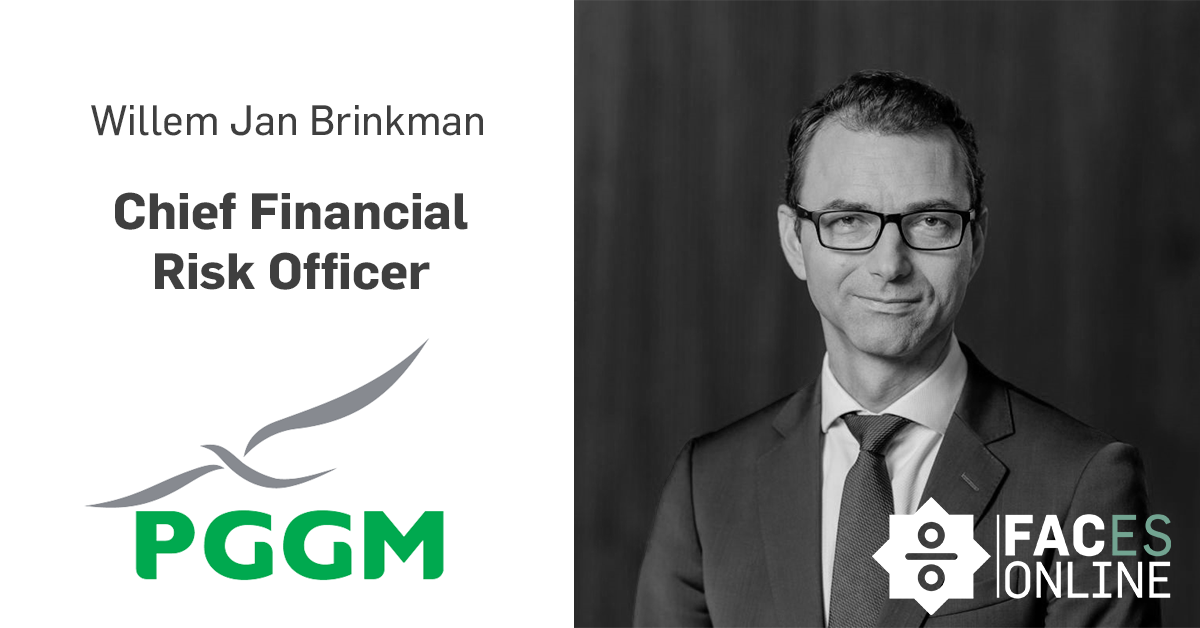
Interview with Willem Jan Brinkman – CFRO at PGGM
For the Dutch version, click here Since 2019, Willem Jan Brinkman has been CFRO of pension fund service provider PGGM. In this interview, he talks about his career and provides more insight into his work as CFRO. Besides, Brinkman shares his future vision of responsible investment within PGGM and how the affordability of pensions will develop in the upcoming years. You studied Economics at the University of Groningen. Can you outline what your time as a student was like? The study lasted five years in total because there was no split between the Bachelor and Master. I was active at the rowing club Aegir in Groningen. At the beginning of my studies, I was a very fanatical rower, but this became less so as I further progressed in my studies. During my studies, I did an internship at the headquarter of the Gasunie in Groningen. I finished my student years with a traineeship at PriceWaterhouse in the united states, a predecessor of PriceWaterhouseCoopers (PwC). I was able to do this traineeship through AIESEC, an organization that is still active today. How did you experience the transition from studying to working? The traineeship at PriceWaterhouse had a positive impact on my transition from studying to working. I ended up in the tax consultancy department advising rich people. You just had to work really hard there. For me, it was a huge transition to go from studying to working in a company. This traineeship also helped me to get a good idea of what working there actually entailed. In my student days, I found it difficult to form a good idea about this. In 2015 you made the switch from KPMG to PGGM. Can you explain why you made this move? At KPMG I was a partner in the M&A department, focusing on the financial sector. These were mainly transactions between banks, insurers, and asset managers. This transition was a nice switching point in my career. You’re in your early 40s and you ask yourself the question; ‘are you going to keep doing what you’re doing now or are you going to make a real change?’ The social mission that PGGM has appealed to me in particular, promoting the interests of employees in the care and welfare sector. The focus on responsible investment and SRI, for which PGGM is known, also appealed to me. Moreover, the scale of PGGM and the fund behind it (PFZW) means you can achieve a lot. From my work at KPMG, I already had some contacts at PGGM. I had PGGM in my sights, but there had been no reason to actually start working there. The reason came from PGGM’s involvement in the Dutch Investment Institute, a new initiative for investing in the Netherlands. As PGGM was looking for someone who could contribute to this, I decided to make the switch. Can you describe your day-to-day tasks as PGGM’s CFRO? How does your role differ from that of CFO? I am CFRO, a combination of Finance and Risk. Therefore, I have two different perspectives in which I operate within the company. Together with the CEO, I form the board of directors. This means that every issue that involves board-level decision-making comes to my desk. Almost every issue contains a financial or risk component. This can be about the financial results, the risks related to the company, or about investigations taking place. Hence, my tasks are enormously diverse, and I really enjoy that, but all from a managerial role. However, it’s not my intention to get lost in all kinds of details. My job is to maintain a birds-eye view of the total process. “I, therefore, expect people to look more closely at their pensions in the future.” The difference between CFO and CFRO is a development in the market. Previously, it was common for a firm to have a CFO and a CRO who supervised. Currently, these two positions are often combined into CFRO, although in larger companies you still see this split occasionally. At PGGM we have two separate departments that exist side by side but report to me as CFRO. Generally, pension funds focus on long-term affordability. To what extent do you focus on short-term financial instruments? We are the pension administrator, which means that the pension funds are our clients. They have a certain policy with regard to the fund’s investments. PGGM is the party that implements this policy for the pension fund. So, you look at the coming years: what needs to be paid out and what is coming in? A lot of liquidity is needed to be able to pay out money or make payments. The short-term part is then mainly taken care of by the treasury department of our asset management. This means that stock market-listed investments are held for shorter or longer periods, such as equities and credit. While investments in private markets are often really long-term, and for which we have built up large internal investment teams with a lot of specialist knowledge. An example is our team of forty people that make large investments in infrastructure, like for example the purchase of a water purification company that takes care of a city’s water supply. We usually hold these types of investments for a longer period of time, and they yield us a nice, stable dividend every year. We also do “structured investments,” such as what is known as Credit Risk Sharing transactions. Here we actually invest in the loan books of banks. These investments run for about 3 to 4 years. To properly reflect affordability, we look at the coverage ratio. This is the ratio between the present value of the amount to be paid out and the money that is currently available. The value of the coverage ratio is very much influenced by the interest rate. When interest rates are low, your liabilities’ value is very high, which causes the coverage ratio to fall below 100 percent. Because of the impact of COVID-19 on the economy,
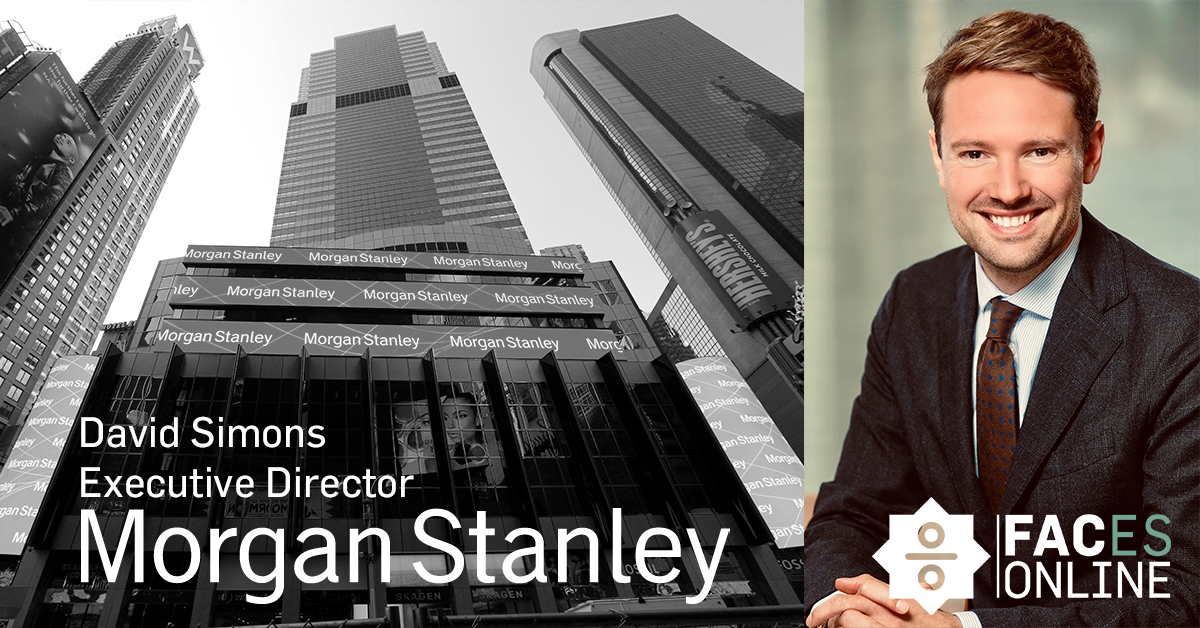
Interview with David Simons – Executive Director at Morgan Stanley
For the Dutch version, click here David Simons graduated in econometrics at Tilburg University in 2008. Now, 13 years later, he is an Executive Director in the Investment Banking Division at Morgan Stanley in London, one of the largest investment banks in the world. In this interview, David talks about his career path, motivations behind it and transition from his student life to the corporate world. Can you tell us a bit more about your background? In 2001 I started studying econometrics at Tilburg University. At the same time, I fully jumped into student life, which was not the perfect combination. Towards the end of my bachelor’s degree, I started working as a working student at NN in their Risk Management department in Rotterdam. As a working student, I was mainly involved in project work, where I was often the link between the technicians and managers. Partly due to this job, I decided to do my master’s in Rotterdam, which I completed in one year. I then moved on from NN to ING’s corporate development department, partly because NN was part of ING Group at the time and ING was looking for insurance expertise. As an analyst in this team, I was given major responsibilities, which allowed for a steep learning curve in M&A. After this, I worked on the NN IPO for 12 months before it finally came to fruition in June 2014. During this project, I worked closely with the major investment banks, including Morgan Stanley. The discussions with advisors made me eager to work at an investment bank myself. Just after NN’s IPO, I continued my career at Morgan Stanley and started as a second year Associate within the Finance Institutions Group, the team that advises financial institutions. I have been working here for almost 7 years now, and still enjoy it every day. What choices that you have made during your time as a student have had a significant impact on your eventual career? The main subject you study steers you in a certain direction in the Netherlands, perhaps more than in the UK. I think my eventual choice to go to Rotterdam, both as a working student and for the Master’s degree, made a big impact. The change of environment, people and routine had a tremendous effect on me. In addition, by settling in a different environment and a bigger city, you automatically have a better connection to an international career. Which transition had the most impact on you, the shift from being a student to entering the corporate life, or the transition from a Dutch corporate to one of the largest investment banks in the world? The transition from student life to corporate life was mentally the hardest. If you are still living in a student house, completing your studies and also sitting on a train at 7 a.m. two days a week, feels like quite a step. In the transition to London you are thrown into the abyss as soon as you arrive, but the setting fits that life; your roommates are likely to live a similar lifestyle, as they also come to London to work hard, and hence you face most of the same issues. Both these changes of scenery had a good effect on me, it’s remarkable how quickly these new environments become part of your comfort-zone though. You have been working for Morgan Stanley in London for almost 7 years now, so aren’t you starting to run into the same problem again, that you need a change of scenery? To the contrary, if you find a place where your work is so dynamic, then you can last a very long time. The projects are always different and you end up with a variety of clients you try to help with their ambitions or problems. The core of what you do remains the same but your role in it changes over the years as you become more senior. If I were to do this work for a competitor, it would mainly cost a lot of energy to get to know all the new people, processes, etc. So for now, I certainly have no plans to make any changes in this regard. Can you elaborate on what a regular working day looks like for you? I mainly speak to clients, both when it comes to pitches and for projects. This could be around a company that wants to go public where you discuss the when, why and how that should occur. Hopefully your ideas happen to enlighten or spark the client’s mind. Not a single day is the same and besides client conversations there are plenty of analyses we perform for our clients (either for pitches or projects) which I generally outline, control, and assist with. In addition, there is quite a bit of legal work that comes to the forefront when you are working on projects. In short, as an investment bank you feel overall responsible for supporting your clients in achieving their desired outcomes. What are the motivations for an economics/finance student to pursue a career in investment banking? First of all, it depends entirely on your ambition. If your ambition is to see if you can hold yourself together in a world that is faster, more complex and perhaps a little more aggressive versus the one in Tilburg, the world of investment banking may suit you. If you have the right business sense and motivation, you could have an incredibly interesting career. And if after all it’s not for you, the experience you’ve gained will only make it easier for you to look for an interesting job in the Netherlands or somewhere else. “As an analyst, you mainly need to be accurate, fast, and do many processes at the same time and although we men are not natural multitaskers, this is something that you will learn fast.” What skills that you’ve developed during your studies are the most useful now? As a junior you mainly benefit from your
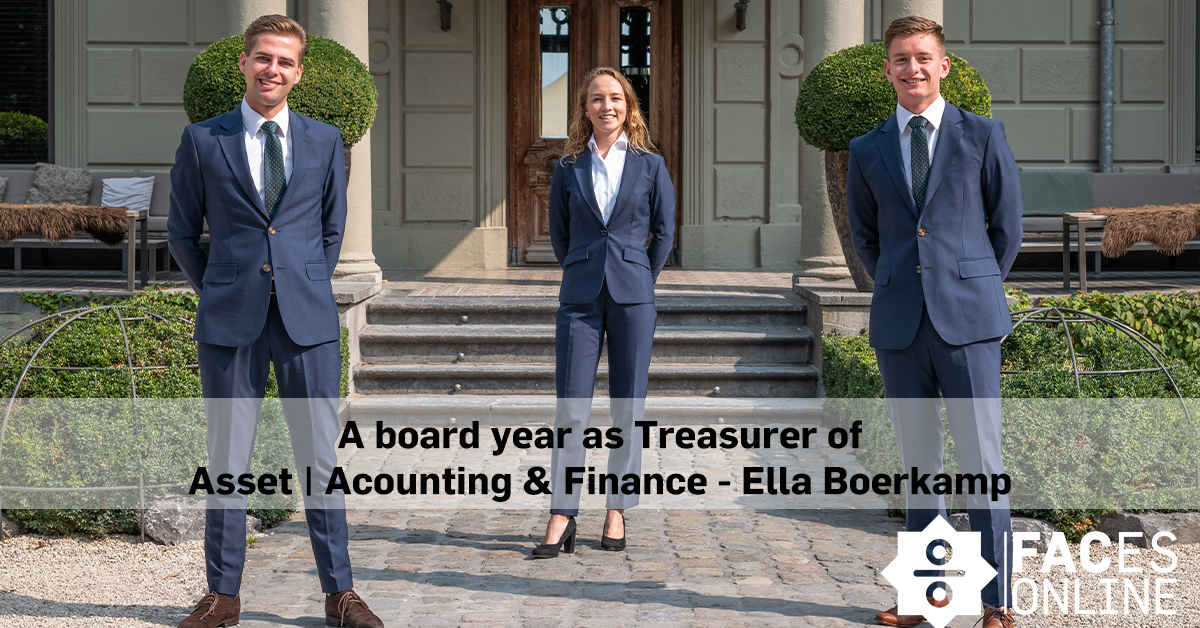
A board year as Treasurer of Asset | Accounting & Finance – Ella Boerkamp
For the Dutch version, click here As Treasurer, you are responsible for the finances of Asset | Accounting & Finance. In addition, you coordinate the Activities, CityTrip, and Investment Night Committee. In this article, I describe my experiences as Treasurer of Asset | Accounting & Finance. Why did I choose to do a board year at Asset | Accounting & Finance? During the first three years of my student life, I wanted to get my credits as quickly as possible. After three years, I obtained my bachelor’s degree and started with the Master Accountancy. I realized that after one year I would probably be finished with studying and therefore also with my student life. This made me doubt. After all, I was only 21 years old. Then I started thinking and came to the conclusion that I wanted to do something else. Therefore, I started to find out how I could prolong my student life a bit and meanwhile gain experience within my interests. As of my third year of study, I have been an active member of Asset | Accounting & Finance and I always had a good time. For me, that was the main reason that I applied for a board year. I wanted a fun and above all enjoyable year. A board year at A&F was therefore the perfect choice. After all, I already knew most of the members, completed the Master Accountancy and I could come into contact with a variety of companies. “What do you do all day?” That is a question I often receive from many friends. Actually, it is difficult to explain what you do all day to people who have not done a board year. When I started my board year, I knew it would be a busy year with many responsibilities, but what it would look exactly was also not clear to me. On Monday morning, we always have our board meeting. When I saw the agenda for the first time, I was flabbergasted. The agenda contained a lot of different topics, such as our formal and informal events, articles that need to be written for Faces-Online, acquisition, etc. As a board member, you are doing a lot of different things, because everything needs to be well-organized and nothing should be forgotten. In short, besides having drinks with fellow students, you have a lot of responsibilities as a board member. At the moment of writing this article, I am thinking again: “What did I actually do last week? The week always flies by!” Is the position of Treasurer exactly what I expected? Before I started my board year as Treasurer, I expected to be busy with the bookkeeping of A&F: paying invoices and declarations, requesting quotes, keeping track of the budget, and sending out invoices. In the first few weeks, I was indeed very busy with this. Twinfield, our accounting software, was not really my best friend at the time and it took me a while to understand and work efficiently with the system. Every week, I mean every day, I contacted my predecessor with questions about Twinfield. After a while, I became more and more proficient and I started to understand what my predecessor meant by ‘Twinfield is just like gaming’. “That as a board member of A&F, you are working in a mini-company with 120 employees and you will never get these responsibilities at your first job.” In contrast to the beginning of my board year, I am currently spending much more time coordinating my three committees. This results in variety in my work. The Activities Committee organizes various events for active members so that they can get to know fellow students despite the few physical contacts that are currently possible. I also coordinate the Investment Night Committee. Investment Night is a symposium that will take place on May 12. Organizing this is a very fun and exciting challenge. Furthermore, I am the coordinator of the CityTrip Committee. I am very happy with this, because last year, I was a member of the StudyTour Committee that organized the trip to South Korea. Even though traveling is not possible at the moment, we still organize fun activities! Besides coordinating my committees, I am also busy with helping other board members, the weekly meetings of all Treasurers of Asset, the quarterly Audit of Accounts, the bookkeeping of the Alumni Association Financials, and the Financial Association Netherlands (FAN). What are you most proud of? I am proud of the fact that, with all the board members, active members, and partners, we have made it an inspiring and instructive year so far. As a board member in this crazy period, we have to make sure that we keep all our partners and members happy. We ensure that events continue and that requires us to be proactive and creative in finding solutions. Hence, our problem-solving skills were highly demanded this year. I am also happy about and proud of the fact that all our events have taken place this year, despite the various Covid-19 restrictions. As a result, fellow students still had the opportunity to develop themselves and get to know other students. Would I recommend a board year to others, even in these strange times? Definitely! When I started my board year in the summer of 2020, I knew that my board year would be different from a ‘normal’ board year. Nevertheless, it has been a fantastic period so far! My board year cannot be compared to any other board year. I hope, of course, that this unique board year will not become normal. During this year, we had to do the best we could to remain successful as a study association. Every event needs to have a plan b and c, which are usually a physical plan and one or two online plans because the rules are constantly changing. For this reason, we are constantly searching for the best option. Looking back at what I have learned, I dare to say
Working at EY
For the Dutch version, click here What is it like to start working at an accountancy firm in a time in which everything is online and working from home is the standard? In this article, Daniek Veldhuis will tell about her experience as a first-year staff member at EY. Who am I? To begin, I will shortly tell something about myself. My name is Daniek Veldhuis, I am 22 years old and I live in Tilburg. After obtaining my VWO diploma in 2015, I decided to make the move to the student city Tilburg. From 2015 to 2018, I studied Business Economics and after completing this bachelor, I continued with the master Accountancy at Tilburg University. Next to my studies, I was a board member at the study association Asset | Accounting & Finance. As such, I got the change to organize network events together with my fellow board- and committee members. These network events were organized for, among others, several accountancy firms,. Due to this, I was able to get a good idea of the various Big-4 offices and eventually make an informed choice to apply for a job at EY. Why EY? You might wonder which factors contributed to my choice for EY. First of all, I quickly decided for myself that I wanted to start at one of the Big-4 offices. For the many possibilities, but also the international aspect appealed to me. Another factor that was important to me was a good match with my colleagues. The actual work at the different accountancy firms does not differ much, which makes the social aspect even more meaningful. Working at EY During my master, I first did a thesis internship at EY in Eindhoven. During such an internship, you will have the opportunity to write your thesis at the office. As such, you can already experience the ins and outs and the atmosphere on a normal working day at the office. My thesis internship started in February, but unfortunately we quickly had to work from home due to the COVID-19 crisis. Fortunately, fear that this would cause less contact with colleagues was not necessary. At the beginning, all thesis interns were assigned a buddy group and mentor and we had a weekly contact moment with this buddy group during the duration of the internship.. Despite the special circumstances, I enjoyed this time so much that I started at EY Eindhoven as a Staff Audit last September. The first two weeks consisted of an introduction period with all the other starters from the same region in which we covered different cases to prepare us for the work to come, but also several informal activities were organized to create a good relationship with my fellow starters. “The activities as a Staff Audit differ throughout the year, from testing internal controls to analyzing the figures in the annual report.” After the introduction weeks, it was time to really get to work. A big step, but you will be guided in this process as well as possible and in the case of any questions, you can always contact your personally assigned coach.. None of my colleagues will have exactly the same working day. This mainly depends on everyone’s client package. My client package consists of different types of clients, including one large client from the United States that I have been working on for most of the time so far. The activities as a Staff Audit differ throughout the year, from testing internal controls to analyzing the figures in the annual report. You work on this together with the team, at the EY office or at the clients site. This year, it has been different and I have spent most of the year working from home. This is very different from what I had imagined my first year at EY to be, but we all try to make the best of it. Where you would normally meet in a meeting room with your senior to discuss something, this is now all done via Teams. Furthermore, we now have virtual work sessions to re-create the feeling of a normal working environment. All team members will join the session, so we can also get an idea of what the other team members are working on. Besides all the hard work, there is, of course, also time for other fun activities. Unfortunately, this year, events like the Christmas drink or ski trip could not take place, but online activities are organized as much as possible, with the entire region or within the team you are working with that week. For example, two colleagues of mine organized a Carnival pub quiz for the entire team a few weeks ago. In short, my first year has been an eventful year so far and different than expected, but precisely because of the way EY has approach this situation, I am still happy with the choice I made.

The CFA track: a valuable addition to the Master Finance?
For the Dutch version, click here It is a well-considered choice for many (future) students of the Master Finance: the CFA track, a specific study program that is a stepping stone towards the Chartered Financial Analyst (CFA) level 1 exam. In this article, two students provide their insights and share personal experiences. Furthermore, Peter de Goeij, Academic Director of the Master Finance, gives an insight into the university’s rationale behind this program. Chartered Financial Analyst is a globally acknowledged certificate, provided by the CFA Institute. The CFA Institute is a worldwide renowned institute that provides investment professionals with finance education. It aims to promote standards in ethics, education, and professional excellence in the global investment industry. It offers several international designations, amongst the famous Chartered Financial Analyst (CFA) designation. Tilburg University is linked with the CFA Institute enabling access to students – worldwide – to study at our institution. Having a CFA certificate displays your knowledge in analyzing, understanding, and applying investment instruments. Boris de Bie (24) chose this particular track as it provided more in-depth information regarding financial management and investment analysis: “During my Bachelor’s degree I regarded investments and financial instruments as the most interesting topics. When I found out that there was a specific track in the Master Finance that particularly focuses on these topics, it was an easy choice.” To ensure that you obtain an appropriate preparation for the CFA-exam, the track contains certain restrictions relative to the regular MSc Finance track: “If you decide to choose the CFA-track, there are several courses that you will certainly follow, such as Investment Analysis, Empirical Methods in Finance, Advanced Corporate Finance, and Financial Statement Analysis & Valuation. Besides these courses, there are three electives, for a total of 18 ECTS that you can pick. The number of possible electives is smaller compared to the regular track. However, if your main interest lies in the field of investing and financial instruments, these are the courses that you would have chosen anyhow.” Sjors Seinen (22) had a similar decision-making process regarding the choice for the Master Finance – CFA Track: “I was already familiar with the CFA charter given that Tilburg University offers a Finance Master that primarily focuses on the topics deemed important by the CFA Institute. Knowing that my interest lies, to a large extent, with investing and asset management, the Master Finance – CFA track seemed to be cut out for me. Hence, I opted for the CFA track program to prepare myself well for a future career in investment management. “The top employers of CFA charter holders globally include JP Morgan, UBS, Morgan Stanley, BlackRock, and Goldman Sachs.” After finishing his Master Finance, Sjors directly started with the preparations for the CFA-exam: “After successfully defending my Master thesis this September, my time as a student at Tilburg University had come to an end. Nevertheless, being only 22 years, I decided not to immediately enter the labor market. Instead, I found that I could supplement the acquired knowledge I gained during the Masters by enrolling for the CFA Level I exam.” Whilst studying for the CFA-exam, Sjors discovered that there was more to it besides the gained knowledge during the Master Finance: “Even though the Master Finance – CFA track covered all finance-related topics embedded in the CFA curriculum, the focus of the CFA exam level I goes far beyond portfolio management, equity investment and fixed income alone: approximately half of the study material is dedicated to fields such as ethics, economics, quantitative methods, and financial analysis and reporting. Therewith, the CFA Institute ensures that its members and candidates have an all-out understanding of any disciplines that could be associated with the investment management profession.” Even though the CFA exam contains additional study material that goes beyond the Master Finance program, Sjors did experience the CFA track to be substantially helpful: “Mandatory Master courses like Fixed Income Analysis, Derivatives Securities and Risk Management, Financial Analysis and Investor Behaviour provided an accurate reflection of the Finance-related topics in the CFA curriculum, which saved me tons of study time that I could now redirect to other prominent topics (e.g. ethics).” Approximately two weeks ago, Sjors finally took the CFA level I exam: “After three months of preparations, I took the CFA level I exam on December 5, 2020 in Amsterdam. Although the results will not be published for the next two months, I am very certain to have passed the exam, mainly thanks to the Master Finance – CFA track!” According to Peter de Goeij, Academic Director of the Master Finance, the CFA track offers multiple benefits to students interested in this knowledge area: “The CFA track covers about 75-80 percent of the material for the CFA level I exam. In that way, there are huge time-savings possible when studying for this exam. In addition, for a few students scholarships are available that help cover some of the fees for the level I exam.” After passing the exam, a CFA-student has various options to enter the labor market, according to Peter de Goeij: “The top employers of CFA charter holders globally include JP Morgan, UBS, Morgan Stanley, BlackRock, and Goldman Sachs. In general, the main profession is found in wealth management institutions, financial advisor companies, and (investment) banking companies.” All in all, the CFA track incorporates many courses and topics that are well-suited for students with a particular interest in asset management and investment analysis. It offers a curriculum that covers around 75 percent of the CFA Program Candidate Body of Knowledge (CBOK) and is, therefore, a good preparation for the CFA level I exam. Interested in this particular master track? Check your eligibility and the deadlines for the applications here. For international students: check your eligibility here.