

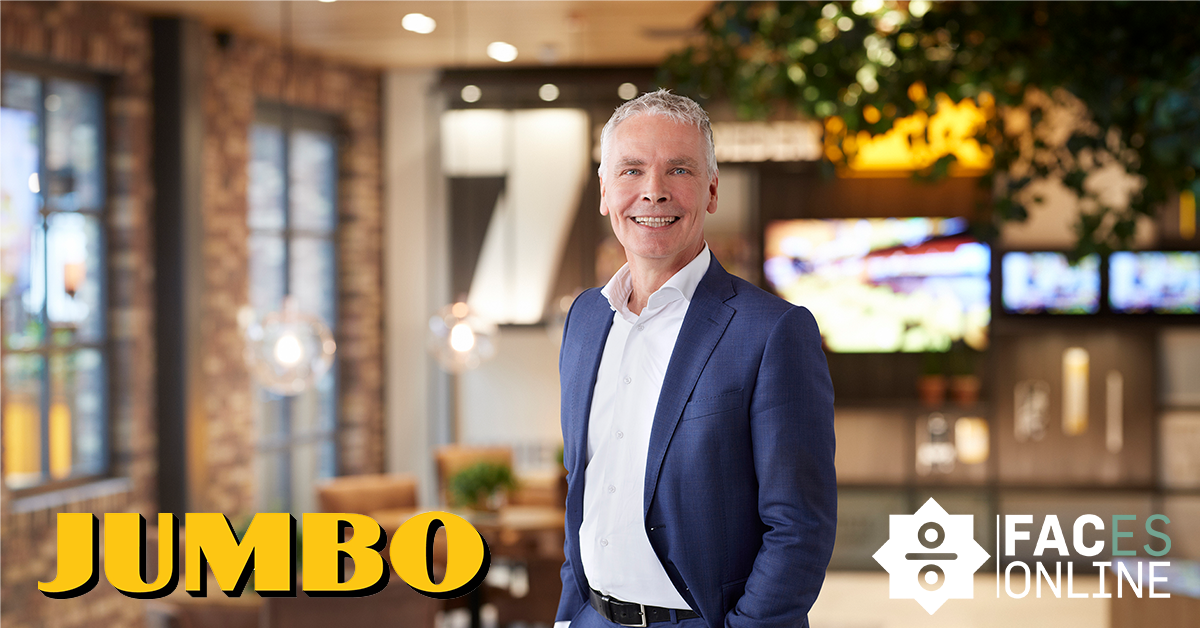
For the Dutch version, click here My name is Peter van Erp. I am 55, married, and have two children. After my high school studies, I started to study Economics in Tilburg in 1985. Eventually, I graduated in Finance. I have always found it very interesting to look at how companies were valued, and what the rationale is behind certain price movements. Today, I am Executive Director of finance at Jumbo. Why did you start studying Economics? That’s a good question, why do you do anything? I knew already in the fourth grade of high school that I liked it and it was also the subject that appealed to me the most. So there was an intrinsic interest in that to know something about economics. I really liked business economics, but also general economics. I think these subjects are very telling about how the world works. Also, you have to understand history to understand general economics. What steps did you take after college? When I finished college in 1990, I didn’t know what I wanted to do. I thought everything was interesting. Then you let your environment inform you and after all the wisdom I picked up from that, I thought it was a good idea to go to an accounting firm. I worked there for 5 years and simultaneously did the postgraduate training RA in Tilburg. I started working at Unigro in 1995. That was one of the forerunners of the large food retail concern Laurus. So I left the world of accountancy. I liked accountancy, but not enough. I felt more attracted to the business than to accountancy, apart from the fact that it was very instructive. At Unigro I was a treasurer. Unigro eventually merged with De Boer Winkelbedrijven. As a result, a move to the head office in Amersfoort was planned. Then there comes a time when you have to choose: are we going to move or are we going to stay in the province of Brabant. I chose the latter option and left De Boer Unigro in 1998. I then came to Jumbo and saw the company change from a small family business to the concern it is today. Jumbo started 100 years ago as a wholesaler. Then we made the step to retail and with takeovers, we kept growing. Finally, in 2009 we made one of our biggest acquisitions, that of Super de Boer. We had to delist the parent company, which was twice the size of Jumbo. That was very exciting, but because of the conviction of our formula we knew we would make a success of it. After the takeover of C1000, Jumbo has grown into a concern with 10 billion euros in turnover and almost 100,000 employees. Why did you make the switch from accountancy to business? This switch has been very logical for me. After 5 instructive years in accountancy, I wanted to have more influence on business processes and be more responsible for implementing decisions, instead of just giving advice or a statement with the annual accounts. Was it a specific choice to work in the supermarket industry? I find FMCG very interesting and challenging. You often work in a very competitive environment and you have to be very agile. Food retail completely fulfills this. The traditional marketing P’s work directly on sales and profitability, so you also see short-term effects of the plans you have put in place. In terms of typology, food retail is not particularly complex. You buy something, you store it and you send it back to the store. Customers pay with cash at the till and you pay your suppliers on 30 or 60 days. Yet you may be surprised to learn that we base our assortment, shelf plans, layout and also selling prices on algorithms that have a lot of data behind them. Where in the past stores had a one size fits all approach, we have invested heavily to offer individual shelf plans per store that meet the eating and drinking habits of that area. So technical innovations will play a big role at Jumbo in the future? Big steps are being taken in this area nowadays. For example, there are already cashless stores. The checkout actually takes place the moment the product is taken from the shelf. At the moment it is still too complex to implement, but that is the direction in which it can eventually go. An enormous challenge is how to avoid compromising on service when you start automating and mechanizing. You also don’t want to turn a store into a very cold environment where you don’t see any people anymore. So at the moment, we are mainly working on making the supply chain more efficient. For example, a year ago we started using a fully mechanized distribution center in Nieuwegein. Here products are collected and then stacked on a roll container, without human intervention. These are investments of 100 million euros. To be able to finance this, having sufficient scale and profitability is self-evident. To what extent will online grocery shopping play a role in Jumbo’s business model? Online grocery shopping is an integral part of our business model. Since corona, it has made an enormous flight. Customers have become increasingly accustomed to it and also experience the convenience of online shopping. The competition is perhaps even fiercer than in the bricks-and-mortar world. The customer wants it and we follow the customer. The problem, or rather the challenge, is that the customer is hardly willing to pay for it. So here too we will have to have sufficient scale and mechanize the logistics processes to increase the return. Are you also planning to chase competitors like Gorillas and deliver groceries within minutes? That’s a tough question because if we have to do everything the competition is offering today, you have to be playing chess on a lot of boards. We just have to stay the course and continue to execute our own strategy. And that is
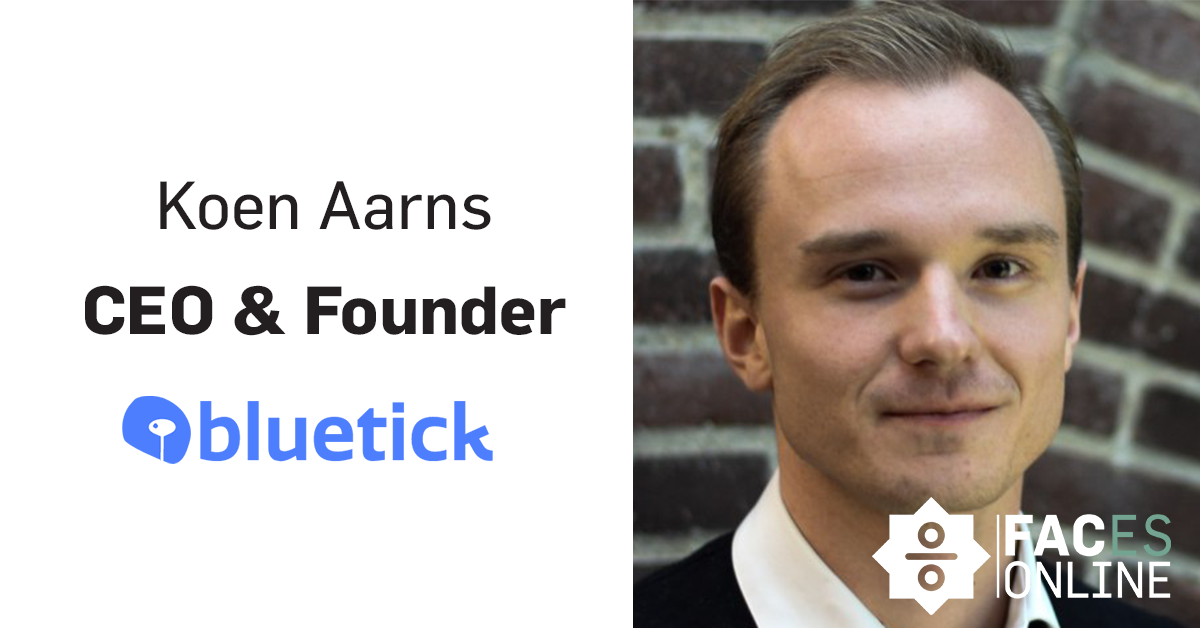
Interview with Koen Aarns – CEO of Bluetick
For the Dutch version, click here Can you tell me something about yourself? I did IBA in Tilburg as a bachelor’s student. From that course, it was quite difficult to make a choice for a Master’s degree. IBA is actually a very broad program, so you can go in any direction when you’re done. After graduating, I did a lot of research, with some help from the university, for my Master’s choice. Eventually, I found out that I wanted to trigger my brain a little more. After walking into JADS in Den Bosch once and seeing the ‘Data Science & Entrepreneurship’ program, I was convinced pretty quickly. It was a technically challenging study that was also very practical. It was always about creating value and solving problems, not just the techniques that exist. During my master’s I wanted to put my knowledge into practice even more, so then I made a list of companies where I would possibly like to try that. At the top of my list was KLM. Actually, KLM didn’t have any room for someone with my profile, but after a number of talks, they were able to place me as a working student in the Data Science department. This I did for a few days a week, and in the summer for a few months full time. Data science is not really an extension of IBA, how did you get into this? So I was kind of struggling with my master’s choice. At the time I was talking to a friend who had already done this course in Tilburg, and he explained to me what data science was exactly. The essence is that you teach a computer to recognize patterns in a dataset and to take those patterns to make a prediction about the future. I found that a very intriguing thought, that you could teach a computer something. In addition, I did see a future in Data Science, and I was always good at math and statistics, which is why I started to delve more into these courses. During your studies at JADS you founded Bluetick together with some other students, can you briefly tell us what exactly you guys do and how this group and company came about? During our master’s, we followed the course ‘Data Entrepreneurship in Action’. The goal of this course was to look for a real problem in our environment and see if we could develop a solution for this problem. Two requirements for our solution were: it had to be a Business-to-business solution, and it had to deal with textual artificial intelligence. We all found this interesting. This was also when I first came into contact with the legal world. The girlfriend of one of my Co-founders is a government lawyer, and she pointed us to the “search problem” as we actually always describe it. The four of us then started to solve this problem, to also approach it as if we were going to turn it into a ‘real’ business. “The Sprout trophy, for example, is right here in the middle of the office and should be visible.” During the trade itself, we were mainly validating our problem. We had a lot of conversations with lawyers and jurists to see what their work process looks like, and what problems they run into. At the same time, we put together a very rough prototype. At the time, I made that with a few lines of code. The main goal here was to see if it was possible for users to upload whole pieces of text as a search query, instead of a number of search terms. Then this should be able to be used as the starting point of the search. We then showed this prototype to a number of large law firms, asking if they would like to develop it with us. So you see, there really was an unsolved problem in the legal profession, as a number of large firms made their money and time available to work with us on our product. Do you think your software can also be used more broadly than just in the legal sector? We have experimented with other applications such as strategy consulting and news websites. Although the algorithm can technically be applied in these sectors, we decided to keep our focus on the legal sector. This sharp focus gives us a significant advantage over more general competitors. You guys have brought in substantial investments twice in the recent period. Can you tell me about this process and how you experienced it? It’s pretty much a full-time job raising money. For about 6 months I was working on this sometimes up to 40 hours a week. In such a financing round, the network is the most leading. We had the best click with the people we were introduced to by our network. It also helps a lot to tell the people around you that you are looking for money. For example, before the second financing round, I mentioned to someone at the UvA that we were looking for money, and through that person, we were then linked to an investor. You have been elected several times as the most promising entrepreneurs of the Netherlands. How does this recognition affect your team? I think it’s mainly a nice recognition of what we do. It is also necessary to keep the positive energy in the team. After all, in one day you have to deal with 10 setbacks, and then you may also celebrate a victory. The Sprout trophy, for example, is right here in the middle of the office and should be visible. If you ask our developers this question, they will probably emphasize that we must not become a company that only appears in the news, but then has little to add in terms of content. It is a balance that ensures that we have a good product on the one hand, and on the other hand use the

Choosing a Minor during the Bachelor Business Administration & IBA
For the Dutch version, click here The study Business Administration introduces you to many different facets of a business. The four pillars that the study mainly focuses on are accounting, finance, marketing, and management. However, this wide range of subjects can also result in students not seeing the wood for the trees anymore, as most of the time, not all the courses spark their interest. To prevent this, Tilburg University allows students to choose their own courses during their minor, in a direction that interests the student the most. This article explains the rationale behind students’ choices for both the Accountancy minor and the Finance minor at Tilburg University. Various options In the first semester of year 3, business economics and IBA students have various ways to fill their first term. You can go on exchange abroad to a partner university, do an internship or take a minor at Tilburg University. All these options have their own added value. In exchange, you develop certain independence and learn to cope in an unfamiliar, international environment. If you are curious about the business world and want to gain your first experience here early on, an internship may be the perfect opportunity for you. If these options do not appeal to you, there is the option of taking a minor at Tilburg University to complete several courses of your choice. For both Accountancy and Finance, the university has compiled a minor that focuses on one of these subjects. If a student is interested in more than one of these subjects, they can also choose to compose the minor themselves. Minor in Accounting The minor in accounting focuses on the “language of business”, the financial audit, and management accounting. During this minor, students take three courses: Auditing & Accounting Information Systems, Intermediate Financial Accounting, Intermediate Management Accounting. Bo Janssen chose this minor during her third year as a Business Administration student: “I always found the accounting-related courses given during the bachelor’s degree interesting and was curious whether I might want to do something with this later on.” According to Bo, the subjects that came along with this did make the field of Accountancy a bit clearer: “The minor consisted of three subjects, each covering a different topic within Accountancy. You get, just a bit more detailed than in the rest of the bachelor, a picture of what Accountancy is really about.”However, according to Bo, there were also some disadvantages about the minor: “I did find it difficult to judge from the theory of the minor alone whether I would actually like the profession of accountancy. Therefore, I think it’s good to discover what the field of Accountancy looks like in practice, to really experience where you could end up.” In addition to the three Accountancy courses, the minor does require the completion of the required 30 credits, which means choosing at least two additional courses. Bo did this with an eye to the future: “Because I was thinking of taking the master’s in Accountancy after my bachelor’s, I chose to take two deficiency courses in addition to the required minor courses. You have to pass these deficiency courses before you start the postmaster. That way I didn’t have to take them into account later in my studies.” Meanwhile, Bo has started the master Accountancy: “Now that I have started my master Accountancy, I notice that I encounter several things that I recognize from the Minor. Although you certainly don’t need the minor courses as a building block for the master, it is nice to see different concepts from the minor come back and be dealt with more extensively this time.” Minor in Finance The Finance minor dives deeper into the content of the courses Finance 1 and 2 of the IBA and Business Economics bachelor’s degree. The focus is on investments as well as valuing and assessing financial decision-making. Anne Kemps and Sjors Seinen both chose to follow this minor. Anne was mainly triggered by her interest in previous courses in the bachelor: “During the first two years, Finance interested me the most, but because the economical scope of the bachelor is very wide, I could only follow a few Finance courses. Therefore, I chose to follow courses from the minor in Finance so that I could get a better understanding of this subject, as this would enable me to decide whether I wanted to delve deeper into this field during my master’s.” The Finance minor also consists of three courses: Financial History and Intermediation, Financial Management, and Risk Management. Sjors was able to confirm his interest in Finance while following these courses: “Whereas Financial History and Intermediation was primarily focused on theory, the other two courses directed a great deal of attention to practical applications. After covering the basic concepts comprehensively during the first few weeks, I started to connect underlying principles and better understand financial markets than beforehand. As we dove deeper into the course material, I became increasingly interested: concepts such as asset-pricing models and derivatives motivated me to go beyond the teaching materials to find out more, which is something I had never done before. This spike in interest, primarily fuelled by Finance minor curriculum, led me to believe that Finance is my passion.” As for Anne, her interest in Finance was also confirmed, resulting in her choice to start the Master Finance: “In the Master Finance I now notice that the same topics are brought up again. You are not expected to know the subjects from the minor, nor are they specified as required subjects. It is therefore not necessary to take the minor if you want to start the master, but it already gives you a lot of insights into the subjects that will also be dealt with in the master.” All in all, as a business economics student in year three, you are given multiple options for the first semester. Besides broadening your horizons abroad or doing an internship at a company to gain practical experience, you

Interview with Roderick Munsters – Former CEO of Robeco
For the Dutch version, click here Roderick Munsters may not be a born but raised Brabander who studied at the University of Tilburg from 1981 to 1988. Besides following his MSc. Business Economics and the MSc. Finance at TIAS, Roderick was very active in his student days at T.S.C. St. Olof and Dispuut Kongsi. Currently, Roderick holds several supervisory positions at large international companies. He is married to Marjoanne Munsters and together they have two children, Mart and Milou. What were your plans right after graduating from Tilburg University? Did you know right away that you wanted to go into the financial world? At the start of my studies, I did not yet know in what sector I wanted to work. The jobs were not easy to come by then. I graduated in the investment subject of securitization, in which you make debt securities marketable. At the time, this was a very unknown subject in the Netherlands. I started my career at Esso Benelux in Breda. In retrospect, this did not quite fit with what I was looking for. Via Piet Duffhues of the university, I came into contact with Interpolis. I started there at the department fixed-interest value. At Interpolis, we applied a value arbitrage strategy that was very successful. Later, I became responsible for Interpolis’ capital markets department. In 1997, when I had been working at Interpolis for eight years, the entire investment business was transferred to Robeco. I then made the switch to PGGM and became Chief Investment Officer there. This was a nice step for me towards the pension world How did you experience the switch from insurance to a pension fund? I did not find the step from an insurer to a pension fund to be a huge one. I did find the step from departmental director to Board of Trustees a big one. I went from managing a team to managing an entire business unit. I was 33 at the time and therefore still relatively young, but I was lucky that PGGM CEO Dick de Beus took me under his wing. The main task as CIO at PGGM was to modernize the investment strategy and create more in-house management. We wanted to grow in portfolios with a link to real returns, such as private equity, commodities, and inflation-linked products. As PGGM (healthcare pension fund), we worked a lot with ABP/APG (government pension fund). It was a very exciting time, in which I was given a lot of room to excel with my whole team. After eight years at PGGM, I was asked to succeed Jean Frijns as CIO at APG. I enjoyed working here for five years, after which I was asked to become the CEO of Robeco Group. A common thread in my career is that the people around me have always been very important. At Robeco, for example, I had a very professional and outspoken chairman of the Supervisory Board alongside me in Dick Verbeek, from whom I learned a lot. A major challenge in my career was the sale of Robeco by Rabobank to Orix, a large Japanese financial services provider. For me, it was very important that Robeco, in the interest of both clients and employees, was sold as one company and that there would be no break-up. Fortunately, this also succeeded. Robeco is still doing well and has continued to grow because they have some good investment strategies. They have not grown further through mergers and acquisitions, which was Orix’s initial intention. I left Robeco two years after the sale. I then became CEO of French Edmond de Rothschild Asset Management. What was it like working for a French asset manager? It was very different working at Robeco, not so much because Edmond de Rothschild is French, but because it is a family business focused on managing French institutional money as well as the assets of wealthy families. It is a well-known name worldwide, so much of it is under a magnifying glass. My main intention was to have the investors of Edmond de Rothschild’s bank in Switzerland cooperate much more with the head office in Paris. This was eventually implemented. SRI is currently becoming an increasingly important factor in the investment world. How did you guys deal with this in the past? Is this in line with how it is now? From the end of the 1990s, I have been focusing on sustainability at both PGGM and APG and took the first steps to include sustainability as a criterion in investment decisions. Sustainable investment is becoming an increasingly relevant and well-known subject. There are actually two reasons for this. Society wants consumer money to be handled responsibly, but sustainability factors also have a major impact on a company’s financials. As a company, you can be fined for emissions and customers will turn away if, for example, child labor is used. This change also brings opportunities for companies, such as the new market for renewable energy. In practice, you also see that administrators are increasingly concerned with sustainable business, as also outlined in the Sustainable Development Goals of the United Nations. I personally think that the government could and should play a more active role in making the business community and financial sector even more sustainable, for example by pricing CO2 emissions. I expect that a business model based on sustainable entrepreneurship will emerge for many countries in the long term. The corona pandemic has drastically changed the way we work for over a year. How do you deal with this? It’s perfectly doable to work from home and most companies are now well equipped for it. I normally work abroad, so I save a lot of travel time. However, I also look forward to meeting people again. This brings energy, new ideas, and insights, from which you can learn a lot. Video conferencing is practical and this will definitely continue, but I hope and expect that many meetings will go back to physical. You have been a

Cryptocurrencies: currency or investment vehicle?
F0r the Dutch version, click here Many beginner and experienced investors either have a fortune in them, or have at least played with the idea of putting a fortune in them. Regulators have the greatest difficulty with them, while consumers are getting rich with them. For example, with 1 coin you could buy a pizza in 2011, and a Tesla in 2021. I am of course talking about cryptocurrencies, such as Bitcoin, Ethereum, and the most recent, Dogecoin. For more background on the growth of crypto and Bitcoin, I’d like to refer you to an earlier article that appeared on Faces-Online in 2019: “The Renaissance of Bitcoin.“ The innovation of cryptocurrencies lies in the fact that currencies exist and are emerging that are not dependent on traditional banks or financial institutions. This is good news for people who lost trust in these institutions after the financial crisis. However, the downside of this independence is that these cryptocurrencies are not yet accepted as a method of payment in many places. The willingness of large companies to accept crypto as a method of payment has grown in recent years, but is still very volatile due to, among other things, the volatility in the crypto market, the high transaction costs, and the lack of speed in the systems that process these transactions. “For example, only one well-known person needs to express his confidence in a crypto currency and the price immediately rises.” One of the great examples of this is Tesla. Elon Musk, a big supporter of crypto, announced in February 2021 that Tesla had purchased large amounts of Bitcoin and was planning to accept Bitcoin as a payment method. After this announcement, the value of Bitcoin increased substantially. Last week, Musk stated that Tesla would no longer accept Bitcoin as a payment method because its collection by “miners” would emit too much CO2. A tweet hinting that Tesla would have to sell all of its Bitcoin holdings caused the price to drop dramatically. The effects of a number of tweets on the price of a so-called “currency” also immediately shows the downside of a currency that is not dependent on traditional financial institutions. The price of crypto currencies is extremely volatile and thus makes large jumps in value on a daily basis. In the past month alone, the price of Bitcoin has dropped from €50,000EUR to €38,000EUR. A drop of a whopping 24%. If we put this next to the fluctuation of a traditional currency; the Euro versus the US Dollar for example, we see that in the same period, there is an increase from 1.20USD to 1.22USD about 1.6%. So the big problem is that the rate of crypto is not dependent on banks and the political situation in a country, as it often is with traditional currencies. The price of crypto is partly influenced by supply and demand. For example, only one well-known person needs to express his confidence in a crypto currency and the price immediately rises. A real substantiation of why this coin is worth so much at that moment is also often lacking, especially given the fact that there is no physical commodity behind crypto, like gold with traditional currencies. A nice comparison is the sudden interest of private investors in GameStop in 2021. There is little fundamental evidence to show that the price should rise, but due to the large numbers of individual investors driving up demand, it still increases. The same thing happens in my opinion with cryptocurrencies. This creates large peaks and deep valleys, instead of stability. And let that be the very thing we benefit from in payment instruments. The price differences are therefore unpredictable and large, making it virtually impossible to build long-term wealth with crypto, without spending too much time with it. This is also one of the traps of Crypto at the moment. To make the most of the value of crypto, you will need to be engaged with the market on a daily basis and continuously rearrange your portfolio to preserve your capital. Thus, in my opinion, the crypto currency market is nowhere near mature enough to function as a payment method. Because let’s face it, if the Euro lost a quarter of its value in one month, I wouldn’t have a bank account anymore, but a safe deposit box with gold.

What opportunities are there as a starter in the labor market?
For the Dutch version, click here A common problem you may run into; “You just graduated, now what? ”. This article discusses different options, through an overview and with the help of experts who have faced the same problem. I will tell you more about the considerations you can make and give tips on making a good decision. The world is developing at a rapid pace and tasks are increasingly performed by computers. In addition, the opportunities for newly graduated young professionals are also increasing. Some starters, without a clear direction, storm onto the job market. Others, on the other hand, follow a strategically mapped out path. With countless options, such as following an internship, a starter job, a traineeship, or a work-learning program (RA/RC), there are many options. Ultimately, there is only one aspect of the decision-making process that is really important: the decision must feel right to you. But what do you base it on? I have listed several points for you through various interviews. Internship After all, an internship, a less obvious choice is something you do during your studies, right? Of course, that is an option, but what if you skipped that step and still want to gain some extra experience. Or even more interesting; you know very well what type of job you are looking for, but don’t know yet at which company. You can then look at an internship, where you hand in part of your salary. For that amount you ‘buy’ a piece of flexibility, allowing you to sample and gain experience in several places. Piet-Heyn Goedhart completed his MSc. Finance in the summer of 2020. Despite his extra-curricular activities at De Kleine Consultant and other internships, it was not yet entirely clear to him which company he wanted to kick off his career at. Now working at a fast-growing strategy consulting firm in Amsterdam called Metyis, he briefly recounted the important points for him when choosing a job: “I knew for a while that I wanted to work as a strategy consultant. Now the question: where? In any case, the company had to have a working environment in which I could develop myself well. This meant that I was looking for a position where I would be continually challenged and would look up to colleagues. In addition, it was important to me that the firm had inspiring and large clients so that I got to know those companies as well. Finally, it was important to me that the average age was not too high and that I would have a good connection with my colleagues.” So, are you looking for a specific job, but do not yet know at which office. Then definitely consider an internship, because it gives you a good impression of different companies in a relatively short period of time. Work-based learning (CPA) As a (nearly) graduated MSc. Accountancy student, you have probably seen this option before. With a work-learn program, you develop yourself in a short time to a full-fledged accountant. During a period of 3 years, you will be challenged by following a university theoretical study, which in many cases is paid by the employer. In addition, you will work as an auditor and you will slowly become familiar with the audit field. A great advantage of this track is the tasting of different companies. For example, audits are carried out at large multinationals and regular SME companies, so you get a good picture of different companies and their activities during your work. Guido van Gerwen started his career with such a program at Deloitte. After following his studies (HBO Accountancy & MSc. Accountancy) he was convinced that audit was an interesting field for him and continued his path with an RA study. He briefly explains the most important points for him when looking for his first job: “On the one hand, I was looking for an ambitious organization in which I can develop myself well. On the other hand, I think it is important to have the right click with the people who work there”. If you are looking for a position where the title of ‘chartered accountant’ is a requirement, this is a very good option! “I’ve been able to orient myself well to work that suits me, gain a lot of substantive knowledge, and meet many new people!” Traineeship Whereas the work-based learning program is linked to a training institute, the traineeship is more focused on a ‘fit to purpose’ principle. This means that the training and courses are largely focused on professional knowledge and people skills. Think for example of courses in giving feedback, planning, or more of an update on new regulations. The main goal of a traineeship is to provide the new employees with a large set of skills in a short period, that you can use in the execution of their future management functions. An additional advantage of a traineeship is the rotation in roles. During the traineeship, you will be introduced to the organization in various locations, which enables you to build up a large network. During the last rotation, you will often have to rely on your network to get your next position after which you will be placed in the most suitable position for you in consultation with human resource management. After completing his MSc. Finance, Tom van Arendonk started as a Deals trainee at PriceWaterhouseCoopers (PWC). After his rotations, he now works for the Financial Restructuring Department and tells briefly about his motivations for choosing such a position. “When orienting myself, I was looking for a position where I could continue to feed my broad interest in Mergers & Acquisition. Through different rotations within a traineeship, you get a good look behind the scenes at what’s possible. In addition, you build a good relationship with your fellow trainees and this sociable aspect still appeal to me greatly! All in all, I am very happy with my choice. I’ve been able to orient myself well to work
