

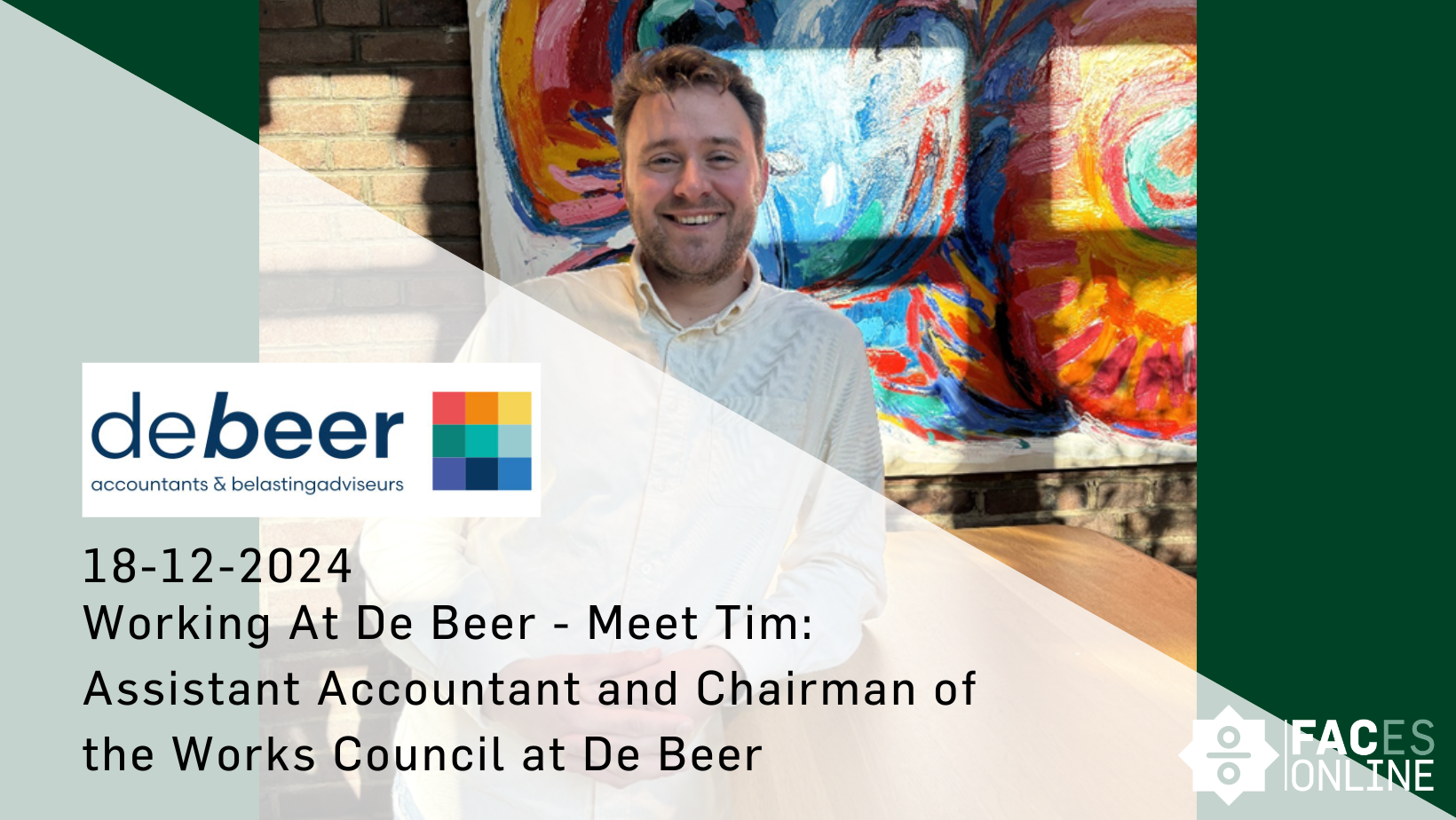
Tim Steketee (30) has been working at De Beer for a year and a half and will soon be moving into his new house in Hilvarenbeek, which he is currently renovating extensively. With his broad interests and energetic approach, he shares why he feels completely at home at De Beer and how he combines his role as Assistant Accountant with that of Chairman of the Works Council. What made you want to work at De Beer? “Through my hockey club in Hilvarenbeek, I had already heard many positive stories about De Beer. What immediately attracted me was the personal atmosphere and working in a smaller office. At my previous employer, the focus was mainly on growth, which didn’t quite fit what I was looking for. I particularly appreciate a work environment with short lines of communication and the freedom to find my own way. At De Beer, I really feel seen, both by colleagues and by clients. That personal and involved atmosphere makes a big difference for me.” How do you combine your work with your role in the Works Council? “Combining my work as an Assistant Accountant with my role as Chairman of the Works Council is going well. In my job, I am active daily in the Audit team, where I perform audits for various clients. I get enough time and space to contribute to the council and shape it further with my colleagues at De Beer. Although we are still in the start-up phase with the Works Council, the goal is to become an equal partner in discussions with management. We act as a link between employees and the board, ensuring that everyone has a voice. While many accountants are analytical and structured according to the DISC test, I belong more to the ‘red’ category: I am action-oriented and like to take the lead. This fits well with my role as chairman.” What do you like most about De Beer’s clients? “The client base at De Beer is really a breath of fresh air for me. The focus here is on local SMEs, mainly in Tilburg and the surrounding area. Most clients are within cycling distance, which creates an accessible atmosphere. At larger firms, you often work for big companies and only perform audits as an accountant. At De Beer, I can mean more and really support clients. This way, I add more value and work with clients who suit me well.” How do you experience the collaboration with your colleagues? “The collaboration here is good, especially thanks to the open culture. You can walk into anyone’s office, regardless of the team or your position. Within the Audit team, the lines of communication are short, and we are often on the same page, which makes collaboration efficient. You can easily switch with other departments, and if it gets too busy, you just say so. People really listen. Besides work, there are plenty of informal moments. Regular drinks are organized, and recently we went paddleboarding with the team. These activities make the atmosphere even more enjoyable.” What makes working at De Beer special for you? “At De Beer, I have a lot of freedom to divide my time between my Post-Master’s degree to become a Registered Accountant and the renovation of my house. Practical matters, such as working hours and the possibility to work from home, can be filled in flexibly. I greatly appreciate that flexibility and understanding of personal priorities. We work in small teams with experienced colleagues, so we continuously learn from each other. The culture is flat and open; you have all the space to find your own way and grow. If you have an idea or want to achieve something, you get the chance to explore and put it into practice. You are not just a number here and do more than just tick off tasks. That combination of an informal atmosphere and room for personal development makes De Beer special for me.”
Working at Wesselman
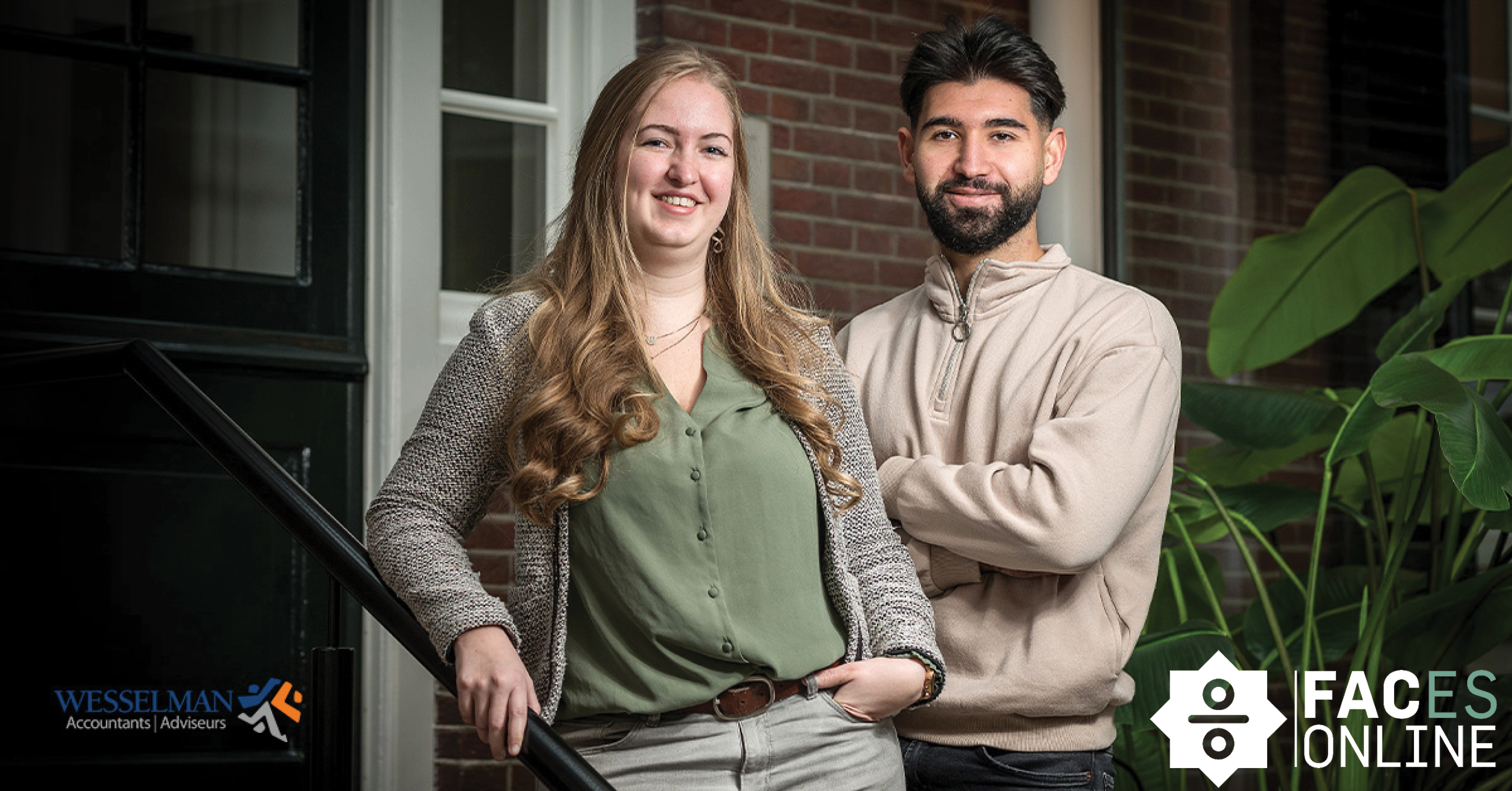
For the Dutch version, click here. “You get every opportunity to pursue your dreams.” Mithat Yucel combines his role as Assistant Accountant at Wesselman Accountants | Advisors with a Master’s degree in Accountancy & Controlling at Maastricht University. “A tough study, but Wesselman takes this into account – even during busy periods,” he says. Lotte Elsenaar sits down at ‘De Berk,’ one of the stately meeting rooms of the monumental building on the Aarle-Rixtelseweg in Helmond. She decided, after studying Tax Law & Economics, she also wanted to obtain her RA title. “That decision didn’t happen overnight,” she explains candidly. “A study requires a lot of time and energy, and I wanted to combine it with my job as an Assistant Accountant.” Essentially different According to the duo, this is what sets Wesselman apart from other firms. “At Wesselman, you are listened to as a person. You get every opportunity to pursue your dreams,” Mithat answers. Lotte and Mithat also appreciate the small gestures from Wesselman. “Just a little present, a gift with your birthday or a bunch of flowers when you buy a new house. Happiness is in small things,” adds Lotte. “We have lunch together with our colleagues every Thursday. Very nice to be able to catch up,” says Mithat. “Definitely! These lunches are always super well taken care of,” Lotte adds to him. “Every week it’s a treat! We have – apart from this weekly lunch – a control lunch with the team once every two months; all personal and business highlights and successes are discussed and celebrated then!” Making big steps Lotte and Mithat talk about GROW conversations, which focus on personal development. Together with your manager, you look back on the past period and determine your learning goals for the coming period. “You get to determine your own path,” says Mithat. Goals and expectations are also mapped out during the pre-audit meetings. Everyone gets to indicate his or her development points. “I have learned a lot with regard to mentoring juniors,” adds Lotte. “My supervisor gives me regular feedback. That feedback allows you to develop further.” Never the same Every client is different; there are different risks involved everywhere. “That’s what makes it so much fun,” Mithat explains enthusiastically. “I pick up certain posts, chart developments and work through to-do’s.” The basics are good. “We start the day with the team,” Lotte explains. “Very nice, because that way everyone knows what’s going on. Sometimes you work in the office, other times on location. A nice variety and the perfect opportunity to discuss important matters with the client. The role of Assistant Accountant is very diverse!” Wise counsel Still, there is one thing the pair would like to give students. “Make careful considerations,” Lotte replies. “Look carefully at which firm suits you and don’t underestimate the pressure – of working as well as studying.” Mithat nods in agreement. “In addition, it is also important to look into the educational possibilities. I study in Maastricht because for me that was a finer and especially more practical choice than Nyenrode. There is no right or wrong and you should mainly do what feels right for you.” Would you also like to work at Wesselman? Then contact Milou Kutscha at hrm@wesselman-info.nl or 0492-54 85 55. Who knows, maybe we’ll have a cup of coffee together soon.
Accounting Insight 2022: Looking back
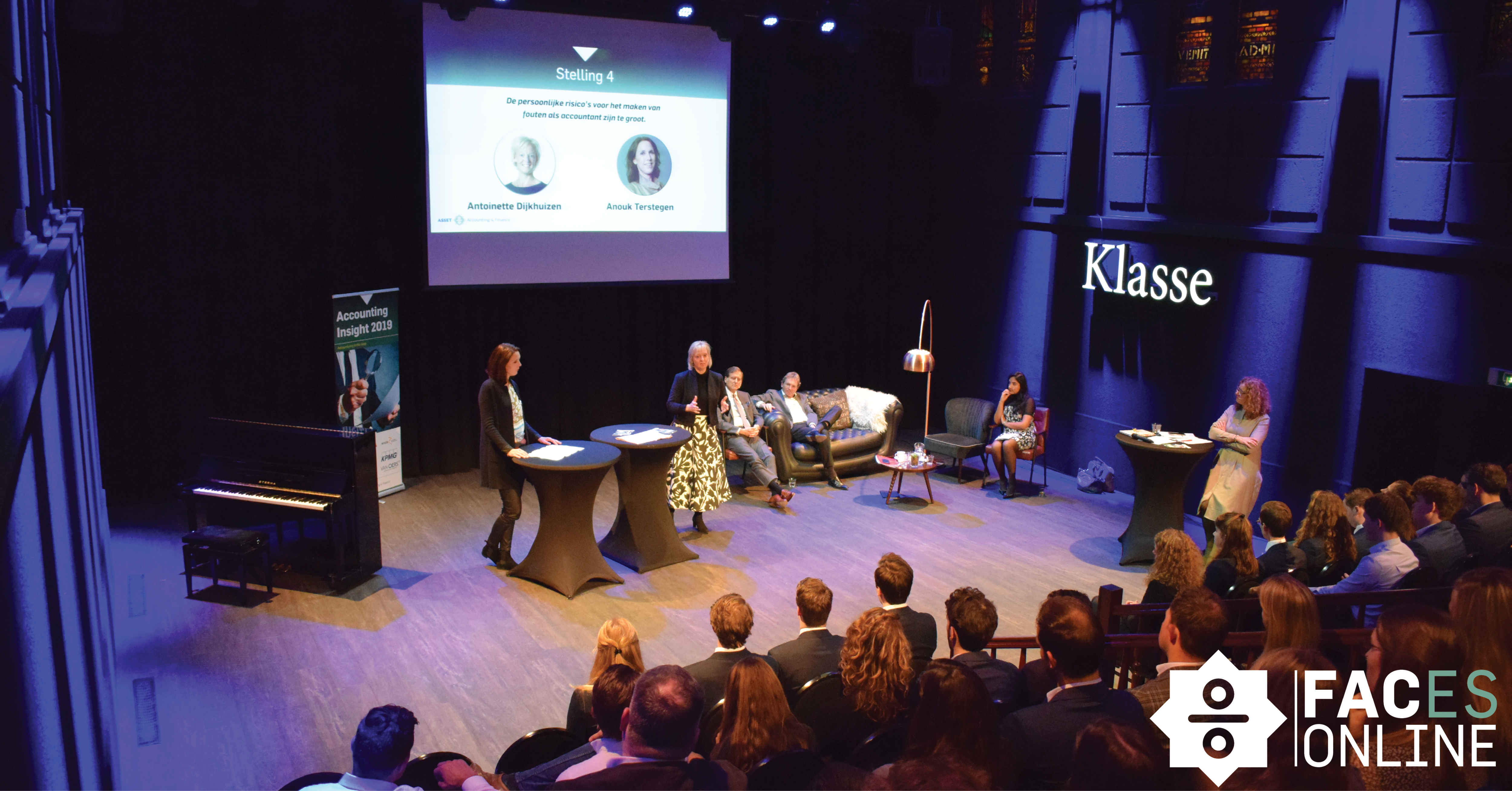
For the Dutch version, click here. On Wednesday, November 30, we were once again able to join the Class Theatre for the twenty-first edition of Accounting Insight. Starting at seven in the evening, the doors opened for guests. The guests, whether students, working professionals or professors, were able to meet here while enjoying a cup of coffee, tea or a soft drink. The themes of this evening were: Fraud, Data Analysis and Sustainability. After last year’s edition unfortunately could not take place due to measures, the themes were moved on to this year. Under the motto: ”Improve today to advance tomorrow” we asked our speakers to explain from the different themes how we can improve accountancy now, so that we can advance in the future. This edition was also the first edition of Accounting Insight to be held entirely in English. Fraud After the guests had half an hour to chat, it was time to enter the auditorium. With nearly one hundred guests, the room was quite full. After a word of welcome from the chairman of the committee, Bas Penders, and the introduction by the chairman of the day, Margreeth Kloppenburg, it was time for the first proposition: ”Auditors are not equipped with a critical mindset to detect fraud.” This proposition was explained by two speakers, Marianne van Kimmenade of the NBA and Don Raaijmakers of the AFM. Marianne has thirty years of experience at EY, having also been a partner there. After her brief retirement, she became a policy advisor on fraud at the NBA. Don Raaijmakers himself worked for fourteen years at KPMG, then five years at EY, where he was a college graduate of Marianne. After this, he has been working at the AFM as a team leader for fifteen years. Don and Marianne together came to the conclusion that auditors are sufficiently trained to detect fraud, but that the critical eye of especially young auditors is not used enough when conducting an audit. Therefore, they would like to see auditors take a critical look, and not let their biases be a factor in conducting an audit. Data analysis The second topic of the evening was Data Analysis, with the proposition: ”For a future accountant, it is better to study physics as opposed to business economics.” For this thesis, Theo-Jan Renkema and Ferdy van Beest were the speakers. Theo-Jan Renkema has worked at Rabobank for 24 years, currently as Chief Innovation and Technology Auditor, and is also a professor at Tilburg University. Ferdy van Beest has been working at Nyenrode Business University for seventeen years, where he is currently Associate Professor. He also works at Flynth as Director of Data Propositions and Integrated Reporting. So two experts in the field of Data Analysis. Theo-Jan Renkema argued that auditing uses more and more data and its analysis, so that in the future he indeed sees mathematicians as auditors, instead of business economists. Ferdy responded that yes, data is being used more and more, but that the auditor is a bridge between the audit and the business, requiring the human touch that business economists have. Together, the speakers agreed that business economics still remains important within Audit, but that there is going to be more and more specialization, with a lot of help from mathematicians. After this substantive discussion it was time for and break, during which guests could discuss afterwards while enjoying drinks and snacks Sustainability After the break, it was time for the third and final topic of the evening, Sustainability. The thesis of this theme was, ”The Chief Financial Officer (CFO) of the future is the Chief Value Officer.” Under this theme, Nicolette Loonen and Ferdy van Beest discussed. Ferdy van Beest has already been introduced at the previous theme. Nicolette Loonen worked at KPMG for 15 years, after which she held all different jobs. She is a co-founder of Tribe of Sustainability Change Agents (TOSCA). The discussion began with Nicolette explaining that the CFO needs to change to the CVO, because there is a need to look more at the long term, and then also how to do business responsibly. Ferdy disagreed, because he thinks that the duties of a CFO are going to be different in the future, and this includes a long-term view. He doesn’t think the position should be renamed for this. In the end, the speakers agreed that the CFO should think about the long-term vision of a company, but the disagreement was mainly in the name of the position. Business Market After another great edition of Accounting Insight, the speakers and partners were thanked by the chairman of the committee, and the chairman of the day closed. After this the guests could have a drink at the company market, where KPMG, EY, PwC and ABAB had set up a stand, all our other partners were fortunately also present. While enjoying a beer, soda, and plenty of snacks, the participants were able to get to know each other, or their future employer, for a while. Also inspired by my story and would you like to be the person responsible for Accounting Insight 2023? Then quickly become an active member at Asset | Accounting & Finance. You can sign up via: Info@Asset-AccountingFinance.nl
Working at PWC
For the Dutch version, click here. The image of a boring accountant, dressed in a suit with a calculator in their hand, is outdated. Liselotte de Zoete is keen to explain why her profession is so fascinating and far from boring. She discovered her interest in accountancy during her Economics and Business Administration studies. After which she followed a business course at PwC and was hooked. Sharing my opinion “Before I started studying, people sometimes told me I should become a politician. I have opinions on everything and I really want to make an impact. I didn’t become a politician, but I still like to share my opinion. I do this as a senior associate and recently also as chairman of the works council. A nice combination that challenges me to get the maximum out of myself in different areas. As a senior associate within Financial Services, I advise clients on how to achieve their goals in a responsible manner. On the other hand, as chairman of the works council, I focus on PwC’s own policy. In both roles, I am very much involved in gathering and sharing knowledge. As a senior associate, I work in multidisciplinary teams with various specialists. For example in the field of digitalization and data analysis. That results in a nice interaction in terms of knowledge sharing, from which I in turn also learn a lot.” Focus on opportunities and possibilities “PwC employs people with many different backgrounds and talents. That inclusive culture and open work atmosphere immediately appealed to me. I have adhd and am dyslexic. This is no problem at all at PwC. In fact, there is even a diversity network for PwC employees with work challenges. Within this Ability network the focus is not on limitations but on opportunities and possibilities. At the time, I was therefore pleased to be able to do my graduation internship here. It was a nice way to get to know the organization and the audit and accountancy practice better. I discovered that I liked the field of Financial Services within the Assurance business unit best. So it was very nice that I could start working within this team immediately after graduating.” “The world in general, the world of our clients and that of PwC is constantly changing. So it makes sense to move with that and keep developing yourself.” A large training center “PwC is, in a sense, one big training center. The world in general, the world of our clients and that of PwC is constantly changing. So it makes sense to move with it and continue to develop yourself. There are plenty of opportunities to do so. You can follow courses and training programmes and you have access to a worldwide network of professionals with whom you can share knowledge, experience and ideas. When I indicated that I wanted to stand for election to the works council, I was given every opportunity to do so. I had good talks about it with our management team. They thought along with me in a positive and constructive way about how to fulfil this role alongside my work as senior associate. This has worked out well. So good, in fact, that I have been able to make great strides in both areas. The presidency has brought me much and is an immense learning experience. In addition, I will soon grow into the role of manager within my accountancy work, where I am the pivot between management and execution.” A pleasant working environment for everyone “Within the OR, we are committed to a pleasant working environment for all employees. We also maintain an open dialogue with the management about company policy and employee interests. This can be about anything. For example, we have made a case for flexible working hours and a personal well-being budget for each employee. In this way we ensure a good work-life balance. What about my own work-life balance? In terms of audits, the winter period is a busy time, when my work really comes first. As soon as the sun shines more often again you can find me on the field hockey field in my spare time. I also love cooking, good food, reading, traveling and of course my dog Saskia.”
Interview with Patrick van Zwieten – Ambassador for the NBA
For the Dutch version, click here Patrick van Zwieten is Senior Accountant at BDO and also an ambassador for the NBA. In this interview he talks about his experiences in the accountancy profession, the importance of the NBA and gives his vision on the future within Accountancy. Can you tell us something about yourself? My name is Patrick van Zwieten and I have been working in the field of Accountancy for four and a half years now. I have a higher vocational education background, after which I followed the part-time master’s program at the University of Amsterdam. Within BDO, I work in the Audit & Assurance department where I primarily serve clients in the corperate segment. Why did you choose Accountancy? I found this a very difficult choice at first. I initially worked at ABN AMRO in the investment department for a while. This was more finance-related and that’s why I actually wanted to do a master’s in finance. I then decided to look around for more information by, among other things, taking part in various trial days at accountancy firms. I discovered that I didn’t really know what accountancy entailed and after the trial days I realized that I had a completely different idea of what accountancy actually entailed. The profession requires analytical skills, but also social skills and you have to be able to deal with deadlines. After this, I finally made the choice to go in this direction. What are the biggest differences between Finance and Accountancy? If I compare it to the RA audit practice in Accountancy, we have a project every five to six weeks and we visit the client. This concerns the audit of the financial statements and we speak to all layers of employees within the organization. This makes it very diverse and fun, something that is less applicable in Finance. In addition, you see many different companies, for example, last week I was at the office of a pharmaceutical company and next week I will visit a large clothing retailer. What does an average accountant’s work week look like? Actually, every week is different. It also varies a lot what function you have within the office. If you are just starting out, then you will often be working on an executive level. After a year or two or three, you often get more responsibility and start supporting and guiding starters. The longer you work in the company, the more you are allowed to lead the smaller teams and act as manager, while with the larger clients you still mainly have the executive task. This ensures a good balance. Besides the ‘standard’ work at BDO, we sometimes have a padel tournament with the office. This ensures that we can also meet up outside of work hours and build up a good relationship with colleagues. In addition, we are actually at the client’s office every working day. The audit consists of two parts: the interim part and the year-end part. During the interim part, we visit the client to gain knowledge of the client and the company’s process in order to analyze risks, but also to find points of departure for our audit. In the second year, which often starts around January, we really look at the figures. Using various techniques, we then check whether the annual accounts are actually correct. How has combining work and study worked out for you? In the beginning I found it quite hard. I started working full-time and also had a part-time master’s degree to complete. Especially in the first year I was searching for the right planning. I noticed that over time I could find my feet and things went better. This was also because everyone around me was going through the same process, both my colleagues and my fellow students. The office also helped me a lot, we get an extra day off before exams and we can ask for help if we find a course difficult. What are the opportunities after getting your master’s in accountancy? I think there are many possibilities once you have your degree. In the path of RA, you could grow within the office to partner, but in addition you also see that someone with an RA title is popular in the business, you are then Accountant in Business (AIB). This is for example in large companies to work in the finance department. Another possibility is to become CEO or CFO. So outside of the accountancy field, it offers a huge amount of opportunities in the job market. Can you tell us a little bit about NBA? The NBA is the Dutch Professional Organization of Accountants. There are over 22,000 registered accountants in the Netherlands today. These are both Chartered Accountants (RA) and Accounting Consultants (AA). They are all listed in the NBA register. This organization promotes the professional practice of accountants. They do this by drawing up rules of conduct, testing the knowledge of accountants and providing education. At the end of the practical training, there is a final exam that tests whether you are capable of acting as a starting professional practitioner. However, before that happens, you must first complete your theoretical training as a Chartered Accountant before you can complete the practical training as a Chartered Accountant. What is the role of the NBA within the field of Accountancy? The NBA plays a big role. On the one hand, it is the NBA’s job to monitor us and check whether the firms are meeting the quality requirements. But in addition to that, the NBA is in talks with the Ministry to draw up an accountant protocol. The offices will then be presented with guidelines with which they can check whether, for example, last year’s NOW scheme was rightly obtained. What does the NBA ambassadorship entail? There is a fair amount of shortage on the labor market within Accountancy and through the NBA ambassadorship they want to try and give a better insight into the profession of accountant
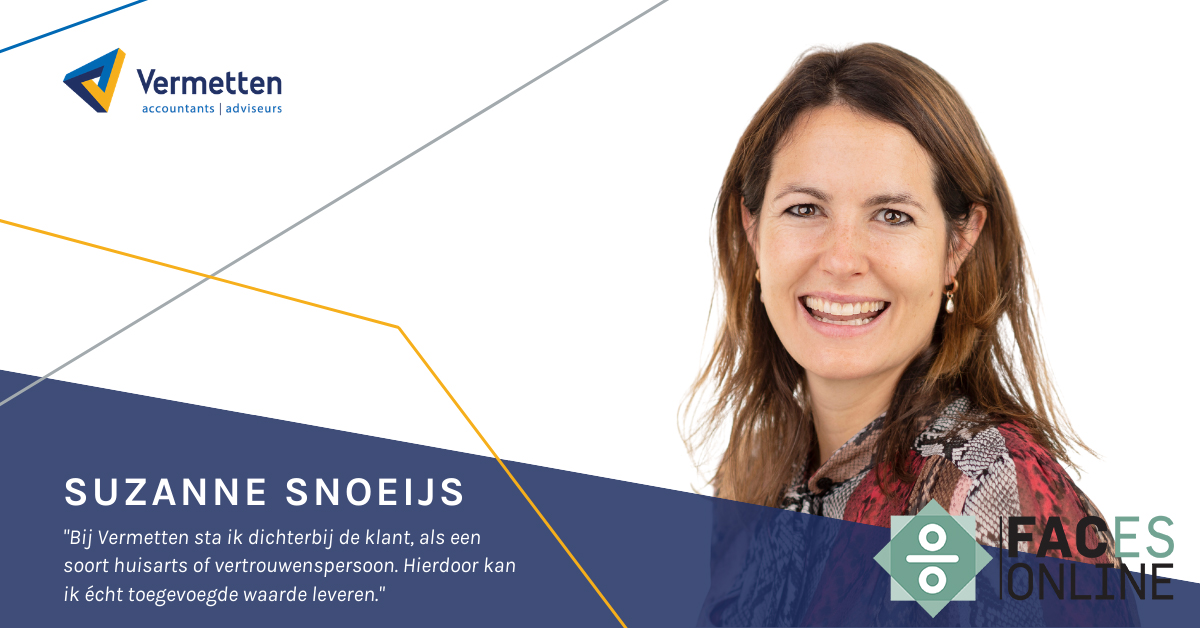
Working at Vermetten
For the Dutch version, click here Suzanne Snoeijs was a member of FST about 15 years ago, now better known as Asset | Accounting & Finance, where she organized the StudyTour to Boston at the time. She studied Master Accountancy at Tilburg University and is now employed at Vermetten. Can you tell us something more about yourself? I used to study at Tilburg University, where I did the bachelor Business Economics and then the master Accountancy. I was a member of FST at the time and organized the StudyTour to Boston. I have always enjoyed my time with FST and have good memories of it. After my master’s I started working at PwC. I started at the Breda office, where I worked for four years. Then I switched to the Rotterdam office, where I worked for another four years. I was able to gain more experience in Rotterdam because that’s where the larger clients were and where the IT Audit department was located. After eight years I made the switch to a smaller office. I first worked at Witlox for a year and then switched to Vermetten, where I have been working for about six years now and will soon become a partner. What is the difference between a large and small office? At Vermetten I am closer to the client. In Accountancy, it is difficult to provide added value. If the relationship with your client is good, you can deliver this much better and you also get more satisfaction from it. You are more like a doctor than a confidant of the client, which means you get completely different questions than just about the audit of the annual accounts. Sometimes people just want to talk about something and tell their story. Clients then give me a call, even though I can’t always help them. At the larger offices, you are forced into a kind of checklist culture. I like to audit based on common sense because I think you can then do a much better quality audit. Why did you start at PwC and, if you could do it over, would you make the same choice? I wanted to learn a lot, so a Big 4 firm was my preference. I had been to Barcelona with PwC. The people at PwC and the culture suited me, so choosing PwC was easy. The training program at PwC is fantastic and you start with a large group of people, which is different at smaller firms. You also learn a lot on the job. Smaller firms have smaller clients and you can often get to know them from the beginning, front to back. The learning curve at a smaller firm is, therefore, in my opinion, somewhat steeper. So it just depends on what suits you as a person. “You are more like a doctor than a confidant of the client, which means you get completely different questions than just about the audit of the annual accounts.” Can you tell us a little bit more about Vermetten? John started about 25 years ago on his own. When I started at Vermetten 6 years ago, about 35 people were working in 2 locations. This makes you have a very different culture. You don’t have a consultation structure where 20 people have to be involved in the decision-making. In recent years many other branches have joined. At the moment we have about 200 people spread over 7 branches. This means that we are entering a new phase in terms of structure. This includes a partner structure, so this year 8 new partners will join. These are all people who already have a certain responsibility and will grow in their function. We also work with a team of 15 people on the audit. The nice thing about the team size is that we all know each other very well. Another nice thing is that it is not as hierarchical as I was used to. We help each other when necessary and socializing is crucial to do the job well. We have a relatively young team. The majority are between 20 and 35 years old. We have many different types of clients and do anything that is not too difficult. So we don’t do hospitals and municipalities, because you need industry-specific knowledge for that. Furthermore, we mainly have smaller production and profit companies in our portfolio, as they are highly represented in this region. Besides the audit team, we have many other teams, offering any service which an SME needs. Here you can think of: corporate finance, tax, human resources, compilation, salary, and legal. We want to be able to answer any question a client might have. What is your future perspective? Many students, clients, and other people do not yet know us very well. We would like to continue to grow as an organization because if you grow you also have a good development perspective for new talents. Ultimately, we want to become the best office in Brabant. Furthermore, our strategy is to remain active in the region and focus on Brabant. This is also where the bulk of our portfolio is located. How do you experience corona time? I work at home as much as possible. We try to limit contacts at the office and with customers. Sometimes this is difficult, especially if we have to count the stock, then we do have to visit the customer. Furthermore, not everyone must get overworked. We have a team meeting every week where we discuss the progress and see if we are still on schedule. I find it important to clear my head once in a while, which I do by going for a walk outside, playing tennis a few times a week, making large jigsaw puzzles, or coloring by number, among other things. Everyone is in the same situation and yes, sometimes you hear a dinosaur cry, but that has its charms too. Why did you choose Accountancy and do you have any other tips
