


For the Dutch version, click here. The venture capital (VC) industry is an exciting and fast-growing field that provides individuals with the opportunity to make an impact in the business world, which can be highly rewarding if you’re willing to put in the work. If you’re looking to break into the VC industry, you’ll need to demonstrate a combination of skills and knowledge that can be developed through a variety of avenues. This article will provide a comprehensive guide on how to start your career in venture capital and the skills you need to succeed. 1. Develop Your Knowledge of the Industry The VC industry is a complex environment, and it’s important to have a detailed understanding of the industry before you jump into it. You will have to have a thorough understanding of how VC funds add value, how VC investments are structured, and the different stages of the venture capital cycle. Additionally, it’s important to understand the regulations and legalities of the venture capital industry, as you will need to know the boundaries you are required to operate in. In order to develop your understanding of the VC industry, you could best read industry publications and blogs by leading VC funds, attend conferences and seminars (for example from the NVP), and network with other professionals in the industry. 2. Develop Your Analytical Skills A major part of a venture capitalist’s job is to conduct due diligence and financial analysis on potential investments. First, it’s important to have the ability to assess a company from a financial perspective. Here, you have to be able to determine the valuation of the company with limited information, understand how the investment will create value in the future, and be able to evaluate whether the financial forecasts of the company make sense. Next to this, you also have to be able to analyze the market to understand how the company compares to its competition, how the market is segmented, and to be able to evaluate its product/service positioning. To develop your financial skillset, you should dive into some finance and accounting books and articles, take economics and financial analysis classes, and practice analysing financial statements. For market analysis skills, you’ll have to do the same things, read up on the topic, take classes, and practice. 3. Develop Your Network Having a strong network within the VC industry is essential to finding the best deals and staying abreast of the latest trends. Networking is in essence talking to people, but finding the right people is easy said than done, so here are a few tips: Attend networking events, join industry associations, connect with professionals on social media platforms like LinkedIn, and ask for introductions from people you already know. If you show a willingness to learn and a genuine interest in the people you reach out to, you’ll be amazed by their willingness to help you out. 4. Develop Your Negotiation Skills Venture capitalists need to be skilled in sales and negotiation to be successful. In the end, the valuation of a company and all other terms in the deal come down to the negotiations between the VC fund and the company. When it comes down to negotiations within venture capital, you need to know where the other party is coming from. While it may seem that a VC investment is purely financial, for the founders of the company that you are investing in, a lot of emotions are at play. It is therefore important to understand that venture capital is a people’s business, where building long-term relationships is essential. Being able to explain why certain terms are included in a deal and being able to defend your valuation of their fund without offending them is key to making a deal go smoothly. While you could develop these skills by practising presenting, you can only truly learn these skills through experience, which brings us to our last point. 5. Get Experience Gaining experience tops all other points in the VC industry. There are two ways you can go about this. The first one is the long way around, namely starting and becoming successful with your own company with VC backing. This will essentially give you a ticket into the VC industry as then you will already have almost all the skills needed, but this way is not for the people who want to go directly into the venture capital industry. If you want to immediately start in the VC industry, you can start by doing an internship at a venture capital fund, become part of a student VC fund or start working as an analyst at a venture capital firm. If you’re not able to start this way, you can also work for startups and get involved in the entrepreneurial community. By following these steps, you can lay the foundation for a successful career in venture capital. Developing a career in venture capital is no easy feat, but with hard work, dedication, and a willingness to take risks, it can be a rewarding and lucrative path. By gaining experience, building a strong network of contacts, staying educated on the industry, and staying up to date on industry news, you can set yourself up for success in the venture capital world. Good luck!

Who are you and what is your position at KPMG? I am Ester Louwers, 46 years old and I have been working at KPMG all my life. After my studies I started at the Eindhoven office as an audit trainee and I am now a partner at the Eindhoven office, also in audit. My clients are mainly the Dutch branches of American companies. These can be private, but also listed companies. In listed companies we also have to deal with the SEC and stock frameworks, so in that capacity I also have the US accreditation. With us, that means you have to have more specialist knowledge to be allowed to do that kind of audit. In addition, I am also responsible for HR in our office. We have 110 employees on the audit that I am responsible for in terms of HR…. In addition, I also have to make sure that our talents stay with us. This gives me a lot of energy and I really enjoy it. I am also married, live in Eindhoven and have two children. I also like to make music, I try to play the guitar. And I try to do sports, I run and spin. I also spend a lot of time with the children and every now and then I go out for a drink or a bite to eat with friends. Besides Eindhoven I also worked in Madrid for 2 years. I was a young manager and wanted to spread my wings. I had a big client in the Netherlands who was also active in Spain, they could use some help. I moved to Spain with my husband and we lived there for 2 years. It was a really nice time over there. Why did you choose KPMG then, and not a small firm? I’ve always had trouble making a very specific choice. Working at a Big Four gave the opportunity to study further, think of getting the post master. Working at a large international firm also gave me the opportunity to go abroad, which becomes difficult at a smaller firm. If you start at a large firm, you have somewhat broader possibilities. It does have to suit you a bit, I was extremely driven, ambitious and wanted to see something of the world. Then I think a bigger firm suits you better. When I look at the clients we have, we at KPMG are very diverse. For example, we have the larger SME companies, such as Bavaria and Van Haren shoes. We also have companies that often operate internationally and are listed on the stock exchange. Examples are ASML and DSM. But we also do start-ups like Lightyear. We also have non-profit organizations as clients, such as universities, colleges and the healthcare sector. “We put the human factor on one” Why KPMG and no other Big Four firm? During my studies, I did my homework. I also participated in business courses and in-house days at Deloitte and PwC. Nice firms, but conversations at KPMG felt just a bit different to me. Mainly go talk to the companies, participate in activities that are organized and see where you feel most at home. What distinguishes KPMG the most is that we (KPMG) are a human company, we put the human factor on one. You always have to be open and honest, of course we are a professional company where we really expect something from our people and if people don’t meet that, you as a company have to be open and honest and give feedback. But this is always done in a respectful way. What can happen is that you notice that someone is not quite in his or her place and that perhaps KPMG is no longer the best employer for that person. We start a conversation with this person and try to find out together what really suits him/her and we really offer some guidance in this. We do not drop anyone, we will not fire someone who does not meet our expectations. We always lead someone to a new job. With that, our human factor is paramount. So you’re not a ‘number’ at a Big Four firm? No, absolutely not. Sure, we have an employee number, but you always have to deal with the people you work with in your office. They also assess you and you have conversations with them about your development. They also look at what is best for you. In general, what are your daily activities? I take the kids to school several times a week. Then I leave for work, either to clients, the office or just at home. We always start the day with our daily’s, which are short meetings with the team where we discuss what our objectives are for the period we are monitoring. Then the team knows what the objectives are and what they can work on. After that, I have a number of meetings with the team, clients, specialists on specific topics and also talks with employees from my HR role. We have four offices within our region and run KPMG in the region south from a regional perspective. So you have regular contact with HR partners at the other offices as well. I also have lunch with my team or with clients. In the evening I go home again, have dinner with the family and then possibly sports. So it’s very varied. Is the work pressure high at KPMG? At KPMG we have set up a work-life balance project. That is about finding the right balance. Large offices are known for high work pressure with a lot of overtime. So what we have done are those dailys to discuss with the team how we are going to work together. This is also where we discuss when we might work overtime. This way everyone knows far in advance when overtime might be needed. It’s not the case that you never have to work overtime at KPMG; it’s part of the
Working at Van Oers
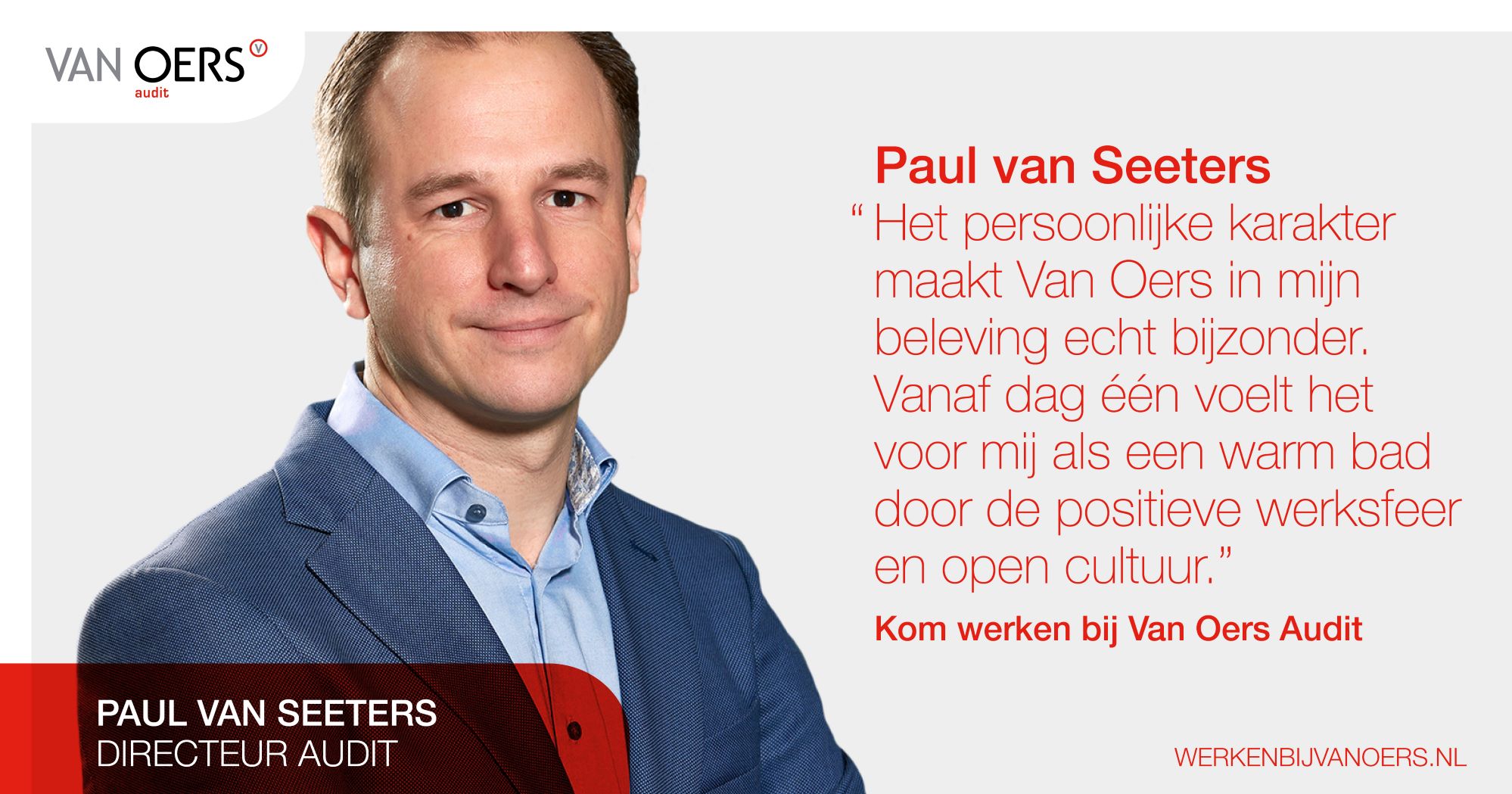
Paul van Seeters has worked at Van Oers as Audit Director since May 2021. From day one, Van Oers feels like a warm bath to him. An interview about working at Van Oers, but first more about the link with Tilburg University and with Asset. Did you study at Tilburg University yourself? I did not spend my student years there, but I did follow the post-master’s course ‘Business succession for family businesses’. Before that, I studied at the Erasmus School of Accounting & Assurance (practical training as a Chartered Accountant) and at Nyenrode University (master’s plus post-master’s in Accountancy). I also laid my foundation for Accountancy at Avans University of Applied Sciences. Van Oers is investing heavily in its relationship with Tilburg University. How does Van Oers invest in the relationship with Tilburg University and Asset? You can meet us at Asset’s career events. We have also been participating for some time in Asset’s section, Faces Online. And in our audit team – currently about 80 people – there are several working students from Tilburg University. In combination with their studies, they work at least two days a week with us in the audit team. The nice thing is that this way they can get a taste of what it is like to work for Van Oers and the pleasant atmosphere at Audit. This summer, several work students are also in the project team for the NOW grants. We are going to do all the checks on the NOW subsidies in one go. In this way, we are ahead of the deadline later in the year. Moreover, this year we have associated ourselves with the Tilburg University Challenge. We will be present at the speed dates and provide an in-house day, but what we will mainly be doing is supporting students with their innovative case. That fits well with the innovative character of Van Oers. Would you like to tell us more about Van Oers and its innovative character? First something about Van Oers in general, because Van Oers might not be the first office that comes to mind as a university student. After all, we are not one of the Big Four firms. Incidentally, I myself worked for many years – with great pleasure – at one of the Big Four, at PwC. It was not until 2021 that I made the switch to Van Oers. Van Oers is one of the larger regional accountancy and tax consultancy firms in the Netherlands. We have about 400 employees. We are big enough to take on challenging issues but with personal attention for clients and employees. The personal character makes Van Oers truly special in my experience. From day one, the positive work atmosphere and open culture have made it feel like a warm bath for me. Our Audit team works entirely from Breda, but we also have branches in Oosterhout, Roosendaal, Etten-Leur and Zundert. Within Audit, I am the innovation driver, think of the use of data analysis and dashboards. If you look at the way in which Van Oers has embraced the New World of Work, then that is also innovative. What does the New way of working look like at Van Oers? In consultation with their team, all employees can opt for their own mix of working from home, working in the office and working at customers. Everything is well organised in terms of system and employment conditions. Every employee gets a nice budget at Coolblue for setting up his own home office. Where you see that many other larger offices are still struggling with the design of the new way of working, it has already been arranged at Van Oers. That has to do with the agility of our organisation. Of course, the new way of working requires good team arrangements. What helps here is that every employee already has an (internal) coach. Co-ordination and coaching are part of the culture. In addition, within Audit we work with a coach per assignment. Giving and receiving feedback is organised via a feedback tool. That is a perfect tool for self-development. The Van Oers University also contributes to this. “Don’t wait and see, but get to work!” When you start in the audit team, where do you start? You start in a staff position and are part of an audit team. That means that you go directly to customers. These are family businesses and private equity firms that are subject to audit. That is, by the way, the great thing about working for Audit. You get the chance to look behind the scenes of so many different companies. Nothing is more fun than getting a tour of the company at the start of an assignment for a new client. I still like that very much. Then the figures really come to life. Anyone starting in the audit team follows the theoretical post-master’s course on Fridays to become an RA. What is a hot topic in Audit? Within audit, we are increasingly confronted with the theme of sustainability and report on what companies do in that area. This requires different competences of accountants. Our clients are the first to be confronted with stricter regulations in this area. Sustainability is also an important theme at Van Oers. We are working on making our premises more energy efficient, thinking about how to deal with mobility and are actively involved in the welfare and vitality of our employees. This also includes attention to our social involvement. For us, just like for other companies, this is a search. That is why it was extra nice to organise a knowledge session on this subject recently with one of our clients – construction and developer Maas-Jacobs. Typical Van Oers: don’t wait but take action! Is that what you want to teach students? What I mainly want to pass on is: follow your instincts. At the moment, young talent is in demand. So choose an organisation where you feel comfortable. Do you find warm personal contact
Working at Vermetten
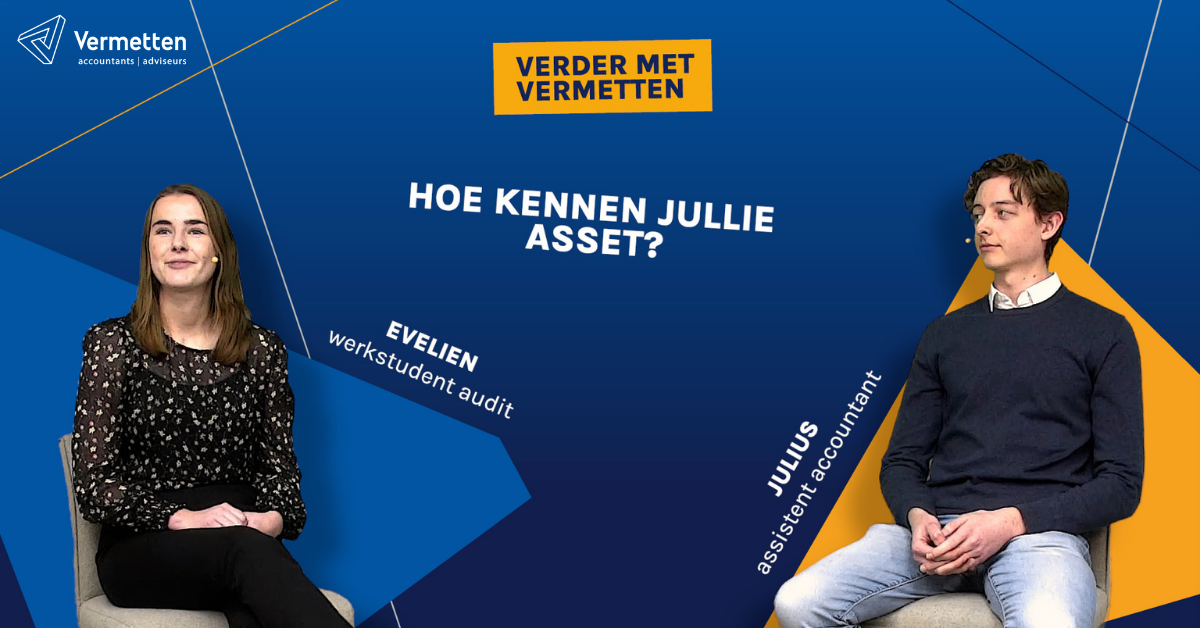
Working in the controlling practice at Vermetten. What is it like? Evelien (working student) and Julius (assistant accountant) tell you all about it. From the close relationship with your audit colleagues to being allowed to go and see customers straight away. And much more!

Working at EY
For the Dutch version, click here Vitality is a theme that is often put high on the agenda within large organizations, but where people do not always have a clear picture of the concept. EY is one such firm where, alongside Tech, Diversity & Inclusiveness and Corporate Responsibility, Vitality is referred to as one of the four main focus points and where personal career development is central. We talked to Marieke Brouwers to find out how this theme manifests itself in practice. Marieke Brouwers is Manager Audit at EY, but in November she also won the World Championship Duathlon! After 10 kilometers of running, 40 kilometers of cycling, and another 5 kilometers of running, she was not only the fastest of her age group but also the fastest overall. She traveled to Aviles (Spain) with the motto ‘participating in a World Championship is more important than winning’ and eventually took home the title of “World Champion”. Something that had not even occurred to her beforehand. Could you briefly share a bit about your career path and your current position within EY? In 2014 I completed my Master’s in Accountancy at Tilburg University and then started at EY Eindhoven in September. In the meantime, I have also obtained my Post-Master (RA) and I am a manager in the audit practice. During my first years, I served many different clients and gained experience in different sectors. In 2018 I worked in Tokyo for EY for six months, which was a hugely cool experience! Currently, I am working in the Amsterdam office where the biggest client in my client portfolio is one of the clients I served in Tokyo. How do you manage to combine this busy job with everything else you do besides work? One of the sayings I often make is “time, is priority”. I really enjoy exercising and find that it makes me a better person. If I didn’t prioritize sports, I’m sure it wouldn’t benefit my performance at work. Especially in busy moments, I find it very important and nice to clear my head by exercising. Despite having a busy job, in my opinion, there is no such thing as a large number of hours in the week that you can arrange yourself. There are colleagues who find it relaxing to then sleep in, “Netflix” or have a family that they invest a lot of time in but draw energy from. I live with my boyfriend, have a rich social life, and a busy job but I can arrange my own time in such a way that I do exactly the things that I need and get energy from. Sports is one of them. What does a day in your life look like? Actually, there is not really a standard day in my life. I train about 15 hours a week according to a schedule that I get from my coach. Each day is then indicated what I should do, which can vary from running to cycling to swimming or strength but also a combination of the aforementioned sports is quite possible. I always get this schedule on Thursday or Friday for the next week. However, I can indicate in advance if training on a particular day is not feasible because, for example, there are deadlines for work or client appointments outside the door. Also for work, I know what needs to be done each week. Based on this, I plan my week on Friday with a combination of work and sports. Of course, this is not set in stone but it gives me peace of mind that I basically don’t have to think about it anymore. “Within an organization like EY everything is possible, as long as you communicate clearly about it and indicate what you need.” Today, for example, I was at the gym at 7, was showered, and sat behind the laptop at 8:30. I will go for an hour run as soon as it gets dark and have to answer some emails after dinner. Tomorrow I go to the office and there is a 2-hour bike ride scheduled as training. So then I’ll try to get to the office nice and early so I’m not home too late to eat, let that sink in, and then get on the Tacx (indoor bike) to do my workout. What does the theme of ‘vitality in the workplace’ mean to you? In my opinion, vitality in the workplace is the right balance between work and other things that are important to you. Personally, I get a lot of energy from my work, but if I only worked that would no longer be the case. The balance you need between work and home is, in my opinion, important to be a happy person. Only when you are happy and pleased with yourself can you get the best out of yourself and others. So when my colleagues have found this right balance they can get the best out of themselves and other teammates and deliver the energy at work that they deserve. In my eyes you are then “vital” or “fit for the job”. For me personally, that is clearly sport and my social life, but there is no right or wrong here. Vitality in my eyes is therefore not directly related to sport. Why do you think this theme is so important? This theme is especially important in order to realize that more is not always better. Many people have the impression that the Big-4 firms are all about working long hours, but that is not the case at all. I also try to communicate clearly to my teams that balance is very important. For example, I would rather have a staff or senior indicate that he needs to do something for himself and is productive for 8 hours and recharges himself than work 10 hours but is only productive for 6. When someone is comfortable in their own skin they can function better which improves quality. It

The Dutch accountancy sector: time for change
For the Dutch version, click here “These are turbulent times within the accounting sector.” This is one of the headlines that have been published around the Dutch accountancy field in the past few years. Last year, the Minister of Finance appointed two quartermasters to guide the sector through these “turbulent” times. What was the reason for their appointment? And what is the task and progress of the quartermasters? In this article, we will update you on these developments within accountancy! Concerns about the quality of statutory audits Let’s start at the beginning: November 21, 2018. On that day, the Dutch Authority for the Financial Markets (AFM) published a report in which they exposed vulnerabilities in the structure of the accountancy sector for public-interest entities [1]. In the report, the AFM concludes that there are several sources of market failure lurking within the current structure of the accountancy sector. We speak of a market failure when market forces in the sector lead to insufficient audit firms serving the public interest. The AFM identifies five structural features that trigger market failure. The first three features have to do with the fact that the current earning, partner, and business model of the accountancy organizations can give the accountant wrong incentives. The AFM indicates that audit firms may be less critical in their statutory audits because they are appointed and paid by the organizations they audit. The AFM also sees a risk in the decreasing degree of independence of audit firms due to long contract terms, connectedness, and the provision of non-audit services to companies to be audited. Moreover, the AFM considers the partner model as a potential source of market failure. An accountant who is also a partner will want to serve the public interest as well as commercial interests. The partner thus takes on different roles, due to which the audit quality can be harmed. In addition to these three structural features, the AFM mentions the supply and demand side of the accountancy sector. On the one hand, a statutory audit is so-called credence good, a good whose quality is difficult to observe. This creates a potential market failure on the demand side of the accountancy sector. On the other hand, the AFM argues that market failures on the supply side can halt competition on audit quality. All in all, the AFM states that the current structure of the accountancy sector leaves room for market failures, which can negatively affect the quality of statutory audits. On the same day as the publication of the AFM report, the Minister of Finance, Wopke Hoekstra, sent a letter to the House of Representatives [2]. In response to the report by the AFM and a previously published report by the Monitoring Committee Accountancy (MCA), a committee set up by the NBA [3], Hoekstra wants to set up an independent committee. This committee will conduct further research and publish advice on increasing the audit quality and how possible legislative changes could bring this about. The two quartermasters and their tasks In January 2020, the Future Accountancy Committee (CTA) reported on their findings in the report “Vertrouwen op controle” [4]. Furthermore, the committee makes 22 recommendations to raise the level of statutory audits on three points: the individual audit process, quality control within audit firms, and other factors (such as culture and remuneration). Based on the report, the Ministry of Finance comes up with a package of measures. Some examples of measures are shifting supervision to the AFM, drafting criteria for measuring quality, and improving internal supervision within audit firms. In addition, it is also intended to appoint a quartermaster to keep an eye on the progress of the measures. “In the report, the AFM concludes that there are several sources of market failure lurking within the current structure of the accountancy sector.” In April 2020, Hoekstra announced the names of the two quartermasters: Marlies de Vries (assistant professor Accounting, Auditing, and Control at Nyenrode Business University) and Chris Fonteijn (former chairman of the Dutch Authority for Consumers and Markets board) [5]. Together they have three and a half years to fulfill their task as quartermasters. This task is twofold. On the one hand, the quartermasters will use their terms to carry out some of the steps in the package of measures of the Ministry of Finance. This includes developing audit quality indicators (AQIs), conducting research into audit-only and joint audit models, and experimenting with the intermediate model. You can read more about these different models below. On the other hand, the quartermasters are also expected to monitor the progress of the overall package of measures and inform the minister about it. The first results We are now more than one year later; a good time to consider the progress of the quartermasters. In September 2020, de Vries and Fonteijn shared their action plan [6]. They divided their task into five themes: monitoring progress, developing AQIs, researching various structural models, safeguarding culture change, and improving audit quality. Developing AQIs is a high priority. Consequently, four working groups were immediately launched in September 2020, each focusing on a different issue. In the meantime, another working group is setting up an experiment with the intermediate model. This is a model in which an expert third party is involved in the appointment and management of the auditor, to promote independence and improve the quality of the audit. Furthermore, preparations were made for the research on the joint audit model and the audit-only model. The audit-only model means that audit firms are no longer allowed to offer non-audit services to the organizations to be audited. In a joint audit, two audit firms become responsible for the audit report of one company or organization. The idea behind this is that the two audit firms keep a close eye on each other, which increases the quality of the audit. The quartermasters also tell about their progress in the field of cultural change in their first progress report [7]. De Vries and Fonteijn indicate
