
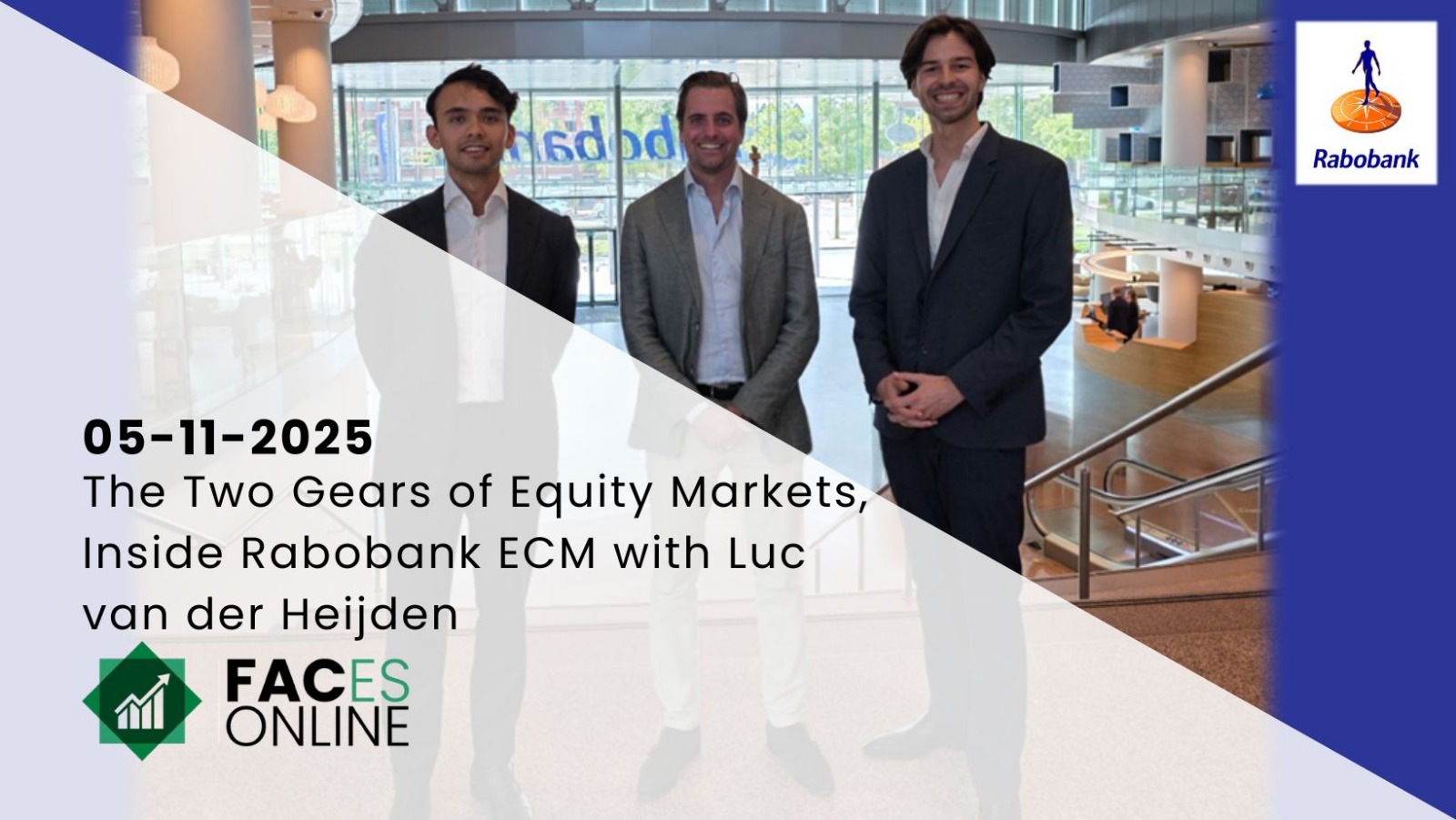
Inside Rabobank ECM with Luc van der Heijden
How preparation leads to pricing, and why scale is essential for ECM success. Drawn entirely from an in-depth interview with Tilburg University alum Luc van der Heijden, Associate Director, Equity Capital Markets at Rabobank.
Written by: Bryan Groeneveld & Mathijs van den Broek
A listing gong, a bookbuild, a lesson
On a Wednesday morning in Amsterdam a listing took place, the company’s CEO looked across the room. Instead of the lone executive striking the Euronext gong, he invited everyone up on stage: the lawyers, the bankers, the entire IPO working group. Luc van der Heijden found himself on that podium too, a first for him, on a deal that had taken months to blossom, including intense origination efforts. But there he stood, celebrating a moment to remember, reflecting on the culmination of an intensive but ultimately rewarding IPO process. “That’s what you do it for,” Luc says. “A company happy with its listing, and a team proud it delivered.”
The listed company was Theon International, a European-based manufacturer of night-vision and thermal imaging systems for military and security applications, which went public on the Amsterdam Stock Exchange in 2024. Rabobank ECM obtained a spot in the syndicate on the back of its demand generation capabilities and technical competence.
Fuelled by the recent rise in interest in the defence sector, driven by macroeconomic and geopolitical events, investor demand was strong: initially priced at €10, the stock is currently trading around €30. This story is just one example, yes, but a neat one. Why? Because it captures the essence of ECM: the originating work of building relationships, followed by the rapid decisions made during the execution phase, and the final climax when the gong sounds and the market takes over. These are the two gears that drive equity capital markets.
What is ECM?
For those unfamiliar with the Equity Capital Markets (ECM) product group, here’s a brief introduction: the ECM team sits at the intersection of corporate finance and the financial markets, advising companies on issuing shares to raise capital or provide exit opportunities for existing shareholders. Rabobank’s ECM specialists originate, structure, and execute equity and equity-linked transactions, including initial public offerings (IPOs), secondary offerings, block trades, convertible bonds, share-buybacks, and other forms of equity advisory.
Two gears, one craft; ECM runs on two tempos
The ‘slow’ gear is origination: years of relationship-building and extensive pitching, via IPO workshops, for example. The aim is to position a company for a future transaction and prepare stakeholders for the scrutiny of public markets. “We’re sometimes at a client’s table for five or six years before an IPO,” Luc says. This timeframe isn’t unusual, as the preparation is far from abstract coaching; it often involves fixing governance gaps, adhering to accounting standards, refining KPIs, and testing messages with a select group of investors. Sometimes the feedback is blunt, and the advice is to wait a year or two longer before listing. Adding: “Origination is a long breath,” Luc says, “but the art is staying present throughout, because the reward lies further in the future.” Ideally, if origination has been done well, the formal RFP for a transaction, or “bake-off”, is simply a confirmation, not an audition.
The ‘fast’ gear is execution: once the mandate is awarded, an IPO typically takes six to twelve months, while a follow-on transaction, such as an accelerated bookbuild (ABB), in which an already-listed company raises capital or an existing shareholder sells (part of) their stake, can be completed in just a few days. During this phase, Rabobank advises the company on the structuring of the transaction, sharpens the equity story, and places the shares at the best possible price, selling to institutional investors, family offices, or retail investors; all depending on the structure of the transaction.
Where ECM actually happens: a small room with fast decisions and direct client lines
Rabobank’s ECM team consists of fewer than 15 people, with most based in Utrecht and one colleague in New York. The advantage of having a relatively small team is speed, and clarity of voice: direct lines between everyone, from analyst to MD, and your opinion counts from day one. That also means early exposure to clients. “It’s one thing to build slides,” Luc says, “but when you have to present them yourself, you start thinking differently: what do I actually tell them? What is the message, and what is the overall storyline I want to convey? That’s when you really learn the ECM craft.”
Why Rabobank partnered with Kepler Cheuvreux
About nine years ago, Rabobank partnered with Kepler Cheuvreux, the largest independent broker in Europe, to enhance its distribution and research platform. In short, Rabobank ECM focuses on corporate advisory, while Kepler Cheuvreux leads distribution to investors and provides company research. The partnership has given Rabobank a meaningful competitive edge: additional reach. Through this close collaboration, Rabobank ECM offers their clients access to more than 1,300 institutional investors, over 110 salespeople and sales traders, and 125+ research analysts covering approximately 1,000 companies across 34 sectors. The result? More investor demand for offers, and order books that aren’t just larger, but also better tailored to each client’s needs.
And, as several other European banks have partnered with Kepler Cheuvreux, the firm remains consistently active across a wide range of transactions. This network effect gives both Kepler Cheuvreux and Rabobank access to unique market intelligence, granting an additional layer of insight to the advice provided to Rabobank’s clients.
Two playbooks: Private vs. Listed
A private IPO candidate and a listed follow-on require two different approaches.
- For private companies, ECM teams typically work with limited public information, ‘a one-time chance to shape the story from scratch.’ The challenge lies in deciding on what KPIs to steer and how to position the company towards investors. If the initial investor feedback isn’t strong, you don’t force the timing; instead, you wait. As Luc puts it, “timing is part of the product.”
- In contrast, listed companies come with established data and market recognition. Here, the role of ECM shifts from telling a new story to refining an existing one. Rather than building from zero, it’s about “updating the facts, sharpening the pitch, and making sure the order book is strong, and the allocation logic makes sense”, Luc describes. “A key part of this, is translating the rationale for raising equity into a compelling story for the market.”
The IPO marketing process of an ECM deal in short
1) Long runway (origination). Start early: Pitch the bank, discuss markets, run simple-to-understand IPO workshops, and keep the dialogue going throughout market cycles. The entry point can vary, through relationship bankers, sponsor coverage, or even just a read on public news, but the goal is the same: be present well in advance of the actual decision. Between origination and execution there is a short transitional phase. Here, the focus is on technical preparation (e.g. KPIs, governance, disclosure), positioning, and preparing management for the choices ahead. This ensures that both the company, and its story, are ready for exposure to investor judgement.
2) Pre-marketing. Build a target list of investors, wall-cross a few funds, gather feedback, and refine the pitch. If the signals aren’t there, don’t push, it’s better to wait than to force a cold market. When the initial feedback is positive, you continue and can broaden the investor group.
3) ITF & extensive investor education. Announce the “Intention to Float” and start investor education. Management meets as many investors as possible during this marketing period prior to the bookbuild, often in a hybrid mix of travel and virtual sessions. By this stage the story should run smoothly, because it’s already tested. This is also the moment when the various banks involved in the transaction launch their research reports.
4) Book build & pricing. Once the book opens, investors can place orders across a pre-set price range that is based on investor feedback thus far. You usually have a sense beforehand, but the real picture only emerges when the orders come in, who wants what number of shares, and at what price. Then comes the moment of truth: the syndicate and the company set the final price, anchored by where the strongest demand lies and which investors are desired in the shareholder register post-deal. Pricing is not the sole consideration. Equally important is securing a well-balanced investor base, including long-only investors that will remain over time, as well as, hedge funds that contribute liquidity to the stock.
The market sentiment: stocks at all-time highs, yet lower IPO activity over the last years
Post-COVID, and despite equity indices reaching all-time highs, investors have become more cautious about investing in new names compared to established, familiar, firms. This is not a contradiction; it reflects how investors price risk. After 2021, follow-on offerings continued, while first-time issuers were expected to justify their valuations through solid financial and operational track records.
In practice, Luc says that this has led to greater selectivity around IPO investments and a premium on preparation. Therefore, a key point in many IPO discussions remains the valuation perception of a company’s existing owners and new investors. In recent years, there has often been a perceived valuation gap, driven in part by rising interest rates, which are a key input when valuing a company.
The path into the industry for students and juniors
Luc started studying a BSc in IBA followed by a MSc Finance at Tilburg University, but finding his way into ECM was gradual. He joined Rabobank as a trainee, rotating through four departments before landing at the desk he now calls home: ECM.
During his traineeship Luc worked in:
- Business Lending (Pricing team): The team developed pricing models for local banks to price loans. While it was analytically interesting and the team was great, Luc missed having direct contact with clients.
- Loan Syndication: He worked on large loan transactions where multiple banks had to collaborate. This was already a much more commercial role, as the team had direct contact with clients and pitched for the coordination role within mandates.
- Sponsor Coverage: Relationship management for private equity. Luc found it to be an interesting environment that offered early client exposure and opportunities to think strategically with sponsors. However, he missed being involved in the execution of the deals he helped originate.
- Finally, in Equity Capital Markets, the pieces came together. The role was commercial, client-facing, and involved full execution responsibility in a small, tight-knit team. Here, Luc discovered his passion for markets. “Within two weeks I knew this is where I wanted to be.”
Other than following a traineeship, Luc advises students to start exploring career options early, ideally during their bachelor’s studies. He also encourages participating in recruitment events such as the EBT and Tilburg Career Days, not as make-or-break moments, but rather as valuable practice opportunities. In addition, he recommends making room for internships, even if it means extending the duration of a master’s program. Internships are often the only way to truly experience what certain jobs are like, and they can significantly strengthen a CV when applying for a position you genuinely want. Finally, Luc emphasizes the importance of taking every opportunity to master the skill of pitching yourself.
How to practice the skill of pitching oneself according to Luc van der Heijden:
- Treat career events as practice, not performance. The awkward conversations you have now are low-stakes compared to a final-round interview for a role you really want.
- If ECM or M&A is your goal, avoid diluting your profile with rotations that do not support that path. If you are still exploring different options near or at the end of your studies, a traineeship is ideal.
- Make an effort to present or speak publicly. Building a deck teaches you the facts; presenting teaches you the story.
Back to the gong
To end where we began: Theon’s listing – Closing the transaction, the €10 offer that traded up to above €30, and the enjoyment of being able to join the company on the Euronext stage – was merely the surface, the part that makes headlines. The real story lies beneath, in the decisions made long before the gong gets hit: who to call and when, what KPIs to steer on, and how to time it.
ECM, at its core, is translation. It is the craft of turning a company into a story that is ready for the public markets, and pricing that story into something both sides can accept. For private issuers, that story is told in public for the first time. For listed firms, it must be sharpened to stand out in a crowded market.
“Success in ECM doesn’t come from spreadsheets,” Luc van der Heijden says. “It comes from the ability to connect two worlds: the company and the capital markets, between ambition and what the market will bear.” Only when the book finally opens do you grasp the true reward of all your preparation. “That moment,” Luc reflects, “no matter how many deals you have seen, never gets old.”