



Let me start by saying that completing three master’s degrees was not part of my original plan. My journey evolved over time, shaped by curiosity, opportunities, and a little bit of luck. By no means am I sharing my experience to set an example but to offer insights for those exploring their own academic paths. Here’s a look at how this unique combination of degrees came together, the challenges I faced, and the unexpected synergies that made it worthwhile. How It All Started As I approached the end of my bachelor’s degree in International Business Administration at Tilburg University, I felt a sense of uncertainty about what to study next. Having specialized in marketing through a minor and an internship in trade marketing, a master’s in Marketing Management seemed like the natural choice. So, in February, I dove in. But while I enjoyed the course, I felt that something was missing—the analytical side of things. To satisfy this curiosity, I decided to enrol in a second master’s program: Marketing Analytics. This shift added complexity, but soon I realized that programming and hardcore analytics weren’t what I wanted to focus on. By then, I’d invested time and effort into this path, but I couldn’t ignore the pull toward the numbers, and started to explore possibilities in finance. So, in a seemingly less conventional move, I added a third program: Finance. Fast forward to today, and I’ve completed the Marketing Management degree, with plans to finish both Finance and Marketing Analytics by the end of 2025. The Synergies Between the Programs When people hear I’m working on three master’s degrees, reactions range from “You’re crazy!” to “You must be a nerd.” The first I will ignore for the pursuit of a formal article. I’m willing to accept a bit of the latter; enjoying studying is definitely a prerequisite. But often, people also question whether these specific programs really complement each other, and that’s where I think they’re missing out on the hidden synergies. Firstly, there’s the learning curve: once you understand what a master’s program demands in terms of commitment, research, and self-discipline, the second and third degrees are more manageable. Writing a second thesis, for instance, is significantly less daunting than the first. More importantly, though, the content itself starts to weave together in ways that offer unique insights. Marketing and finance might seem like opposites—creative versus analytical, strategic versus operational—but in practice, they’re interdependent. For example, while finance departments often act as gatekeepers on budgets and expenditures, marketing teams drive the revenue side. This is the well-known friction of business, where marketing is limited by the restrictions set by finance. Having a foot in both camps has given me a rare perspective on how these fields interact. I can evaluate marketing opportunities with a financial lens and understand the constraints and expectations finance teams operate under. This provides the perfect base for valuation calculations. In a broader sense, this interdisciplinary approach has fostered a strong business acumen. For example, I can spot growth opportunities from a marketing perspective while also being able to assess costs and returns through financial modeling. This dual lens is particularly valuable in fields like M&A and corporate valuation, where a holistic understanding of both revenue generation and cost management is essential. Another valuable synergy is the balance between technical and interpersonal skills. While my finance courses strengthened my quantitative and analytical abilities, marketing added to the social side—communication skills, client presentations, and team projects. These interpersonal skills are critical for finance roles where presenting and explaining complex ideas to clients and stakeholders is as essential as the analysis itself. The Challenges Along the Way Taking on multiple master’s programs isn’t without its hurdles. Juggling different curricula requires careful planning and time management. Scheduling conflicts, coordinating course loads, and staying organized across three fields has certainly been demanding. Beyond logistics, there’s also the mental challenge of switching between subjects that each require different mindsets—creative for marketing, analytical for finance, and data-driven for marketing analytics. Financially, pursuing multiple degrees can be costly. I’m often asked if tuition fees increase with each additional program. The answer is: not necessarily, but it does require careful planning and a lot of administrative preparation. Advice for Aspiring Master’s Students Would I take this academic path again, if I were at the outset of my master’s? Well, it has taught me a lot, both academically as well as personally. This path has broadened my academic knowledge and provided me with insights into myself—my strengths, interests, and areas for growth. For anyone considering a double or even triple degree, here’s my advice: if you’re genuinely curious and motivated, go for it. Not only does it deepen your knowledge base, but it also gives you extra time to explore different career paths and internship opportunities. You meet more people, interact with more professors, and become part of a larger academic network, all of which can have lasting professional and personal benefits. In the end, these degrees aren’t just lines on a resume—they’re experiences that have taught me resilience, adaptability, and a new way of seeing the world of business.
Accounting Insight 2022: Looking back
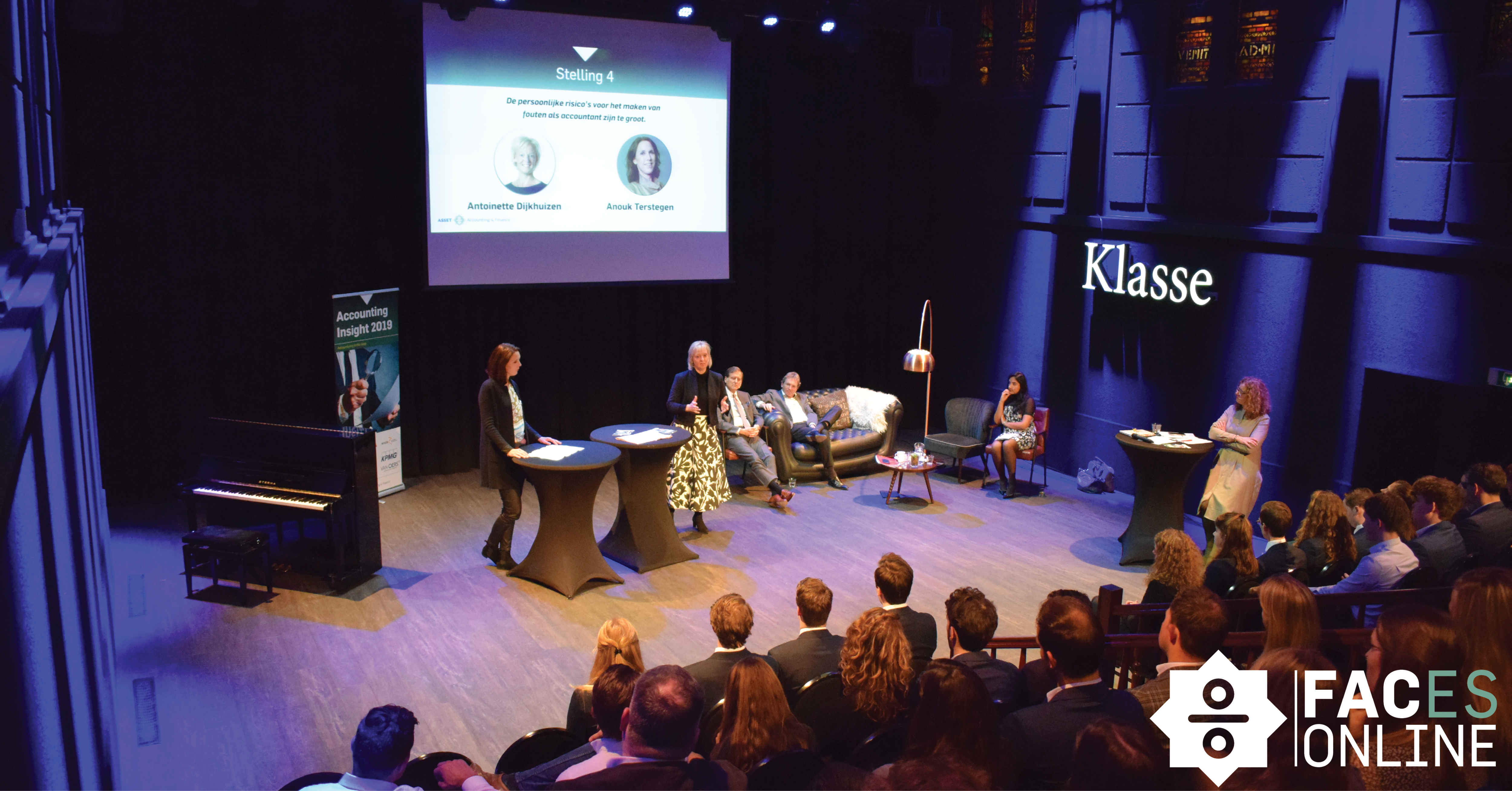
For the Dutch version, click here. On Wednesday, November 30, we were once again able to join the Class Theatre for the twenty-first edition of Accounting Insight. Starting at seven in the evening, the doors opened for guests. The guests, whether students, working professionals or professors, were able to meet here while enjoying a cup of coffee, tea or a soft drink. The themes of this evening were: Fraud, Data Analysis and Sustainability. After last year’s edition unfortunately could not take place due to measures, the themes were moved on to this year. Under the motto: ”Improve today to advance tomorrow” we asked our speakers to explain from the different themes how we can improve accountancy now, so that we can advance in the future. This edition was also the first edition of Accounting Insight to be held entirely in English. Fraud After the guests had half an hour to chat, it was time to enter the auditorium. With nearly one hundred guests, the room was quite full. After a word of welcome from the chairman of the committee, Bas Penders, and the introduction by the chairman of the day, Margreeth Kloppenburg, it was time for the first proposition: ”Auditors are not equipped with a critical mindset to detect fraud.” This proposition was explained by two speakers, Marianne van Kimmenade of the NBA and Don Raaijmakers of the AFM. Marianne has thirty years of experience at EY, having also been a partner there. After her brief retirement, she became a policy advisor on fraud at the NBA. Don Raaijmakers himself worked for fourteen years at KPMG, then five years at EY, where he was a college graduate of Marianne. After this, he has been working at the AFM as a team leader for fifteen years. Don and Marianne together came to the conclusion that auditors are sufficiently trained to detect fraud, but that the critical eye of especially young auditors is not used enough when conducting an audit. Therefore, they would like to see auditors take a critical look, and not let their biases be a factor in conducting an audit. Data analysis The second topic of the evening was Data Analysis, with the proposition: ”For a future accountant, it is better to study physics as opposed to business economics.” For this thesis, Theo-Jan Renkema and Ferdy van Beest were the speakers. Theo-Jan Renkema has worked at Rabobank for 24 years, currently as Chief Innovation and Technology Auditor, and is also a professor at Tilburg University. Ferdy van Beest has been working at Nyenrode Business University for seventeen years, where he is currently Associate Professor. He also works at Flynth as Director of Data Propositions and Integrated Reporting. So two experts in the field of Data Analysis. Theo-Jan Renkema argued that auditing uses more and more data and its analysis, so that in the future he indeed sees mathematicians as auditors, instead of business economists. Ferdy responded that yes, data is being used more and more, but that the auditor is a bridge between the audit and the business, requiring the human touch that business economists have. Together, the speakers agreed that business economics still remains important within Audit, but that there is going to be more and more specialization, with a lot of help from mathematicians. After this substantive discussion it was time for and break, during which guests could discuss afterwards while enjoying drinks and snacks Sustainability After the break, it was time for the third and final topic of the evening, Sustainability. The thesis of this theme was, ”The Chief Financial Officer (CFO) of the future is the Chief Value Officer.” Under this theme, Nicolette Loonen and Ferdy van Beest discussed. Ferdy van Beest has already been introduced at the previous theme. Nicolette Loonen worked at KPMG for 15 years, after which she held all different jobs. She is a co-founder of Tribe of Sustainability Change Agents (TOSCA). The discussion began with Nicolette explaining that the CFO needs to change to the CVO, because there is a need to look more at the long term, and then also how to do business responsibly. Ferdy disagreed, because he thinks that the duties of a CFO are going to be different in the future, and this includes a long-term view. He doesn’t think the position should be renamed for this. In the end, the speakers agreed that the CFO should think about the long-term vision of a company, but the disagreement was mainly in the name of the position. Business Market After another great edition of Accounting Insight, the speakers and partners were thanked by the chairman of the committee, and the chairman of the day closed. After this the guests could have a drink at the company market, where KPMG, EY, PwC and ABAB had set up a stand, all our other partners were fortunately also present. While enjoying a beer, soda, and plenty of snacks, the participants were able to get to know each other, or their future employer, for a while. Also inspired by my story and would you like to be the person responsible for Accounting Insight 2023? Then quickly become an active member at Asset | Accounting & Finance. You can sign up via: Info@Asset-AccountingFinance.nl

Growing stress among students due to COVID-19
For the Dutch version, click here Since the beginning of last year, life has been at a standstill. Where normal life first started up again at a snail’s pace, within no time everything ground to a halt again. Everyone has experienced lesser moments. For example, for some, social life has largely fallen away and the pressure at school is difficult to keep up with from home. In this article, we further explore how students from Tilburg University experience stress due to current conditions. Also, this article reflects the experiences of fellow students who are members of Asset | Accounting & Finance. Last year Worries about now and the future, everyone knows them. For some, it is easier to deal with them than for others. Everyone has different worries, which weigh in differently for each person. One person braves crisis after crisis and another needs a hand to get back on his feet. The situation started and everyone deals with it in their own way. A press article from Tilburg University reveals an increase in psychological complaints, particularly among students. A group that is normally socially very active, who have experienced many changes due to the measures. A group of people who often have a different outlook on life than, for example, full-time workers. For many people, attending lectures helped with discipline, a fixed routine with work, school, and private life. A routine that now takes place mainly in student rooms, because the lecture banks and libraries are no longer accessible. Furthermore, there are people who have lost a nice side job, because practicing their job is not possible within the current measures. The imbalance is a major cause of stress for many. Fortunately, there are several ways to make it a little easier on yourself. Experiences of A&F members How are members of Asset | Accounting & Finance (A&F) experiencing this strange period? In response to this issue, a number of A&F members were interviewed who are currently pursuing the Bachelor of Business Administration, Master of Finance, or Accountancy. Bo Janssen, MSc Accountancy, gives her experience about switching from physical to online classes. “The online lectures were fine although it was harder to really interact with other students. The second semester I found it a little more difficult. The only interaction left was through online Q&A sessions and usually not a lot of questions came up there.” Sem van den Berg, MSc Accountancy, briefly talks about the effects the current period had on his motivation. “I did notice that my motivation for attending lectures deteriorated. In the end, my school performance did not suffer. I am normally used to completing subjects without much interaction and personal guidance.” Thus, it can be concluded that studying in the ‘new normal’ has its advantages and disadvantages. For example, one person generally experiences online classes as pleasant, but the lack of interaction proves to be an obstacle for another. An obstacle that some people cope with better than others. The role of Tilburg University What role did the university have in the transition to the new normal for students? Has the university handled this positively or negatively? In the end, every organization has had to make drastic decisions due to the current measures. The school shows an upward trend in terms of application measures that apply in education according to Bo Janssen. “Furthermore, I think that they are now trying to look at how a certain subject can best be arranged online instead of just transferring the lectures that are normally given physically to online (for example, by making videos available at any time).” “For many people, attending lectures helped with discipline, a fixed routine with work, school, and private life. A routine that now takes place mainly in student rooms” Similarly, there were also students who took a critical view such as Ahlam Kodade, MSc Finance. “I understand that these are special times for all of us. That we have to be creative and flexible with solutions, but I got the feeling that little consideration was given to international students like me. An important group for the education sector.” Some students felt that things were unclear like Jari Heijnen, MSc Accountancy. “There was a lot of ambiguity from the university, in that respect, they can still learn a lot. Also, there is an expectation that students are always available for an online lecture and that is not possible for many working students.” Lack of clarity is a recurring thought in Tilburg University’s course of action. The university is actively working on it and adapting its new teaching methods as time goes on. Lessons will certainly be learned from this new form of teaching and the policies of the educational institutions and national government for years to come. Tips from A&F members How have members of Asset | Accounting & Finance kept themselves mentally and physically fit this year? A few members will briefly explain the positive habits they have adopted. Perhaps this will provide inspiration for maintaining a healthy attitude. Discipline and daily routines can be supportive in times of studying at home, says Joep Groenen, Bsc Business Economics. “First of all, I think it is important to keep a good daily routine: get up on time, shower right away, etc. That way I fill in my day much more effectively and I have more motivation. I also like to go outside regularly because I am indoors a lot.” Thus, sporting activities can also contribute to your health according to Sem van den Berg. “I mainly focused on going to the gym. In addition, I used to run in the summer. I notice that sports can have a positive influence on your mental state.” Others have been able to get a lot of peace of mind from being home with family as described by Ahlam Kodade. “I spent six months in my home country. I think this was very valuable since I had no courses at the time. It was nice to
MSc Accountancy: Master File vs. Thesis – what’s the difference?
For the Dutch version, click here Over the years there have been many debates about whether a thesis at the end of a graduate’s education actually helps him/her in becoming a better employee in practice. Many have argued that a thesis can improve the skill set of the student and enhance his/her capabilities, while others have argued that it adds no extra value to what they will eventually end up doing. This has been the case in the accounting sector. Tilburg University has responded to this by taking a different path than other universities when it comes to writing a thesis. They have looked to improve the link between students and their future job. This has led the MSc Accountancy at Tilburg University to introduce the MSc File Accountancy, better known as the Master File, to replace the thesis of the graduate accounting students since the academic year of 2019-2020. Master File You might ask yourself, what is the Master File; and what makes it so special? The Master File is a more practice-oriented thesis but with a clear academic basis, and consists of three parts, namely a Business Application, a Replication Study and a Research Note. The Business Application focuses on a real-life problem experienced by a selected company. This company is then given advice through the use of published academic research of which the findings are applied to your individual case. Hence, this covers more of the ‘literature research’ that you would have ought to do in a ‘regular’ accountancy thesis. In the Replication Study students have to select an already published research paper which they will have to replicate with a well-motivated variation in the context and/or time of the study. This part of the Master File is meant to cover and train your data analytics skills which are tested in the latter part of a regular thesis. The Research Note, the third report, approximates a traditional thesis as most of us know. However, it has a shorter length than the traditional thesis as it is meant to be briefer. The goal of the Research Note is for the student to come up with a creative idea for a new research and to develop a plan on how this would be executed. Hence, the entire research should not be conducted, but the plan should be substantiated with literature research and the student should assess the appropriate data analytics that ought to be used. These three components form together the Master File. The first two components each weigh 25% of the final grade and the third component weighs 50% of the final grade. Furthermore, it is important to mention that each component links to a different field within accounting. For example, you can conduct your Business Application in the setting of Management Accounting; your Replication Study in the setting of Financial Accounting; and your Research Note in the setting of Auditing. Main Differences Nevertheless, after conducting all three components, it is hard to try to find a clear difference between a regular thesis and the Master File. The main differences lie in the context that it is given in and in the skills that they focus on. The Business Application brings you in direct contact with the practical world as students will have to solve a real-life problem solely based on academic literature. This makes it clear that the Business Application pushes students to get in direct contact with the practical world, which is not the case for the regular thesis. The Replication Study focuses more on the replication of a study as to where a regular accountancy thesis would at least need an add-on and a clear contribution to the academic field and/or the practical field. As for the Research Note, since you are not conducting an entire thesis, with that meaning that the execution of empirical tests are limited, (though they must be planned out), the main difference lies in the execution of the project. Pros and Cons After having interviewed several students¹ that have completed the new Master File and other students that have completed the ‘old thesis’, they have named several pros and cons to the new Master File towards the ‘old’ thesis. One pro that has often been accredited by the interviewees was the set-up of the Master File. Most students can agree that conducting the Business Application and the Replication Study before the Research Note has helped them a lot. The reason for this is because they were able to apply the skills that they have learned in the first two components of the Master File on to the third component. Next, students were keen to mention that they appreciated the more practice-oriented setting that the Master File has brought. “Furthermore, almost every student interviewed also mentioned that a big pro was having to learn three different accounting subjects against just one.” Furthermore, almost every student interviewed also mentioned that a big pro was having to learn three different accounting subjects against just one. This contributes to a broader knowledge within the field of Accountancy and has also contributed to increasing their expertise in all three areas as opposed to just one. Also, one student conducting the ‘old thesis’ mentioned that she was particularly jealous of the students following the new Master File. “The skills that they have gained while conducting the Replication Study was much more profound than mine. I felt like they really had less obstacles when conducting the Research Note compared to me when I was conducting my ‘old’ thesis”. Lastly, some students really liked the idea of spreading the workload over the entire year. However, this also contributes to a con of the Master File since not all students really appreciated this. “Having your workload spread-out throughout the entire year may have its benefits, but it can sometimes get really busy when you have to follow your regular courses next to it.” Moreover, students have mentioned that they would have appreciated more guidance during their second assignment, which was
A board year as External Affairs of Asset | Accounting & Finance – Nina Thomas
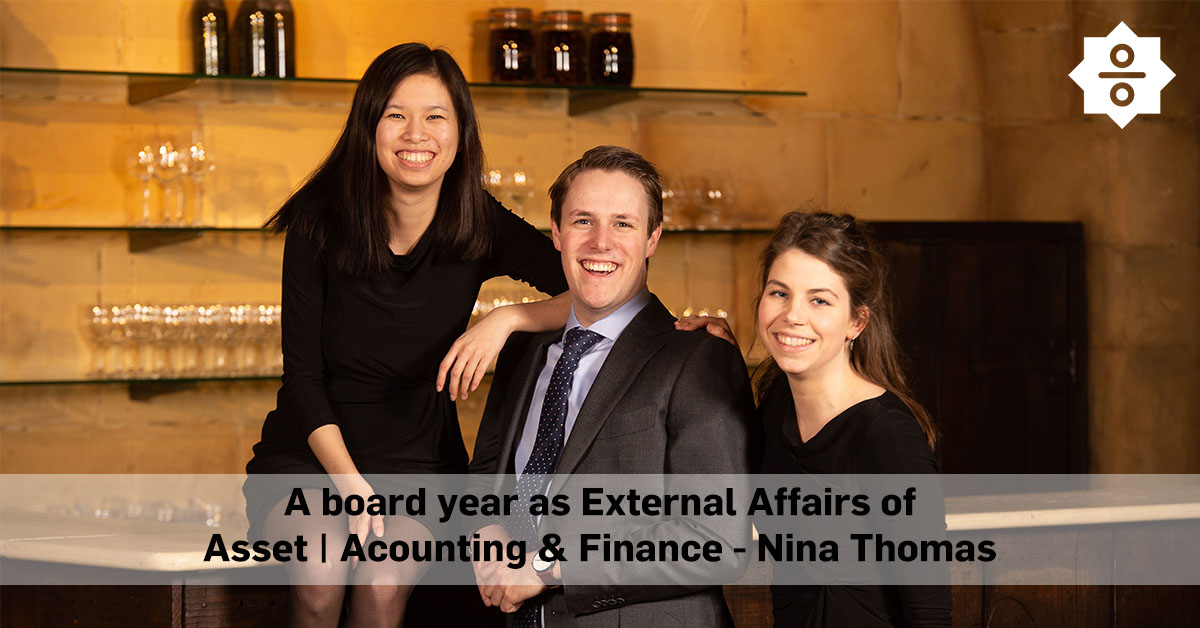
For the Dutch version, click here As External Affairs, Nina is responsible for the contact with current and future partners of Asset | Accounting & Finance. In addition, she coordinates the Accountancy Cycle, Accounting Expedition and Orientation committee. In this article, Nina explains her function and her experience as an External Affairs of Asset | Accounting & Finance. Why did you choose for a board year at Asset | Accounting & Finance? As a committee member of Asset | Marketing, I organized a fantastic trip to Malaysia during my second year of my bachelor. However, I did not think about a board year back then; I wanted to go on exchange and finish my bachelor’s in Business Economics. Only during my exchange in Sydney, I began to think more seriously about it. I’m not sure whether the reason was my carefree student life which suited me well or my personal development growth, but a board sounded more and more attractive. This feeling became stronger during my time as a member of the Financial Business Dinner committee of Asset | Accounting & Finance (A&F), which felt very comfortable. Another reason which contributed to my choice was the difficulty of choosing the right master. However, as someone who is known for doubting a lot, it is not a surprise that I was in doubt about this decision as well. After several conversations, my doubts turned out to be unnecessary which led me to the well-considered decision to apply. The only decision left for me was which function within the board I wanted to fill. Firstly, I was thinking about becoming Treasurer of the board, as I had an affinity with numbers and making budgets. However, a board year is meant to step out of your comfort zone. Therefore, I decided to apply for the position of External Affairs (External). What does your year look like and how do you like it? The year began with a full agenda. During the day, I visited our partners to discuss our cooperation. During the evenings, I was busy with Announcements or dates with other boards and in between, conveyance and policy sessions were planned. I got to know the organizations and recruiters, which improved our collaboration during the year as well as my perspective on different sectors. The Financial Business Dinner took place at the end of September, and soon the events which I coordinated as part of my board position took place. This resulted in greater a responsibility, but also a feeling of being proud of the committees as well. The peak of ‘my’ events happened in February/March. As summer External, I was responsible for the organization of the Finance Day, Master Experience Days and Accounting Expedition. These events all took place within the period of one month, which tested my time management and list of priorities. It is, therefore, gratifying to see that students appreciate our events and use them to build their network. In the end, that is what our association stands for; connecting students with their potential employer. Because there is always something to do, time flies by. Beforehand, I was wondering how I could be busy for seven hours a day; right now, I ask myself how it could be that the day flew by so quickly. Even weeks flew by quickly, and I feel like we have just begun the board year. I think it is difficult to summarize my experiences within 1000 words or to give just one answer. ‘Good’ is not sufficient, as a board year is something you have to experience. Therefore, I am very happy with my choice. And my doubts… those have been replaced by doubts regarding the choice of a menu (it is still a learning process). What are your tasks as External Affairs? As External, you are the first contact for companies. You work together closely with the other External in order to provide companies in their needs. The conversations during the summer form the basis and these are supplemented with new partners. Via either physical appointments or appointments by phone, you determine whether there exists a match between what companies search for and what A&F offers. Sometimes, you have to say ‘no’ and there will be no match. This can change, therefore maintaining a good relation is essential. The same holds for existing partners, you want to keep those satisfied. You are building a network which could be important later on in your career. “Here, it does not really matter whether you are a quiet person in general or someone who prefers to step forward. As long as you are social and open-minded, it is alright.” It is great that my position within the board emphasizes the importance of soft skills. Keeping contact with A&F partners improves your communication skills and it allows you to learn how to present yourself and A&F well. You will learn these skills quickly enough. Here, it does not really matter whether you are a quiet person in general or someone who prefers to step forward. As long as you are social and open-minded, it is alright. Also, you do not have to be a professional in small talks. Moreover, you should not be afraid to bring or receive less positive news. These could be tough conversations, and it is your task to resolve these in the right way. Solutions will differ, yet each situation requires flexibility and rationality. Although you will be the point of contact, fortunately, you are not alone. My skills regarding crisis management have clearly improved and I am proud when looking back at how I solved certain situations. What does your average day look like? An ‘average’ day does not exist, yet there are recurring occasions such as committee or board meetings, keeping social media channels up to date or adding vacancies on Career Platform Tilburg. In addition, I spend quite some time keeping my mailbox up-to-date and making phone calls (or receiving voice mails). However, this is just a
A board year as Chairman of Asset | Accounting & Finance – Allard van Hees
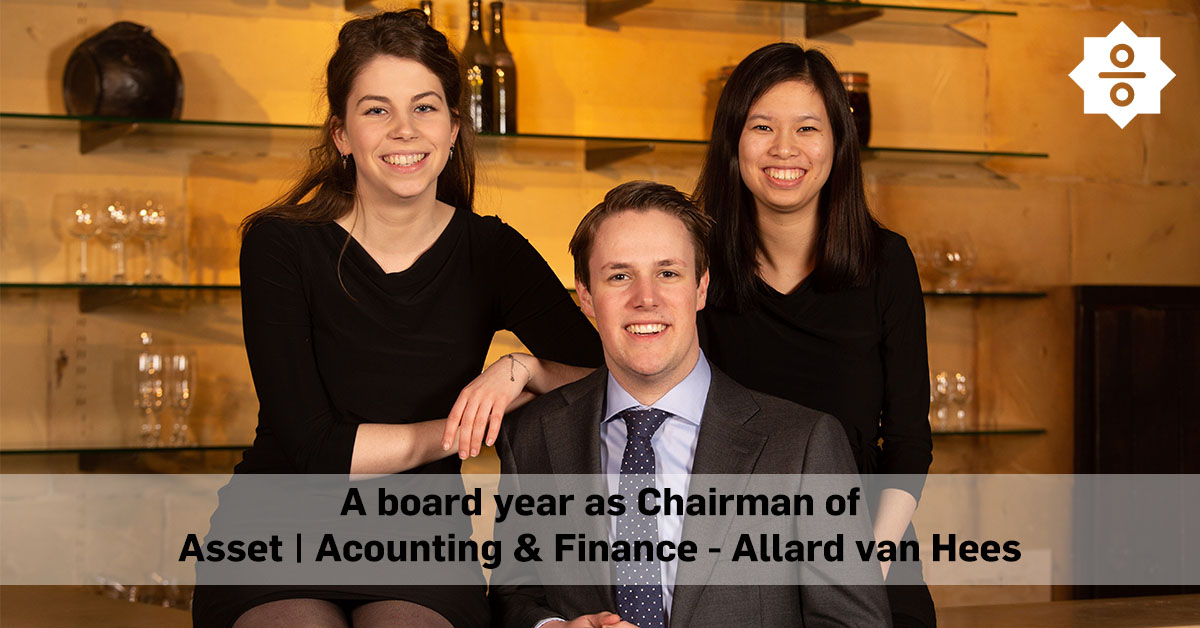
For the Dutch version, click here As Chairman, Allard is responsible for the policy of Asset | Accounting & Finance and external communication to parties such as Asset and the University. He also coordinates A&F Investments and the CityTrip committee. In this article, Allard explains what his position entails and how he experiences a year as Chairman of Asset | Accounting & Finance. Why did you choose to do a board year at Asset | Accounting & Finance? When I joined Asset | Accounting & Finance in my first year I never thought I was going to do a board year. At the time, I was much more concerned with getting my BSA than thinking further about my future. As I progressed in my bachelor Business Economics and I became more active at Asset | Accounting & Finance, for me it seemed more and more fun to do a board year and to view the association from a different perspective. In addition, you also learn a lot from a board year. You learn what it is like to run a kind of company and thus gain a kind of management experience that you can hardly gain with, for example, an internship. I chose to do a board year at Asset | Accounting & Finance (A&F), because after this year I will study Accountancy and can, therefore, come into contact with various companies in this sector. At first, I had the ambitions to become a treasurer, but as the application procedure progressed, I nevertheless chose to become Chairman. “You learn what it is like to run a kind of company and thus gain a kind of management experience that you can hardly gain with, for example, an internship.” What does your year look like and how is the experience so far? The applications started in April, which resulted in me becoming the Chairman for the academic year 2019-2020. At first, I was quite reluctant to become Chairman, because Chairman sounds like something very serious and with a lot of responsibility, but after a number of conversations with other board members I was assured that I could do it. From July onwards I fully participated, first under the wings of my predecessor Stijn, who immediately took me everywhere from the beginning. The conveyance period is a fun, but above all educational time in which many impressions come at you and many things are done. In July, you will also write the policy for the upcoming academic year together with the other board members, which I have to present at the General Members Meeting. After the General Members Meeting, you can quickly join the flow of the year. Many events come your way, fun drinks and tough meetings. Before you know it, you already talk about the successors of Twan, Daniek and Steyn in the weekly board meeting. That makes you think about how fast a year actually flies and what you have experienced up to that point. As Chairman you also have the board of Asset where you take a seat. That makes the position of Chairman fun and challenging, because you are not only dealing with the position of A&F, but also with the position of other departments and Asset as a whole. You have to be able to look from different perspectives to make the right decision. Since I have an affinity with financial data, I chose the position of treasurer there. This fulfils the ambitions of treasurer, which I had when initially applying for a board year. What are your tasks as Chairman and what does your average day look like? As Chairman you are responsible for leading the weekly board meetings, policy meetings, General Members Meeting, and the meeting of the Advisory Board. In addition, you are also on the board of Asset and you are responsible for a portfolio within that board. The Chairman is responsible for writing and complying with the established policy. An average day is difficult to describe since every day is different, but almost every day there is a meeting on the agenda. Beyond that, you have to read and write a lot of updates, prepare for meetings, and help fellow board members where needed. I also attend the meeting of A&F Investments, our investment team, every other week. In this meeting, I learn a lot about the stock market and how you can value companies based on the available figures. Although A&F Investments did not immediately suit my personal interests, I did appreciate the team for the high degree of professionalism and enthusiasm of the members. I think the CityTrip meetings are one of the best meetings of the week. This is because I love to travel and this edition was the first edition of the CityTrip. Do you have any tips for your successor? Don’t forget to enjoy all the things you do in your board year. A board year is over before you know it, and you want to be able to look back on it with a lot of joy! If you would like to know more about my board year after reading this article, feel free to bring a visit to room E1.07 and ask your questions during a cup of coffee! In addition, you can get to know more about the specific division of roles within the board via this link.
