


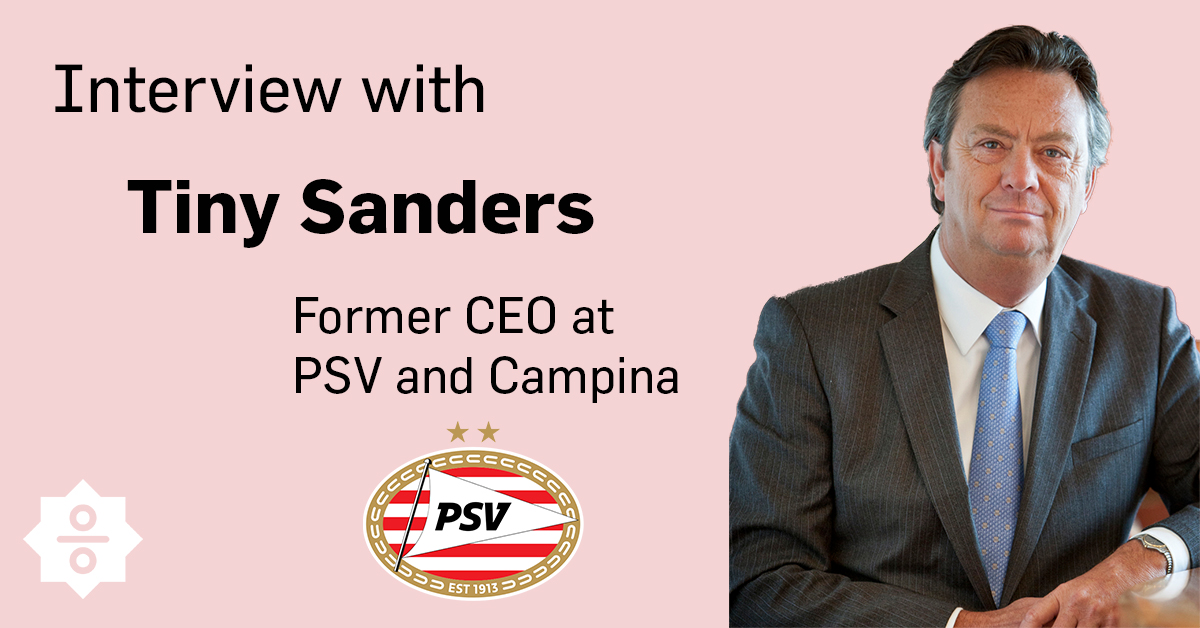
For the Dutch version, click here With his experience as the CFO of HCS, CEO at Campina and Managing Director at PSV, Tiny Sanders has built up an enormously broad portfolio. In this interview, Tiny Sanders talks about his career, setbacks and the wonderful moments that he has experienced over the years. You studied Economics at Tilburg University. What have you learned from this study that you have benefited from for the rest of your career? In my student days, there was more room to do other things besides studying. You had time to develop yourself and to try out new things. The general development that you can gain through doing things next to your study helped me a lot during the rest of my career. The other way of teaching that teachers had at Tilburg University has also brought me a lot of wisdom. Because of its background and philosophy, Tilburg University had just that much more of an eye for the world behind business than other universities. After your studies you started working at Mars. What was your starting position and how did it go from there onwards? Mars had an assessment centre at that time, where you were locked up in a hotel for two days and did all kinds of assignments in groups. This resulted in a management traineeship for me. Once completed, I started working in the finance department, which turned out to be a very interesting part in doing business. After all, financial insight is necessary in almost all (international) projects. In six years, I came into a position in the board of directors. Some time later, the owners of Mars suggested that I could go to the branch in Australia. I have experienced this greatly together with my wife and three children. If you want to make a career in the corporate world, a foreign experience is necessary in my opinion. However, make sure that you do this early enough so that it still fits in with your private life. After Mars you ended up at Campina via a detour, where you became CEO. How did this happen? After my time in Australia, I joined HCS as CFO, a company that focused mainly on computers and software. These three years formed one big learning experience with a lot of setbacks. This company seemed to be very nice from the outside, but on the inside it turned out to be a pool of misery. This included fraudsters and accounting scandals. As a next step, I went to Campina, and I couldn’t have wished for better. After working for 8 years in the finance department and Campina International, I was offered the job as CEO of Campina, which I then did with passion for 8 years. Campina grew into a company that was equivalent to Friesland, which soon resulted in a merger. At that time, two CEOs were not allowed to take over the management of the new company that was formed and it was agreed in advance that both CEOs would have to make room after the merger. Subsequently, you became managing director of PSV. How was your transition from the corporate world to professional football experienced? After this experience, I had seen enough of the corporate world. It could not have gotten any better after eight years as CEO of Campina. Three years later, PSV asked me whether I wanted to start working as the general director of the club. This world was totally new to me and it was a special place, where I used to be in the stadium as a kid, so I almost immediately said yes to this opportunity. Slightly impulsive, but the club is in your heart and as general director you can really contribute something and make a difference. “The most important part of this was to regain confidence after a loss of about 20 million euros and a negative equity.” In your time at PSV, you have resurrected the club on a financial level, especially because of the often-discussed land deal. How did your financial policy get the club back on track? The club turned out to be financially completely grounded upon arrival up to a point where salaries could no longer be paid. We started to deal with this and after six months to a year, the recovery plan was built. The most important part of this was to regain confidence after a loss of about 20 million euros and a negative equity. The only solution for this was additional income, about 80 million to be precise. This was achieved by the land deal with the municipality of Eindhoven, which yielded around 46 million. Though, also almost 40 million have been gained by restructuring loans and entering new, large sponsorship contracts. If you compare these two worlds (the corporate and football world), what are the biggest differences and similarities? The processes within the team are a bit similar, and very dependent on the people within your team. Whether a team functions is crucial, and this is the case for both companies and professional football. Another similarity is that, at both corporations and football clubs, there must always be a keen eye on the structural financial health of the organisation. The biggest difference between these two worlds lies in the emotion and the media. With a corporation, you will be told 2 weeks in advance that you are going to be interviewed, where you will then be allowed to go through everything with the press manager beforehand. At PSV there are 3 journalists at the club all day long, who keep approaching everyone until they find a leak somewhere. So, everything is seen through a magnifying glass at the football club compared to the corporate world. Furthermore, the football world is completely different from the corporate world. I wanted to deal with organisations such as UEFA and FIFA as little as possible. This is also one of the reasons why I indicated from the start

High Frequency Trading: COVID-19 Edition
For the Dutch version, click here Introduction Ever since Michael Lewis released his famous book ‘Flash Boys’ back in 2014, High Frequency Trading (HFT) has been a topic often discussed by investors. Although this is not a fairly new form of trading (some argue that it began in the 1930s), a lot of people and especially many retail investors are still not acquainted with this concept. This has left retail investors and people unfamiliar with the financial markets often questioned during the COVID-19 pandemic. What is High Frequency Trading? And what is so special about it during the COVID-19 pandemic? In this article Faces discusses with professional insight from Quirien Raat what High Frequency Trading is all about and what implications it has for the market during COVID-19. High Frequency Trading High Frequency Trading (HFT) is a type of algorithmic financial trading strategy that traders use to try to gain ‘alpha’. It is a strategy where devices and algorithms try to be the fastest in executing an order. This is where high volumes and low margins come into play. HFT does not only capture arbitrage in the market, it also helps to keep the market less volatile and provides liquidity to the market. Furthermore, HFT is a type of strategy used within market making. A company that continuously buys and sells shares at a listed price is considered a ‘market maker’. Even though the main emphasis of HFT is on speed, a market maker does not necessarily have to be fast. They can execute their orders manually and still be profitable. Nevertheless, the theory of HFT can sometimes be a little hard to understand in just one sitting. Thus, in order to gain more insight into this, it is important to take a look at a practice scenario of HFT. Flow Traders Quirien Raat, alumnus of Tilburg University and currently trader at Flow Traders N.V., guides us through the world of HFT at Flow Traders. Flow Traders was established in 2004 by Jan van Kuijk and Roger Hodenis and has since grown into an entity with a market capitalisation of approximately € 1.5 billion (per May 2020). Although many people know that Flow Traders is an active player in the HFT-market, this is actually not their primary activity. Flow Traders can be considered more as a market maker and executes multiple strategies as a market maker, of which HFT is one. As a market maker, Flow Traders mainly focuses on the so-called Exchange Traded Products (ETP). The best known of these are the Exchange Traded Funds (ETFs). These are the ‘trackers’ of the market. The AEX, for example, is an index of the Dutch market of which many ETFs are created and distributed. This implies that the value of the ETF should be in line with the sum of the value of the underlying shares, but this is seldom the case. Hence, how does Flow Traders respond to this as a market maker? Quirien mentions the following: “Flow Traders ensures that the market is efficient and is brought back into balance. We do this by providing a bid and sell price at all times around the actual value of an ETF.” Though, this might stir up questions such as: what’s it like to keep the market in balance during the COVID-19 period? How does Flow Traders deal with such volatile fluctuations? COVID-19 To date, 2020 must have been one of the most frantic years in modern history. Revenues have declined to levels never seen before and the unemployment rates around the world has been reaching new records. In addition to this, COVID-19 has had a huge impact on the stock market, especially at the start of the outbreak when many investors experienced a huge sell-off. With so much uncertainty and volatility on the market, this is exactly where Flow Traders comes into action as a market maker. “During such a highly volatile market, the price of the underlying stocks and related ETFs fluctuates enormously”, says Quirien. “Even in such situations, investors still want to keep trading. However, everyone wants to sell their securities and this causes the prices of ETFs to sink. Though, Flow Traders has the ability to then buy these ETFs, split them up and subsequently sell the shares separately. This then leads to the case that some people will still buy these stocks separately, thus preventing the ETFs from becoming worthless. Shortly, by continuously displaying bid and sell prices to the market for ETFs, volatility is curbed and this market then remains in balance.” This operating mechanism has led Flow Traders to realise a high operating result last quarter. Yet, one might assume that this would have been due to an increase in trading on the market. However, according to Quirien,it is not only due to the higher volumes in the market. “It is also due to the larger margins created by the increased volatility and uncertainty on the market.” “We don’t invest in stocks that ”add value”. We don’t keep a portfolio and our business model isn’t about having a long-term vision.” But if the market plummets, doesn’t Flow Traders’ market positions cause a negative operating result? No, this is not the case. Due to the fact that Flow Traders hardly holds positions for a long period of time, they are hardly sensitive to price changes in equities. “We don’t invest in stocks that ”add value”. We don’t keep a portfolio and our business model isn’t about having a long-term vision.” HFT is an essential part of market making during the COVID-19 period. Though, it is certainly not the case that everyone could easily start implementing this strategy in a short period of time. First of all, you need a large amount of capital to invest in top-of-the-line devices that can run your algorithms at an extraordinary speed to make sure that you are (one of) the fastest traders on the market. Next, according to Quirien, you would also need a special license to act as a market
Being an active member at A&F Investments
For the Dutch version, click here A&F Investments is the largest individual committee of Asset | Accounting & Finance. It is an investment group run by students of Tilburg University to broaden their knowledge in investing and asset management. Why do students choose to join? What extra knowledge do you get? These are some of the questions that are frequently asked by interested students. In this article current and past members provide us with details about their experiences, ranging from their reason to join, to how it is having an impact on their future career. Why choose to join and how much time does it take up next to your studies? There are many different reasons why students choose to join. Most students want to gain a more practical experience in addition to their finance related studies. In addition, you will come into contact with students who share the same interests. For Burak Coskun, currently MSc Financial Economics student at University of Oxford and alumni member, the reason to join was that he aspired to become an investor with a rigorous, analytical approach but had no idea where to start. Regarding the input time he said: “The preparation prior to a pitch to the committee takes about 10-15 hours, but on average you spend 3-4 hours a week on committee work. I learned more from A&F Investments than from any of my courses, so the time spent was well worth it.” Iris Heuten, currently a BSc Business Economics student at Tilburg University and active member, chose to join because she wanted to get a better insight in the financial world and use this to help her decide whether this is what she would like to do later. “On average it does not take a lot of time, when I have to make a stockwatcher report it takes 2-3 hours more than for a regular meeting. And when I have to pitch it depends on the topic that is being covered.” The reason why Tim de Jong, currently MSc Finance student at Tilburg University and active member, stated he joined was that he wanted to learn more about investing and wanted to achieve this on a larger scale. “If you invest with a group you can buy larger stakes than when you invest by yourself and you also learn a lot more together. The amount of time you have to put in is easy to combine with your studies, the 2 hours every other week on Wednesday does not take almost anything away and you learn a lot from every pitch.” What kind of impact has A&F Investments had on your current studies or future career? Burak: “My experience at A&F Investments solidified my decision to stick with finance and investing both as an intellectual pursuit and a career path. I found it so fulfilling that I spent my semester after Tilburg in an uphill battle to start an investment club of my own back at my home university. I’m also managing a mid six-figure fund on behalf of several investors, which has allowed me to pay for my degree and make a decent living on the side. The skills I gained as a result of my time at A&F Investments undoubtedly contributed to the market beating track record I’ve managed to build up and my ability to raise capital.” Iris: “When I joined, I only completed the first year of Business Economics, so I was a bit inexperienced. But I quickly learned a lot of new things and it helped me to better understand the theory and apply it in practice. Everyone is always really nice, and helps you whenever you don’t know something for sure or have a question. New members are always grouped with more experienced members so that you always have others to help you out.” Tim: “Especially when you want to go into the direction of investing for your future career it helps a lot when applying for jobs. It is always very good to do extracurricular activities and in my experience also good for your resume. Even if you don’t pitch at all meetings, by asking good questions you also learn to be critical.” “One can learn how to run a discounted cash flow or comparables model anywhere, but convincing a room full of intelligent and informed investors is a completely different ball game.” What are the best highlights that you have had with this committee? Burak: “The time I convinced the investment team to get rid of the club’s cash position and put it all into a global index fund in what was then the largest transaction to date. Besides that speculating on Pandora’s stock at the end of the night with a few beers have also been one of the fondest memories of my time at A&F Investments and Tilburg University.” Iris: “The drinks after the meetings are a great way of getting to know everyone better in a more informal way. You make a lot of new friends during your time at A&F Investments.” Tim: “Whenever you pitch something for the group and convince them to buy it and later on see the whole group benefitting from it, you always get a good feeling looking back at that.” What have you learned the most from A&F Investments? Burak: “How to articulate investment ideas. One can learn how to run a discounted cash flow or comparables model anywhere, but convincing a room full of intelligent and informed investors is a completely different ball game. Through observing dozens of pitches, I got an understanding of what works well and what doesn’t when pitching an investment thesis. If one day down the line, I become a noteworthy investor, A&F Investments will go down as ‘the place where it all started’. Anybody remotely interested in investing should definitely try it out.” Iris: “I learned how to look at financial figures and make valuation of companies. Besides, I understand now what those numbers actually mean. Furthermore, I

CV building: working students
For the Dutch version, click here In your student days you are in the prime time of your life, in which you progress towards your future. During this time, you might be building up a nice resume. Over the last couple of years, however, many things are expected from you. In 2015, the standard scholarship was abolished, which caused us to build up debt along the way to our graduation (see article Uncle Duo). Besides this, firms expect more often from students to build up a resume of a certain level. Therefore, the Faces editors did some research by interviewing various working students. Dennis Smulders – working student at PwC Dennis Smulders is a third year student Business Economics at Tilburg University. Dennis has been working at PwC in Eindhoven for more than a year now, at the department Assurance. Being a working student provided Dennis with personal growth, but also growth in the academic area. “You learn how to handle things professionally and besides that, you learn how the job as an accountant looks like. In my case, PwC offered me a coach. This coach helped me to develop my professional skills and helped me with my questions in general. I have experienced this as a very positive aspect of being a working student, because someone who has already done this for a few years can provide you with meaningful insights.” Dennis was also directly involved in the audit process. The direct contact with different customers makes the job extra diverse. “It is nice to discuss directly with the customer, and look for solutions to accountancy questions. By doing this, you obtain a good image of firms within different sectors.” Having a good schedule while studying and working is crucial according to Dennis: “By doing this, you avoid having extra work when the studyload is more intensive. Fortunately, your coach helps you with this as well.” Dennis recommends talking to as many recruiters as you can at the events of Asset. “They are open to inform you about the firm and the possibilities. I would say: Give it a chance!” Ella Boerkamp – working student at BDO Ella Boerkamp is currently studying MSc Accountancy at Tilburg University and is a working student at the Audit & Assurance department at BDO. Furthermore, Ella has worked as a working student at ‘Bureau Vak Techniek’ (BVT) at BDO. She started with this in the second year of her bachelors and sees this as the perfect opportunity to start: “It is easy to combine the job with your studies. You choose which days you work and whether you work 4 or 8 hours. Besides that, BDO is located next to the university. So even on days that I had lectures, I could work 4 hours that day, before or after the lecture”. After this, Ella switched to the A&A department at the start of her masters. “This switch felt good to me. At A&A I had the opportunity to perform full control activities that a starting accountant does as well. It is a perfect opportunity to gain experience in practice next to your bachelors or masters. Being a working student can also help you choose whether you want to do the Post-Master Accountancy or not” As a tip for current students, Ella says the following: “Being a working student provides you with much knowledge and you get to know the business life at an early stage in your life. Therefore you are ahead of your fellow students if you have been a working student!” “The knowledge that you gain as a working student cannot be described in academic format which leads to a mutual effect as motivation for your studies.” Luc van den Tillaart – working student at Deloitte Luc van den Tillaart shares his experiences as Staff Audit at Deloitte. In february 2019 he started as a working student at his current employer Deloitte. “I worked three days a week in the audit practice. I performed the same working activities as a starter and had the possibility to look at different types of firms, which made my job very diverse. By working you gain a good image of what an accountant does, rather than just following your colleagues. You are a fulfilled member of the team.” Luc started as a working student during his master and emphasizes that this is the best period to start a working student: “At the end of your bachelors or during your masters is the best period to start. At that moment you get a really good picture of the activities of the job and you can see whether it is your cup of tea.” Although working besides your studies may be time consuming, Luc would definitely do it again. As a tip for other students he says: “Try to orientate during your studies what you want to do. This is the easiest to achieve by going to different events. Via these events you get in touch with employees of accountancy firms. However, do not forget to enjoy your time as a student as well!” Stan Paau – working student at Rabobank As a working student at the headquarters of Rabobank in Utrecht, Stan Paau gained his first experience within the banking sector. He worked in the department Wholesale in the co-operative Rabobank. “The knowledge that you gain as a working student cannot be described in academic format which leads to a mutual effect as motivation for your studies. Besides this, you can use your knowledge that you have gained as a student, to implement this and learn more about the recent developments within the capital markets and the different ways of financing.” Other benefits mentioned by Stan are the significant enlargement of your network and the good orientation on how the function of a starter may look like. A disadvantage according to Stan is the combination of work and studies, what might be difficult for some people. “It is though. However, I personally had a
What happened last quarter? Q3: a recap
The third quarter of this academic year has been a remarkable period. The Coronavirus has halted some events and also forced Tilburg University to close its doors. Nevertheless, before these tumultuous times, several successful A&F events took place this quarter. In this article, the chairmen of the committees share their experiences of organizing their event. CityTrip 6-9 February, 2020 *By Martijn de Roover* From our first meeting in September onwards, we met weekly to organize the first A&F CityTrip. Despite the fact that the plane would only take off on February 6th, we had to hurry as travel and accommodation had to be booked in time. After we had chosen Sofia as our destination and booked the activities, we were ready for it! On the 6th of February, we travelled to the capital of Bulgaria with 15 students. There, we started discovering the local culture through a traditional Bulgarian dinner. The next morning, we took another good look at the Bulgarian culture during a city tour. We not only experienced the beautiful buildings and interesting history, but also the freezing temperatures and cold wind in Sofia. We also got acquainted with the nightlife in Sofia through a pub crawl. On Saturday morning, we started with a cat-and-mouse game through the streets of Sofia. After this it was time for a 1.5-hour travel to ski resort Borovets, which we explored on our snowmobiles. In the evening we explored the nightlife of Sofia for the 3rd and last time. After a successful last night, it was already time to return to the Netherlands on Sunday. In the middle of storm Ciara, we flew back and fortunately landed safely on Eindhoven airport. The reactions on return were solely positive. We as a committee look back with great satisfaction on the trip and the organization of this trip. We are particularly pleased that our choice for more active activities in addition to the more standard city trip activities worked out well. This was the first A&F CityTrip, but definitely not the last! FinanceDay – 18 February, 2020 *By Nina Thomas* We proudly look back on the sixth edition of the FinanceDay and through this blog I would like to tell you more about it. This year we were able to welcome accuracy, Duff & Phelps, FinanceIdeas, First Dutch Innovations, Marktlink and PGGM; a fine combination of the various pillars that finance has to offer. “Whereas one case uses complex datasets for the analysis, another case uses a fictional festival to translate it into practice.” As a summer external it was my honor to organize this day and so at 8 am I was ready to make the preparations. However, time management still remains a point of improvement, because despite the generous planning, the first company was suddenly in front of me while I was still walking around in my socks. Something with a ‘mild morning rush hour’: This can happen of course… A little later the students came in and the day could start. Whereas one case uses complex datasets for the analysis, another case uses a fictional festival to translate it into practice. An aspect that often remains underexposed during the study. This approach shows students how things work in practice. This helps them discover which pillar and work appeals to them the most. Information that can be of added value later on. The lunch, on the other hand, gave more insight into the different work atmospheres and company cultures, so that at the end of the day students walked out with a more complete picture of what each company has to offer. Finally, I would like to thank the companies and students for their contribution and enthusiasm. It has been a real pleasure and I am looking forward to the upcoming editions. Master Experience Days – 2-3 March, 2020 *By Nina Thomas* Where A&F offers job orientation with the FinanceDay, we also organize the Master Experience Days (MEDs) via Asset. During these days, students can orientate themselves on the masters of TiSEM by means of cases and presentations. As Asset | Accounting & Finance, it is, therefore, logical that we take on the organization for the MED Accountancy and MED Finance. For MED Accountancy, EY, KPMG, NBA and PwC were present. The NBA gave insight into the future perspectives after the Master Accountancy and the Big Four introduced students to auditing. By means of a fictitious audit case, students had to perform a risk analysis and analyze checkpoints. In other words, an instructive and relevant introduction to auditing. MED Finance had two separate cases, each with its own focus. Rembrandt Fusies & Overnames (Mergers & Acquisitions) dealt with a quiz on valuation, while students with a case of CapitalMind were working on financial numbers to get to a valuation. Again, it was a relevant introduction to (potential) tasks of your future career. All in All, I think students have gained more knowledge about the masters and maybe even got closer to a choice of study. Accounting Expedition – March 10-11, 2020 *By Melanie Sanders* That it has been a remarkable quarter, certainly applies to the Accounting Expedition. After a successful edition of the AccountantsDay, we started with a lot of energy with the preparations for the Accounting Expedition. With each weekly meeting we came closer and closer to March 10th and 11th, the dates on which the event would take place. The hotel in the heart of Eindhoven was booked, the promotional material was ready and the schedules for the lecture talks were ready. Now all that was left was the promotion and recruitment of the students. After an intensive promotion period we were able to communicate the CV’s of the interested students with the participating offices. “Despite this disappointing outcome, I think we as committee can still be proud of our achievements.” Unfortunately, we soon had to deal with the measures taken concerning the Corona virus. It started with a phone call from which it appeared that a limit of

Auditing in the Caribbean: An opportunity of a lifetime
Introduction On an island 8000 kilometers away from the Netherlands, where the sun always shines and where the average rainfall is less than 20 inches a year, there is a place called Aruba. Aruba is an island that forms part of the Dutch Caribbean and is part of the Dutch Kingdom. Many people are familiar with this island due to its beautiful beaches and friendly people. An ideal vacation destination that one of your acquaintances or relatives always talks about. Though, for some people, this place is considered home, which means that ‘real-life’ jobs also exist here. Reading the word auditing in the title may stir some confusion. What does this island have to do with auditing? What in the world would people audit on such an island? Coconut shacks? Jet ski rentals? Not quite. Aruba is known for its tourism industry and hence has a lot of commerce business on the island. Consequently, this stimulates the need for auditors on the island. On Aruba, the profession of auditing is mostly stimulated through endogenous incentives. Banks are the ones that are the most likely to ask for an audit to be conducted, however, there are also shareholders that require this sometimes. All of the hotels and activities that a person makes use of as a tourist have to be audited as well. Though, what is so different about auditing on the island of Aruba especially if one were to work there? In this article, Mr. Edsel Lopez RA and Dr. Robin Litjens RA guide us through the world of auditing on Aruba. Not only do they talk about the differences in the field of auditing, but they also talk about their experiences as an auditor there. One with a local background, and the other as an expat. The Setting on Aruba Mr. Lopez, current partner at Grant Thornton (former partner at PwC), is a well-known accountant on the island with more than 20 years of experience working on Aruba. He has been in the field of auditing ever since he completed his studies at Tilburg University. Lopez started his career in audit at Coopers & Lybrand in Amsterdam after completing a master’s degree in Administrative Information Science, at Tilburg University. Afterwards, he proceeded to obtain his post-master Accountancy degree at Tilburg University as well. Later, after working for a couple of years in the Netherlands, he then moved back to Aruba to proceed with his career. “As an auditor, you become much more of a generalist because you ought to audit many industries with minimum companies to compare with.” Looking out of his office right outside to the main road on Aruba with coconut trees waving after experiencing a heavy gust, Lopez mentions that the auditing scene on Aruba is to be looked at from a helicopter point of view. “There aren’t many companies in each sector on Aruba, for example, we barely have two complete hospitals on the island.” “As an auditor, you become much more of a generalist because you ought to audit many industries with minimum companies to compare with.” Lopez states that an auditor on the island of Aruba experiences a lot more from a bigger standpoint than the average auditor in a bigger city. Also, with minimum people to carry all the workload, the auditor tends to be placed at a much higher level very fast compared to if he/she were in a bigger city. However, there are other factors that are an outcome of a small island. One must note that there are approximately 120.000 people living on the island. So, one thing that becomes really important is your soft skills. How are you going to deal with a situation where you might meet your engagement client in the supermarket? Are you going to ignore his questions about the engagement and try your best not to create a social bond with him to keep your audit independence? Or are you going to deal with this differently? Hence, you are encountered with challenges that you are less likely to encounter in a big city or a big country where there are millions of people living. A different setting brings its challenges. However, coming from a point of view from someone who has spent a big part of his career on the island can be a bit biased. So, how did an expat experience this? Experience from an Expat During a cold winter day in the Netherlands, where the weather is all grey and it hasn’t stopped raining for the past couple of hours, sits in his office at Tilburg University, none other than Dr. Robin Litjens RA. Litjens is an assistant-professor at Tilburg University at the department of Accountancy. Though, before starting his career in academics, Litjens had been an auditor in practice. After completing his studies, and while he was already working for a couple of years, Litjens looked back at never having the opportunity to go abroad during his college years. “During my time studying, it was not so common for a student to go on exchange. Things didn’t go as easy back then.” This had left Litjens with the desire of moving abroad for his career someday. After going on vacation to Aruba, Litjens spoke with some people about the opportunities there. He immediately knew that this was the place to be. “It was not only the atmosphere that has made me attracted to Aruba, but also its people. I was on vacation and asking strangers about opportunities and people were already offering me positions as a business controller in the then newly opened telecom company Digicel.” However, Litjens wanted to remain in the auditing scene and got to transfer from KPMG Netherlands to KPMG Aruba. “To my surprise, I was almost immediately in a position where I had to make decisions on a higher level than which I had to make in the Netherlands. Some of these decisions entail decisions on what was feasible for the engagement(s) and what could