



My name is Wout Grootte Bromhaar, 25 years old and living in Tilburg. In this ‘Just Graduated’ I tell you more about my job as Junior Business Controller at Homefashion group, the parent company of Leen Bakker and Kwantum. First of all, I will provide more information about my background and my choice for the Master Finance at Tilburg University. From pre-vocational secondary education to WO Master As you could have read from my last name in the introduction, I am not originally from Tilburg. I was born in beautiful Twente. I first did VMBO-TL in high school and, with a small detour via HAVO, HBO and a pre-master, I was eventually able to obtain my WO Master Finance in July 2022, which I am very proud of! This means that I did not do my bachelor’s degree at the university in Tilburg, but first studied Finance & Control at Saxion University of Applied Sciences in Enschede. I thought that was a very nice route, as I had already come into contact with the professional field through various internships and thus had my first introduction to Business Control (and yes, I was also able to earn some money, which as a student is of course a is a nice added bonus 😉). When I graduated from college, I was not yet ready to work full-time. This was partly due to my age (I wasn’t even 22 yet) and my drive to continue studying and get back into school. The pre-master Finance in Tilburg, the mandatory bridging program if you come from HBO, was very tough and cost a lot of blood, sweat and tears, but I was thrilled when I passed it and could start in August 2021. the master’s degree in Finance. Master Finance As you read before, I have a passion for Controlling. At the universities in Nijmegen or Groningen you really had master’s degrees specialized in Controlling, so I could have gone in that direction too. However, for me the Master’s degree in Finance immediately stood out, partly because you could choose your own subject package. In addition, I was able to learn more about mergers & acquisitions and corporate financing, which I was very curious about. Through various guest lectures I learned more and more what working in M&A entailed and the assignments certainly helped with this. An example I can give is that for the Financial Statement Analysis & Valuation course we had to create a company valuation for Basic Fit. I ultimately did my thesis on the performance of family businesses versus non-family businesses during the Covid-19 pandemic. I liked that my supervisor gave me a lot of freedom while writing my thesis. And through the course Empirical Methods in Finance I learned a lot about the STATA program, which was very useful during my thesis. Ultimately, I obtained my master’s degree in Finance within one year. Extended student life During my studies I became an active member of A&F, where I was the chairman of Faces Online and the Alumni committee. By attending various (in)formal activities I have made friends for life here. I can definitely recommend everyone to join an association, especially if you are not from the city. This way you get to know new people in the fastest and easiest way. However, I was unlucky that the world was in the grip of a pandemic with many social restrictions during my ‘student days’. It is not without reason that student years are in quotation marks in the previous paragraph. When I found my job in Tilburg, I decided to extend my membership at A&F by joining the Alumni committee. Even though I was already working, by remaining active in the study association, I was still able to catch up on student life by attending various activities that I missed due to corona. And yes, that sometimes cost some sleep when I had to get up early the next morning after a fun evening, but it was definitely worth it! Finding a job I have now been working as a Junior Business Controller for the Leen Bakker and Kwantum chains for about a year and a half. The decision to continue in controlling, and not to choose the M&A branch, for example, is also due to my previous experiences. For example, I worked at Aebi Schmidt for about a year in various positions. Aebi Schmidt is a production company in Holten (Overijssel) that mainly produces spreading machines. I started there as a graduate student at HBO and, between obtaining my pre-master’s degree and starting my master’s degree, I also briefly worked as a business controller. Then I experienced how cool it was to provide the business with management information through dashboarding (In Excel or Power BI). Building, analyzing and reporting gave me such energy that I knew I wanted to continue in this direction. Soon after graduating, I noticed the vacancy of Junior Business Controller at Homefashion group. After 2 good conversations with, among others, the Business Control manager and CFO, I discovered that the culture within the company certainly suits me and the work appealed to me, which made it a very easy choice to work at this company. A choice that I have certainly not regretted so far and 1.5 months after my defense the first working day could start in September 2022! My daily work at Kwantum & Leen Bakker The nice thing about Business Control is that you are really a spider in the web. You deal with different departments and facets within the organization. For example, you may still be consulting with management and the sales team about the budget in the morning, but an hour later you can be sparring again with the Leen Bakker/Kwamtum at home managers about gaining better insight into data. for these channels. My duties also include creating business cases for a possible new store, assessing items during the month-end closing and building, integrating and presenting KPIs in Power BI.
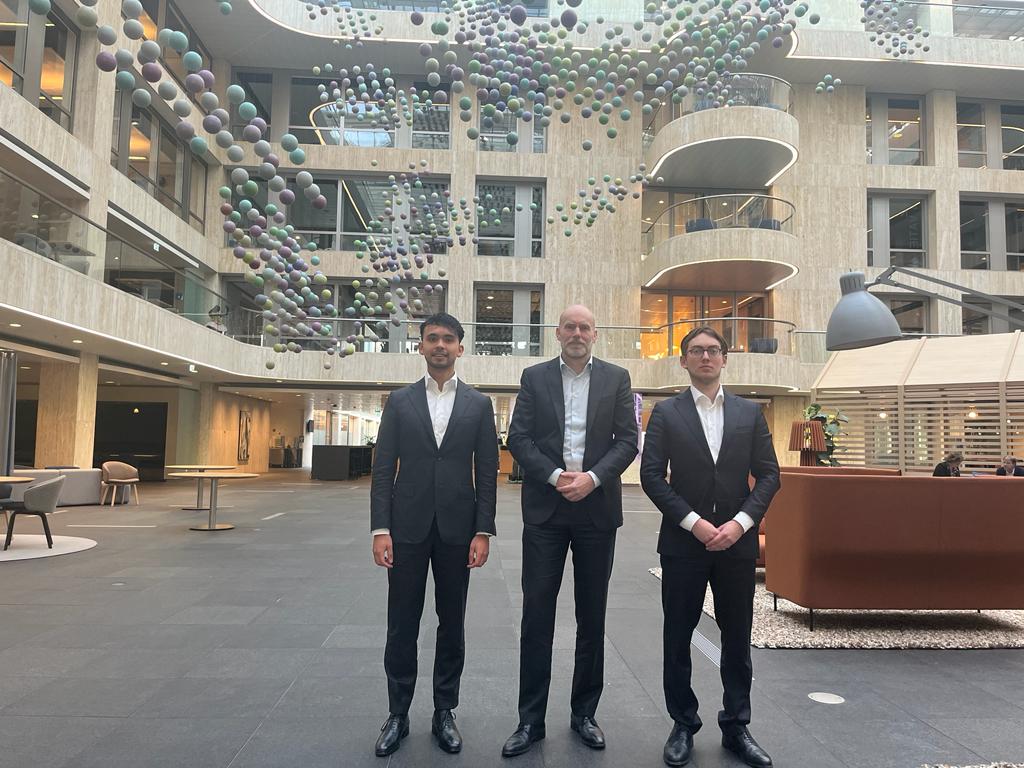
Interview René Berenschot – Executive Director at Aegon Asset Management
Aegon Asset Management is Aegon’s asset manager and offers a wide range of investment services. The company is committed to sustainable investment solutions and integrates environmental, social and governance considerations into its investment process. Aegon Asset Management has offices in Europe, the US and Asia and employs around 1,200 people. Assets under management and advice amount to around EUR 280 billion. Aegon Asset Management’s clients are mainly pension funds, insurance companies, banks, asset managers, family offices and foundations. What did you study and how did you come to this choice? I followed several studies and developed my interest in equity investing as early as secondary school. My choice of study was more or less already made during that school period. I started at Havo and then chose the banking and insurance differentiation at HEAO. After completing that, I entered military service, which was compulsory at the time. After my service, I started applying for jobs and looked for a job in an industry that appealed to me, such as equity investing or asset management. It was a challenging time then and quite difficult to find work. My first job was at Van der Hoop Effektenbank, a bank that no longer exists. There were as many as 1,500 applicants for the position I applied for, and in the end, only two trainees were hired. During my career, I did several courses, including the VBA (Association of Investment Analysts) course. That may not be as well-known now, but you probably know the CFA training. The VBA is the Dutch variant, more focused on Dutch/European laws and regulations. CFA is more international and mainly focused on the US. I also studied Business Administration and Financial Law at Erasmus University. What had you done compared to the other 1,500 men to be chosen? I don’t think there was anything special about my approach. As they always say, just be yourself. But of course, I prepared well for it. In military service, I was given space and time to conduct job interviews. In the team I was on, all the guys had college or university degrees. They were all applying for jobs and it was not always smooth, but you could learn a lot from each other, for example how to write a good cover letter. That made it easier to get through the first round. After several interviews at different companies, you also became more adept at interviewing Did you benefit a lot from the financial law course in your career? I apply daily what I learned during financial law course. Financial law is about financial supervision, risk management, compliance, and everything around it. It is a good background, especially if you work with clients, but of course, it depends on your interests and the position you hold. If you focus on portfolio management, for example, you might need it a little less. Would you recommend students to do the CFA? Because in the Master Finance at Tilburg University, you can choose to do a CFA track. If you really want to go in the direction of asset management, it seems that it is mostly valued in the ‘front office’ (such as portfolio management and similar functions). I can imagine that if you are an accountant working for an asset manager, a CFA is not that relevant. But if your focus is really on the front office, then a VBA or CFA definitely have added value. I remember that for my position at a previous employer, Van Lanschot, it was even mandatory. It was not then a matter of ‘it’s handy if you have it’, but really a requirement that someone had to have a CFA or VBA certification. What else has your career looked like? I started at Van der Hoop Effektenbank where I worked for eight years. I held various positions there; started as a trainee, and then you look around a bit in different departments. Then I did analyst work for a short time. After that, I did advisory work for private clients, asset management for institutional clients, and eventually became responsible for asset management for private clients. After that, I joined Kempen Capital Management. Now you have Van Lanschot Kempen, but back then Kempen was still independent. I then joined Van Lanschot. At the time Van Lanschot Kempen took over, I also got an offer to work at BNG Bank in The Hague (Bank Nederlandse Gemeenten). BNG Bank only provides services to parties serving the public interest such as municipalities, provinces and housing associations. It is one of the largest banks in the Netherlands with a balance sheet total of over €100 billion. At the time, BNG wanted to start an asset management company. Previously, companies such as Vattenfall (Nuon), Eneco and Essent were mainly owned by municipalities and provinces. Then came the liberalisation wave and those companies had to be sold. And BNG bank knew that market well and so the logical idea arose ”let’s start an asset management company” to manage the funds that became available. Well, I thought that was a very nice challenge and it worked out very nicely. Because from scratch, assets under management have grown to around €6 billion. Then a.s.r. came along. BNG Bank wanted to return to its core business and divest asset management, whereas a.s.r. wanted to set up asset management for third parties. Because a.s.r. did not yet have the infrastructure in place, BNG Asset Management was bought. Then at the end of 2022, it was announced that Aegon Netherlands was sold to a.s.r., leaving all of Aegon’s other businesses outside; such as Aegon USA, Aegon Asset Management, etc. Aegon Asset Management has a real ambition to grow further. They invest a lot in new teams, products, services and systems. For example, Aladdin (front office system for portfolio management, risk management etc.) was recently purchased from BlackRock and is currently being implemented. Part of the a.s.r. transaction was that a number of investment teams (and the associated assets under

AI and investing: a great success or one big mess?
Disclaimer: This article is for entertainment purposes only and cannot be used for financial advice. Artificial Intelligence is a term that has been gaining considerable traction in recent years and, in its very early days, is already having a big impact on society. Where it is also having a big impact is on the financial sector, and especially on investing. To what extent is Artificial Intelligence changing investing? Advantages First of all, AI allows for more automation. This works through what is known as quantitative trading. This involves creating algorithms that seek out market inefficiencies to take advantage of them. This is done at high speed, allowing for high returns in a short time. Currently, hedge funds in particular make use of this. The use of AI by hedge funds has therefore exploded in recent years. According to a study by Barclay Hedge Fund, more than half of all hedge funds use Artificial Intelligence to achieve higher returns. However, these hedge funds do not achieve more returns directly. The reason is that it is difficult to interpret outcomes of these algorithms. This requires specially trained workers, of which there is currently a shortage. Private investors can also use AI. For instance, websites like ChatGPT are used for investment advice (Investing News Network, 2023). Secondly, Artificial Intelligence enables easier and faster analysis of large data sets. As a result, good investment opportunities are identified faster, allowing for greater returns. Artificial Intelligence also makes it easier to analyse risks. Companies like Deloitte have developed special programmes for this. Next, fraud can be spotted more easily thanks to the advent of Artificial Intelligence. This way, investing remains fairer and investment platforms can more easily guarantee their integrity. For example, if particularly large trades are suddenly made to a bank account or if a disproportionate number of investors go short in a limited period of time, the AI model identifies this as potential fraud. The model then sends a notification to the investment platform and action is taken. Risks Many people are concerned about the impact of AI, including well-known investors including Warren Buffett. He is not optimistic about the future of the technology and calls it a danger to society. He even compares it to the atomic bomb. Despite his concerns, he does invest indirectly in AI. As much as 47% of Berkshire Hathaway consists of Apple shares, and that while Apple is aggressively investing in building products that work with Artificial Intelligence. It also owns $1B worth of Amazon shares (less than 1% of its portfolio). So Warren Buffett sees no future in the technology, but rather in the companies actively implementing it; which is curious to say the least. Another drawback is that the technology can actually be used to commit fraud. The technology can cause identity fraud with the result that investors are hacked. In addition, stock markets can be manipulated. Algorithms created by an AI model contain such a variety of features and functions that traditional algorithms do not have, making it easier to manipulate markets. To prevent this, financial authorities need strict supervision (Ligon, 2023). Another risk is that Artificial Intelligence mainly takes past returns into account. These are no guarantee for the future and can therefore only be used as a tool. Furthermore, AI can lead to discrimination. While this may not be directly related to investing, it is an issue that deserves extra attention. Implementing technology may cause certain people or companies to be excluded, resulting in discrimination. Therefore, it is important not to blindly rely on Artificial Intelligence and use it only as a tool. Conclusion The advent of Artificial Intelligence brings many consequences; not only for society but also for the financial world. It brings many benefits; for instance, large data sets can be more easily analyzed, allowing opportunities to be identified faster. This should ensure higher returns. Unfortunately, this new technology also has drawbacks. For instance, Artificial Intelligence can lead to fraud and can be used to manipulate the market. Furthermore, care must be taken to ensure that it does not lead to discrimination. To ensure that these drawbacks do not take place, it must be strictly supervised by financial authorities. If this happens, the new technology certainly has a future in the world of investing. Furthermore, retail investors should never simply follow financial advice from an AI chat box like ChatGPT.

The different career paths in asset management, investment banking and private equity
For the Dutch version, click here. After obtaining a finance master’s degree or equivalent, you can pursue various different ‘front office’ careers in investment banking, asset management or private equity. Those terms might seem new to you, but don’t worry, this article aims to define these terms and explain what each career entails. First of all, being able to tell the difference between various careers and additionally, being able to define what role you specifically like, will make you stand out during a recruitment interview. If you know all roles and the differences, you probably know the workload and skill requirements you need for the job you are applying for and such you can figure out and explain why you fit a particular role. Asset management Asset management might be the most familiar role known to students that are interested in investing capital. Asset management is a crucial part of finance where professionals, known as asset managers, help people and organizations make the most of their investments. The main goal is to help clients achieve their financial goals by growing or preserving their investment portfolios. Think of asset managers as the experts who guide clients in making smart investment choices that suit their risk profile. These experts work with all sorts of clients, like high-net-worth individuals, big corporations, pension funds, sovereign wealth funds and more. They have to create investment plans that fit each client’s unique situation and what they want to achieve. Asset managers deal with different types of investments, like stocks or shares, bonds, real estate and other financial assets. They have to pick the right mix of investments based on what the client wants and how much risk they’re comfortable with. It’s like creating a recipe that balances getting good returns while taking an appropriate amount of risk. In a nutshell, asset management is a complex field where experts use their knowledge of money and markets to help clients make more money with their investments. They need to be really smart and experienced to handle all the twists and turns of the financial world while helping clients make the best choices for their money. This guide gives you a taste of what asset management is all about and encourages you to learn more about it if you’re curious. Roles Asset management is a big area with various jobs that need different skills and knowledge. Some of the most common jobs in asset management are: Portfolio Manager, Research Analyst, Trader, Risk Manager, Compliance Officer, Operations Specialist. Portfolio Manager A portfolio manager in asset management supervises a collection of assets for clients to maximize returns while minimizing risk. They make investment choices, track market trends, and adjust the portfolio to meet client goals. Effective portfolio managers need strong financial market knowledge, analytical skills, and quick decision-making abilities. They also manage client relationships, communicate strategies, and work with analysts and traders for data-driven decisions. Overall, they play a vital role in helping clients achieve financial goals by making smart investment decisions and managing their assets. Trader A trader in asset management executes trades to maximize returns and reduce risks for clients. They collaborate closely with portfolio managers and research analysts to find and implement investment strategies. Traders understand financial markets, analysing trends and news to spot opportunities. They possess strong technical skills and manage trade-related risks by monitoring positions and using hedging strategies. Traders might specialize in specific asset classes, like stocks, bonds or derivatives, often while working within a team. The role is fast-paced and high-pressure, but also rewarding for those interested in financial markets and investments. Research Analyst (Equity, Bonds, Commodities etc.) A research analyst in asset management conducts research and analysis on different financial securities to find investment opportunities and suggest actions to portfolio managers or clients. They collaborate with the investment team to understand market trends and use tools like financial statements and news sources for data analysis. They assess company-specific details like financial ratios and management quality to evaluate stock or bond value. Their findings are shared through reports with buy, hold, or sell recommendations for review. The analyst also keeps updated on industry news, meets company representatives, attends events, and connects with experts to gather insights. Overall, they play a crucial role by providing vital research to guide smart investment choices. Risk Manager A risk manager in asset management identifies, measures, and handles risks associated with the firm’s investments. Their main job is to make sure the firm’s investments match the risk levels clients are comfortable with and to prevent exposing clients to unnecessary risks. The risk manager works closely with portfolio managers to ensure investment strategies fit clients’ risk preferences. They also keep an eye on market trends and regulations to ensure the firm follows the rules. Overall, the risk manager is crucial in making sure the firm’s investments align with clients’ risk preferences, safeguarding assets, and maintaining client trust. Operations Specialist In asset management, operations professionals handle the behind-the-scenes tasks that support investment management. They manage processes like trade settlement, cash handling, fund accounting, and reconciliations. Working with investment experts, they ensure trades are done accurately and settled on time. The specifics of their role can vary based on the firm and services offered, like handling trade confirmations or client reporting. Operations is crucial for accurate records, risk reduction, and efficiency improvement through process automation, which cuts costs and enhances performance. Compliance Officer A compliance officer in asset management ensures that the firm follows the legal and industry rules. They follow KYC and AML policies for onboarding new clients and check up on them every once in a while. They also create and enforce policies to keep the firm compliant with laws and regulations. This includes internal audits, reviewing marketing materials, and monitoring trading. Additionally they make sure employees know and follow the rules and report any violations to regulators. Besides external rules, they also enforce internal ethics and conduct policies to protect the firm’s reputation. In short, compliance officers make

A canal house or a tulip after all?
For the Dutch version, click here. Disclaimer: This article does not contain investment advice and only aims to inform and entertain. This article discusses the very first economic bubble. For this we go back to the golden age (17th century). Originally, tulips did not originate from Holland at all, as many believe. They came to the Netherlands through the trade that the Netherlands conducted with Asia. Because of this, tulips were also seen as luxury goods. During this period, the Netherlands was very prosperous, thanks to this international trade, and interest in flowers increased tremendously. During the golden age, status was very important; to increase it, people bought expensive items, including tulips. The Library of Economics and Liberty wrote the following about this: “It was deemed a proof of bad taste in any man of fortune to be without a collection of [tulips].” Partly because of this, the demand, and eventually the price, only continued to rise. Because demand was so high, starting in 1636 it was possible to trade in tulips through the Amsterdam Stock Exchange. In 1637, the tulip price reached its peak; one tulip bulb had the same value as a canal house in Amsterdam. It was also possible to trade in options tulips. Disadvantages of tulips First of all, tulips are particularly fragile and must be grown carefully. Because there was a lot of money to be made in the tulip trade, many growers arose. These growers learned sophisticated techniques to promote the cultivation of tulips. There was even a technique discovered to make a tulip have different colors. These were rarer and therefore worth more money. In addition, tulips did not contain an intrinsic value, which shares do. The intrinsic value of a stock can be calculated by reducing the company’s total assets by its total liabilities and then dividing this by the number of shares outstanding. This can be used to calculate whether a stock is overvalued or undervalued. This method is used by many experts, including Warren Buffett. “What goes up must come down.” Eventually, the tulip bubble burst at the end of 1637. People began trading in tulips using leverage; this involves investors borrowing money to realize returns. These investors often had other debts that they hoped to pay off by making possible high returns on the tulips. When investors were forced to sell tulips to pay other debts, the market began to collapse. So as investors borrowed money to speculate in tulips, this happened very quickly and eventually the bubble burst. What seemed like an easy way to get rich ended in failure for many. Relevance to the present Although the tulip bubble burst almost 400 years ago, the event is still very relevant today. For example, Bitcoin today is regularly compared to this tulip mania. The price of the cryptocurrency is volatile and, like tulips, indeed lacks intrinsic value. In both 2017 and 2021, the value of the cryptocurrency rose unprecedentedly hard only to fall again at least as hard. There are a number of similarities between tulips and Bitcoin. According to Pichet, E (2017) and Taskinsoy, J (2019), both tulips and Bitcoin were only used to speculate. Individuals purchased tulips for the sole purpose of selling it for a higher amount without making rational considerations, the same was true for Bitcoin. Still, there are some differences. First, Bitcoin is scarce, which cannot be said about tulips, which can be grown at any time. In addition, the cryptocurrency is based on the Blockchain. Conclusion The likelihood of a similar bubble occurring in the future will always remain significantly high. People will continue to strive for high status and therefore are looking for a quick way to make money. Thanks to the advent of the Internet, bubbles form a lot faster and as long as people continue to act irrationally, bubbles will continue to form. There are some wise lessons investors can take away from this bubble: Always remain rational. As discussed, financial bubbles occur because people make irrational decisions and, as a result, begin to speculate in investments that they themselves do not understand. As a result, individuals can react emotionally to price changes and subsequently lose a lot of money. Be less concerned with status and don’t compare yourself to others. Instead, it is better to focus on your own (financial) situation. If an investment seems too good to be true, it probably is. Don’t just borrow money to invest. This makes an investment unnecessarily risky and can have negative consequences as the tulip bubble shows. Sources Hayes, A (2022), Tulipmania: About the Dutch Tulip Bulb Market Bubble. Retrieved from https://www.investopedia.com/terms/d/dutch_tulip_bulb_market_bubble.asp Is geschiedenis (nd), De tulpengekte tijdens de gouden eeuw. Retrieved from https://isgeschiedenis.nl/nieuws/de-tulpengekte-tijdens-de-gouden-eeuw Pichet, E (2017), The Conversation, Bitcoin: speculative bubble or future value?, Retrieved from https://www.researchgate.net/publication/324660599_Bitcoin_Speculative_Bubble_or_Future_Value Taskinsoy, J (2019), Bitcoin: The Longest Running Mania – Tulips of the 21st Century, Retrieved from https://www.researchgate.net/publication/338009334_Bitcoin_The_Longest_Running_Mania_-Tulips_of_the_21st_Century

From Startup to IPO: How financing influences the journey to public listing
For the Dutch version, click here. When looking at companies traded on the exchange, you often find a long history of how they grew to their current size. Long-standing companies such as … that originate from the early 1900s usually took a long time, gradually growing and taking over competitors until they became the market leader. Nowadays, with recent IPOs such as … we see that these companies have a different story; getting VC funding to grow exponentially until IPO. Take the FAANG companies for example, each of them used VC funding to get where they are now. In this article, we will explore how companies start out small but use venture capital to become market leaders. Many of the companies that we look up to today started out small. You probably are familiar with how Apple and Microsoft started out of a garage, or how Zuckerberg created the first version of Facebook in his dorm room. When companies are in this stage, they are often bootstrapping, i.e. solely financing their company with the revenue that they generate. Growing a company like this can be a long and difficult process, but in the end, the company will be fully owned by you and your co-founders. While bootstrapping is the way to go for some, sometimes this is not possible as you may need more capital to start than you have or if you want to grow your company quickly. If this is the case, taking on external capital is the only option. Within the VC industry, the first moment a company takes on external funding is referred to as the pre-seed round. In the pre-seed round, there are many options available, but the first funding often comes from individuals close to the founders; family, friends and fools. These people will loan money to the founders so that they can make their start, but other than that they don’t provide much else to the company. The same goes for starting grants provided by the government or university. The founders can also look for sources of external funding that will add more than just money; guidance and expertise. Business angels can be useful for starting companies if the business angel is already experienced in the industry or has a good understanding of how to build a company, but can be risky as they operate alone. Other options are incubators and accelerators. These are businesses that are specifically created to grow the companies that they finance and often have in-house services that the companies that they finance can freely use such as office space, lawyers, or accountants. With the initial financing that they received in the pre-seed round, the founders of the company are able to commit to their company and take their first steps. However, this is also the moment when starting companies enter “the valley of death”. This is the phase the company has found their initial proof concept, has a prototype, and maybe even its first cashflows, but remains unprofitable. If nothing changes, the capital will dry up and the company will have to stop operations. This leaves the founders with two options, try to become profitable before capital runs out, or go down the venture capital route. Once a company takes on venture capital, the strategy of the company will likely change drastically. With just the founders or with an early investor on board, time and growth may not be a priority until the company becomes profitable. When a venture capital fund invests, the company is expected to grow as much as possible and as quickly as possible using the newly acquired capital. Venture Capital funds have a limited lifetime in which they have to return their fund to their investors. Because of this, venture capital funds are always trying to realize an exit from their investment before the end of their fund’s lifetime. An exit for a venture capital fund can be made in multiple ways; an acquisition, a MBO, another fund buying their share, or via an IPO, the most lucrative option. So when a venture capital fund invests in a company, the founders are expected to work towards one of these exits as quickly as possible. Much can be said about taking the venture capital option, but if you can take the pressure, much can be gained. The venture capital journey is often described as being on a rollercoaster, with all the ups and downs along the way. Until an exit is reached, it has a cyclical nature to it. While growing your company and trying to reach profitability, you need to make sure that there is enough money in the bank to stay afloat. This is done through fundraising, where the first venture capital investment you raised is called the seed round, and each consecutive round is called series A, series B, series C, etc. The process of fundraising stays quite similar throughout these rounds, starting with pitching your company to various VC funds, settling on deal terms with an interested fund, surviving due diligence, until closing the deal and getting the money in the bank. On the other hand, a lot changes during these investment rounds. The company gains market traction, creates more professional processes, and hires more employees, with each new financing round fueling the fire. This all happens in order to grow the company so that an exit can be realised. The description of venture capital funding above may paint VC funds as just investors seeking to maximise their own gains. However, because of incentive alignment, VC funds will do whatever they can to make the companies that they invest in successful. The people behind VC funds are professionals when it comes to growing companies. Each shortcoming of their portfolio companies will be pointed out and resolved. They will use their network to open up new opportunities, help find new financing, and of course, help realise an exit. When you take on VC funding, you will both win quicker and fail
