


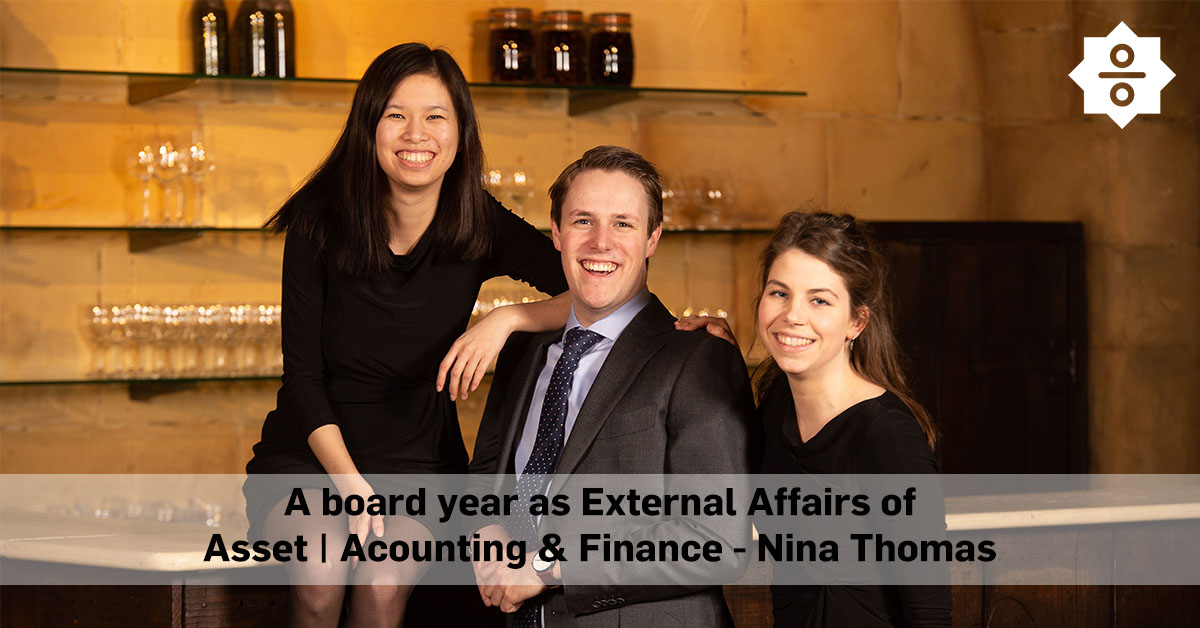
For the Dutch version, click here As External Affairs, Nina is responsible for the contact with current and future partners of Asset | Accounting & Finance. In addition, she coordinates the Accountancy Cycle, Accounting Expedition and Orientation committee. In this article, Nina explains her function and her experience as an External Affairs of Asset | Accounting & Finance. Why did you choose for a board year at Asset | Accounting & Finance? As a committee member of Asset | Marketing, I organized a fantastic trip to Malaysia during my second year of my bachelor. However, I did not think about a board year back then; I wanted to go on exchange and finish my bachelor’s in Business Economics. Only during my exchange in Sydney, I began to think more seriously about it. I’m not sure whether the reason was my carefree student life which suited me well or my personal development growth, but a board sounded more and more attractive. This feeling became stronger during my time as a member of the Financial Business Dinner committee of Asset | Accounting & Finance (A&F), which felt very comfortable. Another reason which contributed to my choice was the difficulty of choosing the right master. However, as someone who is known for doubting a lot, it is not a surprise that I was in doubt about this decision as well. After several conversations, my doubts turned out to be unnecessary which led me to the well-considered decision to apply. The only decision left for me was which function within the board I wanted to fill. Firstly, I was thinking about becoming Treasurer of the board, as I had an affinity with numbers and making budgets. However, a board year is meant to step out of your comfort zone. Therefore, I decided to apply for the position of External Affairs (External). What does your year look like and how do you like it? The year began with a full agenda. During the day, I visited our partners to discuss our cooperation. During the evenings, I was busy with Announcements or dates with other boards and in between, conveyance and policy sessions were planned. I got to know the organizations and recruiters, which improved our collaboration during the year as well as my perspective on different sectors. The Financial Business Dinner took place at the end of September, and soon the events which I coordinated as part of my board position took place. This resulted in greater a responsibility, but also a feeling of being proud of the committees as well. The peak of ‘my’ events happened in February/March. As summer External, I was responsible for the organization of the Finance Day, Master Experience Days and Accounting Expedition. These events all took place within the period of one month, which tested my time management and list of priorities. It is, therefore, gratifying to see that students appreciate our events and use them to build their network. In the end, that is what our association stands for; connecting students with their potential employer. Because there is always something to do, time flies by. Beforehand, I was wondering how I could be busy for seven hours a day; right now, I ask myself how it could be that the day flew by so quickly. Even weeks flew by quickly, and I feel like we have just begun the board year. I think it is difficult to summarize my experiences within 1000 words or to give just one answer. ‘Good’ is not sufficient, as a board year is something you have to experience. Therefore, I am very happy with my choice. And my doubts… those have been replaced by doubts regarding the choice of a menu (it is still a learning process). What are your tasks as External Affairs? As External, you are the first contact for companies. You work together closely with the other External in order to provide companies in their needs. The conversations during the summer form the basis and these are supplemented with new partners. Via either physical appointments or appointments by phone, you determine whether there exists a match between what companies search for and what A&F offers. Sometimes, you have to say ‘no’ and there will be no match. This can change, therefore maintaining a good relation is essential. The same holds for existing partners, you want to keep those satisfied. You are building a network which could be important later on in your career. “Here, it does not really matter whether you are a quiet person in general or someone who prefers to step forward. As long as you are social and open-minded, it is alright.” It is great that my position within the board emphasizes the importance of soft skills. Keeping contact with A&F partners improves your communication skills and it allows you to learn how to present yourself and A&F well. You will learn these skills quickly enough. Here, it does not really matter whether you are a quiet person in general or someone who prefers to step forward. As long as you are social and open-minded, it is alright. Also, you do not have to be a professional in small talks. Moreover, you should not be afraid to bring or receive less positive news. These could be tough conversations, and it is your task to resolve these in the right way. Solutions will differ, yet each situation requires flexibility and rationality. Although you will be the point of contact, fortunately, you are not alone. My skills regarding crisis management have clearly improved and I am proud when looking back at how I solved certain situations. What does your average day look like? An ‘average’ day does not exist, yet there are recurring occasions such as committee or board meetings, keeping social media channels up to date or adding vacancies on Career Platform Tilburg. In addition, I spend quite some time keeping my mailbox up-to-date and making phone calls (or receiving voice mails). However, this is just a
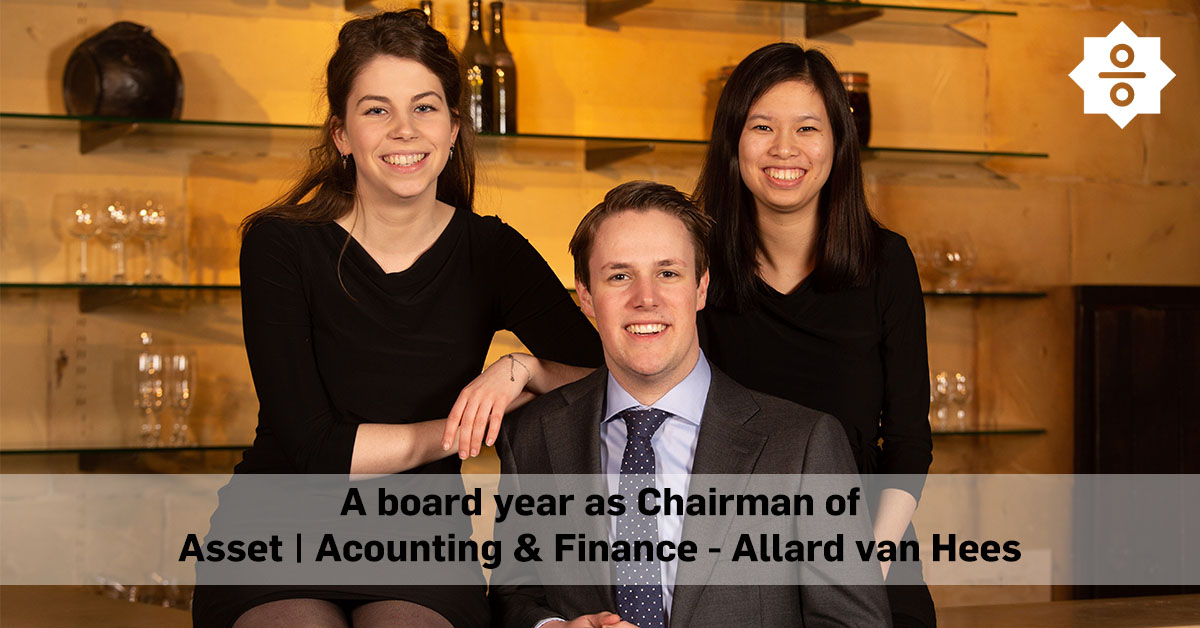
A board year as Chairman of Asset | Accounting & Finance – Allard van Hees
For the Dutch version, click here As Chairman, Allard is responsible for the policy of Asset | Accounting & Finance and external communication to parties such as Asset and the University. He also coordinates A&F Investments and the CityTrip committee. In this article, Allard explains what his position entails and how he experiences a year as Chairman of Asset | Accounting & Finance. Why did you choose to do a board year at Asset | Accounting & Finance? When I joined Asset | Accounting & Finance in my first year I never thought I was going to do a board year. At the time, I was much more concerned with getting my BSA than thinking further about my future. As I progressed in my bachelor Business Economics and I became more active at Asset | Accounting & Finance, for me it seemed more and more fun to do a board year and to view the association from a different perspective. In addition, you also learn a lot from a board year. You learn what it is like to run a kind of company and thus gain a kind of management experience that you can hardly gain with, for example, an internship. I chose to do a board year at Asset | Accounting & Finance (A&F), because after this year I will study Accountancy and can, therefore, come into contact with various companies in this sector. At first, I had the ambitions to become a treasurer, but as the application procedure progressed, I nevertheless chose to become Chairman. “You learn what it is like to run a kind of company and thus gain a kind of management experience that you can hardly gain with, for example, an internship.” What does your year look like and how is the experience so far? The applications started in April, which resulted in me becoming the Chairman for the academic year 2019-2020. At first, I was quite reluctant to become Chairman, because Chairman sounds like something very serious and with a lot of responsibility, but after a number of conversations with other board members I was assured that I could do it. From July onwards I fully participated, first under the wings of my predecessor Stijn, who immediately took me everywhere from the beginning. The conveyance period is a fun, but above all educational time in which many impressions come at you and many things are done. In July, you will also write the policy for the upcoming academic year together with the other board members, which I have to present at the General Members Meeting. After the General Members Meeting, you can quickly join the flow of the year. Many events come your way, fun drinks and tough meetings. Before you know it, you already talk about the successors of Twan, Daniek and Steyn in the weekly board meeting. That makes you think about how fast a year actually flies and what you have experienced up to that point. As Chairman you also have the board of Asset where you take a seat. That makes the position of Chairman fun and challenging, because you are not only dealing with the position of A&F, but also with the position of other departments and Asset as a whole. You have to be able to look from different perspectives to make the right decision. Since I have an affinity with financial data, I chose the position of treasurer there. This fulfils the ambitions of treasurer, which I had when initially applying for a board year. What are your tasks as Chairman and what does your average day look like? As Chairman you are responsible for leading the weekly board meetings, policy meetings, General Members Meeting, and the meeting of the Advisory Board. In addition, you are also on the board of Asset and you are responsible for a portfolio within that board. The Chairman is responsible for writing and complying with the established policy. An average day is difficult to describe since every day is different, but almost every day there is a meeting on the agenda. Beyond that, you have to read and write a lot of updates, prepare for meetings, and help fellow board members where needed. I also attend the meeting of A&F Investments, our investment team, every other week. In this meeting, I learn a lot about the stock market and how you can value companies based on the available figures. Although A&F Investments did not immediately suit my personal interests, I did appreciate the team for the high degree of professionalism and enthusiasm of the members. I think the CityTrip meetings are one of the best meetings of the week. This is because I love to travel and this edition was the first edition of the CityTrip. Do you have any tips for your successor? Don’t forget to enjoy all the things you do in your board year. A board year is over before you know it, and you want to be able to look back on it with a lot of joy! If you would like to know more about my board year after reading this article, feel free to bring a visit to room E1.07 and ask your questions during a cup of coffee! In addition, you can get to know more about the specific division of roles within the board via this link.
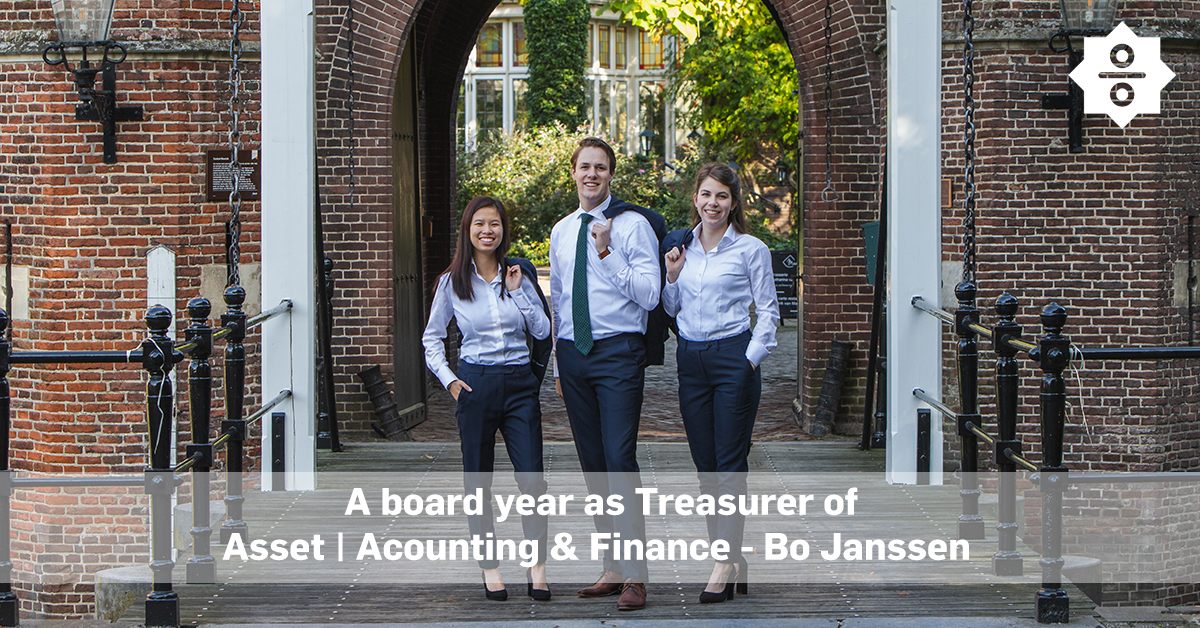
A board year as Treasurer of Asset | Accounting & Finance – Bo Janssen
For the Dutch version, click here As Treasurer, it is Bo’s responsibility to control the finances of Asset | Accounting & Finance. Besides that, she coordinates the Activities, Alumni, CityTrip, and Investment Night Committee. In this article, Bo describes what it means to be the Treasurer of Asset | Accounting & Finance and how she has experienced her board year so far. Why did you choose to do a board year at Asset | Accounting & Finance? When I started with my Bachelor Business Economics in Tilburg, I didn’t know a lot of people here. Because of that, I decided to become Active at Asset. I started by joining a committee at Asset | Marketing and because I enjoyed this a lot, I decided to join Asset | Accounting & Finance (A&F) as well. I considered doing a board year for quite some time, as I really enjoyed my time at A&F and wanted to boost my CV. Although I had not fully decided yet on which master I wanted to follow, Accounting and Finance seemed very interesting fields to me. To orientate better on which master to follow and to get in contact with firms in these fields, I decided to apply for the position as Treasurer of the board of A&F. What does your year look like and how is the experience so far? This year really feels like it’s flying by and when I look back, I already have great memories of the things we’ve done so far. The application procedure for the summer positions started in April. When I found out I was going to be the new Treasurer, the announcement couldn’t come soon enough for me and it was really hard to keep my plans for this year a secret. After the announcement, the transition period started in which I learned what tasks I was going to have as Treasurer. Because most departments within Asset switch boards in the summer, you start with a large new group in the Esplanade building in August. During the Announcement and Constitution Drinks, you will get to know your fellow board members of other departments, which will create a nice atmosphere at the rooms of Esplanade. When my board year started in the summer, I was still very busy organizing the studytrip to South Korea together with the StudyTour Committee. With the start of my new function, my responsibility and the number of tasks increased considerably and for some time I questioned if I could sufficiently do all tasks simultaneously. Eventually, this turned out fine and it came in quite handy that as Treasurer I had the overview of all the expenses and credit card usage during the StudyTour. However, I had to watch out for keeping the A&F card and my personal card apart while doing this. After a couple months already, the application of new board members was a discussion topic in our weekly board meetings. I felt like we had just started, so the idea of a new group coming was not on my mind yet. Therefore, it felt quite strange to me to look at a new Candidate Board with whom we were going to form the new board. Now that we have just started with the new board members, I realize how quick this year is passing by. Half a year has already passed, and suddenly we are the ‘older’ half of the board and soon we will start to look for the people who are going to replace us. Nevertheless, I do like this semi-annual board switch. The new board members bring in fresh ideas and I’m convinced we will make the upcoming semester a great success! What are your tasks as Treasurer of A&F and what does your day look like? As Treasurer you mainly focus on the financial situation and the administration of the association. To do this well, you must be able to communicate well with your fellow board members and the treasurers of the various committees. As Treasurer, you also meet with the auditing committee every quarter. They audit your financial administration and advise you about the financial situation of the association. This range in different tasks makes it quite difficult for me to describe what an average day looks like. Something that takes place every day is the fulfillment of my task list. At the start of every week, I set up a list of things I want to achieve the upcoming week and most of the days I start with the tasks that are on this list. What did you learn so far in your board year? Besides the responsibilities I have as a Treasurer, I also coordinate several committees. I really like brainstorming with the committees about setting up certain events and then working towards them. In this enjoyment I notice that it is quite hard for me to only coordinate the committee without taking on tasks myself as well, but I am currently working on finding my balance in this. Because you’re focused on various events, you’re always working on several tasks simultaneously. To keep these various tasks running, you must have a good overview of this. Additionally, I find it important to remain my own social life besides my board activities. Although it can be quite hard to plan this out, I think I’m getting better at it. Moreover, I am still undecided about which master to pursue. Initially I thought I had made up my mind, but lately I’ve started to doubt again. Therefore, I am happy that I postponed my masters’ choice and still have some time to orientate to find out what I find interesting. The events that A&F organizes significantly helped me with this. Due to these events, I met several companies and got a much better overview of the job possibilities that lie ahead. What is your greatest accomplishment? My committees! I enjoy working on our events with my committee members and I enjoy seeing everyone again at
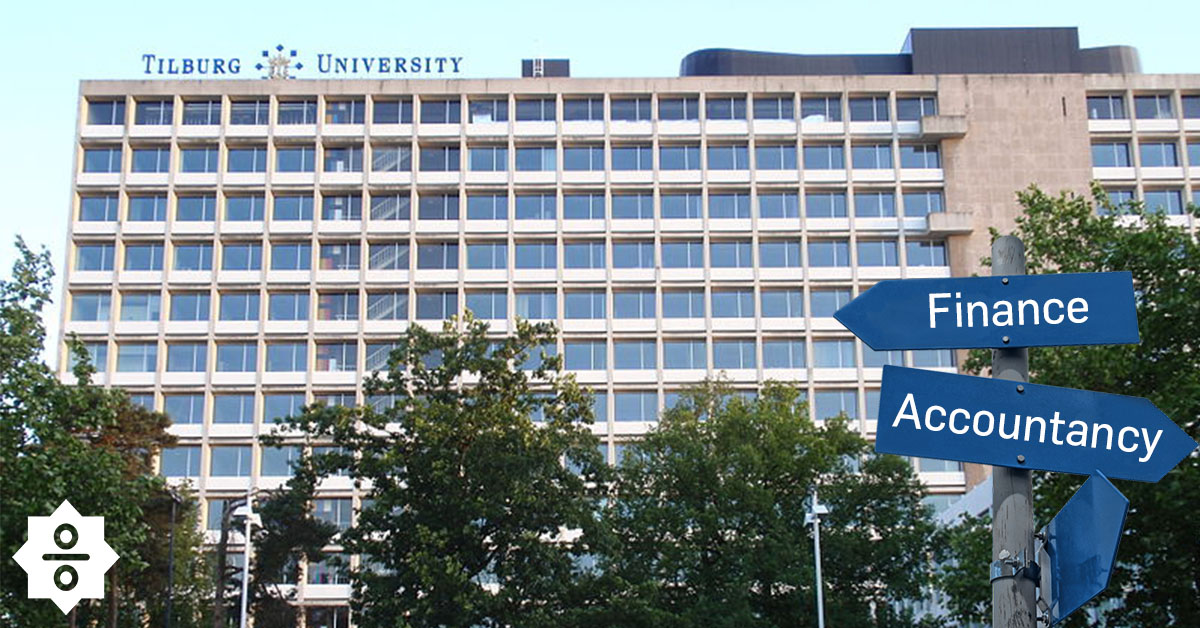
What’s next: MSc Accountancy or Finance?
Picture: Ron Maijen For the Dutch version, click here It’s that time of the year again when all students are starting to think about what to study and where to study. There are so many choices and so many cities that offer the same study, which makes it a very difficult choice for most students. Hence, to lighten this burden a bit up, current students of MSc Finance (Boris de Bie) and MSc Accountancy (Emil & Kevin de Veer) have given their thoughts about the program that they are following at Tilburg University. MSc. Accountancy – Emil & Kevin de Veer When we had to make the decision to choose a masters to study, we were both really hesitant on choosing Accountancy. We really had the idea that it would all be about bookkeeping and reconciling balance sheets the whole time, but were surprised to find out that it was a lot more than that! “Not only do I feel like they are preparing you to become an excellent chartered accountant or controller, but they also teach you how you can master the financial language of the world. “ Emil: After I found out about this, I applied in no time because I knew that this was exactly what I wanted to do. With mandatory courses such as Empirical Methods in Accounting and Financial Statement Analysis & Valuation, I immediately knew that this masters program was on another level in the accounting world. Not only do I feel like they are preparing you to become an excellent chartered accountant or controller, but they also teach you how you can master the financial language of the world. You really realize that you are being taught A-class material when after following most subjects, they start to fall in line with each other. Valuing a company and using accounting to help you make better investment decisions is something that this masters program also offers. Thus, also a part of Finance is included. Another course that I really admired was Management Accounting. The reason for this is because it does not only teach you how to read financials as a manager but also how you could better manage your company with the use of accountancy. Kevin: What surprised me at being different in this program was the use of ‘Tweets’ (from the social media platform of Twitter) during the course of Management Accounting. We had to construct tweets as summaries from papers in the most creative way to resemble the meaning and context behind the paper. This different way of teaching is one of the factors that contributes to the quality of the program that master accountancy brings with it and one that helped surpass my expectations of this program. The quality of the program is also sustained by the in-depth material that is covered in courses Advanced Auditing and Empirical Research in Accounting. In these courses they cover recent papers in the field of accountancy that teach you how to think about the accounting profession from another perspective than just from the regular activities. An example would be discussing recent developments in the United Kingdom where consultancy and accountancy are going to be split apart. Why are they doing this and what are the pros and cons of this development? By gaining an extra insight in the field of accountancy itself, you will develop a stronger foundation. This helps you to decide in which accounting areas to specialize yourself in the future, so you will get the most out of your accountancy career. MSc. Finance – Boris de Bie Choosing a master’s degree was one of the most difficult choices that I had to make at the end of my bachelor’s degree in Business Economics. I was often told that the Finance master’s degree was one of the more challenging master’s degrees. This was because the bar was set quite high for this master’s degree. Now that I am halfway through my master’s, I can speak from my own experience that it indeed requires a lot more work compared to my bachelor’s, but more importantly, you also get a lot more knowledge and satisfaction out of it. “With a CFA qualification you demonstrate, among other things, that you have knowledge of analyzing, understanding and applying of investment instruments. “ Within the Finance Master’s, I follow the CFA (Chartered Financial Analyst) track, which focuses on financial management and investment analysis. This may sound a bit abstract, but the bottom line is that the courses that you follow offer a good preparation (+/-70%) for the CFA exam. With a CFA qualification you demonstrate, among other things, that you have knowledge of analyzing, understanding and applying of investment instruments. This is an internationally recognized qualification, which can be very useful when applying within the finance world. Courses that are specifically highlighted in the CFA track are courses such as Investment Analysis, Financial Analysis and Investor Behavior. These prepare you very well as a potential player in the investment world. Derivatives Securities & Risk Management is an elective course that fits in well with this, whereby different forms of securities are treated. Within the CFA track you have, in addition to a number of compulsory courses and just like in the regular Finance master, also a choice between different courses. However, the choice with the CFA track is somewhat more limited compared to the regular program.
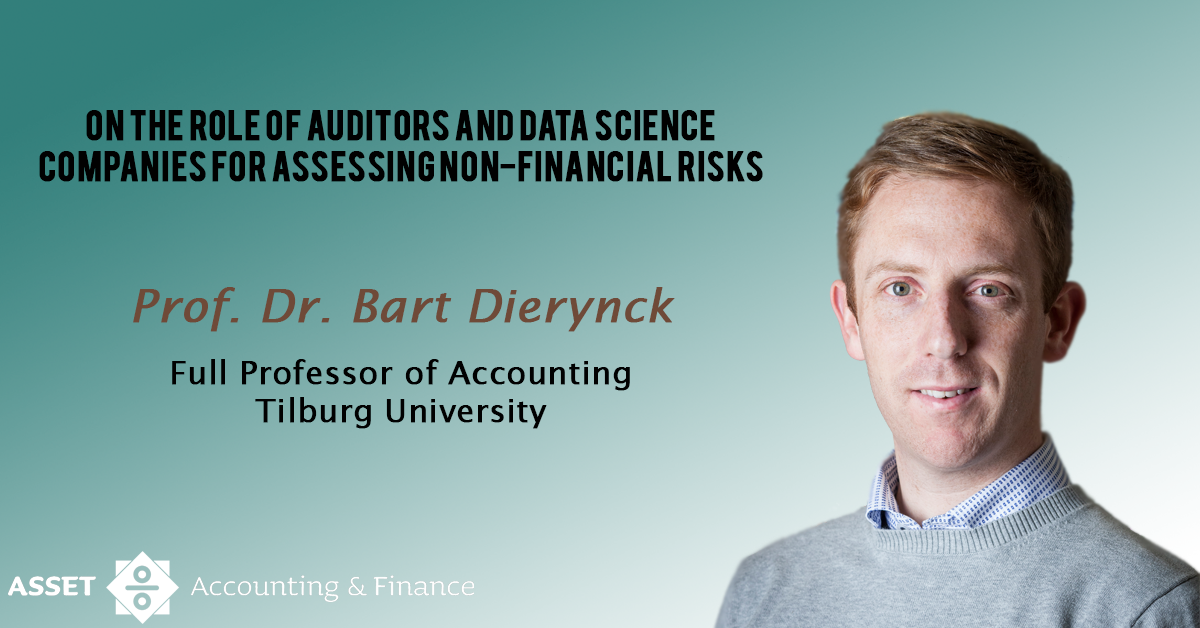
On the role of auditors and data science companies for assessing non-financial risks
The role of an auditor is to help outsiders to develop a true and fair view of a firm’s performance. In a more extended form, the true and fair view of a firm’s performance refers to the true and fair view of a firm’s strategy development and strategy implementation. For decades, the focus of auditors to enable the outsiders’ true and fair view was on the firm’s financial numbers. Such a financial audit happens within the boundaries of a standardized reporting format, implying that every firm, irrespective of its industry and strategy, reports the same financial metrics. As a result, deciding which metrics a firm should disclose to give a true and fair view is a competency that is not trained intensively among auditors during the last decades. The consequence of this evolution is that auditors lost sight of the link between a firm’s strategy and the financial numbers. Admittedly, educational institutions are guilty too! For instance, the link between a firm’s strategy and its management control system is a cornerstone in management accounting courses but is almost nonexistent in financial accounting courses. During the last decade, the increased attention for corporate responsibility has increased the demand from shareholders and stakeholders for more non-financial numbers in order to develop a better view of the firm’s strategy development and implementation, to assess the non-financial risks of the firm and to assess the consequences of a firm’s behavior for society. Importantly, the relevance of non-financial numbers to develop a better insight into the firm’s strategy development and implementation is conditional on the firm’s strategy and is thus difficult to standardize. Stated differently, the demand for more non-financial numbers requires that auditors consider the firm’s strategy when judging the relevance of the non-financial numbers that the firm wants to disclose. Given the auditors’ focus on the standardized reporting format for financial audits, judging whether the disclosed non-financial metrics give a true and fair view is often a struggle for auditors. “I would like to invite you to turn the question upside down and ask yourself what auditors need to do to reinforce their position when it comes to assessing non-financial risks.” Next to the struggle that auditors experience when doing non-financial audits, progress in data science has given data science companies opportunities to exploit the auditors’ struggle. Specifically, data scientists exploit the possibilities of machine learning to develop tools that give a quantified estimate of a firm’s non-financial risks. For instance, Datamaran, which is a business intelligence tool developed by eRevalue, uses information from corporate reports, global regulations, social media, stakeholder surveys and online news to assess a firm’s non-financial risks. An easy conclusion could be that those data science companies will drive audit firms out of the market for assessing non-financial risks. Admittedly, when learning about the tools offered by several data science companies and working with their data, I was quick to make this easy conclusion. At this point, I would like to invite you to turn the question upside down and ask yourself what auditors need to do to reinforce their position when it comes to assessing non-financial risks. A first answer could be that regulation can save the position of the auditor. I am not a big fan of relying on regulation to safeguard a particular competitive position. As an example, regulations have long protected the position of licensed cab-drivers and hotels but regulations have not been able to stop the success of companies like Uber and Airbnb. A second argument is grounded in the observation that the predictive validity of rankings for firms’ environmental, social, and governmental (ESG) activities, such as those developed by data science companies, is lower than usually claimed. For instance, many firms on Fortune’s Change the World List, which is a list of firms that are delivering profit-driven social impact, do not achieve top positions on ESG rankings developed by data science companies but outperform the MSCI World Stock Index by an average of 3.9 percent in the year following the inclusion in the Change the World List. “Of course, the entrance and pressure of data science companies in the market for assessing non-financial risks should still be a wake-up call for audit firms. It is thus crucial that audit firms revitalize the link between a firm’s strategy and its non-financial and financial numbers.” The reason for the lower predictive validity of ESG rankings is quite intuitive. Even though most rankings rely on machine learning, some standardization is needed to make such tools effective and efficient, which implies that the list of non-financial metrics used by machine learning tools requires standardization. As a result, most tools insufficiently capture the idea that assessing non-financial risks preferably happens conditional on the firm’s strategy. Importantly, the point is not that the ESG rankings are completely useless but that the conclusion that data science companies will drive audit firms out of the market for assessing non-financial risks is too far-stretched at the moment. Of course, the entrance and pressure of data science companies in the market for assessing non-financial risks should still be a wake-up call for audit firms. It is thus crucial that audit firms revitalize the link between a firm’s strategy and its non-financial and financial numbers. Relatedly, audit firms could more clearly communicate their judgment regarding the relevance of the non-financial metrics chosen by the firm conditional on the strategy of the firm. Importantly, auditors should be trained in making such judgments, implying that the role of firm strategies should get a more prominent role in (non)-financial accounting courses. In the MSc Accountancy of Tilburg University, which runs in an updated form since the academic year 2019-2020, we are already training future accountants to make judgments regarding the relevance of non-financial metrics by offering a course focused on developing, auditing, reporting, and using non-financial metrics!
Discover the fun side of learning
Who is Bob van den Brand? Bob van den Brand is a teacher and researcher, part-time at the University of Tilburg and part-time at the TIAS School for Business and Society. I combine these two and I especially have fun in teaching people and learn them new things. I like teaching stuff that people find very difficult for example mathematics, accounting and bookkeeping. The aim of this is to bring these lessons in a funny way so that people will remember it later and that they also have something that they can use. Further, I live in southern Netherlands, Brabant, I am married and I have three children. What did you study and how does your career look like? After high school I studied teacher training at Fontys in Business Economics and Economics, which lasted for 4.5 years. Then I studied Economics here at the University of Tilburg, at first I thought overall economy was very fun, but during the study I found accounting and external reporting more interesting. After my graduation, I started at the University of Tilburg. Here they sought people who could give a good education and the dean had taken a good look at my resume and then approached me. I mostly taught accounting in bachelor years 2 and 3. Later on, other things came on my path, such as business courses for all different companies. Then, I also did research for being promoted here in Tilburg; my research was about financial reporting in the Netherlands and Belgium. After that I started teaching in Rotterdam, RSM, I have worked 7 years, at the accounting department. I set up and decorated it. When I was asked by Jan Bouwens to come back to Tilburg, at that moment the accounting course had a very bad name. I had the honor to address this. The success rate was between 20 and 30 percent. I then started with the E-learning. Later, in Tilburg I did about everything from bachelor’s to master. In Tias, I am particularly concerned with online learning. You have to imagine that you enter at a business school to learn, but everyone there has a totally different background. Trying to use all kinds of fun interactive social media design you bring in those people custom knowledge. It’s a very international school, which also makes it great fun. Why did you ever choose accounting? The teacher program gave the same amount of all subjects, micro, macro, marketing, finance, accounting and organization. Just like here at the university at the beginning of your bachelor’s degree in Business actually. I found consolidating and everything what is related to it and the laws and regulations surrounding very interesting. That is why I thought accounting was something for me. The topics just appealed to me, I did something with it. I also see it in my family; so much is also a bit towards accountancy. That would have influenced me stuck in my choice of accounting. At that time there was also a lot of work in the accounting industry, I have a job in accounting and external reporting. Perhaps, it influenced my choice, but most of all I had just fun in accounting! What does your typical week look like? There are colleges, lectures and seminars. They are scheduled in the beginning of the week, I teach financial accounting and bookkeeping. I am very busy with it. That is actually the first half of the week. Second half of the week, I do my tasks as Chair of the Examination Board at TIAS and I run a big starter module there. Furthermore I am also very busy with making weblectures; I do this both for Tilburg University as well for Tias. I especially like to make funny weblectures and that preparation takes really a huge amount of time! When I record one day, I need three days to prepare. It takes a while before you really have a nice product. If you record an hour, you have only ten minutes of good film. Often I want to create a nice background, or with a football shirt or a Burberry bag or something. I try to dress it in an attractive way and that takes time, but makes it more engaging. Accounting topics are not only about sports and football, there is also fashion included. What is the i-STAR method and why did you start this program? We started i-STAR because we only had 7 lectures and the students needed more time to understand the course. The students were motivated but we wanted to activate them as well. Therefore, in 2008 we started to make digital lectures which we call interactive weblectures. We record or broadcast the weblectures live so students can respond immediately. The S represents the Snippet Practice. This includes exercises which we try to make in a fun way. Trying Tests and Bonus Tests, do you understand the information which was discussed in class. Ask Questions, several times during the semester where you can ask questions. 60 to 70% of the registered students watch these weblectures. Results, after the examination the exam will be discussed again live. 40 to 60% of the students attend these weblectures and afterwards they are viewed more often. The weblectures consists of two parts, the part where I explain the question and the part which has a poll to rate the question. Furthermore, we want to implement more gaming activity in I-Star. For instance, if your answer is wrong, we will lead you through other questions so you will understand it eventually. This will lead to more gamification. In addition, we would like to have more open educational resources. So everything is available everywhere, for example via YouTube. How do you see the future of i-STAR? Because everything is free available at the moment, I believe that one will invent a business model for online education. I support online education but combined with traditional education. We call this combination Blended. In the beginning
