



Hedge funds are a unique and often misunderstood part of the financial world, known for their sophisticated investment strategies and the allure of high returns. While hedge funds have traditionally been associated with exclusive clientele and secretive operations, the reality is far more complex and nuanced. This article explores the fundamental aspects of hedge funds, the strategies they use, the roles they offer, and the skills required to succeed in this competitive industry. What Are Hedge Funds? In short, hedge funds are specialized investment vehicles that use a wide range of strategies to generate high returns while managing risk. Hedge funds obtain their capital from accredited investors, such as high-net-worth individuals and institutions. Unlike traditional mutual funds, hedge funds have far greater flexibility in their investments and are less bound by regulations. They can invest in a larger set of different assets including equities, bonds, derivatives, currencies, commodities and more, all while using leverage if desired. Hedge funds aim to generate superior risk-adjusted returns, often seeking to outperform traditional benchmarks like the S&P500 or to outperform other investment vehicles like mutual funds. They take advantage of market inefficiencies, economic shifts, and impacting corporate events. The industry thrives on innovation, and the strategies used by hedge funds are as diverse as the assets they invest in. Key Hedge Fund Strategies Hedge funds distinguish themselves through their unique and often complex investment strategies. Each fund typically specializes in one or more strategies to achieve its goals. Some of the most common hedge fund strategies include: – Long/Short Equity: This is perhaps the most well-known hedge fund strategy, where the fund takes long positions in stocks they believe will increase in value and short positions in stocks they expect to decline. This could even be done with stocks within an industry, such as long Tesla and short GM, or between a set of pharmaceutical firms. The goal is to profit from both rising and falling stock prices, or profiting from the spreads between two or more stock prices, offering flexibility across different market conditions. – Global Macro: This strategy capitalizes on large-scale macroeconomic trends by investing across various asset classes, such as stocks, bonds, currencies, and commodities. Fund managers employing this strategy analyses global economic conditions, geopolitical events, follow macroeconomic indicators, follow central bank statements (“FED watchers”) and market trends to make their investment decisions. – Event-Driven: Event-driven strategies focus on specific corporate events, such as mergers, acquisitions, bankruptcies, or restructurings. These funds aim to capitalize on pricing inefficiencies that arise during these corporate events. For instance, a fund might take a long (or short) position in a company that is acquiring another firm, expecting the stock price to rise (or fall) after the acquisition is finalized. – Quantitative (Quant): Quantitative strategies, often referred to as “quant” strategies, are based on mathematical models and algorithms to identify market inefficiencies and trading opportunities. These strategies are created by using large datasets (e.g. data on asset price or volatility over time) and modelled using advanced computational techniques, and they can be (partially) automated. Quant funds are known for their data-driven approach and the use of the newest methods and technologies. – Arbitrage: Arbitrage strategies seek to exploit price discrepancies between related assets. For example, if a stock is priced differently on two exchanges on different places, the hedge fund might buy the stock on the cheaper exchange and sell it on the more expensive one. This is a relatively low-risk strategy that relies on the convergence of asset prices, expecting prices to revert back to one global price. – Distressed debt: Distressed debt funds invest in the bonds or debt of companies that are experiencing financial distress or are in bankruptcy. The idea is to purchase this debt at a significant discount, with the expectation that the company will recover, and the value of its debt will rise. Each of these strategies comes with its own risk and reward profile, making it crucial for investors and fund managers to align strategies with their risk tolerance and market outlook. Roles in Hedge Funds Within Hedge funds there are many different roles for professionals, each playing a different role in the fund’s overall operations. From portfolio managers to quantitative analysts, each role brings specialized expertise to the table. – Portfolio Manager: The portfolio manager is responsible for the fund’s overall investment strategy and decision-making. They analyse market trends, economic data, and investment opportunities to allocate the fund’s capital. Their decisions directly impact the performance and risk profile of the fund. A successful portfolio manager needs a deep understanding of the markets, strong analytical skills, and the ability to adjust strategies whenever market conditions change. – Research Analyst: Research analysts are tasked with conducting detailed research on potential investment opportunities. They analyse financial statements, industry trends, macroeconomic data, and competitive landscapes to support the fund’s investment decisions. Their insights help portfolio managers make informed choices about which assets to buy or sell. Strong analytical abilities and attention to detail are essential for this role. – Quantitative Analyst (Quant): Quantitative analysts, or quants, are the brains behind the algorithms that drive many hedge fund strategies. They use mathematical models to analyse financial data and develop trading strategies. A quant’s day might involve programming algorithms, back testing trading models, or refining existing strategies based on market data. Strong programming skills, a solid foundation in mathematics and statistics, and an understanding of financial markets are crucial for success in this role. – Trader: Hedge fund traders are responsible for executing buy and sell orders based on the fund’s investment strategy. They work closely with portfolio managers to ensure that trades are executed at the right time and price, often under tight time constraints. Traders must stay on top of market movements, monitor liquidity, and make quick decisions. The role requires strong market knowledge, quick thinking, and the ability to manage risk effectively. – Risk Manager: Risk managers monitor and manage the risks associated with the fund’s positions and strategies. They

A Double Master’s Degree: Exploring the Possibilities
Let me start by saying that completing three master’s degrees was not part of my original plan. My journey evolved over time, shaped by curiosity, opportunities, and a little bit of luck. By no means am I sharing my experience to set an example but to offer insights for those exploring their own academic paths. Here’s a look at how this unique combination of degrees came together, the challenges I faced, and the unexpected synergies that made it worthwhile. How It All Started As I approached the end of my bachelor’s degree in International Business Administration at Tilburg University, I felt a sense of uncertainty about what to study next. Having specialized in marketing through a minor and an internship in trade marketing, a master’s in Marketing Management seemed like the natural choice. So, in February, I dove in. But while I enjoyed the course, I felt that something was missing—the analytical side of things. To satisfy this curiosity, I decided to enrol in a second master’s program: Marketing Analytics. This shift added complexity, but soon I realized that programming and hardcore analytics weren’t what I wanted to focus on. By then, I’d invested time and effort into this path, but I couldn’t ignore the pull toward the numbers, and started to explore possibilities in finance. So, in a seemingly less conventional move, I added a third program: Finance. Fast forward to today, and I’ve completed the Marketing Management degree, with plans to finish both Finance and Marketing Analytics by the end of 2025. The Synergies Between the Programs When people hear I’m working on three master’s degrees, reactions range from “You’re crazy!” to “You must be a nerd.” The first I will ignore for the pursuit of a formal article. I’m willing to accept a bit of the latter; enjoying studying is definitely a prerequisite. But often, people also question whether these specific programs really complement each other, and that’s where I think they’re missing out on the hidden synergies. Firstly, there’s the learning curve: once you understand what a master’s program demands in terms of commitment, research, and self-discipline, the second and third degrees are more manageable. Writing a second thesis, for instance, is significantly less daunting than the first. More importantly, though, the content itself starts to weave together in ways that offer unique insights. Marketing and finance might seem like opposites—creative versus analytical, strategic versus operational—but in practice, they’re interdependent. For example, while finance departments often act as gatekeepers on budgets and expenditures, marketing teams drive the revenue side. This is the well-known friction of business, where marketing is limited by the restrictions set by finance. Having a foot in both camps has given me a rare perspective on how these fields interact. I can evaluate marketing opportunities with a financial lens and understand the constraints and expectations finance teams operate under. This provides the perfect base for valuation calculations. In a broader sense, this interdisciplinary approach has fostered a strong business acumen. For example, I can spot growth opportunities from a marketing perspective while also being able to assess costs and returns through financial modeling. This dual lens is particularly valuable in fields like M&A and corporate valuation, where a holistic understanding of both revenue generation and cost management is essential. Another valuable synergy is the balance between technical and interpersonal skills. While my finance courses strengthened my quantitative and analytical abilities, marketing added to the social side—communication skills, client presentations, and team projects. These interpersonal skills are critical for finance roles where presenting and explaining complex ideas to clients and stakeholders is as essential as the analysis itself. The Challenges Along the Way Taking on multiple master’s programs isn’t without its hurdles. Juggling different curricula requires careful planning and time management. Scheduling conflicts, coordinating course loads, and staying organized across three fields has certainly been demanding. Beyond logistics, there’s also the mental challenge of switching between subjects that each require different mindsets—creative for marketing, analytical for finance, and data-driven for marketing analytics. Financially, pursuing multiple degrees can be costly. I’m often asked if tuition fees increase with each additional program. The answer is: not necessarily, but it does require careful planning and a lot of administrative preparation. Advice for Aspiring Master’s Students Would I take this academic path again, if I were at the outset of my master’s? Well, it has taught me a lot, both academically as well as personally. This path has broadened my academic knowledge and provided me with insights into myself—my strengths, interests, and areas for growth. For anyone considering a double or even triple degree, here’s my advice: if you’re genuinely curious and motivated, go for it. Not only does it deepen your knowledge base, but it also gives you extra time to explore different career paths and internship opportunities. You meet more people, interact with more professors, and become part of a larger academic network, all of which can have lasting professional and personal benefits. In the end, these degrees aren’t just lines on a resume—they’re experiences that have taught me resilience, adaptability, and a new way of seeing the world of business.
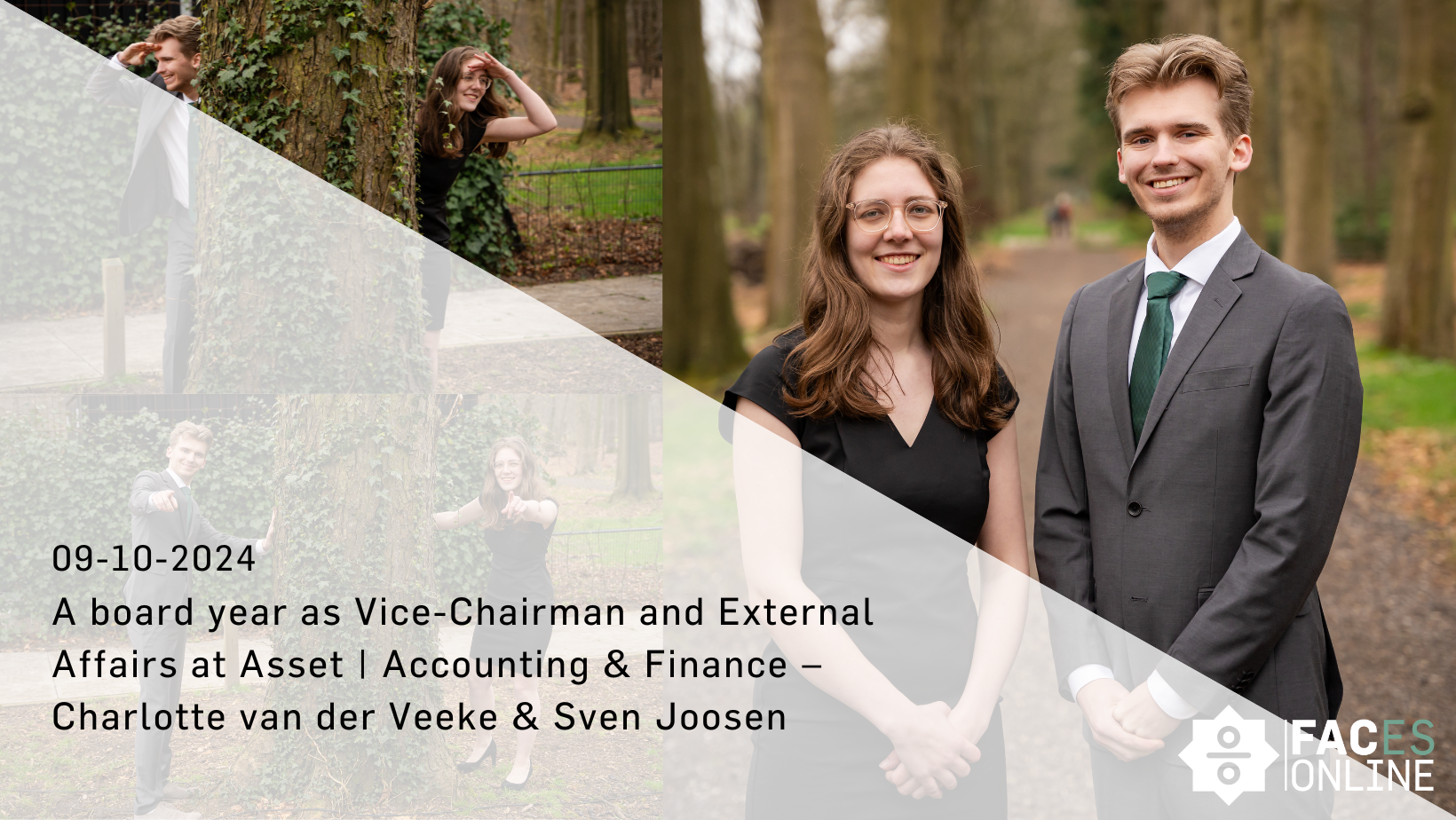
A board year as Vice-Chairman & External Affairs at Asset | Accounting & Finance
Charlotte van der Veeke Who am I? I am Charlotte van der Veeke, 20 years old, and from Almelo, which is definitely not close to Tilburg. Nevertheless, I came to North Brabant to study, and I haven’t regretted it for a moment since. I officially started my third year of the bachelor’s in Business Administration (previously Business Economics) this September, but since I began my board year last winter, I’ll continue with the courses from the second semester of the second year soon. A year ago, I joined Asset | Accounting & Finance and became part of the Orientation Committee. I enjoyed it so much that after half a year, I decided to join the board. Why did I choose a board year at Asset | Accounting & Finance? I chose a board year because I wanted to develop myself both personally and organizationally. I enjoy connecting with companies in such a unique way, learning how to hold meetings, functioning in a close-knit group, while still having the social and informal atmosphere of students around you. It’s also a welcome break from studying, and it feels good to dedicate myself fully to the association. I chose the position of vice-chair because I love interacting with members and want to serve them. I enjoy providing new members with information and making them feel involved in the association. I’m also good at remembering names, which helps! Additionally, I’m responsible for the website, and I love making it as functional and appealing as possible. Another big task for the vice-chair is promotion, which didn’t initially appeal to me, but I’ve found I enjoy brainstorming and helping figure out how to reach as many students as possible. What does a week as Vice-Chairman look like? As vice-chair, I mostly focus on member contact and promoting the association. Every Monday morning starts with the board meeting, where we discuss everything important. Usually, I don’t have many set tasks on Mondays, so after the meeting, I can focus on preparing for other meetings and tasks throughout the week. Every Wednesday, I attend the meeting of the website coordinators from other departments, followed by a meeting with all the other vice-chairs. In the first meeting, we discuss technical matters that need alignment or new digital developments relevant to our associations. In the second meeting, we organize promotion for Asset General and the parties we host. The vice-chairs are responsible for organizing major events like COdE, the Pre-Carnival Party, and Asset Champions League. This is a fun extra challenge, and it’s a great way to learn event management. The vice-chair also oversees informal committees: CityTrip, Cooking Club, and the Master Committee. The CityTrip always takes place in the second semester and goes to a city in Europe. As a coordinator, it’s amazing to help organize this entire trip. The Cooking Club is a relatively calm committee, where you cook for different committees about three times per semester to strengthen bonds between members. It’s always fun and a great addition to the role. The Master Committee organizes informal activities for Master’s students, which is different from the other two and provides a nice variety. Final words I recommend a board year to any student. So far, I’ve made countless beautiful memories that wouldn’t have been the same without this experience. I’ve also made many new friends, for which I’m very grateful. I’ve grown immensely, and I now feel more confident and capable of handling various situations. For example, you learn how to work well with people you may not naturally get along with, which is a valuable skill for later in professional life. I’m thankful I’ve had the chance to fulfill this role and will always look back on this year with a big smile. Sven Joosen Who am I? My name is Sven Joosen, and I am 24 years old. I’m originally from the beautiful town of Made in North Brabant (though you can’t really tell from my accent). Until recently, I didn’t live in Tilburg, and after COVID, I thought about becoming active in a student association again. Eventually, through various connections, I ended up at A&F, and I haven’t left since—and I plan to stay for a while longer. After six months, I joined the Activities Committee and then the board, which was the best decision of my life! Why did I choose a board year? I don’t enjoy studying, and I’ve never really found it fun, though I’ve always done my best. During my very theoretical master’s in Finance, I ran into two problems. I loved the subject itself, but I didn’t enjoy the studying part, and I didn’t know which career path to pursue—Investment Banking, M&A, Due Diligence—I was really unsure. Then I got a message from Stijn, the former chair, asking if I wanted to grab a coffee, and that’s when things started to fall into place. It turned out to be the perfect opportunity for me because in the role I would take on, I would get in touch with nearly all the finance partners and focus on finance-related events. After considering my parents’ well-thought-out opinions, I realized this was a golden opportunity that I needed to grab with both hands. Plus, it would allow me to improve my management, acquisition, and communication skills. What does your role involve? I’m one of three External Affairs officers at A&F and Economics. However, my responsibilities, apart from the basics, differ quite a bit from those of the summer External Affairs officers at A&F and those at Economics. My role heavily focuses on finance. I organize Private Equity Day and also coordinate the Financial Business Dinner, the Finance Expedition, and the Mergers, Acquisitions, and Private Equity committees. I’m also setting up a new event, the Control Dinner, which is derived from the Financial Business Dinner but focuses on control. At Asset | Tilburg, I’m also part of a body called the Acquisition Meeting, where all the External Affairs officers meet to discuss which partners

Financial tips for the start of the academic year
The start of the academic year is an excellent time to get your finances back in order. In this article we discuss some tips to strengthen your financial basis, this is done through the following topics: Budgeting Saving Investing Book tips Podcast tips Budgeting The easiest way to saving is spending less money. This is difficult for many students and this is of course understandable. But without realizing it, you spend a lot of money on things that are not really necessary. A handy way to do something about this is to use budget software. This allows you to see exactly what you spend a lot of money on and which subscriptions you pay for that you don’t actually need. Banks such as ING and ABN AMRO offer this software through their app, but other free apps include: Dyme iBilly MijnGeldzaken Huishoudboekje Saving Most students will not have much money left over, but it is useful to try to set aside some money every month. For example, to use for large purchases, such as a phone or laptop. Or to make sure you have enough money to go on vacation. Additionally, putting some money aside every month ensures that you get into the habit of saving—a habit you will thank yourself for later. Nowadays, interest rates are higher again, which means you earn more money on the amount in your savings account. A disadvantage of this higher interest rate is, of course, that the interest on your student loan is also higher… But if we focus on the interest, we see that for the major banks (ING, ABN AMRO, and Rabobank), it is around 1.5%. This is already a lot more than you received a few years ago, but at other institutions, you can get a much higher interest rate. For example, at Bunq, a Dutch internet bank, it is 3.36%. You can also place your savings with an investment company. At these companies, you currently receive the highest interest rates. For example, TradeRepublic offers 3.75%, and Trading212 even offers 4.2%. If you decide to place your savings in an account with an investment company like TradeRepublic or Trading212, it is, of course, important to know about the safety of your savings. A high interest rate is of little use if you lose all your savings in the event of a bankruptcy. Fortunately, this is well regulated. For instance, TradeRepublic is covered by the German deposit guarantee scheme. This scheme guarantees that your savings up to €100,000 are safe in case of a bankruptcy. So, if something happens, you will get your savings back up to €100,000. With Trading212, it’s a slightly different story: here, your savings are protected up to €20,000 by the Cypriot Investors Compensation Fund. This is because you are not really saving with Trading212, but placing your money in a money market fund (MMF). Check the following website for current interest rates: https://www.actuelerentestanden.nl/sparen/hoogste-spaarrente.asp Investing Once you have saved some money, it is wise to start investing with a small amount. Even if you can only spare a small sum, it is good to develop this habit. When it comes to investing, the earlier you start, the greater the returns you can achieve in the future. Most of the returns in your investment portfolio are generated from the money you invest in the first few years. This effect is well illustrated in the following video by Visual Capitalist: The Benefits of Investing Early in Life. But why should you invest? Simply put, investing allows you to invest in companies that then share the profits they earn with you. Suppose you own a 1% share in a company, and that company earns 100 euros. Then 1 euro of that profit is essentially yours. Of course, investing comes with risks because investments can fluctuate significantly, and if you invest in just one company, there is a higher risk of losing your money. A good way to mitigate this risk is to invest in a diversified ETF (Exchange Traded Fund). A good example of this is the MSCI World ETF. This is a basket of stocks that invests in many different countries and sectors. For example, this ETF invests in Apple but also in Heineken and ASML. To start investing, you can look at the following Dutch brokers: Bux DeGiro TradeRepublic Trading212 eToro Make sure to do a lot of your own research before you start investing. At some brokers, it is even possible to start with fictional money. Book tips A tip is also to read books on these subjects, so you not only start thinking more about the ideas and concepts but also gain access to in-depth explanations and practical examples that help you better understand and apply the material in your own life. Examples of such books are: Rich Dad Poor Dad (Robert Kiyosaki) I Will Teach You To Be Rich (Ramit Sethi) The Psychology of Money (Morgan Housel) Atomic Habits (James Clear) Money Master The Game (Tony Robbins) “Rich Dad Poor Dad” talks about the lessons Robert Kiyosaki learned from his “rich dad” (the father of his best friend) and his “poor dad” (his biological father). The book discusses the differences in mindset and financial habits between the rich and the poor and emphasizes the importance of financial education, investments, and building assets to achieve financial independence. “I Will Teach You To Be Rich” offers a practical guide to building wealth without too much self-denial. Ramit Sethi discusses topics such as saving, investing, paying off debts, and smart spending. It includes a 6-week plan to achieve financial freedom, focusing on automating finances and investing in yourself. “The Psychology of Money” explores the emotional and psychological aspects of money and investing. Morgan Housel highlights how human behaviors, habits, and emotions influence financial decisions. The book contains 19 short stories that describe the various ways people think about money, wealth, and success and provides insights on how to make better financial decisions. “Atomic Habits” presents

The Evolving Landscape of Financial Management in Startups: From Intuition to Data-Driven Decision-Making
Traditionally, startup financial management has largely been an exercise in intuition and adaptability. Founders often rely on their gut instincts to make financial decisions, navigating an uncertain, fast-paced environment with limited resources. While this approach can work in the early stages, as startups scale, the complexity of financial management grows exponentially. Cash flow management, budgeting, and forecasting are crucial, not just for survival but also for long-term growth. As startups raise capital, they must also balance the expectations of investors with the demands of day-to-day operations. Despite the importance of financial management, the attention of startup founders is split broadly, where their focus tends to lie on product development and customer acquisition. As a result, financial management has often been reactive—dealing with cash flow shortages or sudden changes in revenue. However, the rise of new tools and technologies is changing this dynamic, reshaping how startups manage their finances and make informed decisions. The Role of Financial Management Platforms In recent years, there has been an explosion in platforms dedicated to helping startups better manage their finances. Tools like Moneybird offer startups the ability to track their spending, forecast cash flow, and even create financial statements. These platforms not only automate financial tasks, freeing up time for founders, but also provide real-time data that allow for more informed decision-making. Startups can now have a clearer picture of their burn rate, runway, and financial health, empowering them to be proactive in managing their resources. One of the most significant developments is the ability for these platforms to integrate with other business tools, like CRMs or payroll software. This integration allows for seamless data flow, reducing errors and inefficiencies that could otherwise lead to costly mistakes. The ability to consolidate various financial data points in one place provides startups with a holistic view of their operations, aiding both short-term decisions and long-term strategic planning. Shifting from Intuition to Data-Driven Decisions As data becomes more accessible, startups are increasingly moving from instinct-driven financial management to a more data-driven approach. Financial dashboards can offer real-time insights into spending patterns, revenue fluctuations, and customer acquisition costs. This shift is crucial as the startup landscape becomes more competitive, and the margin for error shrinks. Inaccurate financial projections can lead to over-investment in areas like marketing or hiring, while underestimating expenses can result in cash flow shortages that cripple growth. One of the critical advantages of data-driven financial management is the ability to model different scenarios. By leveraging predictive analytics, startups can anticipate potential risks and opportunities, allowing them to make better-informed decisions. For example, using historical data, a startup might forecast how a change in product pricing could impact revenue over the next year, or how hiring additional engineers might affect their burn rate. Such insights allow startups to manage risks proactively, rather than reactively addressing financial problems as they arise. Challenges in Startup Financial Management While data-driven financial management holds promise, startups still face several challenges. One of the key issues is that early-stage startups often have limited financial data to work with, making it difficult to generate meaningful insights. In these cases, founders must rely on benchmarks or industry standards, which can be inaccurate or unsuitable for their unique circumstances. Additionally, many startup founders lack formal financial training, which can result in poor decision-making or an over-reliance on external accountants and advisors. Another challenge is the tension between growth and profitability. Many startups, especially those in tech, prioritize rapid expansion over short-term profits. While this approach can lead to explosive growth, it often results in significant cash burn. Startups must strike a delicate balance between investing in growth and maintaining financial stability. This is particularly challenging in sectors where startups need to raise several rounds of funding before reaching profitability. Furthermore, as startups scale, their financial management needs evolve. What worked for a 10-person team may not suffice for a 100-person company. As they grow, startups must implement more robust financial controls, hire dedicated finance teams, and consider external audits to ensure they remain financially healthy and compliant. Opportunities in Financial Management Innovation Despite these challenges, there are tremendous opportunities for startups that embrace modern financial management tools and strategies. One of the biggest opportunities lies in predictive financial modeling. With the rise of machine learning and artificial intelligence, startups can now access tools that help them predict future financial outcomes with greater accuracy. These tools analyze everything from cash flow trends to external market conditions, providing startups with a deeper understanding of their financial future. This can help startups not only in managing their operations but also in securing funding, as investors are increasingly interested in seeing data-backed financial projections. Another emerging trend is the use of fractional CFOs—highly experienced finance professionals who work with multiple startups on a part-time basis. This model allows early-stage startups to benefit from expert financial advice without having to hire a full-time CFO, which can be expensive. Fractional CFOs often bring valuable industry insights and can help startups make strategic decisions about financing, scaling, and managing investor relations. Conclusion In conclusion, financial management in startups is evolving rapidly, moving from a primarily intuition-based approach to one that is increasingly data-driven. Modern financial platforms and tools are providing startups with more accurate, real-time insights, empowering them to make better decisions and mitigate risks. While challenges such as limited data, lack of financial expertise, and the tension between growth and profitability remain, startups that embrace data-driven financial management are better positioned to succeed in today’s competitive landscape. As these tools continue to evolve, the role of financial management will become even more central to a startup’s success. By leveraging data and predictive models, startups can not only improve their financial health but also foster sustainable growth and attract investment, ultimately contributing to a stronger, more resilient startup ecosystem.
GameStop Saga: Unraveling the Dynamics of Short Squeezing and Retail Investor Influence
In early 2021, the financial world witnessed an extraordinary event that not only captured the attention of global audiences but also sparked widespread discussions about the dynamics of stock trading and the evolving influence of retail investors. The meteoric rise in the stock price of GameStop, a video game retailer facing business decline, unfolded through a market phenomenon known as a “short squeeze.” This article delves into the mechanics of short squeezing, examines the GameStop phenomenon, discusses the broader implications for the financial markets, and compares it to another similar event. Understanding Short Squeezing Short squeezing represents a complex but intriguing aspect of the stock market that stems from the practice of short selling. To fully understand short squeezing, it’s essential to delve into the nuances of how short selling works and how it can lead to dramatic shifts in stock prices. This detailed explanation not only demystifies one of the market’s most dramatic phenomena but also equips investors with knowledge of the risks and dynamics involved. The Mechanics of Short Selling Short selling is an investment strategy employed by traders who believe that a stock’s price is going to decrease. Initially, the investor borrows shares of the stock from a broker, committing to return these shares at a later date. Once these shares are borrowed, the investor sells them at the current market price, under the assumption that the stock will soon decline in value. The goal is to repurchase the shares later at a lower price. If the investor’s prediction is correct and the stock price drops, they can buy back the shares at this reduced price, return them to the lender (the broker), and keep the difference in price as profit, minus any fees or interest paid to the broker for the loan of the shares. The Risks of Short Selling The strategy of short selling carries substantial risks, especially if the stock’s price moves contrary to the trader’s expectations. If the stock price begins to rise after the shares have been sold, the potential losses can escalate quickly. Short sellers might be forced to repurchase shares at a higher price to cover their positions and prevent further losses. This scenario can occur due to various factors such as positive news about the company or changes in market sentiment that drive the stock’s price up unexpectedly. The Dynamics of a Short Squeeze A short squeeze happens when the rising price of a stock compels short sellers to buy back shares to cover their positions. This need to buy back shares can happen suddenly and en masse if a significant number of traders need to exit their short positions due to rising prices. The increased buying activity, in turn, drives the price up even further. During a short squeeze, the price of the stock can rise sharply in a very short time, as was notably seen in the GameStop case. The dynamics were intensified by a large number of retail investors and traders on platforms like Reddit who recognized that the stock was heavily shorted. They began buying up shares and options, which reduced the number of available shares and pushed prices up, forcing short sellers to buy back at progressively higher prices to cover their short positions. The GameStop Phenomenon GameStop, a well-known retail chain that once thrived by selling video games and related merchandise, faced significant challenges as the retail landscape evolved. With the advent of digital distribution and shifts in consumer preferences towards online shopping, GameStop’s business model became increasingly unsustainable. By 2020, these challenges had led to a steady decline in sales, casting doubts on the company’s future viability. Amidst these struggles, GameStop caught the attention of institutional investors, who saw the company’s declining fortunes as an opportunity for profit through short selling. Betting on the company’s continued decline, these investors began shorting the stock extensively. By the end of the year, GameStop was among the most shorted stocks in the market, with over 100% of its available shares being borrowed and sold by those betting against it. This overextension in short positions set the stage for a dramatic financial phenomenon. The situation took a surprising turn when users of the Reddit forum r/wallstreetbets started to take notice of GameStop’s heavily shorted status. Many in this online community, comprising mainly retail investors, recognized a unique opportunity to influence the stock’s price. Motivated by a mix of profit potential and a desire to challenge the dominance of institutional investors, they started buying GameStop shares in large quantities. This coordinated buying effort began to drive the stock’s price up rapidly. As the price of GameStop shares started to climb, the pressure on short sellers intensified. The rising prices represented not just unrealized losses but an escalating threat to their financial positions. Hedge funds and other institutional investors who had bet heavily against GameStop found themselves in a precarious situation. The higher the stock went, the more money they lost, creating a sense of urgency to limit losses. Compelled by the mounting financial pressure, these short sellers began to buy back shares to cover their positions. However, since so many shares had been shorted, the demand for GameStop stock sharply increased as these investors scrambled to repurchase them. This surge in buying further accelerated the increase in stock price, creating a feedback loop that drove the price even higher. This dynamic resulted in an explosive increase in GameStop’s stock value, which soared from about $17 per share at the start of January 2021 to nearly $350 per share by the end of the month. The rapid rise was unprecedented and highlighted a significant shift in market dynamics, where retail investors collectively could exert substantial influence over the stock market, challenging established financial institutions. The GameStop saga not only reshaped the fortunes of the company but also sparked a broader discussion about market practices, the power of collective retail investing, and the potential need for regulatory changes. It demonstrated how modern trading platforms and social media could
