


After the company’s Q1 and Q2 2017 financial results, it was likely that Gilead Sciences was planning something. The company maintained a huge cash pile, had some stock repurchases and provided extra dividends. Advice was given for the contrarian investor to step in, as there was sizable potential on the long-term horizon. It seems that the advice was right on point. From June 19th 2017 until September 12th 2017, the share price surged from $64.23 to $84.52 per share, which is equal to an increase of 31.59%. Historic Low On June 19, an article (Can Gilead Sciences Do Its Impressive Namesake Proud?) was published about the research-oriented biopharmaceutical corporation Gilead Sciences. The company, which is known for its bullish performance on the stock market, was at a historical low of $64.23 per share. The plummeting of Gilead’s share price raised questions, as the company had a large cash pile that could potentially be used for M&A practices. At that particular moment, an important question was raised by investors on why the company was at a historical low, while there was huge potential for M&A in the industry. One of the main reasons for the share price decline was the decrease of the companies’ hepatitis C drug (HCV) franchise. A second reason was that investors were highly disappointed after the Q1 2017 financial results, as revenue and earnings further declined in comparison with Q1 2016. “It seems the cash cow is becoming a lazy dog that should make room for a new star to rise.” The above quote from the aforementioned article was highly applicable around June 2017. However, it currently seems that Gilead Sciences has proven that it is far from lazy, and that there is a new star on the rise. Two weeks ago, Gilead Sciences had a takeover bid accepted by Kite Pharma, a clinical stage biopharmaceutical company well known for its developments of novel cancer immunotherapy products (e.g. CAR-T). The accepted takeover bid had a value of $11.9bn, which is equal to $180 per share. The transaction will be finalised around Q4 2017. Contrarian Beliefs Some analysts may question Gilead’s accepted takeover bid of $11.9bn (a 29% premium), as the company mentioned that new drug candidates for acquisition were overpriced. Recently, Gilead Sciences held a conference call with investment bank analysts, where the company explained why it has initiated the acquisition process of Kite Pharma. In this meeting Gilead Sciences mentioned the following three reasons that eased analyst concerns: 1. Kite Pharma has an equally important pipeline – especially its CAR-T candidate, which is an innovative solution to combatting cancer using a patient’s own immune system to fight tumours. 2. Gilead Sciences expects a healthy reimbursement for innovative treatment – the CAR-T candidate is expected to provide a return on investment in the medium-term. 3. The Kite Pharma acquisition is not just a one drug development acquisition – Kite Pharma and its innovative drug developments have the potential to become a standalone unit under the Gilead Sciences umbrella with a diverse set of drugs in the pipeline. It can be argued that Gilead Sciences was right to wait with the use of its cash mountain for M&A. It seems the acquisition of Kite Pharma was correctly timed, as one of Gilead’s direct competitors, Novartis, won FDA approval for its life-changing CAR-T cancer drug Kymriah just after Gilead’s takeover bid was accepted by Kite Pharma. This will likely increase Kite Pharma’s chances of receiving a regulatory green light for one of its CAR-T drugs Axi-Cel in November 2017. Share Price Developments Overall, the stock market reacted positively from June 2017 onwards, as can be seen from the chart below. Source: Y Charts From the above chart, it is visible that Gilead Sciences had been in a downward trend until June 2017. Eventually, the downward trend moved to an upward trend as soon as good earnings were presented ($2.56 EPS versus the consensus estimate of $2.11 EPS). Consequently, the share price increased from approximately $64 to $76 on August 1, which is a share price increase of 18.75%. Moreover, a beneficial dividend announcement and M&A activity speculations gave the share price an additional boost around mid-August. As a result, the stock price has increased to $84.52 per share at the moment of writing this article. Future Outlook In the Q2 2017 earnings conference call, CEO John C. Milligan mentioned the following: “So we have been very, very active, as we always are. We have beefed up our groups, as you are aware, so that we can evaluate more different kind of opportunities. And so we are working very hard behind the scenes here on a number of things, but I certainly cannot direct you to anything specific, other than to say that we are very, very active. And when the things are right for us, we will announce them. That is all I can say.” Milligan was right around that time- Gilead Sciences had been genuinely busy, as the company commenced the acquisition process of Kite Pharma. The large question is if there are more acquisitions on Gilead’s schedule. Gilead’s cash position is still approximately $25bn after the Kite Pharma acquisition, so there is still room for additional acquisitions. It is likely that Galapagos could be the next target company, as the company is valued at $5bn. Aside from Galapagos, more acquisitions are expected in the near future and the Kite Pharma acquisition is likely to be a catalyst for future growth. Conclusion At the moment, Gilead really is on its way to make its namesake proud. In addition, there is a significant chance that Kite’s CAR-T Axi-Cel drug will be FDA approved in November 2017, as Novartis has just had its Kymriah CAR-T cancer drug FDA approved. Therefore, it is highly likely that Gilead’s share price will further increase in the coming months.
Being an editor of Faces Online
Hi, my name is Roel Elissen and since September 2016 I am one of the editors of Faces Online. As of today, the 1st of September 2017, I will be the chairman of this committee. In this article I’m going to give you an insight on what it is like to be an editor of Faces Online. When I started my bachelor Business Economics in 2016 I wanted to do something next to my study. I started searching for some study associations and that brought me to Asset | Accounting & Finance. After contacting them, they invited me for a personal conversation to have a look at the available committees. Finally, I decided to join the editors of Faces Online, better known as the Faces Committee. What does an editor do? During the weekly meetings with all the editors, we brainstorm about subjects that might be interesting to post on Faces Online. The concrete ideas will then be divided among the editors. These ideas are finance- or accounting related subjects, but it is also possible that you will manage an article about someone who has experienced something interesting in a foreign country. Furthermore, sometimes you are able to do an interview with a prominent person from the business world, this could be the CFO of Mars Nederland for instance. As soon as you know which article you will manage, you start approaching the relevant company or person. You introduce yourself, explain what you want and ask them if they want to cooperate. At the beginning I couldn’t imagine many people would respond positively, but this wasn’t true. Together with your contact person, you plan a deadline for the article. “By becoming active beside your study you meet a lot of amazing people who contribute to an amazing student life!” Having received the article, you check the article and possibly give some feedback. Articles on Faces Online are published in two languages, English and Dutch, so it’s possible that you have to translate your article to one of these languages. When the article is finished, you will think of an interesting title and make an attractive banner. When everything is ready, you will upload the article. When it is uploaded, one of the editors-in-chiefs, one of the chairmen of the committee, give it a quick check and after that they finally hit the publish button! Everyone can read the article then on our website, and Faces Online shares the article on its Facebook and LinkedIn, to reach as many people as possible. What do you learn from the Faces Committee? As an editor of Faces Online you learn a lot of things! When I started in this committee, I thought I wouldn’t learn too much, but nothing is less true. – You learn how to work in a team during the weekly meetings and communicating. – By contacting organizations and other people, you learn how to present yourself. – By translating articles, your English language skills improve. – By making banners and pictures, you learn how to work with Adobe Photoshop. – Last but not least, by becoming active beside your study you meet a lot of amazing people who contribute to an amazing student life! Are you interested in becoming an editor of Faces Online? Mail to info@asset-accountingfinance.nl.
Here’s why PPG withdrew its AkzoNobel takeover bid
From March 2017 onwards, AkzoNobel (Akzo hereafter) has been in the news, because of a takeover battle between the company and PPG, which is an equivalent company known for its paint and coatings. This resulted in many offers, lawsuits, and political debates in The Netherlands. At the end of May 2017, the deal had a value of approximately €26.3bn, which is equivalent to €95 per share, while the share price was €74.34. Finally, PPG dropped the deal in the beginning of June, since this was the ultimate date set by Dutch law to make a final offer. Shareholder Obligations The main question just after PPG dropped the deal was if AkzoNobel could keep its shareholders satisfied, as the shareholders could gain quite some additional value if the company had accepted the deal. Akzo increased its performance targets, promised extra dividends to shareholders, and made promises to sell a major chemicals subsidiary to please its shareholders during the ‘takeover’ period. Elliot Advisors (Elliot hereafter), who is one of the major shareholders in Akzo – with around 3.25% before the Akzo PPG clash, 5% just after PPG dropped the deal, and 9.5% at present – forced the company to talk with PPG. However, this aggressive approach led to a loss in the Amsterdam Enterprise Chamber. Nevertheless, Elliot is still continuing with increasing the pressure on Akzo, as the aggressive hedge fund is demanding a special shareholders meeting, where the hedge fund hopes to fire the chairman of the supervisory board, Antony Burgmans. The Current Situation Currently, Elliot is forcing Akzo to have a special shareholders meeting. The major shareholder requests to fire the chairman of the supervisory board of Akzo, as he probably blocked a takeover by PPG earlier this year. Surprisingly, Akzo made a ‘smart’ move by quickly responding to the special shareholders meeting request. As a result, Elliot is not able to put their preferences on the agenda, as the agenda filling term is already terminated. In addition, Akzo is indicating that there is no need to fire Antony Burgmans, as he is going to leave in April 2018 at latest, since this is the end of his three terms period at the supervisory board of Akzo. However, this is not a clever move at all since the management of Akzo is intentionally evading its responsibilities, according to one of Elliot’s lawyers. That being said, it is an uncertain time for the painting and chemicals corporation. Especially, since its CEO Ton Büchner resigned last week because of health issues. Consequently, he was replaced by Thierry Vanlacker – former head of the specialty chemicals subsidiary – who only joined the company in 2016. Büchner and Burgmans promised shareholders to report better sales performance in the upcoming period; however, Q2 results missed the expectations and Vanlacker has a huge job in order to deliver on the higher sales and margin promises made before. The following chart shows the share price movement of Akzo during recent months 6-month Akzo price movement Source: Google Finance From the above chart, it is clearly visible that shareholders were tremendously supporting the company as soon as takeover news was published around March 2017. However, the share price declined from the moment shareholders realised that takeover chances were diminishing in April, since Akzo refused to take on serious talks with PPG. Recently, a drop in the share price occured as a likely result of the court case between Akzo and Elliot, and because Akzo’s Q2 results missed investors expectations. Short-term Outlook The short term is likely to feature endless conflicts between management, the supervisory board, and the shareholders. Dutch companies are famous for their stakeholder-oriented nature, which is more about value creation in the long-term and spreading its focus among the applicable stakeholders. However, this often leads to confrontations when shareholder-minded companies and investors show interest in a Dutch company. On August 10, the Dutch court will present its rulings about the Akzo-Elliot case. Incredible changes are likely to happen if Burgmans is fired by a shareholder vote. At the moment, PPG is having a so-called cooling off period of six months, according to Dutch law, and opportunities may arise when Burgmans is fired before the end of the year. Conclusion In the worst-case scenario for Akzo, Burgmans is fired, Elliot further increases its stake in Akzo, and PPG forces a hostile takeover by the end of the year. However, Dutch law combined with Dutch politics may prevent this from happening.
Working at Fagro
My name is Koen Polman, I am 24 years old and working at Fagro Consultancy as Junior Consultant since November 2016. I’m originally from Didam, a small village near Arnhem, but after travelling to Tilburg daily for half a year I moved to Tilburg. What did I study? In Tilburg I studied the bachelor Business Economics first and afterwards chose for the master Finance. During my last year of my bachelor I became active at study association Asset | Accounting & Finance. I was treasurer of the StudyTour 2014 committee, which organized a trip to Japan. Because I thought it was important to do things next to my studies, I chose to spread my master over 2 years. This enabled me to stay active member of A&F by joining the investments-committee and becoming treasurer of the badminton association for students (TSBV Sauron). Enough about my past, where am I now? A couple of months before graduating I came into contact with Fagro by a personal talk during the Economic Business Weeks Tilburg. Twenty minutes went past very quickly and I was invited to drink a cup of coffee at the office in Eindhoven. This first meeting, but also the open conversations that followed were very appealing to me. Fagro is a company that is focused on you as a person and not just what is on your resume. Where some companies work with intake moments, Fagro always has a place for the right people. After a few more conversations, where I got to know all business managers in Eindhoven, followed the competence test; the Virtual Competence Manager. This test analyses your knowledge, skills, motivation, interests and future perspectives. Because of the feedback from this test, you get to know yourself a lot better, not just your strong points, but also your points of improvement. After this test I got offered a contract. I signed my contract at the beginning of June already, even though I would graduate at the end of August. Why did I choose Fagro? Besides the personal match, there were other reasons why I chose for Fagro. I wanted, especially as my first job, to work as a consultant. This way you get in contact with a lot of people, but you also get to see a range of different companies from the inside. To prove yourself again and again and receive different types of challenging assignments, are things I find important as well. Furthermore, I think it is very important to have enough time for my personal life next to my working life. I have noticed that this balance is very important at Fagro too. My first assignment at Fagro? At this moment I just finished my first assignment at Nutricia. I was responsible for mapping the financial obligations they have for the upcoming years. I got the chance to work in an international environment at Nutricia. The average length of an assignment is about 8 to 10 months, but the assignment at Nutricia was a lot shorter. Although there is always space to claim more tasks and more work, thus extend the assignment and improve the business where you are even more. Thus, at Fagro our mission is: ‘Improving your performance’. After Nutricia I got an assignment at Dura Vermeer, a sizeable construction group within the Netherlands, where they needed a replacement for the financial administration. Besides that, Dura Vermeer is combining the financial administration of two of the business units, where they need my contribution as well. That is one of the beautiful things of consultancy, apart from the fixed work a company hires you for, there is room to implement improvements when you think they are needed. If you are in between assignments, the business managers work hard to get you another project. In the meanwhile, you work at the office in Eindhoven (or Maastricht or Arnhem). During this period, you can develop yourself in the way that seems most useful for you. For example, I received two Excel-trainings, the last one with macro’s, but I also got training in both advanced communication and assertiveness on location with a professional trainer. I also got to know a couple of colleagues, who you don’t see often apart from the drinks and business meetings. Until now I have had an amazing time at Fagro and I can’t wait to work at a broad field of different companies and develop myself constantly in the upcoming years. Do you think Fagro would fit you after reading this article? Then I am always open for questions about my activities and I can get you in contact with the right people. Tips for current students? Be active besides your study, this way you can develop yourself as much as possible. And, when you are looking for a job, I recommend visiting the companies that you are interested in. This way you get to know the right people and you get a good image of what the company is like. So if are you interested in Fagro, you are very welcome to stop by!
Interview with Daniëlle Jansen Heijtmajer, Global Process Director Finance FrieslandCampina
This article is currently only available in Dutch.
A brief flashback of the Financial Business Dinner
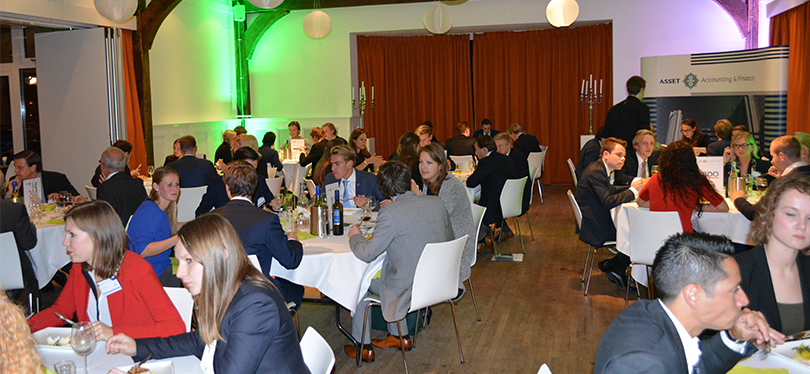
My name is Bolot Ebbing. This year I had the honor to be chairman of the Financial Business Dinner 2016. The Financial Business Dinner 2016 took place in Villa de Vier jaargetijden on September 29. And I must say it was a great success! The preparations for the Financial Business Dinner 2016 were launched in January. Along with Eline Bulsink, Jeanine Adams, Rianne Steinbusch and our coordinator Immo van der Veen, we started the first meetings with reading the conveyance and by discussing last year, also we started the brainstorm session about what we want this year. Just like last year, we decided to invite 5 Accounting and 10 Finance firms to participate in the dinner. The most important question was: which 15 companies should be invited? We are very proud of the 15 companies that were present at the Financial Business Dinner 2016. The Accounting firms which participated in the dinner were: BDO, EY, ING, KPMG, and Witlox Van den Boomen. The 10 finance companies were: ABN AMRO, Ahold, Delhaize, CZ, Delta Lloyd, ExxonMobil, FrieslandCampina, JUMBO, KLM, PostNL, and Rembrandt Fusies & Overnames. It was also important that the dinner took place in a nice location which would be able to accommodate 100 people. The location that met all our requirements was Villa de Vier Jaargetijden. It was a beautiful location with the ambience we were looking for and also important: delicious food. “60 top students participated” Besides arranging the firms and the location we needed 60 top students to participate in the Financial Business Dinner 2016. The students were invited by the companies based on their resume. We started our promotion with distributing flyers at the master Finance and Accounting and minor Finance and Accounting. Also, we had a chat lecture for extra promotion of the event. After the intensive promotion period, we were very pleased with the number and the quality of the resumes. Most of the work of the Financial Business Dinner 2016 started after receiving the registrations, namely matching the resumes. All resumes were sent to the companies and the companies communicated their top 10 to us. After receiving the top 10, we had to start with the big puzzle. Which 60 students may participate in the Financial Business Dinner 2016 and were selected by the companies. Last Thursday it was finally THE day. After months of preparation we were pleased that the day of the dinner finally had come. The night before we made everything ready and controlled it, so that we would have no stress on the day. But of course, there were always things that could be better or need to be arranged last minute. First, at 14.00 hours, a workshop Business Etiquette provided by butler Laurens took place, in which 25 students participated. During the workshop butler Laurens taught the students how it’s supposed to be, so the students could make a good impression on the companies during the dinner. At 18.30 the evening started and the first students and companies arrived. After the opening reception and the speech the dinner started. All companies saw the first 4 students of the total 16 students the get to see over the evening. After 50 minutes the students changed place, so the companies saw 4 new students and the students saw another company. Unfortunately, after four course the dinner was ended. All companies and students were excited, so this positive news was well received by the organization. After the closing reception, the Financial Business Dinner 2016 ended. I am very proud that the Financial Business Dinner 2016 was a huge success. I want to thank all partners and Eline, Jeanine, Rianne, and Immo for all their help and effort.
