


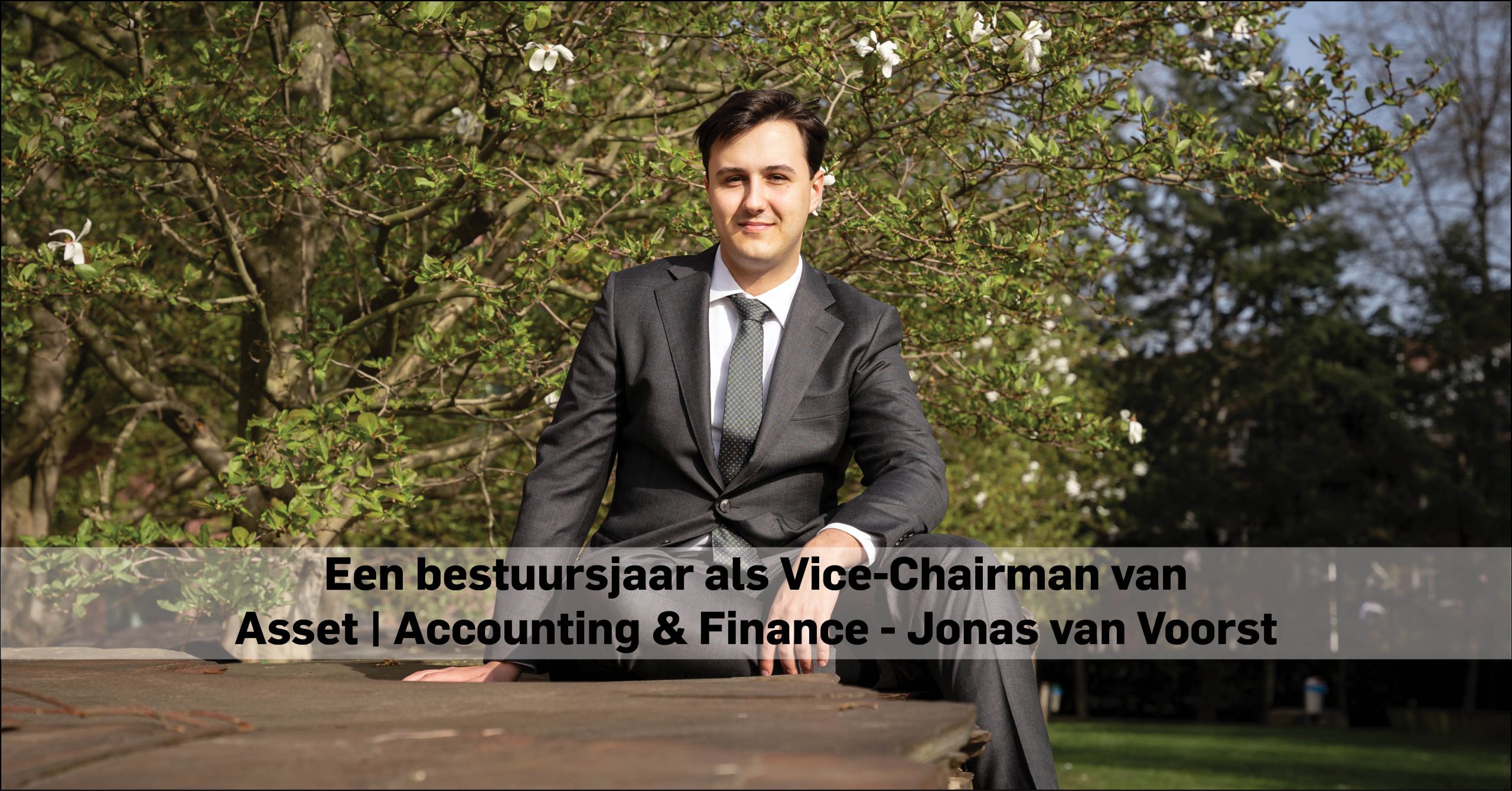
For the Dutch version, click here. Who am I? I am Jonas van Voorst, 21 years old and come from beautiful Den Bosch. In February 2020 I started living in my room and I really like it. I am now in the third year of the bachelor International Business Administration, and am taking a number of courses in preparation for the MSc. Economics. Before my board year, I was convinced to follow the Accountancy master, but since I started, I am more oriented and have gained a strong interest in Economics. Furthermore, I started within A&F with the Activities Committee a year ago, I really enjoyed it and therefore decided to do a board year. My choice to do a board year. The choice for a year on the board was actually made pretty quickly. I was not very convinced about my choice to do a master’s degree yet, and because of corona my student life had been put on pause for a while, so I wanted to extend it. When Joep called me if I was interested in applying, I figured this was a good opportunity to discover where my interests lay, and thus extend my student life. Furthermore, I noticed that I was very chaotic in my studies. A year on the board has given me a fixed rhythm and a much more organised way of working. For example, I have an agenda where I put my appointments and a notebook where I keep track of my tasks. Among other things, these are important soft skills that you develop during your board year. I also wanted to develop myself socially, for this reason I also joined A&F. As a board member, I work with 6 people every day, and you speak to a lot of people within A&F and Asset, so you learn to deal with many different types of people. In addition, my resume was very empty, and I thought a board year was a very good way to change that. Of course I also do it for fun, besides the tasks I have, I regularly do fun things with my board in the rooms or at someone’s house, because of this I have a good bond that will continue after my board year. I also attend almost every party, and have regular get-togethers with other boards, through which I have also made many friends! What a Vice-Chairman does all day long The to-do list of a Vice-Chairman is very vague, which is why I often get asked by friends if I do anything all day besides being hungover and playing a game of Mario Kart. As Vice-Chairman, I am responsible for several things. Since I’m in the rooms almost all day, I have a good sense of what’s going on, and here I occasionally talk about it with the chairman, Luc. I also take over the chairman’s duties when he is not here. I also still have my own duties. I am responsible for the internal policy of A&F. This includes filling the committees, informal promotion and I am also responsible for the active and passive members. I arrange the study support in the form of guidelines, CoEE and various trainings. Furthermore, I organise the introduction activities for the Master of Accountancy and Finance, board trainings, the Citytrip Replacement Activity and the Audit Activity together with our secretary, Lars van Maris. Finally, within A&F I also make sure that the website is up to date. Think of events, news, partner pages. This is another side to being informal so I find that a very nice change. Within Asset Tilburg, I also have plenty of duties. I sit on four Asset bodies: the Public Relations meeting, the Webmaster meeting, the BE cluster and the Study Support meeting. The Public Relations meeting is a weekly meeting with the Vice-Chairmans of each department. Together we organise, among other things, all informal activities from Asset Tilburg. Think of the Kick-Off party or the Pre-Carnival party. We are also responsible for most of the promotion of Asset Tilburg. I am responsible for the budget of the promotion and activities. I also attend the Webmaster meeting with every Asset board member who manages the website of his/her own department. Together we manage the website of Asset Tilburg, we are also busy redesigning the site. I also join the BE cluster every Thursday. Together with S&L, SBIT and Marketing we are responsible for the committees and activities for first- and second-year Business Economics students. I coordinate two committees: the Date Dinner Committee and the Accounting Insight Committee. Starting next year, the Vice-Chairman is also going to coordinate the Citytrip Committee, but unfortunately it will not happen this year. What is the most enjoyable aspect of the Vice-Chairman position? I really like different aspects of the Vice-Chairman position. When I applied, I knew that the Vice-Chairman position appealed to me by far the most of the positions. I regularly saw what my predecessor, Joep, was doing and this excited me. What I like most is that through the conversations with active members you get a picture of each member, and for the active members you are also a point of contact, so at activities you are quickly addressed and you quickly get to know everyone. This contact is not only a lot of fun, but also educational because you get to interact with different types of people Would I recommend a board year? I would definitely recommend a board year! It is a great consideration, so don’t be afraid to talk to a current board member. This can be very helpful if you run into something or want a new insight. Ultimately, a board year is an investment in yourself that you are going to benefit from for a long time to come through your development and connections, and beyond that you are going to be able to look back on this with a lot of joy!

Stand van zaken: Hoe zit het met de geldzorgen van studenten anno eind 2022?
For the Dutch version, click here. 17,1%. That was the inflation rate during last September in the Netherlands measured by the Central Bureau of Statistics (CBS). Inflation has never been this high since World War II. CBS follows the European harmonized consumer price index (HICP) to calculate inflation. This method shows that there is mainly one culprit that caused inflation to skyrocket, namely sharply increased energy prices. By comparison, compared to September last year, energy prices fall 114 percent higher in September 2022. Subsidies and taxes Of course, the focus then goes directly to low-income families who are at the tipping point of being unable to pay the energy bill. One means established to help these families is the possibility of applying for an energy allowance. This is a one-time untaxed payment of 1300 euros on average with a possible bonus of 500 euros if income is very low. However, the exact requirements and amounts vary by municipality. On Budget Day, the government announced to continue and further expand the support. For example, the possibility of an energy allowance will remain, and there will be an increase in the healthcare allowance, an increase in the child-related budget, a reduction in energy taxes and a reduction in fuel taxes. To finance these plans, a whopping 17 billion is included in the budget, 12 billion of which are targeted to help lower-income earners. Also for incomes in the middle class, the government wants to start supporting through an increase in the minimum wage and a reduction in the rate of the first wage and income tax bracket, among other measures. Purchasing power Despite the intensive measures, the government expects that the 6.8% decrease in purchasing power for average households in 2022 cannot be converted into a plus and only achieve a reduction of the negative trend. So it appears that the government is aware of state of affairs at the moment and that action must be taken to help both low-income and even middle-class households get through this particularly financially tough time. Students It is also interesting to take a look at students as they will also feel this price increase. First, there is a positive note. Namely, the return of the basic scholarship. Whereas previously it was only possible to borrow interest-free, students living away from home will be paid €439 per month as a gift in the 2023/2024 academic year. This amount includes the €165 on top of the previously announced basic scholarship. The previously mentioned increase in the minimum wage will also contribute to students’ purchasing power. And finally, the increase in the care allowance (€30 per month) provides support in the right direction. However, this scheme is getting off to a late start and offers support mainly to first-time students. The generation that by now has accumulated a considerable study debt and is nearing the end of its studies will benefit less. However, the reintroduction of the basic scholarship can be clearly explained as study debt has doubled in the past 7 years. It also appears that students are only eligible for the aforementioned energy allowance in 8 municipalities if strict requirements such as 21+ and own energy contract are met. Other factors What is striking, however, is that student purchasing power was already low before the time of high inflation. For example, the interurban student consultation (ISO) already reports in 2019 that a negative trend can be observed due to the rising rental costs of room and the increase in tuition fees. All in all, it can be said that the government is extending a hand to help students get through this financially tough time, but that these measures are only a tool and not the solution. And that students will feel the effects of inflation just like other populations.
ESG Ratings: valuable or untrustworthy?

For the Dutch version, click here. In recent years, sustainability reporting has become increasingly important for companies. The number of companies reporting their ESG information has increased from 20 in the 1990s to 9,000 in 2016 (Amir & Serafeim, 2017). Investors want all this information to be easily accessible so they can use it in their decisions. To meet demand, several raters have started handing out “ESG Scores”. These scores summarize the ESG report into a number, indicating how well a company is performing on its ESG goals. Examples of raters include KLD, Sustainalytics, Moody’s ESG, S&P Global, Refinitiv and MSCI. All are prominent and reliable raters. You would expect all of these raters to come to roughly the same conclusion when they assign an ESG score to a company. Yet research shows that the scores between raters can vary greatly. In this article, I find out why raters disagree and whether the ESG scores they assign then still have value. Berg et al. Research by (Berg et al., 2022) [1] shows that the correlation between the six raters mentioned above varies between 0.38 and 0.71, meaning that even though the ratings move in the same direction, they do not always agree. This makes it difficult for investors to place value on a particular rating and it is not clear to companies which aspects they need to improve in order to achieve a high score. The researchers identify three factors that lead to these differences. In short, these three factors boil down to the what, how and how much they are going to rate. What raters measure is something they can decide for themselves. Where one rater includes corruption in her assessment, another chooses to measure and assess working conditions. Next, how they are going to measure this may also differ. For example, one rater may choose to rate working conditions based on employee satisfaction scores, while another chooses to use the number of lawsuits filed by employees against the employer. How heavily raters judge may be up to them. If two raters both rate corruption and working conditions, one may give greater weight to corruption while the other considers working conditions important. As a result, the rating may differ even if the raters include exactly the same variables. The researchers talk about 709 indicators in 64 categories. From this stack, raters themselves choose which indicators they give how much weight, so it is natural for differences to arise. Research Affiliates. The differences that arise can be large. A study by Research Affiliates [2] demonstrates a good example: Wells Fargo. This American bank is placed in the lowest 5% on Governance by one rater, while another rater places it in the highest 25%. This is because one rater places a scandal in the Governance pillar, while the other thinks it falls under the Social pillar. The scandal involved widespread solicitation of new accounts and credit cards for customers without their consent. The fees that came with these accounts and credit cards were charged though. “They cannot take a random rating and make a decision.” The results are in stark contrast to ratings for non-ESG attributes such as long-term debt. Raters S&P, Moody’s and Fitch show correlations between 0.94 and 0.96 in this area, indicating that the ratings are very similar. The reason? There are many more requirements and guidelines attached to ratings on financial information than there are for ESG ratings. Moreover, the numbers and amounts are often easily measurable. It is easy to give an unambiguous answer on the total amount of outstanding debt than on how satisfied employees are. Investors The fact that ESG ratings vary so much among themselves has implications for investors[3]: they cannot take a random rating and make a decision to invest or not based on it. The investor must do additional research on how the rater calculates scores and whether the factors the rater uses match the factors the rater considers important. If so, the investor can use these scores. The differences in themselves can also give the rater information. In fact, research by Gibson and Krueger [4] shows that the greater the difference in ratings, the higher the returns for that company. Future To make ratings more compatible, some agreements will have to be made about the what, how and how heavily. Accenture [5] lists five recommendations to bring ratings closer together. For example, raters could be more transparent about how they arrived at their ratings. Also, regulators could specify specifically which factors fall under E, S and G, so that all raters include the same factors under the same rubric. There is also a task for the companies that publish their ESG information: standardization. This means that the data they provide through their ESG report is consistent and meets global guidelines as prescribed by the International Sustainability Standards Board. In this way, all companies provide the same type of information to raters, reducing the chance that they will interpret it in different ways.


The end of an era for “Royal Dutch Shell”
On friday the 10th of december during a shareholders meeting, Royal Dutch Shell plc received permission to move their main office to London. As much as 99 percent of the shareholders present agreed with the relocation. With this development, the oil- and gas company will no longer include “Royal Dutch” after more than 100 years in their name, and simultaneously will lose the Dutch part of its identity. [G1] Dividend tax Prior to the administrative departure of Shell, the oil- and gas giant was fiscally located in both the United Kingdom and the Netherlands. Tax laws in the Netherlands are different compared to tax laws in the United Kingdom; namely, dividend tax, which is a percentage of 15% in the Netherlands, does not exist in the UK. This means that shareholders receive relatively more dividends than shareholders in the Netherlands. In an interview with the FD (Financieele Dagblad), the CEO of Shell, Ben van Beurden, stated that the matter regarding dividend has played an important role in the decision to move Shell to the UK. The top executive has indicated that the dividend tax has been eyesore for the multinational for a longer period of time. Shell has already had many conversations with the Dutch government for years. Subsequently, in 2017 the cabinet has advocated for the abolishment of the dividend tax. However, this proposal received heavy criticism from the Chamber and the society, after which the cabinet decided to cancel the proposal in 2018. The fact that the plan did not go through the Chamber led to the creation of serious plans for Shell to leave the Netherlands. [G2] “Despite the departure of the multinational, Ben van Beurden indicated that the activities of Shell in the Netherlands will remain.” Dual structure Furthermore, another important factor for Shell was the dual fiscal structure that the company had. Due to the difference in tax rules between the two home countries of Shell, the multinational had to work with two different kinds of shares (a British and a Dutch one). According to the company, this complex structure brought too many administrative hurdles. For instance, the process of collecting new finances, by issuing additional shares, was more complicated due to the fact that Shell worked with two different shares. With working with only one share, this process would be simplified which eases many future transactions, such as acquisitions. Next to that, the multinational has planned to buy back a proportionate amount of shares outstanding. Because of the tax rules in the UK, it is substantially cheaper for Shell to buy back British shares. However, the company had to cope with restrictions, In the amount of shares Shell could buy back. The level of restrictions depends on the amount of volume of trades of Shell’s shares. Due to the reduction in complexity in Shell’s structure, the volume of British shares traded will increase which means that Shell is able to buy back more shares. [G3] Despite the departure of the multinational, Ben van Beurden indicated that the activities of Shell in the Netherlands will remain. The oil and gas giant wishes to stay a big player regarding the transition to delivered green energy in the Netherlands. Above that, Marjan van Loon, president-director of the Dutch division of Shell, states that the fiscal transition to a pure British company would only speed up the process of transition to green energy in the Netherlands. Nonetheless, Shell’s plan will have negative consequences for the State’s treasury of the Dutch government. The departure of Shell would mean that the Netherlands would miss out on hundreds of millions on tax income. However, the Second Chamber will discuss GroenLinks proposal to fine companies who depart to a foreign country without dividend tax rules. To date, it is still unclear whether this proposal can expect a majority of the vote in the Second- and First Chamber. [G4] Predecessor This is not the first time a multinational company has taken the decision to fiscally depart from the Netherlands. Prior to Shell, Unilever, which had its headquarters located in London and Rotterdam since 1929, has transformed into a purely British company in 2020. Just like Shell, Unilever had to deal with a complex dual structure. Consequently, in 2018 the company decided to maintain one nationality. Initially, the company had plans to move to the Netherlands. However, this initiative received backlash from the camp of shareholders after it turned out the Dutch government decided not to abolish the dividend tax. As a predecessor of Shell, Unilever also risked receiving a fine, of an amount of 11 billion euros, from the Dutch government when they planned to move to the UK. Fortunately for Unilever, they managed to evade this fine after the Dutch Cabinet decided not to enforce the potential new law retroactively. [G5] Business climate Now that two big multinationals have left the Netherlands, it is important to look at the qualities of the business climate in the country as this gives a signal that the business environment might lose its competitive value compared to other countries. On the contrary, to keep things in perceptive, Shell and Unilever both were companies with a complex dual structure and British-Dutch roots. Hence, there is no valid reason to believe that this is an acute problem for the Netherlands. [G1]https://www.volkskrant.nl/economie/na-unilever-vertrekt-ook-shell-hoe-erg-is-dat-voor-nederland~b9e0e04b/?referrer=https%3A%2F%2Fwww.google.com%2F [G2]https://fd.nl/bedrijfsleven/1419454/haags-wanhoopsoffensief-om-shell-voor-nederland-te-behouden-wca2cabqDglC [G3]https://theasset.nl/sectoren/duurzaam/van-twee-kanten-royal-dutch-shell/ [G4]https://www.volkskrant.nl/economie/shell-krijgt-groen-licht-voor-vertrek-grote-meerderheid-aandeelhouders-stemt-voor~ba37fe11/ [G5]https://fd.nl/politiek/1417231/unilever-ontsnapt-aan-verhuisboete-wca2cabqDglC
Share Buybacks in 2021
For the Dutch version, click here Share repurchases were on the back burner at the beginning of the Corona crisis, but now that the economy is picking up and time is moving forward, it seems that the big boys are picking up where they left off: buying back their own shares in large numbers. For example, data from the S&P500 index shows that in the second quarter of 2021, 200 Billion USD worth of shares were repurchased. According to the latest figures, we are heading for a record level of buybacks at the end of 2021. [1] Why do companies buy back shares? A publicly traded company buying back its own shares is one of the ways it can share profits with its shareholders. Normally, this is done through dividends, but these days a different route is often chosen. First, of course, a company will use the profits it makes to invest so that even higher profits can be made in the future. It can also choose to strengthen its own balance sheet. In some cases, however, profits are made so high that there are no other justifiable investment opportunities, so the balance would end up in the bank. With today’s interest rates, this of course only entails costs. In these cases the choice is made to share the profits with the shareholders. This can be done by paying dividends, or by buying back shares. From the shareholders’ perspective, there are two main reasons for preferring repurchase over dividend. One of these reasons is the fact that shareholders value a stable dividend in the future. They prefer a predictable stream of dividends to a one-time increase followed by a lower dividend a year later. The second reason concerns taxes: dividends are subject to tax in the Netherlands, but gains from share repurchases are not. “It may be clear that companies both in the Netherlands and abroad are actively engaged in distributing their profits to shareholders.” A consequence of share repurchases that is beneficial to both the repurchaser and the shareholders is the fact that the earnings per share increase in the following period. Because there are fewer shares in circulation after the repurchase, future profits are spread over fewer shares, which increases earnings per share. This is an important performance indicator for both investors and managers of companies. Shell On December 2, 2021, Shell started to buy back shares worth 1.33 billion Euros. This is the first part of the profits that Shell wants to share with its shareholders after the sale of one of its business units in the United States. In total, more than 6 billion euros worth of shares will be repurchased. The remaining plans will be announced during 2022. [2] ASML It is no secret that the chip giant from Veldhoven has been doing well for several years. As such, they started programs to buy back their own shares back in 2006. One of the most recent buyback programs consists of a plan to buy back 9 Billion Euros of shares between 2021 and 2023. So far, over 4 Billion Euros have been “returned” to ASML’s shareholders. One of the reasons why ASML is buying back shares is because it wants to use them for the compensation plans for its employees. For example, ASML states that 450,000 shares will be used in employee share packages. According to the current price, this amounts to almost 300 Million Euro. [3] Microsoft The US Tech giant has been buying back its own shares for quite some time. For example, the number of shares in circulation has already dropped by 33% since the dotcom bubble two decades ago. Since the appointment of Microsoft’s new CEO in 2014, the amount of money involved in buying back shares each year has quadrupled. [4] ING Our own ING has also begun actively buying back its own shares. For example, in October 2021 ING started a buy-back program, in which the intention is to buy back a total of 1.7 Billion Euros in shares. In the week of December 13 to 17, for example, more than 210 Million Euro worth of shares were bought back. [5] It may be clear that companies both in the Netherlands and abroad are actively engaged in distributing their profits to shareholders. Buying back shares seems an ideal way to reward the shareholders for their loyalty, and to give the company’s performance indicators a little boost. In particular, earnings per share are positively affected by these buyback programs. Another side effect is that buying back shares sends an important signal to the outside world that the company in question has a positive view of the market, and clearly shows that it considers its own shares to be a very wise investment.
