

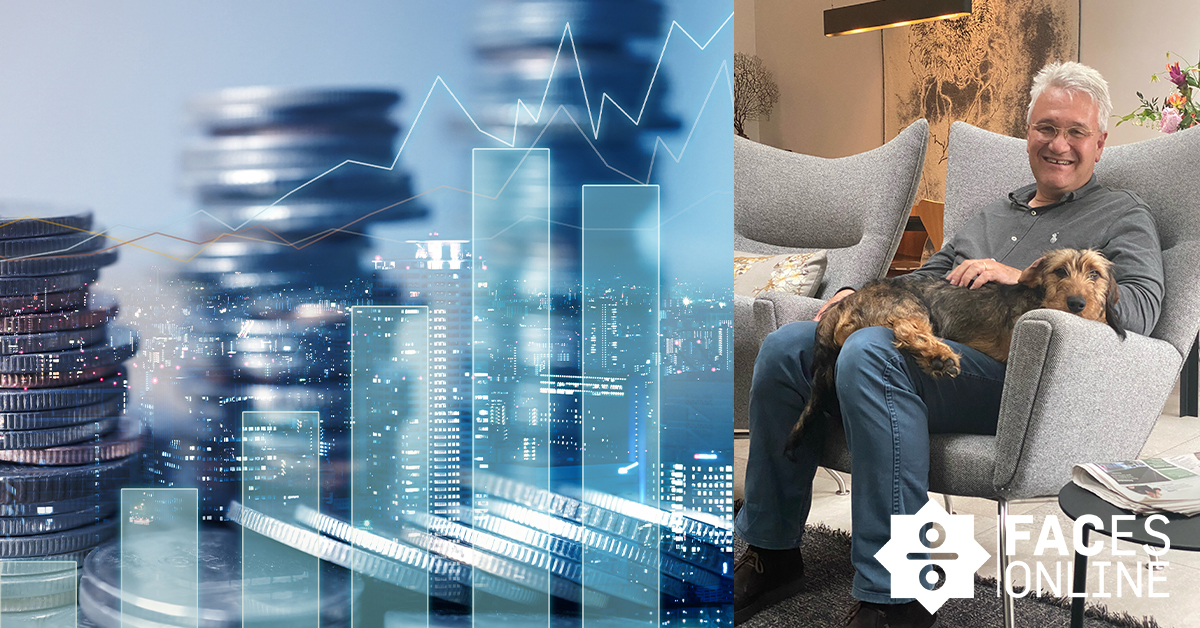
For the Dutch version, click here Roderick Munsters may not be a born but raised Brabander who studied at the University of Tilburg from 1981 to 1988. Besides following his MSc. Business Economics and the MSc. Finance at TIAS, Roderick was very active in his student days at T.S.C. St. Olof and Dispuut Kongsi. Currently, Roderick holds several supervisory positions at large international companies. He is married to Marjoanne Munsters and together they have two children, Mart and Milou. What were your plans right after graduating from Tilburg University? Did you know right away that you wanted to go into the financial world? At the start of my studies, I did not yet know in what sector I wanted to work. The jobs were not easy to come by then. I graduated in the investment subject of securitization, in which you make debt securities marketable. At the time, this was a very unknown subject in the Netherlands. I started my career at Esso Benelux in Breda. In retrospect, this did not quite fit with what I was looking for. Via Piet Duffhues of the university, I came into contact with Interpolis. I started there at the department fixed-interest value. At Interpolis, we applied a value arbitrage strategy that was very successful. Later, I became responsible for Interpolis’ capital markets department. In 1997, when I had been working at Interpolis for eight years, the entire investment business was transferred to Robeco. I then made the switch to PGGM and became Chief Investment Officer there. This was a nice step for me towards the pension world How did you experience the switch from insurance to a pension fund? I did not find the step from an insurer to a pension fund to be a huge one. I did find the step from departmental director to Board of Trustees a big one. I went from managing a team to managing an entire business unit. I was 33 at the time and therefore still relatively young, but I was lucky that PGGM CEO Dick de Beus took me under his wing. The main task as CIO at PGGM was to modernize the investment strategy and create more in-house management. We wanted to grow in portfolios with a link to real returns, such as private equity, commodities, and inflation-linked products. As PGGM (healthcare pension fund), we worked a lot with ABP/APG (government pension fund). It was a very exciting time, in which I was given a lot of room to excel with my whole team. After eight years at PGGM, I was asked to succeed Jean Frijns as CIO at APG. I enjoyed working here for five years, after which I was asked to become the CEO of Robeco Group. A common thread in my career is that the people around me have always been very important. At Robeco, for example, I had a very professional and outspoken chairman of the Supervisory Board alongside me in Dick Verbeek, from whom I learned a lot. A major challenge in my career was the sale of Robeco by Rabobank to Orix, a large Japanese financial services provider. For me, it was very important that Robeco, in the interest of both clients and employees, was sold as one company and that there would be no break-up. Fortunately, this also succeeded. Robeco is still doing well and has continued to grow because they have some good investment strategies. They have not grown further through mergers and acquisitions, which was Orix’s initial intention. I left Robeco two years after the sale. I then became CEO of French Edmond de Rothschild Asset Management. What was it like working for a French asset manager? It was very different working at Robeco, not so much because Edmond de Rothschild is French, but because it is a family business focused on managing French institutional money as well as the assets of wealthy families. It is a well-known name worldwide, so much of it is under a magnifying glass. My main intention was to have the investors of Edmond de Rothschild’s bank in Switzerland cooperate much more with the head office in Paris. This was eventually implemented. SRI is currently becoming an increasingly important factor in the investment world. How did you guys deal with this in the past? Is this in line with how it is now? From the end of the 1990s, I have been focusing on sustainability at both PGGM and APG and took the first steps to include sustainability as a criterion in investment decisions. Sustainable investment is becoming an increasingly relevant and well-known subject. There are actually two reasons for this. Society wants consumer money to be handled responsibly, but sustainability factors also have a major impact on a company’s financials. As a company, you can be fined for emissions and customers will turn away if, for example, child labor is used. This change also brings opportunities for companies, such as the new market for renewable energy. In practice, you also see that administrators are increasingly concerned with sustainable business, as also outlined in the Sustainable Development Goals of the United Nations. I personally think that the government could and should play a more active role in making the business community and financial sector even more sustainable, for example by pricing CO2 emissions. I expect that a business model based on sustainable entrepreneurship will emerge for many countries in the long term. The corona pandemic has drastically changed the way we work for over a year. How do you deal with this? It’s perfectly doable to work from home and most companies are now well equipped for it. I normally work abroad, so I save a lot of travel time. However, I also look forward to meeting people again. This brings energy, new ideas, and insights, from which you can learn a lot. Video conferencing is practical and this will definitely continue, but I hope and expect that many meetings will go back to physical. You have been a
Working at EY
For the Dutch version, click here What is it like to start working at an accountancy firm in a time in which everything is online and working from home is the standard? In this article, Daniek Veldhuis will tell about her experience as a first-year staff member at EY. Who am I? To begin, I will shortly tell something about myself. My name is Daniek Veldhuis, I am 22 years old and I live in Tilburg. After obtaining my VWO diploma in 2015, I decided to make the move to the student city Tilburg. From 2015 to 2018, I studied Business Economics and after completing this bachelor, I continued with the master Accountancy at Tilburg University. Next to my studies, I was a board member at the study association Asset | Accounting & Finance. As such, I got the change to organize network events together with my fellow board- and committee members. These network events were organized for, among others, several accountancy firms,. Due to this, I was able to get a good idea of the various Big-4 offices and eventually make an informed choice to apply for a job at EY. Why EY? You might wonder which factors contributed to my choice for EY. First of all, I quickly decided for myself that I wanted to start at one of the Big-4 offices. For the many possibilities, but also the international aspect appealed to me. Another factor that was important to me was a good match with my colleagues. The actual work at the different accountancy firms does not differ much, which makes the social aspect even more meaningful. Working at EY During my master, I first did a thesis internship at EY in Eindhoven. During such an internship, you will have the opportunity to write your thesis at the office. As such, you can already experience the ins and outs and the atmosphere on a normal working day at the office. My thesis internship started in February, but unfortunately we quickly had to work from home due to the COVID-19 crisis. Fortunately, fear that this would cause less contact with colleagues was not necessary. At the beginning, all thesis interns were assigned a buddy group and mentor and we had a weekly contact moment with this buddy group during the duration of the internship.. Despite the special circumstances, I enjoyed this time so much that I started at EY Eindhoven as a Staff Audit last September. The first two weeks consisted of an introduction period with all the other starters from the same region in which we covered different cases to prepare us for the work to come, but also several informal activities were organized to create a good relationship with my fellow starters. “The activities as a Staff Audit differ throughout the year, from testing internal controls to analyzing the figures in the annual report.” After the introduction weeks, it was time to really get to work. A big step, but you will be guided in this process as well as possible and in the case of any questions, you can always contact your personally assigned coach.. None of my colleagues will have exactly the same working day. This mainly depends on everyone’s client package. My client package consists of different types of clients, including one large client from the United States that I have been working on for most of the time so far. The activities as a Staff Audit differ throughout the year, from testing internal controls to analyzing the figures in the annual report. You work on this together with the team, at the EY office or at the clients site. This year, it has been different and I have spent most of the year working from home. This is very different from what I had imagined my first year at EY to be, but we all try to make the best of it. Where you would normally meet in a meeting room with your senior to discuss something, this is now all done via Teams. Furthermore, we now have virtual work sessions to re-create the feeling of a normal working environment. All team members will join the session, so we can also get an idea of what the other team members are working on. Besides all the hard work, there is, of course, also time for other fun activities. Unfortunately, this year, events like the Christmas drink or ski trip could not take place, but online activities are organized as much as possible, with the entire region or within the team you are working with that week. For example, two colleagues of mine organized a Carnival pub quiz for the entire team a few weeks ago. In short, my first year has been an eventful year so far and different than expected, but precisely because of the way EY has approach this situation, I am still happy with the choice I made.
Working at Vermetten
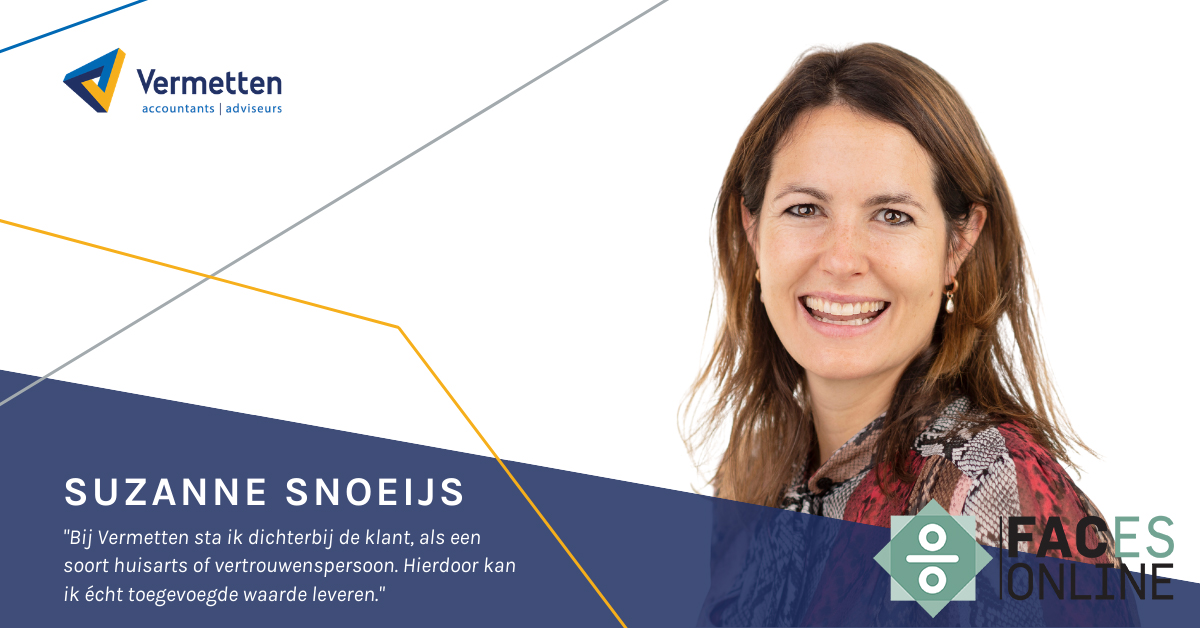
For the Dutch version, click here Suzanne Snoeijs was a member of FST about 15 years ago, now better known as Asset | Accounting & Finance, where she organized the StudyTour to Boston at the time. She studied Master Accountancy at Tilburg University and is now employed at Vermetten. Can you tell us something more about yourself? I used to study at Tilburg University, where I did the bachelor Business Economics and then the master Accountancy. I was a member of FST at the time and organized the StudyTour to Boston. I have always enjoyed my time with FST and have good memories of it. After my master’s I started working at PwC. I started at the Breda office, where I worked for four years. Then I switched to the Rotterdam office, where I worked for another four years. I was able to gain more experience in Rotterdam because that’s where the larger clients were and where the IT Audit department was located. After eight years I made the switch to a smaller office. I first worked at Witlox for a year and then switched to Vermetten, where I have been working for about six years now and will soon become a partner. What is the difference between a large and small office? At Vermetten I am closer to the client. In Accountancy, it is difficult to provide added value. If the relationship with your client is good, you can deliver this much better and you also get more satisfaction from it. You are more like a doctor than a confidant of the client, which means you get completely different questions than just about the audit of the annual accounts. Sometimes people just want to talk about something and tell their story. Clients then give me a call, even though I can’t always help them. At the larger offices, you are forced into a kind of checklist culture. I like to audit based on common sense because I think you can then do a much better quality audit. Why did you start at PwC and, if you could do it over, would you make the same choice? I wanted to learn a lot, so a Big 4 firm was my preference. I had been to Barcelona with PwC. The people at PwC and the culture suited me, so choosing PwC was easy. The training program at PwC is fantastic and you start with a large group of people, which is different at smaller firms. You also learn a lot on the job. Smaller firms have smaller clients and you can often get to know them from the beginning, front to back. The learning curve at a smaller firm is, therefore, in my opinion, somewhat steeper. So it just depends on what suits you as a person. “You are more like a doctor than a confidant of the client, which means you get completely different questions than just about the audit of the annual accounts.” Can you tell us a little bit more about Vermetten? John started about 25 years ago on his own. When I started at Vermetten 6 years ago, about 35 people were working in 2 locations. This makes you have a very different culture. You don’t have a consultation structure where 20 people have to be involved in the decision-making. In recent years many other branches have joined. At the moment we have about 200 people spread over 7 branches. This means that we are entering a new phase in terms of structure. This includes a partner structure, so this year 8 new partners will join. These are all people who already have a certain responsibility and will grow in their function. We also work with a team of 15 people on the audit. The nice thing about the team size is that we all know each other very well. Another nice thing is that it is not as hierarchical as I was used to. We help each other when necessary and socializing is crucial to do the job well. We have a relatively young team. The majority are between 20 and 35 years old. We have many different types of clients and do anything that is not too difficult. So we don’t do hospitals and municipalities, because you need industry-specific knowledge for that. Furthermore, we mainly have smaller production and profit companies in our portfolio, as they are highly represented in this region. Besides the audit team, we have many other teams, offering any service which an SME needs. Here you can think of: corporate finance, tax, human resources, compilation, salary, and legal. We want to be able to answer any question a client might have. What is your future perspective? Many students, clients, and other people do not yet know us very well. We would like to continue to grow as an organization because if you grow you also have a good development perspective for new talents. Ultimately, we want to become the best office in Brabant. Furthermore, our strategy is to remain active in the region and focus on Brabant. This is also where the bulk of our portfolio is located. How do you experience corona time? I work at home as much as possible. We try to limit contacts at the office and with customers. Sometimes this is difficult, especially if we have to count the stock, then we do have to visit the customer. Furthermore, not everyone must get overworked. We have a team meeting every week where we discuss the progress and see if we are still on schedule. I find it important to clear my head once in a while, which I do by going for a walk outside, playing tennis a few times a week, making large jigsaw puzzles, or coloring by number, among other things. Everyone is in the same situation and yes, sometimes you hear a dinosaur cry, but that has its charms too. Why did you choose Accountancy and do you have any other tips
