

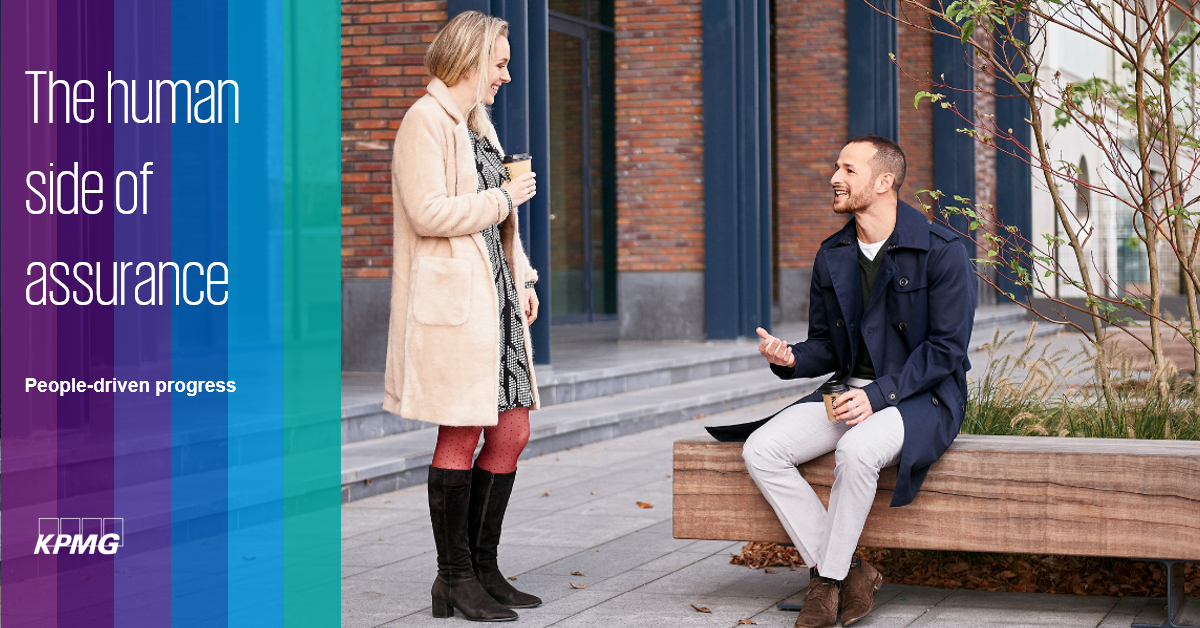
For the Dutch version, click here About me My name is Daan van Overbeek and I have been working at KPMG for 3 years now. I am 26 years old and live in Tilburg. I started studying in Wageningen, where I followed the bachelor ‘Bedrijfs- en consumentenwetenschappen’. In Wageningen, I was also a member of a student association, where I held the position of treasurer for one and a half years. This is where my interest in working with numbers started. This led me to leave Wageningen after my bachelor’s to follow the master Accountancy in Tilburg. After the master Accountancy, I continued with the Post Master Accountancy at Tilburg University, which I completed last year. How I got to know KPMG When I started the master Accountancy, I honestly had no idea what kind of company I wanted to work for. Fortunately, the university and Asset Accounting & Finance organised several introductory events at the beginning of the year, which gave me a better idea of the possibilities after the master. After talking to several recruiters and professionals, I decided to sign up for KPMG’s Business Experience. For five days, we went to Madrid with +/- 30 students and 10 KPMG professionals. The program was arranged in such a way that we learned more about the Audit, KPMG and the colleagues, but also enjoyed the Spanish sun, tapas and clubs. After this week, I was convinced that KPMG and I would be a good match. My experiences at KPMG My career at KPMG started as a thesis intern. The great advantage of a thesis internship is that you can already take a look behind the scenes, without being expected to do very much. Writing your own thesis is the first priority, and if there is time left over, you can work for/at clients as much as you like. It is also a great opportunity to get to know your colleagues. Immediately after my thesis internship, I started working at KPMG, in the Breda office. KPMG Breda is a relatively small office (about 70 accountants), so you quickly get to know everyone. This made me feel at home right from the start. This is partly due to the fun activities we organize with colleagues. From bachelor parties to NAC evenings and from football tournaments to a day of sailing. Besides the activities with the office, there are also fun activities with several offices together. For example, there is an annual ski trip, which we hope will be possible again this year. In short, besides work there is plenty of time for relaxation! At KPMG Breda, we don’t really work with sectors when it comes to clients. As a result, I have (had) a wide range of clients, from a large international construction company to an investment company with only 15 employees on the payroll. Personally, i experience this variety as fun and instructive. For example, one week I am working at a client in an assignment team of 12 accountants where you can learn a lot from your more experienced colleagues, and the next week I am in an assignment team of four accountants where I can take on many responsibilities myself. My experience is that a lot is possible at KPMG. If you like to do something besides auditing, there are more than enough opportunities. I am a coach for interns and I have supported the recruitment team with career events. There are also junior colleagues who, for example, help with the acquisition of potential new clients. My advice to students If you have decided for yourself that you want to work at an accountancy firm, I would attend as many career events as possible. The most important thing is to be able to speak to many people from different offices. After all, the work we do is more or less the same everywhere, since we have to comply with the same regulations. Therefore, my choice would depend on the atmosphere that prevails at the offices. As you can read, I am very positive about KPMG as an employer. It therefore didn’t surprise me to read that KPMG has been chosen as the number 1 employer of the Netherlands in 2021 according to LinkedIn Top Companies. If you don’t believe it, here’s the link: Top Companies 2021: bij deze 25 Nederlandse bedrijven ontwikkel je jouw carrière het best | LinkedIn If you are also enthusiastic and want to know more about my experiences at KPMG, you can always send me a message via LinkedIn. If you have any questions about the (internship) opportunities at KPMG, please contact our recruiter Marvin van Veen via LinkedIn, mail (vanveen.marvin@kpmg.nl) or phone (+31622589360).

The women’s quota: time to say goodbye to a male-dominated workplace
For the Dutch version, click here The women’s quota is a concept that has come up every now and then in recent years. On 11 February 2021, the women among us received some good news; the proposal for a women’s quota was adopted by the Second Chamber. This women’s quota requires at least one-third of the supervisory directors at listed companies to be women. Time to take a closer look at the accountancy sector. How are women doing in this traditionally stereotypical male-dominated workplace? Let’s have a look at the facts. The percentage of female registered NBA members has increased from 19.0% (2013) to 22.9% (2020). A positive, but small growth. When we zoom in on the top of the sector, we see a mixed picture. PwC is one of the firms where things seem to be going in the right direction with three women of the seven members of both the Supervisory Board and the Executive Board. This prompted us to talk to one of PwC’s power women; Marieke Hormann-Buiting. Marieke shares with us her experiences and vision on gender diversity. Could you briefly tell us about your background and career path? Some years ago, I completed my business economics studies at Maastricht University and started my career at PwC. I am now 37 years old and a proud mother of two. I currently live in Brabant and work as a director in Eindhoven. As a director I have the final responsibility for client files, whereby my specialisation lies with technology companies. Besides my position as director, I am also a member of the MT of Business Unit South. Within the MT, I am responsible for the Human Capital portfolio, which means that I am, among other things, involved with talent development and the well-being of colleagues. Why did you choose a career as a chartered accountant? Curiosity and a preference for searching for overview and logical connections were my main motivations. How do business processes within complex organisations come together to form a logic whole. Accountancy was the perfect direction for me to dive into this. After a few business courses and orientation days, the personal connection with PwC was the strongest. I’m now approaching my 15-year anniversary. In the meantime, I even had the opportunity to work for PwC in Silicon Valley for two years. This was a very nice experience. All in all, I can conclude that PwC was a good choice. “Personally, I find it funny when I walk into a room with predominantly grey men. Then I bring a bit of colour.” Have you experienced a difference between men and women during your career at PwC? I have never felt disadvantaged because of being a woman. During my career, I have always worked in mixed teams. There is a philosophy behind these mixed teams. A philosophy that men and women complement each other’s qualities and that this is how we achieve the best quality. I have to say that clients are often more male than PwC itself. My clients generally find it refreshing when I come in as a female accountant. Personally, I find it funny when I walk into a room with predominantly grey men. Then I bring a bit of colour to the table. Within these mixed teams, how do you think men and women complement each other? A balanced dynamic is what I see in mixed teams. For example, I regularly work with a partner. He is high on energy. I, on the other hand, am more concrete and bring the necessary structure. These opposite characteristics make us a complementary duo. In my teams, I see the same effect; all masculine and feminine characteristics come together to form one capacity that includes client management, forward thinking, team connection and conducting a high-quality audit. A common argument as to why female accountants are in the minority is that it is difficult to combine work with a family. How do you experience this? I work part-time and take the lead in my own planning. As a result, I experience a great deal of flexibility in my work. On the other hand, I also have a lot of responsibility. Sometimes a case suddenly comes up with a customer. In such exceptional cases, I make sure that I am on standby. Finding the balance between freedom and responsibility is part of the job. Ultimately, I like the combination of my family and the challenge of my work. The trick is to bring it all together in a balance that feels good. Did you observe any development in the position of the female accountant over the years? This development can be divided into two parts. The inflow is almost 50/50. A lot of attention has been paid to this and the result is positive. The challenge within the sector lies mainly in the development to higher function levels. A general challenge is to retain the group of young parents. I think it’s important to make it clear to them that it’s also possible to continue working as an accountant with a family; dare to rediscover yourself. Within the (senior) manager group there is a nice group of women, but the layer above paints a poorer picture. In the Partners and Directors group of Business Unit South, there are only 2 women in a group of 16. I believe the main cause of this is a lack of role models. Role models are crucial in creating an image of how to do your job well. Stereotypes such as ‘not being able to work part-time, always being available as a partner/director’ can only be broken by talking to role models who prove otherwise. When I was a senior manager, I contacted a number of female partners myself to discuss how they dealt with issues such as managing a family and flexibility. I have also been unconsciously influenced by role models. In Silicon Valley, I had a client with a female top layer. These were feisty ladies and
Working at Van Oers
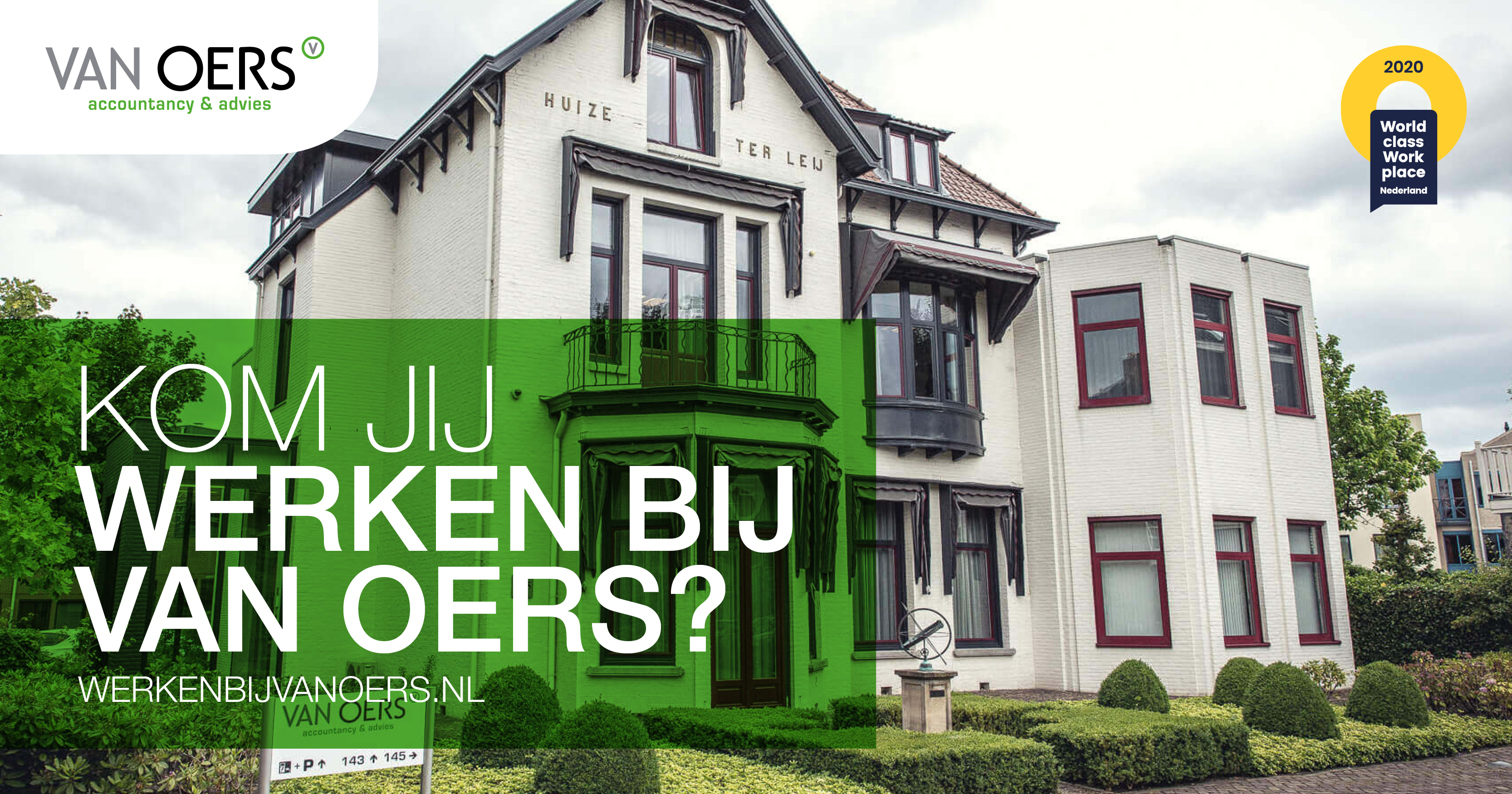
For the Dutch version, click here Who am I? Let me briefly introduce myself. My name is Edward van Dijk. I am 29 years old and live in Breda. In 2009 I chose to study Business Economics at Tilburg University. I found the versatility of the program an advantage, as it allowed me to choose many different directions. In the subsequent master’s, I decided to study Accountancy, but I also wanted to gain practical experience. I therefore chose to follow the master and post-master program at Nyenrode Business University. I hope to complete the final phase of the post-master program very soon! The packed lecture halls with often hundreds of fellow students remain to be a vivid memory for me. As will the 8-week study blocks, which in three years covered every imaginable subject within economics, business economics, and fiscal economics. This gave me a broad theoretical basis. Of course, I also found time for fun during my student years. My best memory of my time in Tilburg is the study trip to Brazil with 20 fellow students, organized by Asset. As one of the lucky ones, I had the opportunity to go to Rio de Janeiro and Sao Paolo. These super cities made a big impression on me. I believe the study tour is still being organized and I highly recommend it! Van Oers Then along came van Oers. In mid 2019 I decided to transfer to the audit department of Van Oers in Breda. This is a well-known accounting firm in West Brabant, consisting of five offices. I felt at home immediately. Van Oers has a very professional look and feel, along with a personal approach. I immediately liked the approach to professionalism and the investment in the growth of (young) professionals, the most important parts of the audit field. In addition, the client portfolio really appealed to me. Van Oers serves both SME clients as well as large for-profit companies in a wide range of sectors, which is also nicely explained on the website. For my own development, I was looking for diversity in my client portfolio. In consultation with Van Oers I was offered diversity, which provides me with many challenges in my daily work. Working at Van Oers Van Oers currently has over 380 employees working in the various disciplines that Van Oers offers. In my department, I work with approximately 65 colleagues, a number that is still growing. In the field of Auditing & Assurance, our department is one of the largest in the region. The work as an auditor mainly consists of auditing financial statements of companies subject to audit. “Due to the good organization and the growth I am experiencing in my own development, I am still satisfied with the choice I made.” To make it concrete, it is best to explain how a regular day for me looks like. As a Senior Staff member, I manage the team members and report to the manager of the assignment. The assignments vary. I sometimes work with three colleagues together on a project, but I also have assignments with 8 colleagues. The work itself is diverse but can be roughly divided into interim and balance sheet audits. During the interim audits in autumn, we focus mainly on gaining insight into the company and testing the internal controls. During the balance sheet audit, we anticipate on the identified risk factors, by analyzing the figures and verifying the information presented in the financial statements. My own role consists of going over the tasks for each item or part of the audit with a Staff member, reviewing the work performed, performing the most complex tasks, and communicating the status and findings to the manager. The project is thus carried out together, in which each team member has his own share. Van Oers believes that involvement is extremely important. Informal activities are always announced with great enthusiasm. An example of a fun activity is the annual employee event, The Voice, which is a popular gathering among all Van Oers employees. In addition, my own Audit department often organizes activities for the entire team, such as a quiz or a (digital) escape room. Because Van Oers also considers quality to be extremely important, I often see my colleagues at seminars. In short, we work very hard. Due to the good organization and the growth I am experiencing in my own development, I am still satisfied with the choice I made. Corona I can’t help not to mention the COVID-19 crisis time at the time of writing this interview. I work mainly remotely, that is, at home at the dinner table. Van Oers has provided me with all the tools to work effectively remotely. This has been effortless. Daily phone calls, but especially switching with colleagues and customers via Microsoft Teams is my fixed daily rhythm. Because I currently work, eat and sit in one place for almost the entire working day, I almost always exercise for an hour after work. This, in turn, is a big advantage: no more travel time and therefore more flexibility! My advice I have always had a good sense of numbers. Economics, management & organization, and math were always my favorite subjects in high school. I must admit that I had a hard time making a choice in my studies. The choice for a somewhat broader preliminary education was for me a great outcome to discover several directions in the financial world. I soon discovered that I was most interested in the “behavior” of organizations. Why do organizations, and especially the people in these organizations, make the choices that lead to success? A company is more than numbers! The accountancy branch fits in nicely with this! My advice: First of all, I recommend that you enjoy your student life. Cliché, but this period flies by. Before you start your career, my advice is to get a better understanding of where your interests and ambitions lie. What is the ideal job for you and
Controlling – Accounting’s long lost brother
For the Dutch version, click here For the accountancy students among us, it’s a familiar ritual by now; as soon as the future comes up, the majority of students hear the all-too-familiar song: first, complete the master’s program Accountancy, then start the postmaster CPA while at the same time, starting to work for example at Deloitte, EY, KPMG or PwC. There is, of course, nothing wrong with this road. After all, the CPA title is very valuable and as long as people have not been replaced by technology, we will also need enough inflow into the audit practice, and the financial sector in general. In addition, working in auditing can also be fun, provided that this is where your interests lie. The demand for the CPA title is therefore growing every year. However, the ever-growing demand for CPA students also has a downside: when people talk about accountancy these days, we only think about Chartered Accountants. However, there is another branch within accountancy; Controlling. What exactly does a controller do? Generally, a controller assists the board or management in understanding and maintaining the financial affairs of a company. The controller oversees a company’s finance department and often leads this team as well. The controller also deals with financial planning and reporting for the benefit of management. Simply put, a controller is concerned with the quality of the entire financial process and ensures that the results and planning are optimally communicated to management, in order to support decision-making. For a career as a controller, you generally don’t need additional training like a CPA. However, these courses do exist. The executive master: Register Controller (RC). If you complete this program, you will be listed in the NBA register, just like a CPA, as an additional quality stamp on your resume. Why RC or CPA? The big question now, of course, is why anyone should choose RC or CPA. One is no better than the other. Both have extensive knowledge of financial data, and both are post-master educated. So the difference does not lie in the level of education. In my opinion, it will mostly be where your interests lie. Of course, your interests lie in finance, otherwise, you wouldn’t even think about throwing yourself into the world of financials. The big difference is whether you like to evaluate a company internally or externally. As a controller, internally you will be mostly concerned with the processes within the finance department and steering for growth and results. As an accountant in the audit practice, you will mainly focus on the correctness of the external reporting and compliance with laws and regulations. The question is therefore what you yourself find most interesting. It’s worth noting that there is a trend where we see a lot of chartered accountants choosing to switch to a controlling position in the business world after a number of years in the audit field. For example, many controllers and CFOs at large Dutch companies used to be CPAs. Think of the CFOs of Adyen, ASML, and Unilever. For those students who already know that they have the ambition to eventually hold a position as CFO: there is also another path than becoming a CPA. The road to RC is about as long, but if we are to believe the universities, you are slightly better prepared for the position you will eventually hold. Boxes The advice I would like to give current and future Accountancy students: do not immediately put yourself into the box of the chartered accountant. Of course, it’s a good profession with good prospects, but there are many other interesting jobs that are just as well suited to financial education. In my opinion, that is also the beauty of training in financial disciplines; at the basis, we all understand financial matters, and eventually, you can end up in plenty of amazing places. Even without a CPA title, you have a degree in your pocket that guarantees your ability to critically think in a certain field. And that piece of paper will get you there.
Working at EY
For the Dutch version, click here What is it like to start working at an accountancy firm in a time in which everything is online and working from home is the standard? In this article, Daniek Veldhuis will tell about her experience as a first-year staff member at EY. Who am I? To begin, I will shortly tell something about myself. My name is Daniek Veldhuis, I am 22 years old and I live in Tilburg. After obtaining my VWO diploma in 2015, I decided to make the move to the student city Tilburg. From 2015 to 2018, I studied Business Economics and after completing this bachelor, I continued with the master Accountancy at Tilburg University. Next to my studies, I was a board member at the study association Asset | Accounting & Finance. As such, I got the change to organize network events together with my fellow board- and committee members. These network events were organized for, among others, several accountancy firms,. Due to this, I was able to get a good idea of the various Big-4 offices and eventually make an informed choice to apply for a job at EY. Why EY? You might wonder which factors contributed to my choice for EY. First of all, I quickly decided for myself that I wanted to start at one of the Big-4 offices. For the many possibilities, but also the international aspect appealed to me. Another factor that was important to me was a good match with my colleagues. The actual work at the different accountancy firms does not differ much, which makes the social aspect even more meaningful. Working at EY During my master, I first did a thesis internship at EY in Eindhoven. During such an internship, you will have the opportunity to write your thesis at the office. As such, you can already experience the ins and outs and the atmosphere on a normal working day at the office. My thesis internship started in February, but unfortunately we quickly had to work from home due to the COVID-19 crisis. Fortunately, fear that this would cause less contact with colleagues was not necessary. At the beginning, all thesis interns were assigned a buddy group and mentor and we had a weekly contact moment with this buddy group during the duration of the internship.. Despite the special circumstances, I enjoyed this time so much that I started at EY Eindhoven as a Staff Audit last September. The first two weeks consisted of an introduction period with all the other starters from the same region in which we covered different cases to prepare us for the work to come, but also several informal activities were organized to create a good relationship with my fellow starters. “The activities as a Staff Audit differ throughout the year, from testing internal controls to analyzing the figures in the annual report.” After the introduction weeks, it was time to really get to work. A big step, but you will be guided in this process as well as possible and in the case of any questions, you can always contact your personally assigned coach.. None of my colleagues will have exactly the same working day. This mainly depends on everyone’s client package. My client package consists of different types of clients, including one large client from the United States that I have been working on for most of the time so far. The activities as a Staff Audit differ throughout the year, from testing internal controls to analyzing the figures in the annual report. You work on this together with the team, at the EY office or at the clients site. This year, it has been different and I have spent most of the year working from home. This is very different from what I had imagined my first year at EY to be, but we all try to make the best of it. Where you would normally meet in a meeting room with your senior to discuss something, this is now all done via Teams. Furthermore, we now have virtual work sessions to re-create the feeling of a normal working environment. All team members will join the session, so we can also get an idea of what the other team members are working on. Besides all the hard work, there is, of course, also time for other fun activities. Unfortunately, this year, events like the Christmas drink or ski trip could not take place, but online activities are organized as much as possible, with the entire region or within the team you are working with that week. For example, two colleagues of mine organized a Carnival pub quiz for the entire team a few weeks ago. In short, my first year has been an eventful year so far and different than expected, but precisely because of the way EY has approach this situation, I am still happy with the choice I made.
Working at WVDB
For the Dutch version, click here Who is Floortje Schroeder? My name is Floortje Schroeder and I am 23 years old. I was born in Tilburg and have lived in ‘s- Hertogenbosch since I was 11 years old. After high school, I started the hbo study Business Economics/Accountancy at Avans University in ‘s-Hertogenbosch. I completed this program in 2018. Since I wanted to study in the city where I come from, I chose to follow the Pre-Master Accountancy at Tilburg University. After completing the Pre-Master I started the Master Accountancy and consequently, I started the Post-Master Accountancy at Tilburg University in September 2020. My path to WVDB My path to WVDB started in 2016 when I signed up for the ‘practice route’. The practice route was a part of my hbo Accountancy studies at Avans Hogeschool and allowed students to get acquainted with the audit practice. To be able to participate in the practical route, a choice of an accountancy firm had to be made. The choice consisted of a Big 4 firm and WVDB. My preference went to WVDB because I believe I fit better in an organization where the lines are short and therefore everyone in the department knows each other and works with each other. In addition, I saw that a medium-sized organization would offer me the opportunity to be given responsibilities and to grow more quickly. WVDB caught my attention because it is a multidisciplinary office where different disciplines work together and because WVDB has a diverse client portfolio. The practical route brought me to WVDB as a junior assistant accountant. The practical route had a duration of 1.5 years where I worked 4 days as a junior assistant accountant at WVDB and followed my studies on Fridays. This allowed me to get an early idea of how everything works in practice. During my working period as a junior assistant accountant, WVDB introduced me to the accountancy profession. They gave me the opportunity to carry out various activities for both the compilation and the audit practice. In this way, WVDB gave me the opportunity during this period to get an idea of the practice and to develop myself. As a result, it was easier for me to make my choices regarding a follow-up study (AA / RA). “During this interim period, I started as a working student in the audit practice at WVDB. Working a few days a week during my studies allowed me to apply all the theoretical knowledge I had gained during my studies and to maintain and expand my practical knowledge.” After finishing the Pre-Master, an interim period follows, and then the Master Accountancy starts. During this interim period, I started as a working student in the audit practice at WVDB. Working a few days a week during my studies allowed me to apply all the theoretical knowledge I had gained during my studies and to maintain and expand my practical knowledge. This gave me an advantage over my fellow students in terms of practical experience. Because of the above, after completing my Master’s in Accountancy it was not difficult to choose where I wanted to work. WVDB has given me the opportunity to gain practical knowledge and develop myself during both my hbo and my Master’s studies. I have always found this time to be very pleasant. Because of this, I chose to stay at WVDB and I started as an assistant accountant audit practice at WVDB on September 1, 2020. My role and activities I have now been working as an assistant accountant for the audit practice at WVDB for several months. I have benefited greatly from the knowledge I have acquired during the practical training and my work-study, as I can now work independently. As an assistant, I am involved in carrying out audit assignments for various clients. WVDB has a very diverse client portfolio, which allows me to gain experience with the different sizes of clients and the sectors in which they operate. The diversity of the work with different clients and the cooperation with multiple disciplines make it challenging to work at WVDB. In addition, there is room for guidance, management, personal development, lots of customer contact and every team member is ready to help each other. There is also a friendly informal atmosphere at WVDB where it is pleasant for everyone to work. Usually, staff parties and outings are also the focus. However, due to COVID-19, these have not been able to physically take place this past year. Of course, WVDB would not be WVDB if we did not replace these outings with virtual ones. We now have the virtual after work drinks on friday, the control practice pub quiz, and the (Christmas) bingo! What do I want to give you? What I would like to pass on to you is that if you have the opportunity to take an early look at the practice to grab this chance. It facilitates your (study) choices in the future, gives you a head start on your fellow students, ensures your personal development, provides extra preparation for the start of your career and WVDB is open to help you with this! I would also like to suggest you take a good look around and see which office suits you best. Go and have coffee at different offices and talk to starting employees so that they can share their experiences with you. This will give you a taste of the atmosphere at different offices. Don’t follow the most popular route, follow your own route!
