


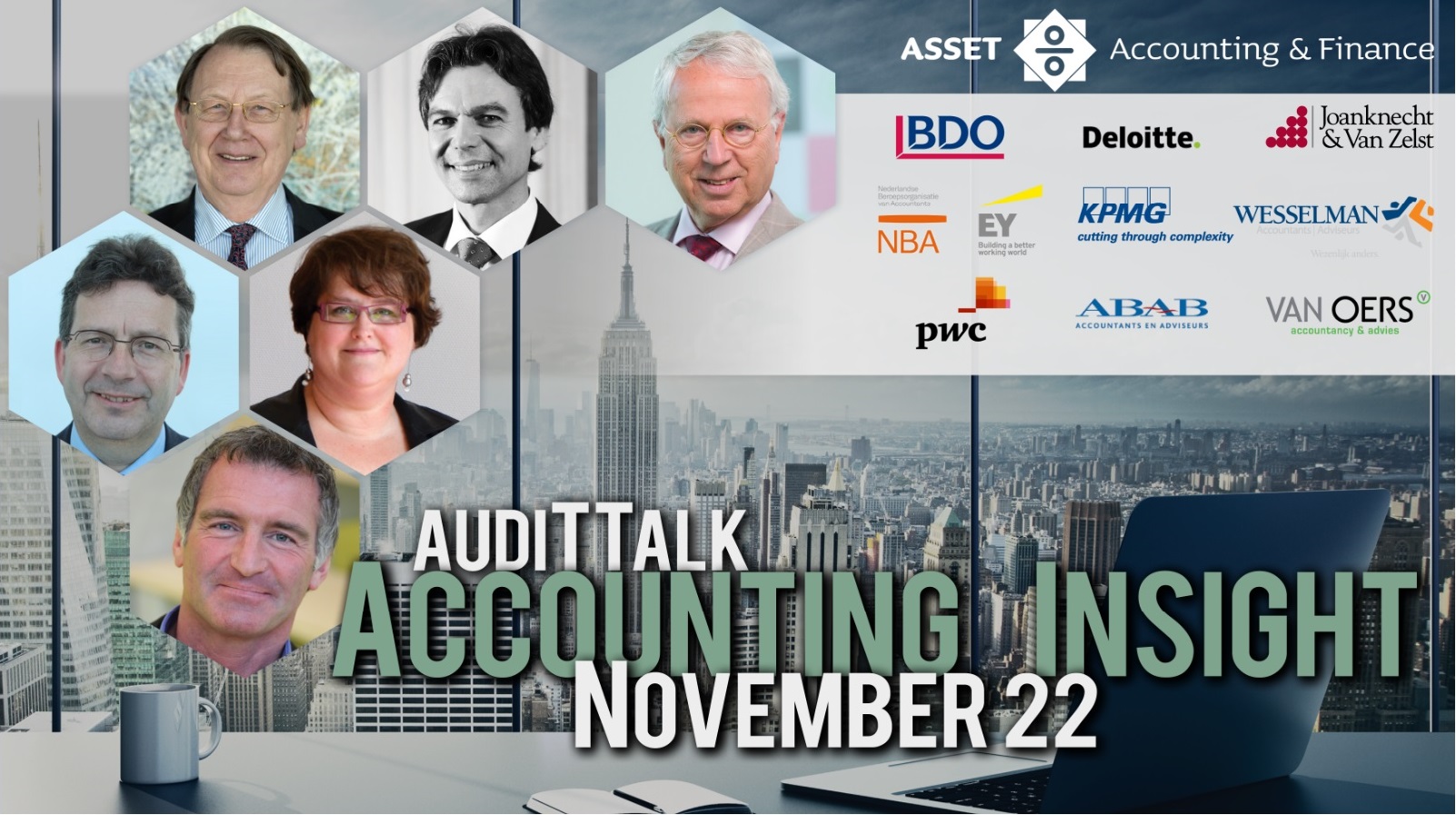
On behalf of the Accounting Insight 2016 committee, I would like to invite you for this event of the study association Asset | Accounting & Finance. The accounting profession is changing! There are many new developments that affect the profession of the current auditor. Lately, the accounting profession is very often in the news; headlines such as ‘The accountants have become cowards, and ‘Longing for the auditor as sparring partner’ are no longer shocking nowadays. Everyone is aware of the changes, but how does this really have impact on the future? Is there even still a future for the audit? Perhaps, in the long run, the current auditor will be entirely redundant. There are innumerable IT innovations going on, but what will be the consequences? Should we be happy with this or will this lead to the extinction of the profession? In addition, a reform plan is being implemented; this also requires in many areas a new approach within the accountancy world. It is important to continue to look to the future and to keep our expectations of the profession realistic. And who said the future will not be better than ever before? “Everyone is aware of the changes, but how does this really have an impact on the future?” During the symposium on November 22, will be a discussion about all these changes and reformation. Thus, the future of the audit will be the central theme. After a brief introduction of each statement, they will be discussed one by one by the panel of speakers and the audience. As a committee we are very pleased to introduce the following speakers of the evening: Dr. Nout Wellink (commissioner PwC), Drs. Jan Hommen (commissioner Ahold Delhaize), Drs. Christine Scheper RA (manager AFM), Drs. Johan Hopmans RA (partner Deloitte) and Drs. Martin van Dijke RA (CEO Van Oers). Chairman Prof. Dr. Eddy Vaassen RA, associated with Tilburg University, will lead the evening. Because of their knowledge in the field of accountancy and the experience they have accumulated in their careers, we are convinced that the speakers and the chairman will share very interesting insights with you. Moreover, this night gives you the opportunity to get in touch with four different accounting firms: KPMG, BDO, Joanknecht & Van Zelst and Wesselman. Before the start of the main event, the audiTTalk will take place in cooperation with these four firms. In this short session you will have the opportunity to get your CV checked and ask all your unanswered questions regarding the accountancy profession and your future role in it. Do you want to remain one step ahead of your future? Then you should definitely be present at this event! After this evening you will be fully informed with all the actualities within the accounting profession. Click here to register!

Overview Big Four Audit Rotation
Overview Dutch listed companies and their external accountant (Deloitte, EY, KPMG or PwC). Public interest entities, in the Netherlands referred to as OOB’s (ondernemingen van openbaar belang), are obligated to rotate of audit firm after a period of 10 years from 1st January 2016. OOB’s include Dutch publicly listed (at a European stock exchange) companies, insurance companies and banks. Naturally a tensed discussion has risen between different parties. Most OOB’s and audit firms are not pleased with the future obligation to rotate and claim it will do more harm than good on their quality of financial reporting. The government is determined to implement this new rule to increase the quality of financial reporting. OOB’s and audit firms claim that it is costly to change audit firm and quality will be lost. Quality, they say, will be lost due to the fact that the new audit firm isn’t as capable as the former audit firm from the start to conduct a high quality audit. It will take time to gain the required knowledge about a company to conduct a high quality audit and therefore high quality financial reporting. Others, mostly political parties, argue this statement and claim that rotation will increase independence of audit firms and OOB’s and therefore improve the quality of financial reporting. Below you can find an overview of the first changes that have already taken place due to the mandatory audit rotation: *No liability accepted for errors. If you find any errors or have more information about upcoming changes please contact us via info@asset-accountingfinance.nl.
Is the AFM doing a good job?
‘Freaky Thursday’ has definitely changed the Dutch audit sector. For those people who lived on another planet during the last months: on Thursday September 25, the Autoriteit Financiele Markten (AFM), which is the Dutch regulator that has to monitor the audit and financial sector, published a report in which it is mentioned that 3, 4, 4, and 7 out of the 10 investigated audit engagements of respectively EY, PwC, Deloitte, and KPMG were of insufficient quality. Based on these results, the AFM concludes that the audit quality of the Big4 auditors in general is insufficient and that no improvements have been made since the previous investigation in 2010. Three Major Weaknesses Although the fraud cases of the last couple of years seem to suggest the existence of structural problems in the Dutch Big4 audit firms, the only valid conclusion I can draw after reading the AFM-report is that the AFM missed a historical opportunity to reveal these structural problems in a credible way. Indeed, the investigation of the AFM is not worth the name ‘research’ and violates the basic principles of how reliable research should be conducted. The weaknesses in the AFM-report are at least threefold. First, the AFM has only investigated 10 audit engagements for every Big4-auditor. This sample size is too low for making general statements about the overall audit quality of the Dutch Big4 auditors. My recommendation is to use at least 50 audit engagements for every Big4 auditor. Second, the sample of the AFM is not randomly chosen which implies that the observed audit quality in the AFM-sample is not a reliable source of information to make reliable conclusions about the general audit quality of the Dutch Big4 auditors. Auditors are often accused for taking samples that confirm their initial hypotheses. Based on the way in which the AFM-investigation has been conducted, one can argue that this critique also applies to the AFM. Third, as the AFM only gives very limited information about the way in which this investigation has been conducted, it is impossible to know whether the results can be used to make conclusions about the differences in audit quality of the Dutch Big4 auditors. Such a comparison between the Dutch Big4 auditors is an important purpose of the report as the AFM states the following in the report: “….users of this report, such as investors and creditors, can see how audit quality of the different auditors differs from each other…”. Comparing the Dutch Big4 auditors based on the results of the AFM-investigation is impossible because it could well be the case that KPMG has more mistakes in its 10 audit engagements because the 10 audit engagement of KPMG are more complex than the chosen audit engagements of the other Big4 auditors. Also the conclusion that the audit quality of the Dutch Big4 auditors has not improved since 2010 can be rejected based on the same argumentation. A possible counter-argument of the AFM could be that the complexity of the audit engagement does not matter as audit engagements should always comply with the legal rules. This counter-argument is not really persuasive as the AFM has on purpose investigated more complex audit engagements. The AFM is thus aware that insufficient audit quality is more likely to be observed in more complex audit engagements. Again, my argument is not that the audit sector does not suffer from structural problems, but that the investigation of the AFM cannot be used to conclude that the general audit quality of the Dutch Big4 auditors is low. The conclusion of the AFM about the insufficient audit quality further loses persuasiveness as the AFM also concludes that, based on another investigation, the overall quality of financial reporting of Dutch firms has increased. Just as my colleague at Tilburg University Jan Bouwens, I am really wondering how an insufficient audit quality can be combined with an increase in the quality of financial reporting. As the auditor has to control the financial reports, the quality of financial reporting can only increase if the auditor is doing a good job. Good news, Bad News The way in which the AFM tries to reveal the structural problems in the Dutch audit sector, can be compared with a lawyer who tries to prove a crime based on wrongfully or illegally collected evidence. Although such evidence can indicate that the crime has taken place, the value of wrongfully collected evidence is zero and cannot be used to determine the penalty. Applying this legal logic to the AFM-investigation implies that the AFM-investigation cannot be used to make conclusions about the general audit quality of the Dutch Big4 auditors. As the weaknesses in the AFM-investigation do not require higher-order research skills, it is very remarkable that a lot of institutions and individuals nearly literally copy-paste the conclusions of the AFM. One expects a more critical mindset from institutions and individuals who use the AFM-report to accuse the auditor of lacking a critical mindset. The Big4 auditors cannot be blamed for missing a critical mindset about the AFM-report because they are currently the object of a heated discussion. The good news of this heated discussion that is currently going on is that we can expect some changes in the Dutch audit sector that will address some of the structural problems. The bad news is that the fuss of the last months has caused (or reinforced) serious doubts about the way in which the AFM fulfills its monitoring role. It sounds like a good idea for the AFM to critically think about the way in which they want to monitor the Dutch audit sector in the future! Just as has been argued for the audit firms, I think it would be good if the AFM could come up with some proposals to improve its own functioning!
