

For the Dutch version, click here Patrick van Zwieten is Senior Accountant at BDO and also an ambassador for the NBA. In this interview he talks about his experiences in the accountancy profession, the importance of the NBA and gives his vision on the future within Accountancy. Can you tell us something about yourself? My name is Patrick van Zwieten and I have been working in the field of Accountancy for four and a half years now. I have a higher vocational education background, after which I followed the part-time master’s program at the University of Amsterdam. Within BDO, I work in the Audit & Assurance department where I primarily serve clients in the corperate segment. Why did you choose Accountancy? I found this a very difficult choice at first. I initially worked at ABN AMRO in the investment department for a while. This was more finance-related and that’s why I actually wanted to do a master’s in finance. I then decided to look around for more information by, among other things, taking part in various trial days at accountancy firms. I discovered that I didn’t really know what accountancy entailed and after the trial days I realized that I had a completely different idea of what accountancy actually entailed. The profession requires analytical skills, but also social skills and you have to be able to deal with deadlines. After this, I finally made the choice to go in this direction. What are the biggest differences between Finance and Accountancy? If I compare it to the RA audit practice in Accountancy, we have a project every five to six weeks and we visit the client. This concerns the audit of the financial statements and we speak to all layers of employees within the organization. This makes it very diverse and fun, something that is less applicable in Finance. In addition, you see many different companies, for example, last week I was at the office of a pharmaceutical company and next week I will visit a large clothing retailer. What does an average accountant’s work week look like? Actually, every week is different. It also varies a lot what function you have within the office. If you are just starting out, then you will often be working on an executive level. After a year or two or three, you often get more responsibility and start supporting and guiding starters. The longer you work in the company, the more you are allowed to lead the smaller teams and act as manager, while with the larger clients you still mainly have the executive task. This ensures a good balance. Besides the ‘standard’ work at BDO, we sometimes have a padel tournament with the office. This ensures that we can also meet up outside of work hours and build up a good relationship with colleagues. In addition, we are actually at the client’s office every working day. The audit consists of two parts: the interim part and the year-end part. During the interim part, we visit the client to gain knowledge of the client and the company’s process in order to analyze risks, but also to find points of departure for our audit. In the second year, which often starts around January, we really look at the figures. Using various techniques, we then check whether the annual accounts are actually correct. How has combining work and study worked out for you? In the beginning I found it quite hard. I started working full-time and also had a part-time master’s degree to complete. Especially in the first year I was searching for the right planning. I noticed that over time I could find my feet and things went better. This was also because everyone around me was going through the same process, both my colleagues and my fellow students. The office also helped me a lot, we get an extra day off before exams and we can ask for help if we find a course difficult. What are the opportunities after getting your master’s in accountancy? I think there are many possibilities once you have your degree. In the path of RA, you could grow within the office to partner, but in addition you also see that someone with an RA title is popular in the business, you are then Accountant in Business (AIB). This is for example in large companies to work in the finance department. Another possibility is to become CEO or CFO. So outside of the accountancy field, it offers a huge amount of opportunities in the job market. Can you tell us a little bit about NBA? The NBA is the Dutch Professional Organization of Accountants. There are over 22,000 registered accountants in the Netherlands today. These are both Chartered Accountants (RA) and Accounting Consultants (AA). They are all listed in the NBA register. This organization promotes the professional practice of accountants. They do this by drawing up rules of conduct, testing the knowledge of accountants and providing education. At the end of the practical training, there is a final exam that tests whether you are capable of acting as a starting professional practitioner. However, before that happens, you must first complete your theoretical training as a Chartered Accountant before you can complete the practical training as a Chartered Accountant. What is the role of the NBA within the field of Accountancy? The NBA plays a big role. On the one hand, it is the NBA’s job to monitor us and check whether the firms are meeting the quality requirements. But in addition to that, the NBA is in talks with the Ministry to draw up an accountant protocol. The offices will then be presented with guidelines with which they can check whether, for example, last year’s NOW scheme was rightly obtained. What does the NBA ambassadorship entail? There is a fair amount of shortage on the labor market within Accountancy and through the NBA ambassadorship they want to try and give a better insight into the profession of accountant

Accounting in A Nutshell
For the Dutch version, click here! Last year marked the 125th anniversary of the accounting profession, with the theme ‘Alive’. The theme indicates that the profession is more important and alive than ever. Continuity, sustainability, continuous auditing, fraud, and work-life balance are themes that are keeping many accountants busy these days. The founders of the Netherlands Institute of Accountants (NIvA) in 1895 would probably never have dared to dream of such developments. How has the accountancy profession developed over the past 126 years and where does it stand today? In this article, we take a bird’s eye view of the accountancy profession and discuss some of the major trends in the sector. The Pincoffs affair in 1879 was the immediate cause for the rapid development of the accounting profession. It concerned a large-scale accounting scandal in 1879 of N.V. Afrikaanse Handelsvereniging, in which an estimated 12 million guilders were embezzled. As a result of this large-scale fraud case, the call for independent supervision of companies grew; after all, the trust had been damaged. So in 1883 the Bureel van Boekhouding ‘Confidentia’ (now known as Ernst & Young) was established by Barend Moret. Confidentia gave a broad range of tasks to the bookkeepers of the time, but the controlling function remained limited. A few years later, in 1895, the NIvA was founded; the first professional organization of accountants. [1] After the creation of the NIva, the number of accountants and accounting organizations increased. However, it would take another 67 years until the title of chartered accountant (RA) was legally protected. On June 28, 1962, the accounting profession was finally legally established in the RA Act; a milestone for the profession we can say. RAs who were registered obtained the authority to issue a “statement of fairness. With the introduction of this law the various professional organizations, which had been formed in the meantime, merged to form the NIVRA. Interestingly, when the RA Act was introduced, only two members of the professional association were authorized to conduct statutory audits. A few years later, the AA Act followed as well, the law that we know today as the law that protects the title of accountant- administration consultant. [2] A jump to another milestone in the accountancy profession takes us to the year 2006; the year in which the ‘Accountants Organizations Supervision Act’ (Wta) came into force. In basic terms, this law ensured that the supervision of accountants was shifted from the individual to the accounting firm. With the advent of the latest and most advanced technologies such as robotic accounting and artificial intelligence, many people believe that the duties of the accountant can be taken over by computers and robots. Now, many years later, it seems that the accounting profession has evolved into a profession with an important social role. This social role in a complex and fluid world makes the profession diverse and subject to continuous change. On the other hand, in recent years the (perhaps somewhat hackneyed) discussion has also arisen about the extent to which the accountancy profession is going to ‘disappear’. With the advent of the latest and most advanced technologies such as robotic accounting and artificial intelligence, many people believe that the duties of the accountant can be taken over by computers and robots. For example, a 2018 survey by World Economic Forum found that accountants and auditors were among the professions whose jobs Would disappear due to automation.[3] An entirely different, perhaps more realistic, perspective is that automation offers several opportunities to improve the quality of an audit. For example, repetitive tasks can be automated and techniques such as data mining, machine learning, and sentiment analysis can be used to analyze a larger set of data and documents [4]. In short, technology will most likely take on the role of a complement rather than a substitute. And then there is the emerging role of sustainability reporting. We can no longer ignore the fact that we need to move towards a more sustainable way of life and that companies play a crucial role in this. Therefore, companies need to report reliable and comparable information on their improvements in sustainable business practices. The guidelines for reporting non-financial information are in continuous development. On April 21, for example, a new directive called CSRD (Corporate Sustainability Reporting Directive) was approved, which means that as of 2023 all large companies in the European Union will be required to report on their progress concerning sustainability. The crucial role of the auditor in providing assurance on these sustainability reports was demonstrated a few months ago when EY, Shell’s auditor, named the energy transition and the financial impact of climate risk as a key audit matter for the first time. This statement made it clear that not only financial information is considered important, but also non-financial information must play an essential role in providing an audit opinion. Interested in the topic of sustainability reporting and the role of the accountant in this? Then click here. The human aspect also seems to be gaining traction in the accountancy profession. For example, in an era when generation Y and X are entering the job market, a much-discussed topic has made its appearance: work-life balance. The stereotypical “boring” male accountant who works 80 hours a week and says goodbye to the Zuidas at 5 a.m. no longer seems to arouse much enthusiasm among the current and new generation of accountants. This is in line with research showing that a healthy work-life balance is associated with job satisfaction, performance, and ethical decision-making [5]. The same research showed that women attach greater importance to work-life balance than men. A nice consequence of the increasing attention to work-life balance and diversity is therefore the increasing number of female accountants in the profession. If sufficient attention is paid to personal development, space, and flexibility, combining working in accountancy with maintaining a family is indeed possible. For example, accountancy firms are intensively implementing a diversity policy, both in terms of

Working at NBA
Accountants are the future The accountant profession is changing. The accountant of the future is another profession than that of 10 years ago. Pieter Jongstra RA, chairman of the Royal Dutch Institute of Chartered Accountants (NBA), sees mostly opportunities for the profession. IT creates change The fact that the accounting profession is changing will come to no surprise. But why is it changing? According to Pieter Jongstra developments in the IT are the major cause: “Automatic systems are of great importance to our work. These systems develop lightning-fast. The time that the entrepreneur came to his accountant with a shoebox full of receipts is over. Figures come into being differently now than in the past and the auditor is no longer the only that deals with this. Blockchain-technology can change the whole payment system. I see these developments as an opportunity. The more information you have, the better you can look for the story behind the numbers. And the better you can do your job as an accountant. ” New opportunities Some pessimists fear that some of the accounting work is taken over by IT professionals. Pieter Jongstra does not share that fear. “Do not underestimate how much knowledge accountants have! Not only about administrative systems, but also about legislations for example. This is knowledge that IT professionals lack. Moreover, it is increasingly important for companies to comply with all regulations. Therefore, they still keep coming back to the auditor. I also have the distinct impression that there´s a growing need for assurance. Therefore, the auditor there may have opportunities to add assurance to new areas. For instance, consider the annual financial report. At present, the auditor doesn´t expresses its opinion on the management report, only on the financial responsibility. In that area, the auditor could broaden itself. ” “With the adjustments that we do now, the profession is ready for the future!” An improved education What does the NBA do to prepare the profession for the future? The Institute manages the register of chartered accountants, represents the interests of the professional group, maintains the quality and is involved with regulation. But the main task is probably the education of new auditors. In that area, we can expect the greatest changes. IT is given an important role and there are different graduation profiles. Three profiles “All auditors are working toward the same goal,” said the NBA chairman, “namely a better quality of financial reporting. But our roles can be quite different. One works as an internal auditor, the other as auditor, consultant or controller. We adjust the education accordingly. There will be three versions of the title, specializations, as it were: assurance, finance and SMEs. So you are better prepared for the practice. In the past, if you wanted work in the business sector, you first had to gain years of experience in public accountancy. Now you get all the right knowledge during the course of the training. This does mean that you have to choose earlier. Do you want to become a financial advisor or SME director, or do you prefer to work as a controller?” Excellent followers Accountants are not known as the most innovative profession. But that is not necessary, according to Pieter Jongstra. “The accounting profession exists in our country for about 130 years. In all that time accountants have always adapted. When I started as an accountant, I worked with pencil. With the advent of the first computers I was overjoyed. They saved me a lot of time I could devote to the quality of my work. Auditors will also adapt to these changes. We may not be the most innovative profession, we are excellent followers. With the adjustments that we do now, the profession is ready for the future! “
Accounting Insight 2016: Exploring the future of accountancy
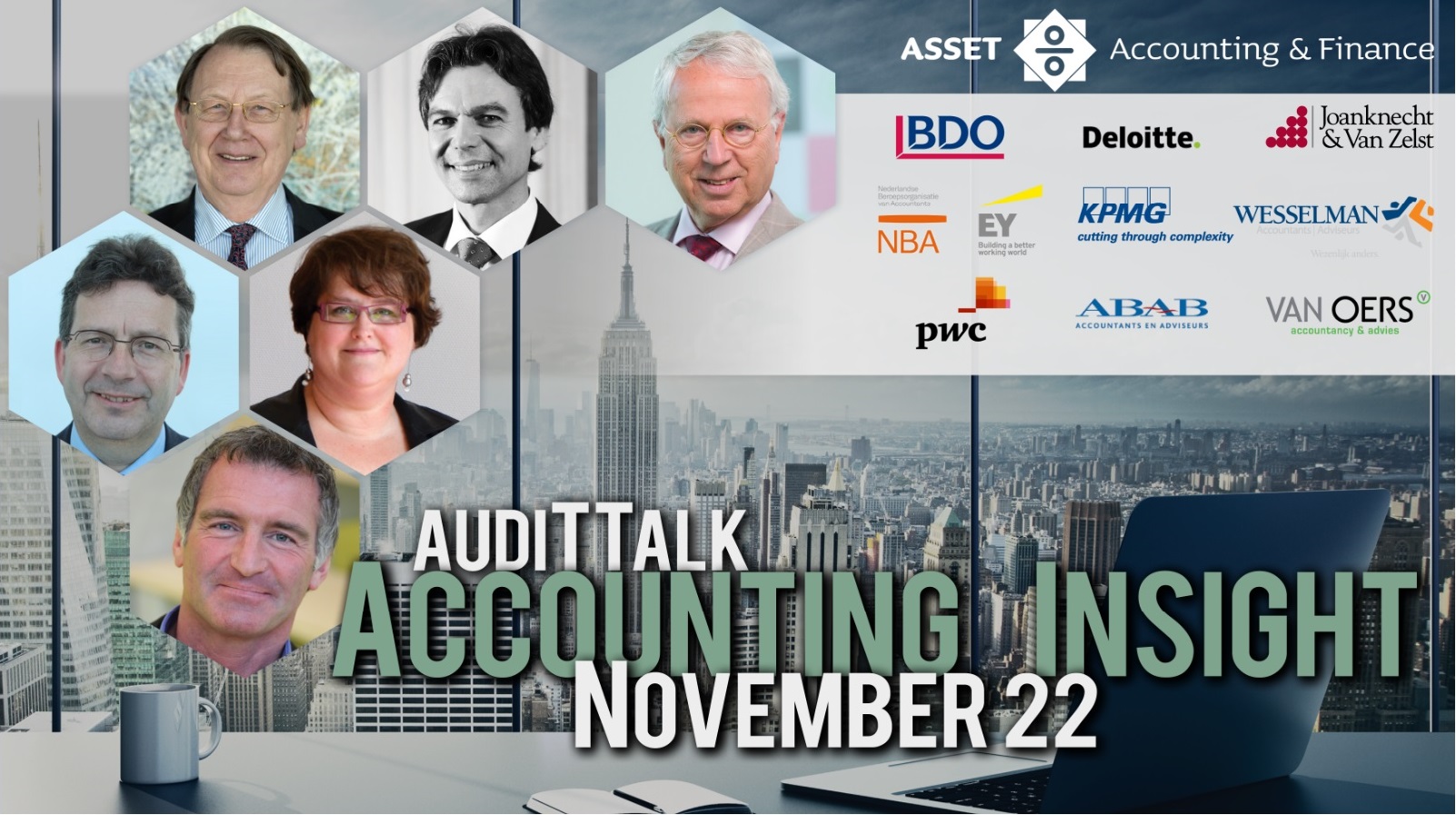
On behalf of the Accounting Insight 2016 committee, I would like to invite you for this event of the study association Asset | Accounting & Finance. The accounting profession is changing! There are many new developments that affect the profession of the current auditor. Lately, the accounting profession is very often in the news; headlines such as ‘The accountants have become cowards, and ‘Longing for the auditor as sparring partner’ are no longer shocking nowadays. Everyone is aware of the changes, but how does this really have impact on the future? Is there even still a future for the audit? Perhaps, in the long run, the current auditor will be entirely redundant. There are innumerable IT innovations going on, but what will be the consequences? Should we be happy with this or will this lead to the extinction of the profession? In addition, a reform plan is being implemented; this also requires in many areas a new approach within the accountancy world. It is important to continue to look to the future and to keep our expectations of the profession realistic. And who said the future will not be better than ever before? “Everyone is aware of the changes, but how does this really have an impact on the future?” During the symposium on November 22, will be a discussion about all these changes and reformation. Thus, the future of the audit will be the central theme. After a brief introduction of each statement, they will be discussed one by one by the panel of speakers and the audience. As a committee we are very pleased to introduce the following speakers of the evening: Dr. Nout Wellink (commissioner PwC), Drs. Jan Hommen (commissioner Ahold Delhaize), Drs. Christine Scheper RA (manager AFM), Drs. Johan Hopmans RA (partner Deloitte) and Drs. Martin van Dijke RA (CEO Van Oers). Chairman Prof. Dr. Eddy Vaassen RA, associated with Tilburg University, will lead the evening. Because of their knowledge in the field of accountancy and the experience they have accumulated in their careers, we are convinced that the speakers and the chairman will share very interesting insights with you. Moreover, this night gives you the opportunity to get in touch with four different accounting firms: KPMG, BDO, Joanknecht & Van Zelst and Wesselman. Before the start of the main event, the audiTTalk will take place in cooperation with these four firms. In this short session you will have the opportunity to get your CV checked and ask all your unanswered questions regarding the accountancy profession and your future role in it. Do you want to remain one step ahead of your future? Then you should definitely be present at this event! After this evening you will be fully informed with all the actualities within the accounting profession. Click here to register!
Do you dare to dive into the financial world of the Efteling?
Daan van Baarsen, CFO Efteling, talks in this deepening interview about the controls of the Efteling, how it was impacted by the crisis, its exchange rate risks and future as well as the future of the accounting profession. Could you tell us something about yourself, your education and your career? After attending HEAO, I started working for Philips. They were pretty advanced in controlling their organization, so this is also where I learned the profession and started to like what I was doing. I learned being close to the management and providing them with useful information for decision-making. In 1991 I started working for the Efteling. At that time the organization was not that far advanced in controlling so I helped it gradually in reshaping from a pure accounting to a controlling organization. Are there any big differences in working for Philips as compared to the Efteling? At Philips you were a very small part of a big organization whereas the Efteling had only four-hundred-fifty employees when I started working here. Besides that, at that moment the Efteling just became a private company instead of a foundation so a lot of things were in the process of being automated as opposed to Philips where this automization was already in place. Furthermore the culture within the Efteling is very different from the culture of a big organization such as Philips. There is a sort of family culture, which we call: ‘The Efteling feeling’. It cannot be expressed into words, but one gets that feeling inside and it makes you not want to leave. Are there any remarkable differences concerning controls between the Efteling and Philips as they operate in such different industries? Yes, for example the renting of rooms at the hotel requires different controls, like checking on occupation, which I never saw at Philips. However the most important different control is the one for the entry tickets, because it is the main part of your revenue. You need to make sure that everyone has a ticket and that no one can fake or copy tickets. Most of the time these controls are automated. Finally, there is no international business; I never need to call an office in Germany or Malaysia, which I did have to do at Philips. Which financial considerations are taken before an attraction is bought? The first phase is analyzing the client’s needs and the available opportunities at the market. In the second phase a financial framework is made, which includes solvency, risks etc. During this phase the appearance and content of the attraction are developed, a factor in which the Efteling distinguishes itself from other theme parks. The third phase is the calculation phase where I decide upon an amount that can be spend. The general assembly and the commissioners have to approve this amount. Then in the next phase we make a final design and calculation. When the final calculation exceeds the budget we need approval from the commissioners again. In the last phase the design is completed and offers from tenders are being analyzed. We also decide if the new attraction allows us to raise the entrance price by discounting the future cash flows. Does the Efteling experience exchange risks? Yes sometimes it does. For example, ‘Aquanura’, the water show is built in cooperation with “Wet Design” in America, so it is susceptible to the exchange rate risk. However we are risk-averse and always hedge the risk. Afterwards it might turn out it was a stupid decision, and it would have been more profitable to not hedge it but at least you have a fixed and certain exchange rate. The new ‘dive coaster’ (Baron 1898) is being supplied by a Swiss company. As we all know the Swiss Franc is really high at the moment, luckily our contract is signed in euros. If we did not have this agreement I would be obligated to hedge it. How did the crisis influence the Efteling? Our number of visitor even increased with one million in 2009 due to the Albert Heijn promotion where we increased the discount from eight to ten euro. We have been able to keep this increased visitor amount which is very important in a crisis. However we did suffer from business to business, these results have halved from thirteen million (in 2007) to seven million. Also in golf we have suffered, mainly the business to business has collapsed. No account manager goes to play golf with his clients to do business anymore, that takes too much time. We always have been more or less countercyclical. The first thing people save on is a third vacation, then a second, they are not going to save on a trip to the Efteling. Now, however, we could ask ourselves the question whether we still are. Since in the earlier years a crisis lasted relatively short, around 3 years. Whereas now it commenced in 2007 and we are still in it. They call it the ‘new reality’, they say we will never go to the 2007 level, however I don’t believe that. I do believe that in the end we did feel some impact from the crisis. How do you think the Efteling will look like in ten years? At the moment there is a focus on becoming an international destination in ten years. In the earlier years we were the number one of Europe, nowadays we are not. Disney has opened in 1992 and has around thirteen million visitors. We have around four and a half million and want to grow to five million. We want to attract this growth mainly from Nordrhein-Westfalen, Belgium and England. We check the nationality of the visitors mainly by license plates. This check is executed manually at the moment but we are planning to automatize this in the future. To attract this target audience we spend on marketing and build new accommodations. In the earlier days a German could arrive easily at 10am and be home around 7pm
Nout Wellink about iFinance 2015
The Hague, Friday the 28th of November we had the opportunity to interview Nout Wellink in Hotel Des Indes. Our enthousiasm and nervousness made sure we were about half an hour early. We started the interview as soon as he entered and quickly noticed the latter to be unfounded. You will rarely meet a man who can elaborate on his knowledge and experience as clearly as Mr. Nout Wellink does, neither will you meet anyone who is as down to earth. This was reinforced by his friendly conversations with the hotel staff, whom he had also met on the streets, and they happily brought his usual order of green tea. Nout Wellink recommends everyone to attend iFinance 2015. For more information about iFinance and registration use this link. Mr. Nout Wellink. I am very thrilled to have this opportunity to talk to you about iFinance 2015. I would like to start this interview with a general question. Your experience and current membership of the Board of Directors of The Bank of China, how did it happen? They simply asked me. I was chairman of The Bank for International Settlements and made sure the Chinese became Board members. The Bank of China knew me because they are a Systematically Important Financial Institution and should abide by international regulations. This includes Basel III implementation, which I worked on during my time at the Bank of International Settlements. Banks have been under a lot of pressure in the past few years. We believe, and often hear, it is due to this regulatory pressure that benefits such as interest rate cuts are not passed through to the public. If I can answer this in a broader sense; before the outbreak of the financial crisis banks held about 1-2% of real capital, capital which they can cover risks with. This excludes “hybrid capital” upon which they cannot truly rely and the market spotted this. We multiplied the real capital figure by a factor seven to ten, depending on the significance of the bank. But it takes time before the banks are at the required levels. By international comparison European banks were in a relatively weak position. The ECB offered to supervise the banks (the 120-130 largest banks in Europe). We wanted to supervise the banks, but only after we were assured that they were healthy. The health of a bank encompassed holding adequate capital and liquidity levels, professional risk management and ensuring transparency on their balance sheets, so as to make sure there was not some secret rubbish. This is where the Asset Quality Review and stress tests come into play. Banks can only do their job once they have written off bad loans and realized the higher capital requirements. Eventually, an undercapitalized bank is required to stop lending entirely, which is worse than reduced lending. I do believe that in order to incorporate the higher capital requirements banks have three options. The first is to simply accept fewer loans and deleverage their balance sheet. The second is to sell balance sheet positions to improve their ratios, and the third is to simply attract more capital. Are banks lending less money because they are lacking the “know-how” to measure the risks’ of today’s world? You are stuck on the thought of “banks are lending less money”. You have to look at it from a different perspective. What is the function of a bank? Simply put: “The transformation of the money from savers to parties who have a need of that money”. It is often converting short term deposits in long term loans. Banks exist because they are one step ahead in the information process; that is, information they possess about others. You would not lend me money and this is simply because you know nothing about me or my credit worthiness, nor do you have any means to check up on my history. Banks on the other hand, do. Banks have a mandatory “know your customer” rule and a “caring” duty, in order to ensure nothing bad will happen. Before the crisis they put too much pressure on each other, which caused the rules and duties to fail. With respect to the products themselves, if there is demand for an AAA (mortgage) product, the banks will accommodate these products. On its own this is not a bad thing, however, you just have to wonder whether they really are AAA? Let us continue to our third proposition. How do you think new ways of financing will develop? The answer to this depends on “where?”. In Europe about two thirds of all investment streams go through banks, in the US this is a mere one third. This means that the methods of financing investments in the US are already fundamentally different from what we have here. This also enabled the US to recover from the crisis much quicker. In the US banks are less important when it comes to transferring of savings to investments. They have a deeper development in their capital markets, which include investment and venture capital funds. A new way of financing that is gaining a lot of ground in the US is crowd funding. Despite the use of the internet, one still requires some information about the parties involved. This significantly limits the possible gains of a single project. This does not mean you cannot have numerous similar projects. If you have an idea, and six thousand people are willing to invest $100, it is still a lot of money for a simple project! It is however, nothing in comparison to the billions of investment streams around the world. In Europe we should prioritize creating one big, broad market, which makes it easy to attract money from different countries and not only just banks. You would not sink 300k into a project of a friend, let alone that of a stranger on the internet. What do you think of cryptocurrencies; the Bitcoin? Very little. Money has three functions, all of which you
