

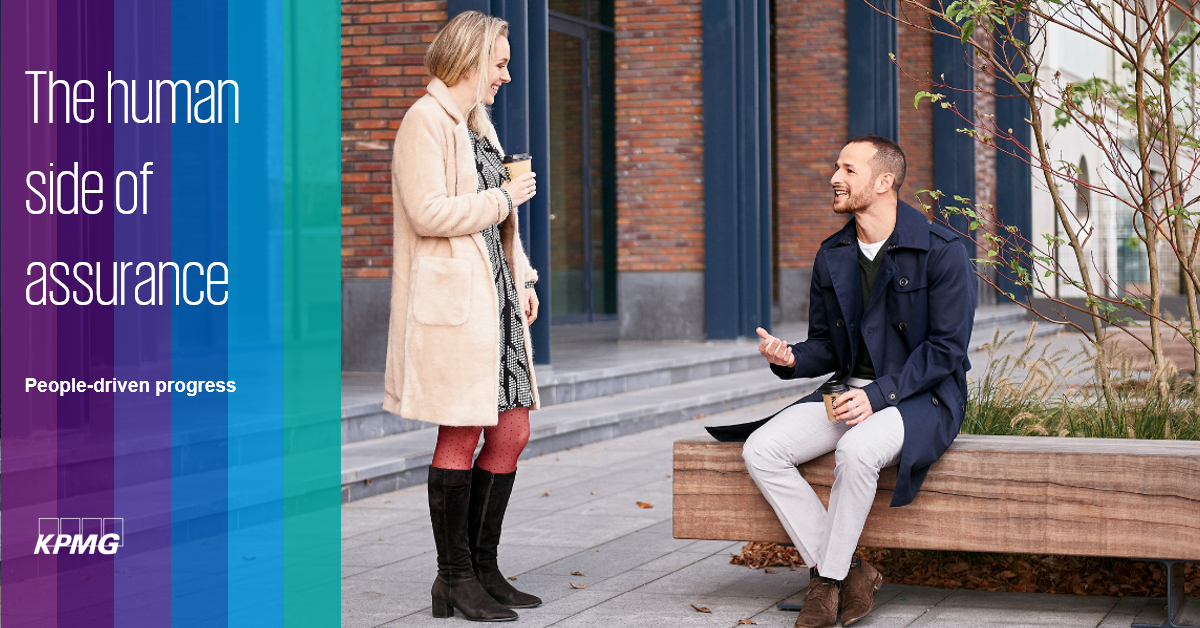
For the Dutch version, click here About me My name is Daan van Overbeek and I have been working at KPMG for 3 years now. I am 26 years old and live in Tilburg. I started studying in Wageningen, where I followed the bachelor ‘Bedrijfs- en consumentenwetenschappen’. In Wageningen, I was also a member of a student association, where I held the position of treasurer for one and a half years. This is where my interest in working with numbers started. This led me to leave Wageningen after my bachelor’s to follow the master Accountancy in Tilburg. After the master Accountancy, I continued with the Post Master Accountancy at Tilburg University, which I completed last year. How I got to know KPMG When I started the master Accountancy, I honestly had no idea what kind of company I wanted to work for. Fortunately, the university and Asset Accounting & Finance organised several introductory events at the beginning of the year, which gave me a better idea of the possibilities after the master. After talking to several recruiters and professionals, I decided to sign up for KPMG’s Business Experience. For five days, we went to Madrid with +/- 30 students and 10 KPMG professionals. The program was arranged in such a way that we learned more about the Audit, KPMG and the colleagues, but also enjoyed the Spanish sun, tapas and clubs. After this week, I was convinced that KPMG and I would be a good match. My experiences at KPMG My career at KPMG started as a thesis intern. The great advantage of a thesis internship is that you can already take a look behind the scenes, without being expected to do very much. Writing your own thesis is the first priority, and if there is time left over, you can work for/at clients as much as you like. It is also a great opportunity to get to know your colleagues. Immediately after my thesis internship, I started working at KPMG, in the Breda office. KPMG Breda is a relatively small office (about 70 accountants), so you quickly get to know everyone. This made me feel at home right from the start. This is partly due to the fun activities we organize with colleagues. From bachelor parties to NAC evenings and from football tournaments to a day of sailing. Besides the activities with the office, there are also fun activities with several offices together. For example, there is an annual ski trip, which we hope will be possible again this year. In short, besides work there is plenty of time for relaxation! At KPMG Breda, we don’t really work with sectors when it comes to clients. As a result, I have (had) a wide range of clients, from a large international construction company to an investment company with only 15 employees on the payroll. Personally, i experience this variety as fun and instructive. For example, one week I am working at a client in an assignment team of 12 accountants where you can learn a lot from your more experienced colleagues, and the next week I am in an assignment team of four accountants where I can take on many responsibilities myself. My experience is that a lot is possible at KPMG. If you like to do something besides auditing, there are more than enough opportunities. I am a coach for interns and I have supported the recruitment team with career events. There are also junior colleagues who, for example, help with the acquisition of potential new clients. My advice to students If you have decided for yourself that you want to work at an accountancy firm, I would attend as many career events as possible. The most important thing is to be able to speak to many people from different offices. After all, the work we do is more or less the same everywhere, since we have to comply with the same regulations. Therefore, my choice would depend on the atmosphere that prevails at the offices. As you can read, I am very positive about KPMG as an employer. It therefore didn’t surprise me to read that KPMG has been chosen as the number 1 employer of the Netherlands in 2021 according to LinkedIn Top Companies. If you don’t believe it, here’s the link: Top Companies 2021: bij deze 25 Nederlandse bedrijven ontwikkel je jouw carrière het best | LinkedIn If you are also enthusiastic and want to know more about my experiences at KPMG, you can always send me a message via LinkedIn. If you have any questions about the (internship) opportunities at KPMG, please contact our recruiter Marvin van Veen via LinkedIn, mail (vanveen.marvin@kpmg.nl) or phone (+31622589360).
The Added Value of an Internship
Joining Philips I joined Philips on the 1st of June 2017, so quite recently as an Intern, while continuing my studies at Tilburg University. I decided to pursue an internship in order to practically use the theoretical knowledge obtained during my bachelor. Moreover, I believed that doing an internship in an international corporate, would further improve my skills. One of the main reasons why I wanted to do an internship was to see how my studies relate to the business-working environment. Moreover, due to the importance that Digital has earned, I strongly believed that I could provide added value in The Digital and Online Marketing. As far as I know these roles did not even exist a few years ago. Besides what I could bring to the table, I also thought of what I could earn and learn from an internship opportunity. Insight Philips I could get an insight of the working environment in an international brand like Philips, in terms of relationships with colleagues. I could test my knowledge, skills and culture to a wide range of employees from all around the world. This could help me grow in the future and affect the choices that I make in terms of my career perspective. I could learn more about specifications of a particular product like vacuum cleaners, since I am part of the Floor Care department. Understanding how a company manufactures its products and how it does business with retailers and third parties is important. As a prospect intern, I was open to every opportunity, even though I had my personal preferences. Besides the brand recognition that Philips has, personally I shared a strong predilection due to the fact that my father retails its vacuum cleaner bags in his business. Familiarity always helps, even it is for marketing a product or deciding on the company you will work at. Experience After two months, I can definitively state that it was the best choice I could make in terms of my professional career. In terms of my personal development, I can firmly say that I have learned a lot in these two months, regarding the product, the business aspect and the path I will choose for my career in the coming years. It is interesting to see the career path of your colleagues and understand the choices they have made. Confronting your perspective and ideas definitively provides a better insight for the near future. What astonished me was the ease of changing the direction of their career. For example, I encountered colleagues who studied accounting in their bachelor and now are working as Product Marketing Managers. I had a completely different perspective during my studies. Advice Furthermore, I would definitively recommend it to every student doubting on doing an internship. Especially for international students, since I strongly believe that it really helps to understand the Dutch working environment and the difference you may encounter with your own. The comparison will definitively help on developing yourself and prioritizing cultural dimensions in their working ethics.
The short expiry date of education
Not just the government, but mainly students themselves should invest more in their student lives. Personal development should be the central point of view. This phase in life offers so much valuable freedom and opportunities, but you are the one that needs to grab them. Jurgen, a good friend of mine, always says that it is better to regret the things that you have done, instead of the things that you haven’t done. During my student life I have done a lot of things next to studying, and I think that I can say a lot more compared to the average student in Tilburg. As applies to many, I also did this primarily because I wanted to improve my resume. However, soon enough, I found out what made these extracurricular activities so valuable. At the end of each role you have taken or activity you have organized, it is always possible to point out some points at which you have improved and developed yourself, even though you might have not been aware of this at first sight. Looking back now, my board year at study association Asset | Accounting & Finance has been a true turning point in my student life: when I paused my study for a whole year back in 2014, I realized how valuable an active student life can be. It was a true eye-opener and it made me see the true importance: developing yourself. If you sum up all the things that you have realized together with your fellow board- and active members at the end of this year, you immediately see all the things that you have learned. You have improved your soft skills, learned to (build a) network, and how to deal with big responsibilities. Beforehand it is almost impossible to indicate how many stakeholders from the University, in business, and among (old) members are related with associations like these. One of my key responsibilities as External Affairs was generating enough revenue from the business contacts. If you fail to do so, some serious liquidity concerns will pop up soon enough (to remain within the accounting & finance domain). Of course, besides all the work, I have also enjoyed this year very much, still making this one of the best decisions in my life so far. Afterwards I did an internship at KPMG Advisory in Amstelveen and finished my bachelor. This internship is another activity that I would do over again every time. I thought that I had developed my professional skills in a big way during all activities at my study association, however I found out soon enough that working at companies like KPMG truly contributes towards a professional way of working. You get used to a more structured working standard and acquire a lot of relevant knowledge on certain disciplines very quickly. Internships like these are ideal when it comes to getting a better view on the potential jobs that you will start after your studies. Next to this, it gives you a valuable lead in working experience compared to your fellow students. “It seems that graduating from your masters is not enough” It differs per function and company for which you want to apply what kind of experiences are desired. Still, I think that almost everyone will be familiar with the general ‘checklist’ of recruiters: Foreign experiences, committee experiences, a special part-time job, a board year, or some students even manage to found and run their own company next to their study. Besides this it is also possible to distinguish yourself within your study program, by for instance following an additional honors program, or through an exchange program or summer course. Lastly, a way to show your qualities is obtaining high grades. However, this last thing is something that always raises a question with me: Even though many obtain these high grades in the highest form of education (a University degree) possible in the Netherlands, why do so many companies value an intelligence capacity test in their recruitment process so much? It seems that graduating from your masters –even with very high grades– is not enough to show your intelligence. All this is something that has been interesting me for a very long time already, which is why I like to see how different choices among my student friends and network turn out in their job searches. I would not dare to say that there is a true one-on-one-relationship between an extensively built-up resume and a successful application. Perhaps it would be even better to specifically train at job interviews, instead of ‘wasting time’ on improving your resume. It always comes down to that one or the couple of interview(s) between you and your desired firm, where will be decided whether you are hired or not. Your resume is just your way into the interviewing room. Taking into account the government, I think that they should play a (bigger) role in this as well. ‘Prinsjesdag 2016’ showed that the Netherlands survived the financial crisis in a good state, and that there is more room to invest our government’s funds. Within a knowledge economy like the one we have in the Netherlands –and with high quality education as one of its main components– I would suggest that the ‘basisbeurs’ (student government grant) would be restored as soon as possible. A while ago I heard in the news that students already live longer at their parents’ place, instead of moving out, due to the reduction in personal study grants. At short term, it is unlikely that the effects of this will be visible at for instance the labor market supply, however I fear that in the long run the results will be less favorable. That is why I believe that now is the time to anticipate. Many international students that I have met here in Tilburg speak laudatory about the active ‘climate’ for students here in the Netherlands. I think we should cherish this and keep this as one of the most
