

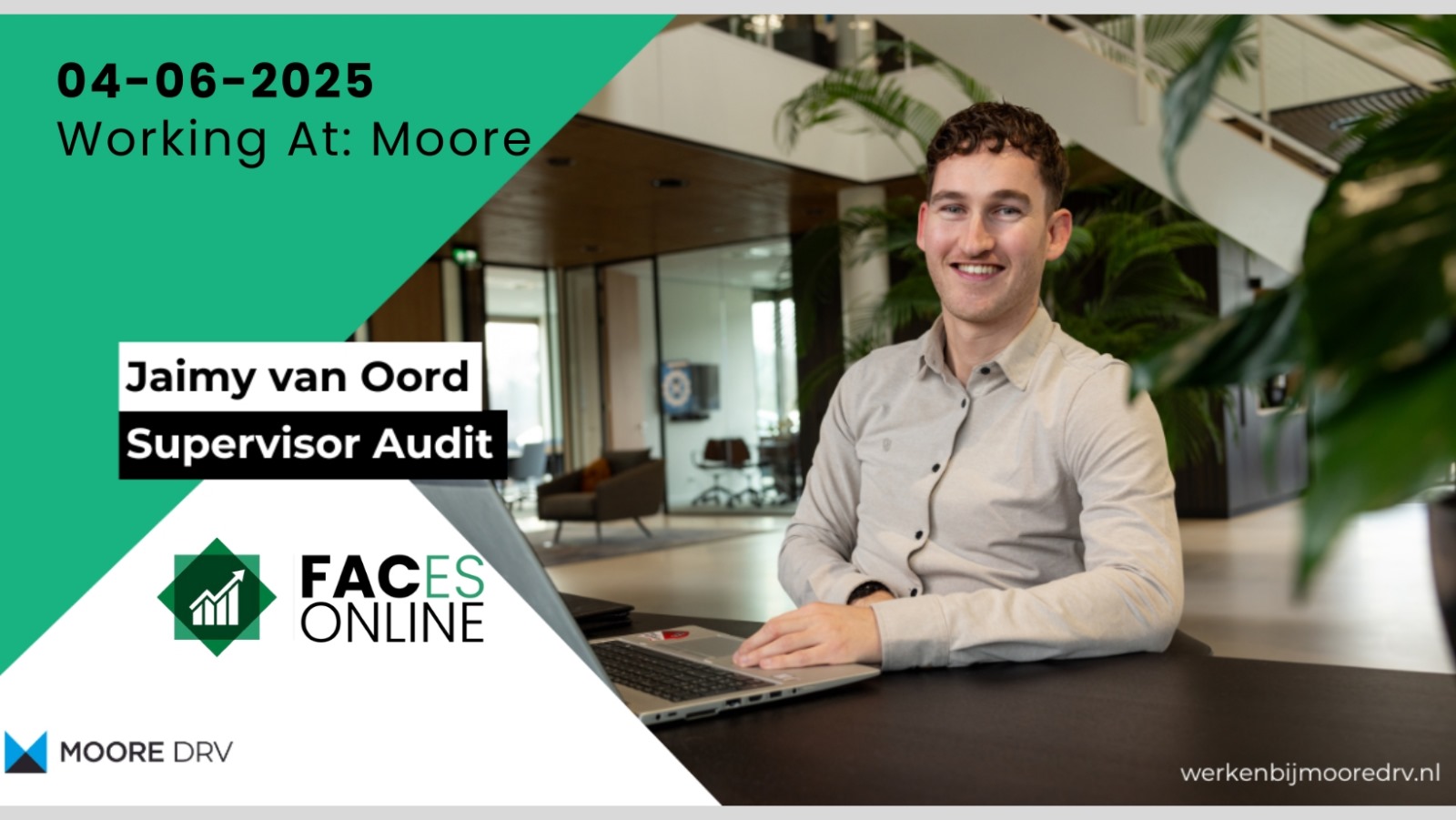
When Jaimy van Oord joined Moore DRV as an audit assistant in 2018, he was immediately given the opportunity to further develop himself. He was allowed to participate in the *Audit Young Profs Program*, a development program for assistants in the audit practice that combines professional knowledge with soft skills. Now, as a supervisor audit in the Brabant audit team, Jaimy says the program has been highly valuable for him. With future development in mind, he strongly recommends ASSET members consider working at Moore DRV. Read this interview to find out why. What did the development program at Moore DRV entail? “The program consisted of two sessions per year. We followed lessons and worked through cases with an actor. We could bring in real situations we encountered in practice, and the actor would role-play them so we could practice handling them. For example, the actor would play the role of a frustrated client, and you had to show how you would handle the situation. We would then discuss how it went and what could have been done better. It gave me tools to communicate effectively – even when a client is uncooperative.” Was there also theory involved? “Yes! I also found the theoretical sessions interesting. At school, you learn a lot of theory that you can’t immediately apply. But everything we learned here was directly related to what we were actually doing as assistants. It was immediately practical. Often, it was about Moore DRV’s audit approach. Internal staff, such as managers and specialists, helped us master that approach during the sessions.” What makes working at Moore DRV enjoyable? “The way we audit numbers at Moore DRV is truly unique. We don’t do random sampling, like many other accounting firms, but work in a highly risk-based manner. We carefully consider what we are actually going to audit. If we see an irregular item in the financial statements, like an invoice that has been outstanding for 70 days, we zoom in on that specifically. It keeps the work challenging, varied, and interesting!” But are you only working on files? “No, definitely not. We also always visit our clients to discuss the process and have a chat with employees and the director. That way, we really get to know the business, understand what they do, and get a much better feel for the numbers. I think that’s one of the biggest advantages of working in the ‘real economy’: with SME companies, you’re often sitting down directly with the entrepreneur.” How did the program end? “We wrapped up the Young Audit Profs Program with all participants by going bowling and having a nice meal together. That’s typical Moore DRV.” Why is that typical Moore DRV? Is it always so sociable? “We have really fun colleagues and often do things together. We’ve previously gone for a weekend trip to Ghent, played padel in the evening, or gone on a ski trip, for example. We have a very close-knit and young team, with many colleagues in their twenties and thirties. But even the managers and partners are very approachable. You can always ask them anything, and even if you just drop by to ask how their weekend was, they’re happy to take the time to chat. From what I hear from my former classmates, that’s not always the case at other firms.” What are your ambitions within Moore DRV? “Where I hope to be in a few years? That’s hard to say. For now, there’s still a lot to learn here, and I see plenty of room for continued growth. I haven’t mapped out my career completely, but I mostly hope to stay healthy and continue enjoying my work. If that’s the case, I think I’ll be happy here for quite a few more years. And what position I’ll be in by then, I’ll see when the time comes.” Do you have questions about internship or job opportunities at Moore DRV? Contact one of our recruiters via email at info@werkenbijmooredrv.nl or WhatsApp at +31 88 460 6988.
The Role of the Advisory Board and Audit Committee within ASSET Financials
At ASSET Financials, we highly value transparency, accountability, and continuous improvement. Our Advisory Board and Audit Committee play a crucial role in this. In this article, we answer frequently asked questions about their tasks and responsibilities. The Advisory Board How often are evaluations or reviews conducted by the Advisory Board? The Advisory Board meets three times a year. This happens in the summer and winter, prior to the General Assembly (GA), to obtain approval for event-related plans. A mid-semester evaluation also takes place. Additionally, board members can submit questions at any time when advice is needed. What are the main tasks of the Advisory Board and the Audit Committee? The Advisory Board provides input on event organization and offers support where needed. The Audit Committee reviews the bookkeeping quarterly to ensure that the treasurer follows accounting regulations correctly. How do the advisory bodies provide feedback to the board? Feedback is given during meetings, which take place twice a year at a restaurant over a three-course dinner. During the summer, when many members are on vacation, feedback is often provided online. What authority does the Advisory Board have to intervene if the board is not functioning properly? The Advisory Board serves solely in an advisory capacity and has no formal authority to intervene. Nevertheless, their advice is often followed, as it benefits the association. Are there fixed criteria by which the board is evaluated? Event outcomes are assessed, and updates are written to provide a complete picture of the association. Additionally, various topics are discussed during the meetings. Who are the members of the Advisory Board, and how are they selected? The Advisory Board consists of three types of members: How is the collaboration between the board and the Advisory Board experienced? The collaboration is considered very positive. The Advisory Board provides the board with valuable insights and key points in a constructive manner, always with the goal of improving the association. Are there examples where the Advisory Board played a key role? After the COVID-19 pandemic, membership declined, impacting committees and events. During a brainstorming session, strategies were discussed to attract more students, such as inviting high-profile speakers or organizing more engaging informal activities. Financial Control (Audit Committee) How often does the Audit Committee review financial records? The Audit Committee conducts a review four times a year. Which financial documents and reports are reviewed? The Audit Committee reviews the balance sheet, profit and loss statement, and general ledger accounts. Additionally, they verify that VAT is recorded correctly via the quarterly VAT return submitted to the tax authorities. What happens if financial irregularities are discovered? Any irregularities are documented and corrected as soon as possible. This is a normal part of the auditing process. How independent is the Audit Committee from the board? The Audit Committee consists of former treasurers. They are no longer part of the board and base their assessments on legally established accounting rules. Are external accountants or experts consulted for financial control? No, this is not necessary. The Audit Committee possesses sufficient internal expertise. Transparency and Accountability How are ASSET Financials members informed about the findings of the Advisory Board and Audit Committee? Findings are incorporated into policies and official documents, which members can review in the lead-up to the GA. How is the balance between independent oversight and board autonomy maintained? The Audit Committee ensures that financial management is responsible, while the board has the freedom to allocate the budget for events. Are improvements from reviews incorporated into board policies? Yes, for example, in time management. Lessons learned from one year are applied to the next. What steps are taken if the board does not comply with advice or guidelines? If the board disregards recommendations, members of the Audit Committee and Advisory Board have the option to vote against proposals at the GA, just like any other member. With the Advisory Board and Audit Committee as essential pillars, ASSET Financials continues to develop and professionalize. Their expertise and involvement contribute to a strong and future-proof association.

Working at KPMG – Digital Audit Associate
Can you briefly introduce yourself, what you studied, and what inspired you to pursue a career in accountancy? I am Ricardo Walrave, 25 years old, originally from Vlissingen. I completed my bachelor’s degree in Finance & Control at Hogeschool Zeeland in Vlissingen and then, through a pre-master, pursued a master’s in Accountancy at Tilburg University. I am now following the post-master Accountancy program, also in Tilburg, while working as an Audit Associate at KPMG in the Breda office. Over the past two years, I have been involved in many enjoyable committees at Asset Financials and am still active in the Cooking Club committee. Some highlights of my time with the association include co-organizing the StudyTour to Brazil and last year’s fifth lustrum celebration. What attracted me to auditing was the opportunity to work with a variety of clients. This allows you to gain extensive knowledge about different industries, understand how businesses operate, and discover where your interests lie. Another aspect I really enjoy is that no two weeks are ever the same. What specifically attracted you to KPMG as an employer, and how did you experience the transition to working life? I got in touch with KPMG through the Accounting Expedition organized by Asset Asset Financials. During my visit, I immediately felt a connection due to the welcoming atmosphere at the office. That experience led me to apply right away. After spending six months as a thesis intern and another six months as a working student, I started full-time last September. The transition to working life took some adjustment in the first few months. Having focused primarily on studying and student life for years, I had to find a balance between a 40-hour workweek and my personal life. However, since I had already gained work experience during my last year of studies, I had a good idea of what to expect, which made the transition smoother. A great aspect of KPMG is that ambitions, requests, or challenges can always be openly discussed with colleagues, and solutions are actively sought. To support this, every new employee at KPMG is assigned a buddy, who provides guidance and assistance. You both work in audit now—what have you learned so far, and which moments stand out to you? In just a few months of working, I have rapidly gained knowledge about auditing and related areas. The first month included an onboarding period followed by two weeks of Audit Foundations training. This provided a strong foundation for client work and was a great opportunity to connect with other new hires from various KPMG offices across the country. I am also part of KPMG’s Digital Audit Track. As part of this program, dedicated time is allocated in my schedule to follow training sessions that enhance my digital skills and contribute to innovation within the audit field. In the first year, we have the opportunity to earn accreditations for tools like Alteryx and Power BI, which can then be applied directly to client work. This helps teams complete tasks more efficiently and effectively. Which initiatives or activities within KPMG make a difference in workplace culture for you? KPMG invests a lot in fostering a good atmosphere among colleagues. Regular office- or region-wide events are organized, and we have a weekly Friday afternoon social gathering. Beyond these official events, spontaneous plans often arise among colleagues to grab a drink after work or organize larger outings together. My personal highlight was a weekend trip to Dublin last October. What were your expectations about working in audit and at KPMG, and how do they compare to reality? Initially, I knew KPMG mainly from its logo and the huge headquarters in Amstelveen, which gave me the impression that it was a massive organization where employees might just be numbers. However, my perspective completely changed when I joined. The office introduction was very personal, and within a few days, I had already met most of my colleagues. Instead of feeling like just another employee, I found that KPMG values individuals and their unique contributions. The Future of Audit: How do you see this field evolving? I expect significant changes in the accountancy profession. Many (AI) tools are already available to streamline our work. For example, at KPMG, we frequently use RobotX and Datasnipper, which automate a large portion of our tasks. Where we once had to manually input data, these tools now allow us to complete extensive work with just a few clicks. Given these rapid advancements, I foresee the traditional aspects of auditing becoming increasingly automated, with auditors focusing more on analysis, evaluation, and providing substantive explanations for their findings. Beyond digital transformation, regulatory developments are also shaping the industry. The Corporate Sustainability Reporting Directive (CSRD) is an example of a major regulatory shift. While some companies are already required to comply, many more will be affected in the near future. In response, KPMG offers an ESG Track alongside the regular audit and Digital Audit Track, allowing employees to dedicate part of their time to sustainability-related work. What advice would you give students about working at KPMG? I would encourage students to focus on what personally appeals to them in a company. I also highly recommend joining a study association (preferably Asset Financials 😉) to explore different firms. A (thesis) internship is a great way to determine whether the work and office culture suit you. What drew me to KPMG was the opportunity to work with diverse clients and gain broad industry knowledge. No two weeks are the same. Additionally, KPMG supports me in obtaining my RA title while allowing me to grow step by step in the audit field, with a particular focus on Digital Audit. Want to learn more? Check out our page: https://www.werkenbijkpmg.nl/vakgebieden/audit-assurance-vacatures!
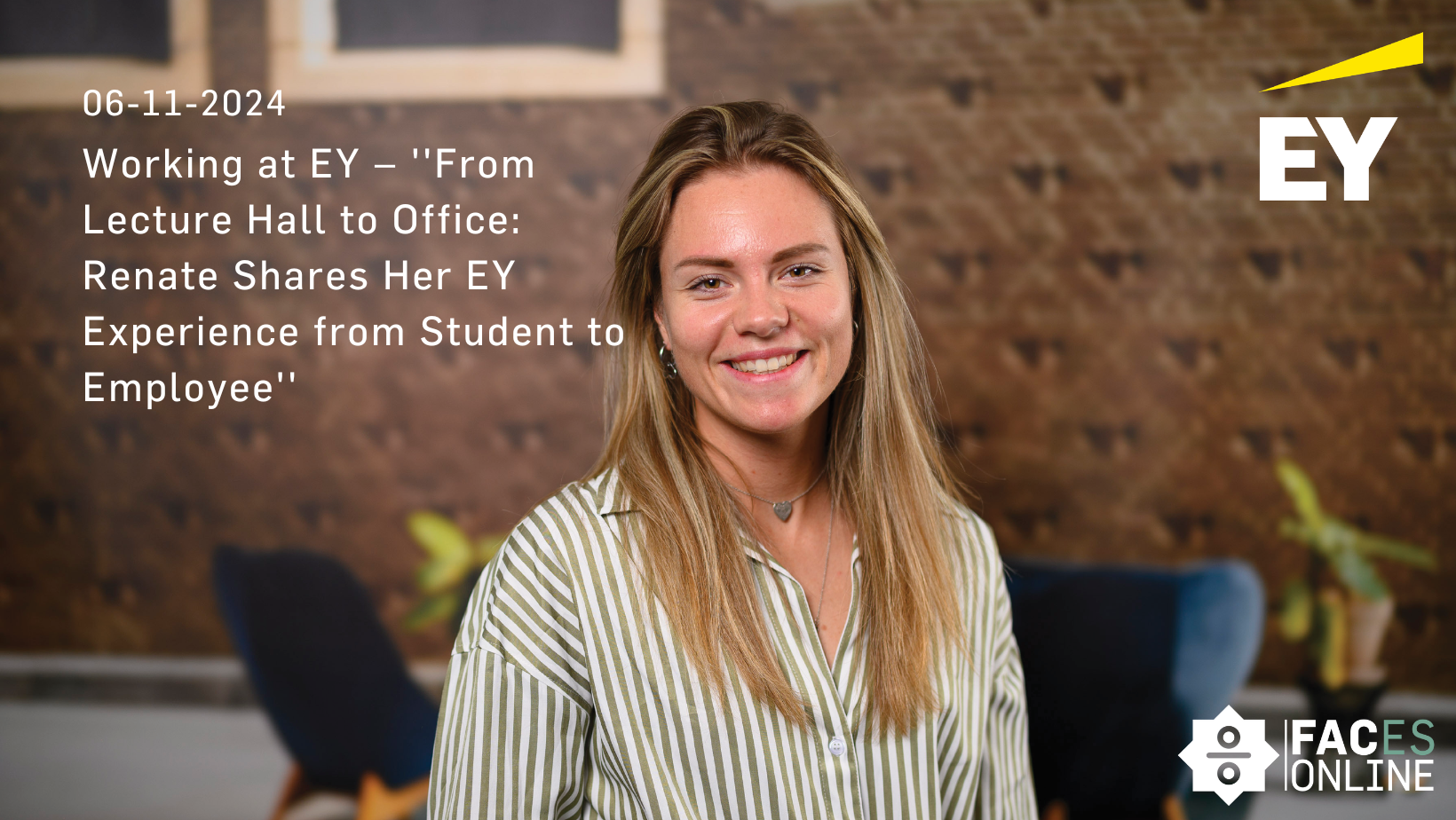
Working at EY – From Lecture Hall to Office: Renate Shares Her EY Journey from Student to Employee
Renate de Vries recently took a significant new step in her career at EY, joining as a Staff Auditor. However, her connection with the organization goes back further. With great enthusiasm, she shares her story of transitioning from a student to a professional career at EY. From her initial exposure to the field of accounting to her current position, Renate describes the challenges and opportunities she has encountered along the way. She highlights the importance of practical experience, finding a balance between work and studies, and the supportive role that EY has played in this journey. Additionally, Renate is actively involved in various company activities, including organizing the ski trip and assisting with several recruitment events. Can you tell us a bit more about yourself and how your EY adventure began? I’m Renate de Vries, 24 years old, born in Hoek van Holland. After high school, I moved to Tilburg to study Business Economics at Tilburg University. My journey with EY began in the third year of my studies when I got the chance to start an internship. My year as Secretary at Asset | Accounting & Finance had already introduced me to various sectors and companies in the financial world. Ultimately, I decided that accountancy appealed to me the most, so I started at EY in Eindhoven. I enjoyed it so much that, now more than two years later, I’m still here, and last September I started as a Staff Auditor. How was it applying theories from the classroom directly to your internship, and what did it teach you? When I started my internship, it felt as if the theories I’d learned in class weren’t directly applicable to real life. Everything was new and somewhat overwhelming. But as the weeks went by, I started to see connections. The puzzle pieces began to fall into place, and even subjects that I initially thought unrelated to accountancy turned out to be unexpectedly useful. During my internship, I also took two courses from the Accountancy minor, which provided a direct link to my daily work. This experience sped up my learning process and made my time in lectures all the more valuable. Balancing studies and work is a challenge. How did you manage that, and was EY flexible with your study schedule? Combining studies and work was a challenge that I was eager to take on. I had classes on Tuesdays and Fridays, and I worked on Mondays, Wednesdays, and Thursdays. At first, this was quite an adjustment, and I had to improve my planning skills. Luckily, I received help from my Buddy at EY, and you learn quickly through trial and error. EY also offered a lot of flexibility. If I couldn’t work on a certain day due to my studies, it wasn’t an issue. I could rearrange my hours or take a day off. EY was very supportive, making it much easier to combine my studies with my internship. What advice would you give students considering a post-master RA program after graduation? If you’re considering the RA program, make sure to gain practical experience in the audit department first, for instance, through an internship or a working student position. This program requires a serious commitment and discipline. Also, it’s important to check if you have any prerequisite courses to complete. Sometimes, you can finish these during your master’s, which saves time and stress later on. Finally, don’t be intimidated by the program. Everything you learn in it is highly valuable in practice. Although it’s sometimes demanding, I also enjoy Fridays when we have study sessions. It’s refreshing to return to university after four days of work and listen to lectures again. We wrap up Friday afternoons by celebrating the weekend together at Esplanade, which always gives me a boost. What helped you transition from student to Staff Auditor? The induction process at EY was incredibly valuable for me. In the first two weeks, you get to know all the new starters, the organization, and what’s expected of you. During the day, we had many training sessions, which felt similar to classes, and there were fun activities planned as well. For example, we did an escape room and had a beach BBQ. In the evenings, there was always an activity like a pub quiz or theme night. This made the transition from student life to a full-time job feel much smoother. After the induction, you start working. I received a lot of support from my teams, coach, and mentor. You also still have a lot of training at first, so some workweeks are only three days, which eased my transition to Staff Auditor. You are also part of a “year group”—the cohort with whom you start in September. This group provides a valuable support network, as everyone faces similar challenges while adjusting to a new job and study program. We still get together for social activities, like going to a terrace on Thursdays or attending office gatherings. You had multiple career options. Why did you specifically choose EY, and what set EY apart for you? During my board year with Asset | Accounting & Finance, I’d already been introduced to different accounting firms. I weighed the pros and cons of a smaller firm and the Big Four. I ultimately decided to start at a larger firm and see where things went from there. I joined Asset’s accounting expedition, where you visit Deloitte, KPMG, PwC, and EY in two days. EY just felt right to me. After my internship, I had the option to apply elsewhere or do another internship, but I chose to stay. I felt good about it, loved the office and colleagues, and thought, “If it feels right, why look further?” This, of course, varies for everyone, but it worked for me. “The fit with EY felt right from the start, so why look further? When you feel at home and see opportunities for growth, it’s a sign you’ve made the right choice.” Looking ahead, where do you
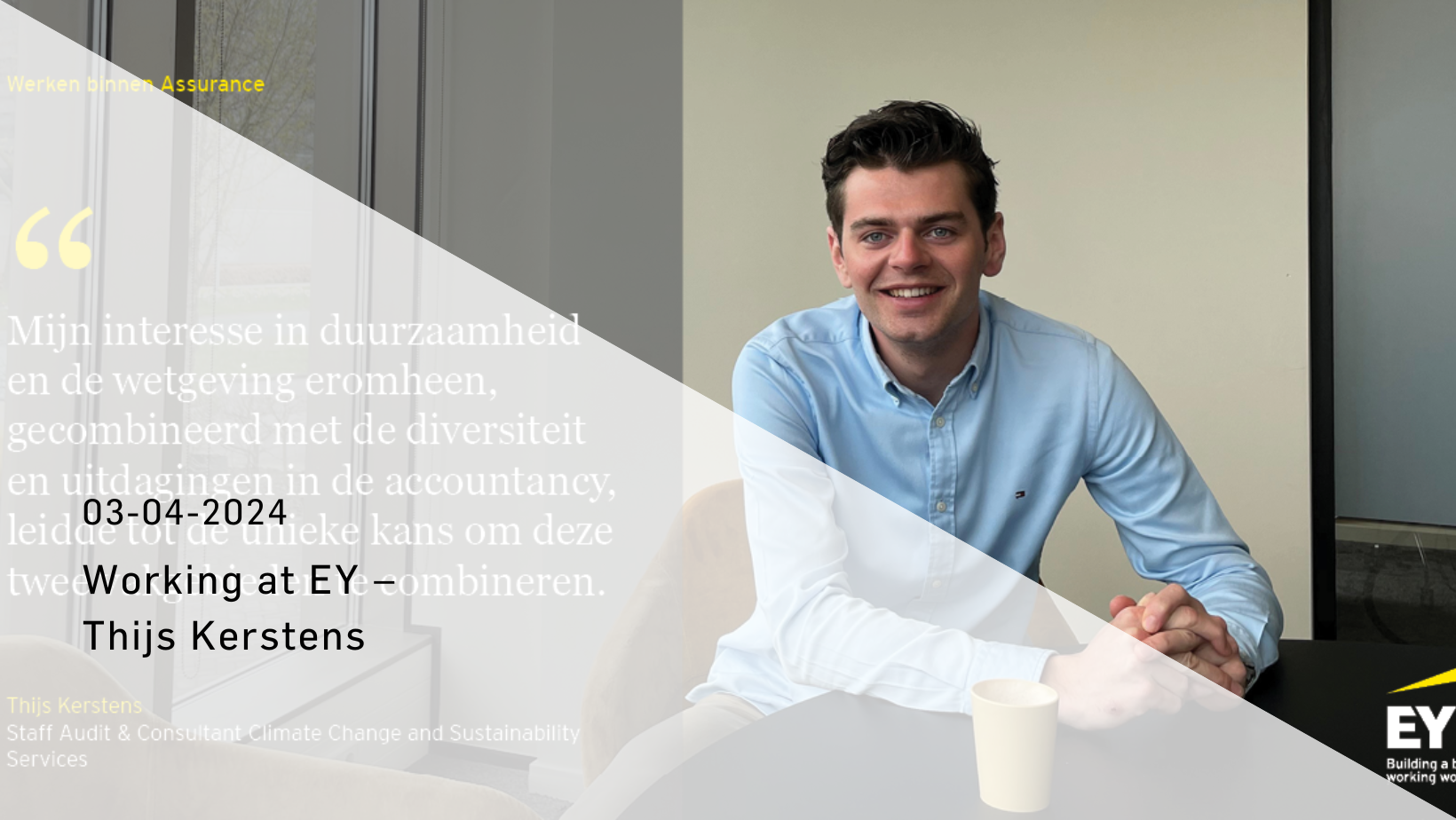
Working at EY – Thijs Kerstens
Thijs Kerstens | Staff Audit & Consultant Climate Change and Sustainability Services Thijs Kerstens has been working at EY as Staff since September 2023, having previously completed an internship at the Audit department in Eindhoven. At EY, we offer you a flexible career with many opportunities for advancement. This provides the opportunity to seize new opportunities. Thijs has arranged his personal development through a dual package with both Audit and also Sustainability. Who are you and how did you end up at EY? I’m Thijs Kerstens, 24 years old and born in Rucphen, a village between Roosendaal and Breda. After high school in Roosendaal, I started studying Business Economics in Tilburg in 2018. After this, I did a master’s degree in Accountancy and a master’s degree in Strategic Management, still at Tilburg University, which I enjoyed. During my studies, I was active in Asset A&F and attended many accountancy events this way, where I ended up being most enthusiastic about EY. Then, in 2022, I did an internship in the Audit department of EY in Eindhoven. Why did you choose to do an internship during your studies? During my studies at university, mainly during the Bachelor of Business Economics, I noticed that in my opinion we did not get much of what possible work would look like later in practice. This was the main reason why I wanted to learn more about what work was like in practice during my Masters in Accountancy. During my time as an active member at Asset A&F, I attended several formal (and also many informal, but that is another story) accountancy activities and here I had several positive experiences with EY. So from these experiences, I can recommend all students to attend activities of study associations and if possible to organize similar activities yourself. I am convinced that you can gain a lot from these kinds of experiences later on, but I would especially like to mention that I experienced these as very nice extracurricular activities. Finally, because of the positive experiences, I decided to do an internship at EY, where I was able to combine writing my thesis with shadowing and working in the field. What motivated you to apply to EY next? Ultimately it was mainly because I liked the internship I had done, I liked the people I was able to work with at the time and I also liked the work. Eventually, after finishing my master accountancy, I still doubted whether I was ready to start working, especially since there had been the Corona period in between and I wanted to do something else before starting my full ”working” life. At the time I discussed this with several fellow interns, with the recruiter from EY and with friends, after which I eventually chose to start a second master’s degree in Strategic Management. Here I came into contact with several consulting companies, which was mainly due to the track (Consultancy) I had chosen. However, I always compared the companies with my internship at EY in Eindhoven and, this combined with the contact I had always kept with several interns and colleagues within EY, made me want to come back here at the end of this master. After an extended period of contact with Lisanne van Ree (the predecessor of Madelief Berendsen, campus recruiter of EY Eindhoven/Limburg) I was eager to return to the place that had pleased me very well during the internship. You chose a dual package with both Audit and CCASS. Why did you choose this? I noticed during my internship in the Audit department that I enjoyed the work, but also that I wanted to see more things. So this was one of the reasons I chose my second master’s at the time. Eventually, during my studies, I found out that there was a lot of legislation related to sustainability coming up (think of the European Corporate Sustainability Reporting Directive, CSRD), which I was very interested in. So I ended up writing my master accountancy thesis, for which I did a thesis internship at EY on this topic. During my internship I also got in touch with several colleagues who worked in the sustainability department, which I found very interesting and after which I noticed that I became interested in both audit and sustainability. This eventually made me want to combine them. At the same time, during my internship I also found out that I wanted to use my background in accountancy, and would like to develop further to become a chartered accountant, which is why I am still following the postmaster at Tilburg University. EY was open to this and that made it possible for me and allowed me to pursue this combination. “My interest in sustainability and the legislation surrounding it, combined with the diversity and challenges in accountancy, led to the unique opportunity to combine these two fields” What does a workday look like for you at EY and what are the aspects of your job that you enjoy the most? This is a fun question for me, but very difficult to answer. My first six months are now behind me (I started on September 1, 2023) and I don’t think any week has been the same for me, let alone an average workday. Generally, I have college on Fridays for the postmaster, but this has been on hold for the past 3 months (from January through March you are free from the postmaster because during this period many companies prepare financial statements and therefore there is a lot of work for accountants), so I’ve been able to focus a lot on work for the past few months. I enjoyed being able to focus on work the past few months, but I am also looking forward to the start of the postmaster again, which means that as of April 5 I can be found on the Tilburg University Campus on Fridays. Furthermore, I like that at EY the days are different and
Working at KPMG
For the Dutch version, click here. Who are you and what do you do at KPMG? My name is Thomas de Wit and I have been with KPMG for 2.5 years now. I am 25 years old and live in Oisterwijk. After my studies I started at KPMG as a trainee in audit where I am now a senior and participate in the Digital Auditor Track, where we are trained to innovate and automate the audit more. Besides work, I enjoy playing tennis, running, mountain biking and meeting up with friends for drinks or dinner together. What do you keep yourself busy with on a daily basis? We always start our day with a daily. Here we discuss with each other how we feel, what we achieved the day before and what we want to do today. This way your team always knows what you are doing, if you need help and how you are doing. Furthermore, the daily schedule is very varied and I don’t really have a ‘standard day’. My daily activities can include meetings with the client to discuss and understand certain documentation, meetings with colleagues to discuss and explain certain procedures, or independently performing the recording of your work for the file. How did you come into contact with KPMG and what is the reason you chose KPMG? During an event from the Economic Business Weeks, together with recruiters and employees from different Big-4 firms, I went golfing in Tilburg followed by a barbecue. At the time I signed up for this event, I didn’t really know at all what I wanted to do for a Master’s or what I wanted to do afterwards. Numbers was always something I liked, so accountancy or finance would be a logical next step. Once at the event I got talking to several people, including the recruiter and two trainees from KPMG. I remember this last conversation best because I had the best click with these people. They invited me to join them for one day. I would then get a laptop and go to the client with a team to get a taste of what a day as an employee at KPMG would be like. No sooner said than done, so two weeks later I was allowed to join them. This worked out really well and I was then invited for a walk-in internship where I had a little longer to find out if working at KPMG would be for me. After I did this, I knew for sure that I wanted to continue in accountancy and I went on to do the Master Accountancy in Tilburg. At the end of this Master I returned to KPMG for a thesis internship after which I started working as a trainee. Like many of us, the feeling at KPMG was very good and I felt seen and heard here, so I knew that KPMG would be a good employer for me. What makes working at KPMG fun for you? A few aspects of working at KPMG stand out for me. First of all, the colleagues. The fact that you work with young people who are in the same stage of life as yourself gives a very nice dynamic to the work. Outside of work there is also plenty to do together with your colleagues where you can think of get-togethers, summer barbecues, the annual ski trip, playing indoor soccer in the KPMG team, running and participating in various running competitions. Secondly, I think serving many different clients where you have a lot of client contact and also physically go to the client is a very cool aspect. Personally, my clients include a small municipal institution, a large energy company, a sensor developer and a vacation rental company. This diversity ensures that my work weeks do not always look the same where you also always take into account different risks. Finally, I really like the fact that you develop strongly. In a very short time, you grow enormously in your knowledge and responsibilities, both professionally and personally. For me, these elements make working at KPMG fun and challenging. What would you like to give students? Especially go to recruitment events, companies, and try to speak to people from as many offices as possible. The work we do is pretty much the same everywhere since we all have to comply with the same regulations. Therefore, getting a taste of the atmosphere at the offices and seeing if you click with people is the most important thing. As you can read, I have done this myself and it has ensured that I am in a good position. Take your time for this. If you want to know more about my experiences at KPMG, you can always send me a message on LinkedIn! If you have any other questions about the (internship) opportunities at KPMG, please contact our recruiter Ariane Kuijt via LinkedIn, email (kuijt.ariane@kpmg.nl) or phone (+31204239495).
