


For the Dutch version, click here A common problem you may run into; “You just graduated, now what? ”. This article discusses different options, through an overview and with the help of experts who have faced the same problem. I will tell you more about the considerations you can make and give tips on making a good decision. The world is developing at a rapid pace and tasks are increasingly performed by computers. In addition, the opportunities for newly graduated young professionals are also increasing. Some starters, without a clear direction, storm onto the job market. Others, on the other hand, follow a strategically mapped out path. With countless options, such as following an internship, a starter job, a traineeship, or a work-learning program (RA/RC), there are many options. Ultimately, there is only one aspect of the decision-making process that is really important: the decision must feel right to you. But what do you base it on? I have listed several points for you through various interviews. Internship After all, an internship, a less obvious choice is something you do during your studies, right? Of course, that is an option, but what if you skipped that step and still want to gain some extra experience. Or even more interesting; you know very well what type of job you are looking for, but don’t know yet at which company. You can then look at an internship, where you hand in part of your salary. For that amount you ‘buy’ a piece of flexibility, allowing you to sample and gain experience in several places. Piet-Heyn Goedhart completed his MSc. Finance in the summer of 2020. Despite his extra-curricular activities at De Kleine Consultant and other internships, it was not yet entirely clear to him which company he wanted to kick off his career at. Now working at a fast-growing strategy consulting firm in Amsterdam called Metyis, he briefly recounted the important points for him when choosing a job: “I knew for a while that I wanted to work as a strategy consultant. Now the question: where? In any case, the company had to have a working environment in which I could develop myself well. This meant that I was looking for a position where I would be continually challenged and would look up to colleagues. In addition, it was important to me that the firm had inspiring and large clients so that I got to know those companies as well. Finally, it was important to me that the average age was not too high and that I would have a good connection with my colleagues.” So, are you looking for a specific job, but do not yet know at which office. Then definitely consider an internship, because it gives you a good impression of different companies in a relatively short period of time. Work-based learning (CPA) As a (nearly) graduated MSc. Accountancy student, you have probably seen this option before. With a work-learn program, you develop yourself in a short time to a full-fledged accountant. During a period of 3 years, you will be challenged by following a university theoretical study, which in many cases is paid by the employer. In addition, you will work as an auditor and you will slowly become familiar with the audit field. A great advantage of this track is the tasting of different companies. For example, audits are carried out at large multinationals and regular SME companies, so you get a good picture of different companies and their activities during your work. Guido van Gerwen started his career with such a program at Deloitte. After following his studies (HBO Accountancy & MSc. Accountancy) he was convinced that audit was an interesting field for him and continued his path with an RA study. He briefly explains the most important points for him when looking for his first job: “On the one hand, I was looking for an ambitious organization in which I can develop myself well. On the other hand, I think it is important to have the right click with the people who work there”. If you are looking for a position where the title of ‘chartered accountant’ is a requirement, this is a very good option! “I’ve been able to orient myself well to work that suits me, gain a lot of substantive knowledge, and meet many new people!” Traineeship Whereas the work-based learning program is linked to a training institute, the traineeship is more focused on a ‘fit to purpose’ principle. This means that the training and courses are largely focused on professional knowledge and people skills. Think for example of courses in giving feedback, planning, or more of an update on new regulations. The main goal of a traineeship is to provide the new employees with a large set of skills in a short period, that you can use in the execution of their future management functions. An additional advantage of a traineeship is the rotation in roles. During the traineeship, you will be introduced to the organization in various locations, which enables you to build up a large network. During the last rotation, you will often have to rely on your network to get your next position after which you will be placed in the most suitable position for you in consultation with human resource management. After completing his MSc. Finance, Tom van Arendonk started as a Deals trainee at PriceWaterhouseCoopers (PWC). After his rotations, he now works for the Financial Restructuring Department and tells briefly about his motivations for choosing such a position. “When orienting myself, I was looking for a position where I could continue to feed my broad interest in Mergers & Acquisition. Through different rotations within a traineeship, you get a good look behind the scenes at what’s possible. In addition, you build a good relationship with your fellow trainees and this sociable aspect still appeal to me greatly! All in all, I am very happy with my choice. I’ve been able to orient myself well to work

Back to secondary school with the educational post-master in Business Economics
For the Dutch version, click here Consultant, financial analyst, auditor, and controller. This is a small selection of the career perspectives you could think of with the master accountancy and the master finance. However, one profession that is not often mentioned is teacher, while the graduates of both master’s programs can be trained within one year to become a teacher of Business Economics (formerly Management & Organisation) at secondary school. Every year, enthusiastic students start this post-master program at Tilburg University, despite the poor image of the teaching profession. Remarks such as “You’re already on holiday?” or “A real man doesn’t become a teacher after all” do not help. What motivates future teachers to choose to teach, how do they experience the training program to become a teacher and what does it mean to be a teacher? You can read more about this in this article. The choice For this article, I spoke with Simone van Oosterhout, Frank Verstraten, and Wim Maas, all three choices for the educational post-master’s program to teach Business Economics at Tilburg University. Simone previously worked as an assistant accountant but chose to pursue her long-cherished wish of becoming a teacher. She is currently in the second semester of the program. Frank obtained his Master’s degree in Finance and worked in the business world for several years, but noticed that an office job did not make him happy. Therefore, he decided to switch to education, as this had previously suited him well as a tutor during his student days. Since 2019, Frank works at a secondary school as a business economics teacher. We know Wim as a university lecturer at Tilburg University. During his master Accountancy, he was looking for an alternative career for the often touted Big Four. By giving tutorials during his student years, he already knew that he liked teaching. Following this, he stumbled upon the teacher training program. After completing the course, he worked in a secondary school for one year before making the switch to university education. The program Students with a business economics background can make the transition to secondary school education through Tilburg University’s Teacher of Preparatory Higher Education in Management and Organisation program. A bachelor’s and master’s degree in business economics will automatically qualify you for this one-year post-master’s program. In the post-master’s program, students are trained to become first-degree qualified teachers of business economics at secondary schools. First-degree teaching qualification in Dutch education means that you are legally qualified to teach senior classes at HAVO and VWO level. In addition, with the first-degree diploma for business economics, you may also teach economic subjects in the second-degree domain, which includes practical education, vmbo, mbo, and the junior classes of havo and vwo. “You are in front of the class from the very first week. You find out right away if it’s something for you. The program is entirely in Dutch and consists of both subjects and an internship [1]. It trains you to be a so-called “starter competent teacher”. Simone explains what this means: “You shouldn’t have the illusion that you will be a perfect teacher after the program, but it does prepare you to stand independently in front of the classroom.” In total, you spend 15 ECTS on didactic subjects, 12 ECTS on didactic research and 33 ECTS as a trainee at a secondary school. The didactic subjects are divided into two parts. On the one hand, students are taught ‘Course Didactics’, which focuses on how to best explain business concepts to students and how to stimulate students’ understanding in addition to a theoretical explanation. In addition, students follow the course ‘General Didactics’, which is taught together with the other teacher training programs of Tilburg University. This course deals with general didactic topics, such as class management, motivation theories, and testing. Finally, in small groups, students research the field of teaching methods. After all, it is and remains a university education. Together, these subjects fill one to two days a week. The rest of the week you do an internship at a secondary school. Teaching Your internship at a secondary school starts simultaneously with the post-master and takes place three to four days a week. The secondary school is assigned to you in consultation with the training coordinator. Once at school, you are soon in front of the class, Simone, Frank, and Wim tell us. Frank experienced his internship as very instructive: “You have to work for hours and accept that you are going to make many mistakes. Eventually, these mistakes are what you learn the most from”. Wim also agrees with the usefulness of the internship: “You are in front of the class from the very first week. You find out right away if it’s something for you. Fortunately, this proved to be the case for Simone, Frank, and Wim. All three concluded that they enjoyed teaching very much during their internship. They emphasize that it is the connection and dynamics with the students that make teaching fun. Frank explains that within the structure of the lesson and with a good atmosphere, there is room to fool around with the students. On the other hand, Wim also found it fun to delve more deeply into the content with his students. To dive into the content, Simone says, it can be useful to have worked in the business world for a couple of years before taking the teacher training course. She feels that her work experience enables her to explain certain concepts to her students better because she has seen them in practice. While Wim has made a transition to higher education, Frank and Simone see themselves continuing to work at a secondary school in the future. Besides teaching the subject of Business Economics, Simone hopes to become a mentor of a class in the future. Frank has already made this happen and is currently a mentor of 4 vwo. Furthermore, he arranges everything concerning the profile assignments of students and organizes a study trip to
Controlling – Accounting’s long lost brother
For the Dutch version, click here For the accountancy students among us, it’s a familiar ritual by now; as soon as the future comes up, the majority of students hear the all-too-familiar song: first, complete the master’s program Accountancy, then start the postmaster CPA while at the same time, starting to work for example at Deloitte, EY, KPMG or PwC. There is, of course, nothing wrong with this road. After all, the CPA title is very valuable and as long as people have not been replaced by technology, we will also need enough inflow into the audit practice, and the financial sector in general. In addition, working in auditing can also be fun, provided that this is where your interests lie. The demand for the CPA title is therefore growing every year. However, the ever-growing demand for CPA students also has a downside: when people talk about accountancy these days, we only think about Chartered Accountants. However, there is another branch within accountancy; Controlling. What exactly does a controller do? Generally, a controller assists the board or management in understanding and maintaining the financial affairs of a company. The controller oversees a company’s finance department and often leads this team as well. The controller also deals with financial planning and reporting for the benefit of management. Simply put, a controller is concerned with the quality of the entire financial process and ensures that the results and planning are optimally communicated to management, in order to support decision-making. For a career as a controller, you generally don’t need additional training like a CPA. However, these courses do exist. The executive master: Register Controller (RC). If you complete this program, you will be listed in the NBA register, just like a CPA, as an additional quality stamp on your resume. Why RC or CPA? The big question now, of course, is why anyone should choose RC or CPA. One is no better than the other. Both have extensive knowledge of financial data, and both are post-master educated. So the difference does not lie in the level of education. In my opinion, it will mostly be where your interests lie. Of course, your interests lie in finance, otherwise, you wouldn’t even think about throwing yourself into the world of financials. The big difference is whether you like to evaluate a company internally or externally. As a controller, internally you will be mostly concerned with the processes within the finance department and steering for growth and results. As an accountant in the audit practice, you will mainly focus on the correctness of the external reporting and compliance with laws and regulations. The question is therefore what you yourself find most interesting. It’s worth noting that there is a trend where we see a lot of chartered accountants choosing to switch to a controlling position in the business world after a number of years in the audit field. For example, many controllers and CFOs at large Dutch companies used to be CPAs. Think of the CFOs of Adyen, ASML, and Unilever. For those students who already know that they have the ambition to eventually hold a position as CFO: there is also another path than becoming a CPA. The road to RC is about as long, but if we are to believe the universities, you are slightly better prepared for the position you will eventually hold. Boxes The advice I would like to give current and future Accountancy students: do not immediately put yourself into the box of the chartered accountant. Of course, it’s a good profession with good prospects, but there are many other interesting jobs that are just as well suited to financial education. In my opinion, that is also the beauty of training in financial disciplines; at the basis, we all understand financial matters, and eventually, you can end up in plenty of amazing places. Even without a CPA title, you have a degree in your pocket that guarantees your ability to critically think in a certain field. And that piece of paper will get you there.

A board year as Chairman of Asset | Accounting & Finance – Richard van der Vlist
For the Dutch version, click here As Chairman, Richard is responsible for the policy of Asset | Accounting & Finance and the external communication to parties such as Asset and the University. He also coordinates A&F Investments and the Alumni Committee. In this article, Richard tells you what his job entails and how he spends his days as Chairman of Asset | Accounting & Finance. In this article, I would like to share with you my story as chairman of perhaps one of the most special years of my life. This is quit a big thing to say, being a former censor of T.S.C. st. Olof, which means that I have spent many evenings and nights behind the bar at Asgard. I have never regretted my choice for doing a board year. However, I am often asked: “What do you do every day? In this article, I want to answer that and get rid of that question once and for all. I will take you with me in an “average” week as chairman of Asset | Accounting & Finance. Monday 9.00h: Every Monday we start with the regular board meeting. This starts at 9 AM, assuming that everyone is on time and no one is left in the kitchen to prepare a three-course breakfast. During the meeting, we discuss a lot of different topics; the daily tasks, our committees, events, and all relevant topics on Asset General level. 13.00h: After this meeting, we often have lunch together and then everyone goes back to work on his or her own tasks. When we are not in our rooms, we often work together in smaller groups of two to three. Tuesday 10.00h: Tuesday morning starts with a meeting at Asset General level, or in other words: GB. This is a meeting with all the chairmen of the Asset departments, the EBT, and the MAK (supported by Asset). Within the Asset General Board, I am the Treasurer. This means that I am the coordinator of all the Treasurers of Asset and have the ultimate responsibility for the financial health of each department and Asset as a whole. GB is led by Joshua Stassen, the current Independent Chairman. Despite Joshua’s heavy Limburg accent, GB is often one of the more enjoyable meetings of the week. You find out what is going on in other departments and what they are up against. Thanks to Simo and Joshua, I can understand Limburg better and better. A board year provides a lot for your CV: soft and hard skills, and even new languages 14.00h: In the afternoon, together with Joshua, I discuss the financial position of the entire association and which strategic plans we want to work on. As chairman, apart from managing my own department, I also have a lot of responsibilities in the general board. This dual responsibility makes my position as chairman a very diverse and challenging position. This is something I personally gain a lot of energy from. 15.00h: Next, I have a meeting with Joyce Ladenstein and Tom van de Louw from Student Career Services and with Mira Gorris and Judith Künneke from the Accountancy department of the university. Simo also joins in. As chairman, I am mainly responsible for the contact with the university. We help each other and spar on various topics such as education, student development, and our formal events. All our meetings are online. Everyone works at home, which sometimes leads to special moments. Joyce’s cat for example regularly disturbs the meeting. The meetings with all stakeholders not only ensure good contact with the other parties we deal with as Asset | Accounting & Finance, but you also get to know everyone personally and build up nice relationships. Wednesday (day at the boardroom) 08.00h: Today we can go to the rooms again. To get the most out of the rare boardroom days, I always make sure I’m there at half-past eight. Unfortunately, many A&F boardies beat me in terms of who is there first. 09.30h: This morning I have a meeting with Peter de Goeij, the Academic Director of the Finance Department, and again Joyce joins me. We discuss the usual things and the next edition of the Banking Days. Together with Myron, I am already working hard on the next edition. Thanks to the discussions with Peter and Joyce, I have started to see more and more which Master’s I would like to do. We discuss not only business things, but also often personal things like the weekend, corona and of course my choice of study. At the beginning of the year, I wanted to do the MSc. Accountancy, but this year has changed and I decided that I want to do the MSc. Finance. “As chairman, I am mainly responsible for the contact with the university. We help each other and spar on various topics such as education, student development and our formal events”. 10.30h – 17.00h: The rest of the day I am busy with smaller tasks and meetings. I discuss with other treasurers the tax rules and I am busy with the organization of the Tilburg Investment Battle in collaboration with my committee A&F Investments. Furthermore, I am preparing the collection of Asset’s membership fees and I have a meeting to discuss Asset’s business model. As a final part of the day, I have an Active Members meeting. During these individual meetings, you get to know the members and discuss how they are doing, both on a personal level and on a committee level, and discuss their coordinator, being another board member. In this way, as chairman, you learn a lot about your own board members and you can guide them. The development of the board is one of the most important and beautiful tasks as chairman. You see your board members grow enormously in six months’ time, and that gives me great satisfaction. Therefore, I dare say that I am proud of my board. 18.00h: In the evening I have dinner and a
A board year as Treasurer of Asset | Accounting & Finance – Ella Boerkamp
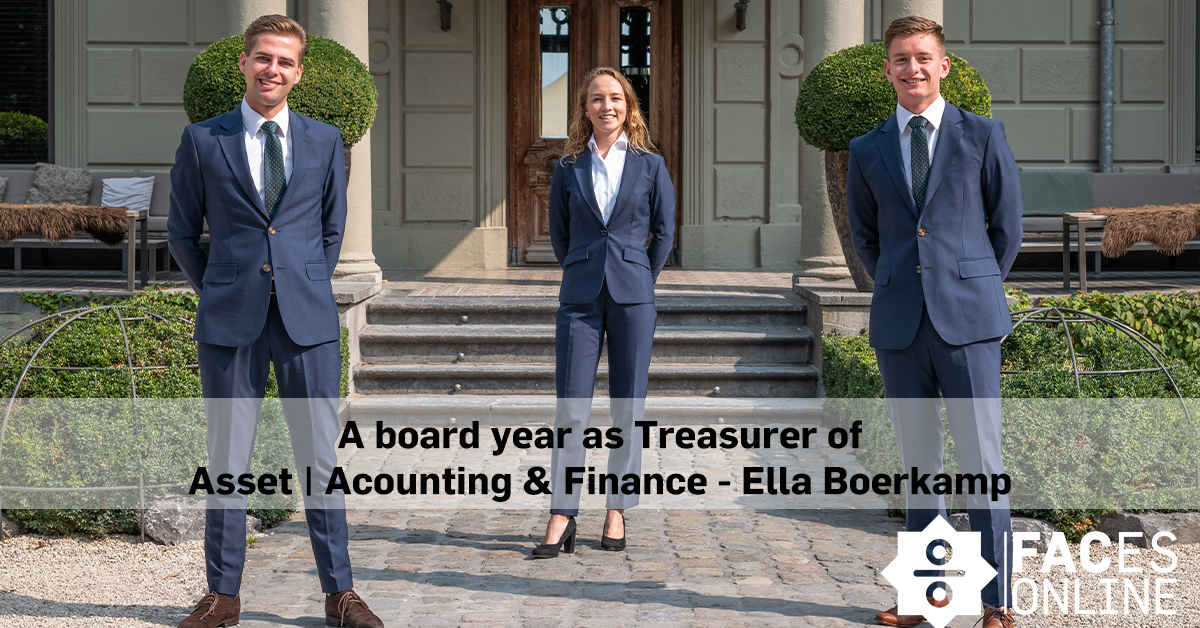
For the Dutch version, click here As Treasurer, you are responsible for the finances of Asset | Accounting & Finance. In addition, you coordinate the Activities, CityTrip, and Investment Night Committee. In this article, I describe my experiences as Treasurer of Asset | Accounting & Finance. Why did I choose to do a board year at Asset | Accounting & Finance? During the first three years of my student life, I wanted to get my credits as quickly as possible. After three years, I obtained my bachelor’s degree and started with the Master Accountancy. I realized that after one year I would probably be finished with studying and therefore also with my student life. This made me doubt. After all, I was only 21 years old. Then I started thinking and came to the conclusion that I wanted to do something else. Therefore, I started to find out how I could prolong my student life a bit and meanwhile gain experience within my interests. As of my third year of study, I have been an active member of Asset | Accounting & Finance and I always had a good time. For me, that was the main reason that I applied for a board year. I wanted a fun and above all enjoyable year. A board year at A&F was therefore the perfect choice. After all, I already knew most of the members, completed the Master Accountancy and I could come into contact with a variety of companies. “What do you do all day?” That is a question I often receive from many friends. Actually, it is difficult to explain what you do all day to people who have not done a board year. When I started my board year, I knew it would be a busy year with many responsibilities, but what it would look exactly was also not clear to me. On Monday morning, we always have our board meeting. When I saw the agenda for the first time, I was flabbergasted. The agenda contained a lot of different topics, such as our formal and informal events, articles that need to be written for Faces-Online, acquisition, etc. As a board member, you are doing a lot of different things, because everything needs to be well-organized and nothing should be forgotten. In short, besides having drinks with fellow students, you have a lot of responsibilities as a board member. At the moment of writing this article, I am thinking again: “What did I actually do last week? The week always flies by!” Is the position of Treasurer exactly what I expected? Before I started my board year as Treasurer, I expected to be busy with the bookkeeping of A&F: paying invoices and declarations, requesting quotes, keeping track of the budget, and sending out invoices. In the first few weeks, I was indeed very busy with this. Twinfield, our accounting software, was not really my best friend at the time and it took me a while to understand and work efficiently with the system. Every week, I mean every day, I contacted my predecessor with questions about Twinfield. After a while, I became more and more proficient and I started to understand what my predecessor meant by ‘Twinfield is just like gaming’. “That as a board member of A&F, you are working in a mini-company with 120 employees and you will never get these responsibilities at your first job.” In contrast to the beginning of my board year, I am currently spending much more time coordinating my three committees. This results in variety in my work. The Activities Committee organizes various events for active members so that they can get to know fellow students despite the few physical contacts that are currently possible. I also coordinate the Investment Night Committee. Investment Night is a symposium that will take place on May 12. Organizing this is a very fun and exciting challenge. Furthermore, I am the coordinator of the CityTrip Committee. I am very happy with this, because last year, I was a member of the StudyTour Committee that organized the trip to South Korea. Even though traveling is not possible at the moment, we still organize fun activities! Besides coordinating my committees, I am also busy with helping other board members, the weekly meetings of all Treasurers of Asset, the quarterly Audit of Accounts, the bookkeeping of the Alumni Association Financials, and the Financial Association Netherlands (FAN). What are you most proud of? I am proud of the fact that, with all the board members, active members, and partners, we have made it an inspiring and instructive year so far. As a board member in this crazy period, we have to make sure that we keep all our partners and members happy. We ensure that events continue and that requires us to be proactive and creative in finding solutions. Hence, our problem-solving skills were highly demanded this year. I am also happy about and proud of the fact that all our events have taken place this year, despite the various Covid-19 restrictions. As a result, fellow students still had the opportunity to develop themselves and get to know other students. Would I recommend a board year to others, even in these strange times? Definitely! When I started my board year in the summer of 2020, I knew that my board year would be different from a ‘normal’ board year. Nevertheless, it has been a fantastic period so far! My board year cannot be compared to any other board year. I hope, of course, that this unique board year will not become normal. During this year, we had to do the best we could to remain successful as a study association. Every event needs to have a plan b and c, which are usually a physical plan and one or two online plans because the rules are constantly changing. For this reason, we are constantly searching for the best option. Looking back at what I have learned, I dare to say
Working at EY
For the Dutch version, click here What is it like to start working at an accountancy firm in a time in which everything is online and working from home is the standard? In this article, Daniek Veldhuis will tell about her experience as a first-year staff member at EY. Who am I? To begin, I will shortly tell something about myself. My name is Daniek Veldhuis, I am 22 years old and I live in Tilburg. After obtaining my VWO diploma in 2015, I decided to make the move to the student city Tilburg. From 2015 to 2018, I studied Business Economics and after completing this bachelor, I continued with the master Accountancy at Tilburg University. Next to my studies, I was a board member at the study association Asset | Accounting & Finance. As such, I got the change to organize network events together with my fellow board- and committee members. These network events were organized for, among others, several accountancy firms,. Due to this, I was able to get a good idea of the various Big-4 offices and eventually make an informed choice to apply for a job at EY. Why EY? You might wonder which factors contributed to my choice for EY. First of all, I quickly decided for myself that I wanted to start at one of the Big-4 offices. For the many possibilities, but also the international aspect appealed to me. Another factor that was important to me was a good match with my colleagues. The actual work at the different accountancy firms does not differ much, which makes the social aspect even more meaningful. Working at EY During my master, I first did a thesis internship at EY in Eindhoven. During such an internship, you will have the opportunity to write your thesis at the office. As such, you can already experience the ins and outs and the atmosphere on a normal working day at the office. My thesis internship started in February, but unfortunately we quickly had to work from home due to the COVID-19 crisis. Fortunately, fear that this would cause less contact with colleagues was not necessary. At the beginning, all thesis interns were assigned a buddy group and mentor and we had a weekly contact moment with this buddy group during the duration of the internship.. Despite the special circumstances, I enjoyed this time so much that I started at EY Eindhoven as a Staff Audit last September. The first two weeks consisted of an introduction period with all the other starters from the same region in which we covered different cases to prepare us for the work to come, but also several informal activities were organized to create a good relationship with my fellow starters. “The activities as a Staff Audit differ throughout the year, from testing internal controls to analyzing the figures in the annual report.” After the introduction weeks, it was time to really get to work. A big step, but you will be guided in this process as well as possible and in the case of any questions, you can always contact your personally assigned coach.. None of my colleagues will have exactly the same working day. This mainly depends on everyone’s client package. My client package consists of different types of clients, including one large client from the United States that I have been working on for most of the time so far. The activities as a Staff Audit differ throughout the year, from testing internal controls to analyzing the figures in the annual report. You work on this together with the team, at the EY office or at the clients site. This year, it has been different and I have spent most of the year working from home. This is very different from what I had imagined my first year at EY to be, but we all try to make the best of it. Where you would normally meet in a meeting room with your senior to discuss something, this is now all done via Teams. Furthermore, we now have virtual work sessions to re-create the feeling of a normal working environment. All team members will join the session, so we can also get an idea of what the other team members are working on. Besides all the hard work, there is, of course, also time for other fun activities. Unfortunately, this year, events like the Christmas drink or ski trip could not take place, but online activities are organized as much as possible, with the entire region or within the team you are working with that week. For example, two colleagues of mine organized a Carnival pub quiz for the entire team a few weeks ago. In short, my first year has been an eventful year so far and different than expected, but precisely because of the way EY has approach this situation, I am still happy with the choice I made.
