

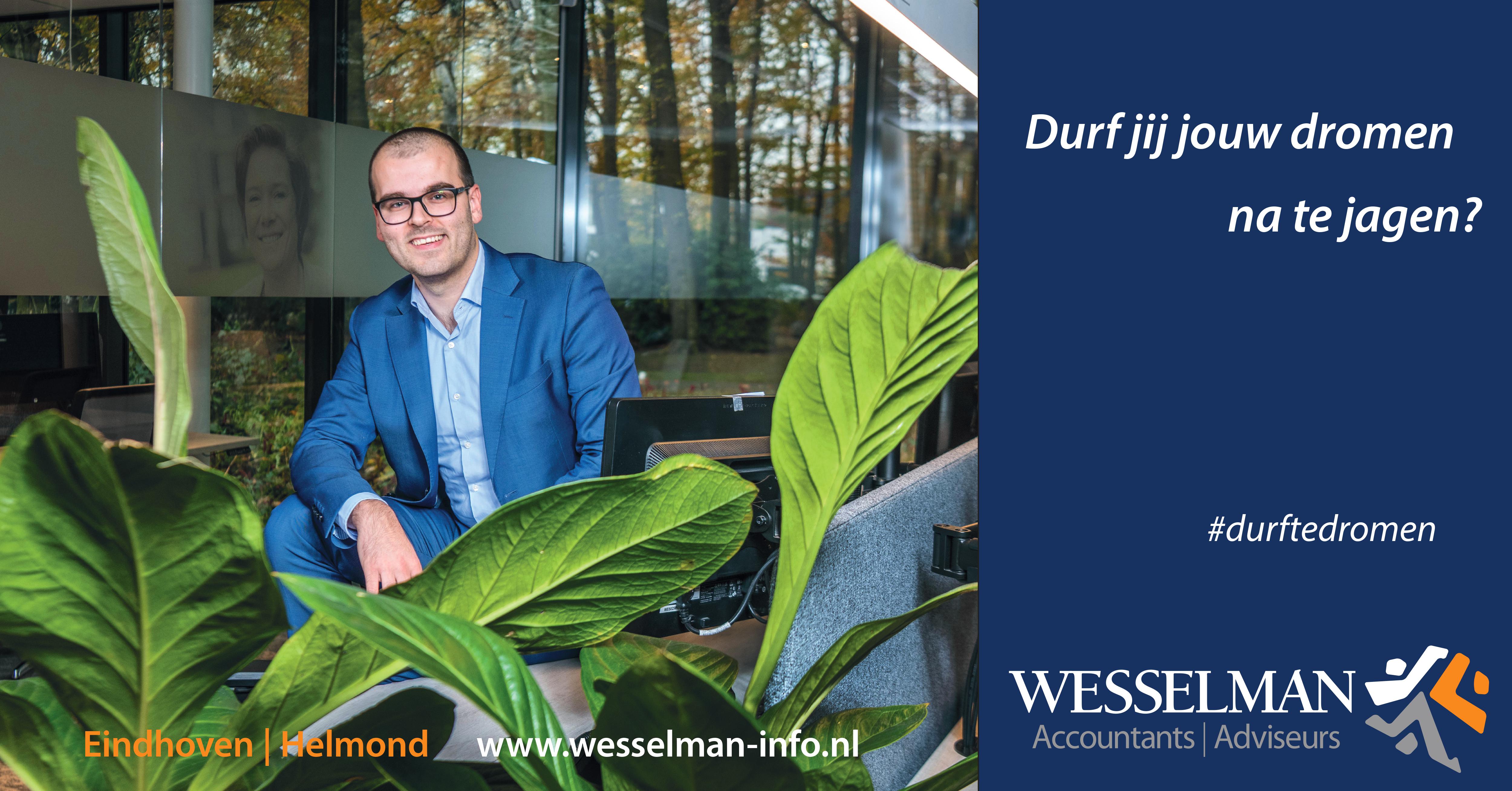
For the Dutch version, click here Who are you and what is your (study) background? My name is Dennis Vaas, 28 years old and born and raised in Weert. I’ve been living there for 5 years together with my girlfriend. In my spare time I like to do spinning and in spring I like to go cycling with friends. I am also active in the carnaval life and I am treasurer of a carnaval event where we organize a pub crawl along 11 pubs in Weert. Here I am responsible for the finances, sponsorship and ticket sales. I am also a member of a carnaval association with which we build a wagon for the carnaval parade. Carnaval is deeply embedded in my life. I have been working for Wesselman for 4 years now. I ended up here via school, as I first did my graduation internship at Wesselman. It was nice to get to know an accountancy firm in an approachable way through my internship. I liked it so much that I stayed on as an Assistant Accountant. I can now call myself Senior Assistant Accountant. I am now responsible for managing and reviewing and I am the link between the controllers and the assistants. This makes the job of Senior Assistant Accountant fun and challenging. I also like the fact that the variety of clients is so great and the complexity is increasing all the time. My clients range from trade organizations to construction companies. In addition, I really enjoy guiding and coaching the junior assistants in their development. Before I started studying Accountancy, I did the Pabo, but this turned out not to be my passion. After visiting a number of open days, I decided to study Accountancy. I first studied Accountancy at the Fontys University of Applied Sciences. Then I followed the pre-master, master and post-master Accountancy at Nyenrode Business University. I completed the post-master’s at the end of 2020, which means that the theoretical part of the RA course is over. I have now started the practical training, the first year of which is almost over. What makes Wesselman Accountants different? When I came to Wesselman I immediately sensed the good atmosphere. It is accessible and informal, and there is a real eye for the individual; they look at the person behind the employee. At Wesselman you are not just a number. I noticed that during the job interview because of the questions they ask, and as soon as you start you get a warm welcome. Wesselman Accountants is a full-service organisation with an accountancy and advisory practice. You can think of an auditing and compiling practice, outsourcing, payroll, tax consultants, tax return practice and a legal department. We have a lot of specialisms and knowledge in house! “In addition, one of our core values is ‘energetic’ and you can see that in the activities.” At Wesselman, I experience a real family culture. It is a small to medium-sized office, which means that you immediately have a lot of freedom in your work. As soon as you start, you are given responsibilities and you do not have to follow the beaten path, which I like. There is room for your personal interests. For instance, I really enjoy subsidy inspections and within Wesselman I am now one of the WMO inspection specialists. At Wesselman, you can focus on what you have an affinity with, which means that in addition to annual audits, you can also be involved in subsidy audits, due diligence investigations, or the IT aspect of the audit. The atmosphere is also very friendly and I would actually say relaxed among colleagues. There is little hierarchy. You can make jokes with a drawing accountant just as well as with an assistant and the partners get coffee for the trainees and vice versa. What does a day at Wesselman look like? It’s cliché but true, every day is different. For example, yesterday I went to a client and there I discussed the sales and purchasing processes with the client and then I worked it out. Today I started with a pre-audit of another customer. In a pre-audit, you’re going to discuss the controls and developments beforehand and you’re going to see how you’re going to frame the audit. Then, I worked out a risk analysis and the personnel process for the same client of yesterday. I also visit the client regularly. In the spring (pre-corona) that is almost every day. Since corona I have been working more from home. I like that because it is very nice for your work-life balance. Half of my work is at home or at the office and the other half is at the client’s. I have clients all over the Netherlands and I really enjoy being everywhere. Every organization is different and different types of people work everywhere. And I get to take a look behind the scenes everywhere. I get great pleasure from customers’ enthusiasm when I show genuine interest in their organization. This ensures a good and professional customer relationship. How can you grow personally and professionally within Wesselman? At Wesselman I get the chance to obtain my RA title and I hope to eventually develop myself into an audit manager. I can walk my own path in this, and I like that. There is also a real focus on soft skills. For example, I followed a Personal Development program where my personal development, cooperation with colleagues and working in the organization were really central. In addition to my work as an Accountant, I dream of one day teaching at a college. My interest in teaching remains, I didn’t start at the Pabo once for nothing. What activities are there outside of work and what is the activity of the year for you? The activity of the year will be our ski trip to Kaprun. We are going to Austria with all our colleagues. We are going to Austria for a long weekend with all of our colleagues, in honor
Investing for dummies
For the Dutch version, click here Disclaimer: The article below provides information and advice on investing. The article is carefully and accurately written, however, we cannot fully guarantee the completeness and accuracy of the information. The advice given cannot be considered as binding and it should be taken into account that any form of investing involves risks. Investing has often been seen in the news, on TV or on social media in recent years. For most people, investing is no longer an unknown concept and the corona crisis has also contributed to the trend that more and more people have started investing. Because investing is a topic of conversation on a birthday it seems that everyone is investing. But how can you actually start investing? What are the different ways to invest? And what is a broker? This article will answer these questions! In addition, we will discuss the things you should take into account before you decide to start investing and what the biggest pitfalls are once you have started. A first point to consider is the idea that you can get rich quick with investing. You should not assume that you can earn a substantial amount of money within a few months by investing. Investing is really for the long term. It is important that, if you want to make a good return, the amount you have invested is not available for decades. To cope with occasional expenses and to be able to receive a mortgage, it is wise not to immediately deposit your entire savings account in an investment account. A second point of attention is that you should think carefully about whether you want to invest entirely yourself, or whether you want to manage your investments through a bank. The advantage of managed investing is that you do not have to pay much attention to it yourself. Especially those who do not feel confident enough to start investing themselves will benefit from it. Reasons for managed investing can be a lack of knowledge and time. The disadvantage is that you have to pay a fee to the bank that manages the investment account for you. The next point to take into account if you want to invest yourself is that it is important that you acquire sufficient information and knowledge before you actually start. With this you are already working on your own investment strategy and you would also recognize your own pitfalls sooner. Reading this article is already a good first step! Finally, it is also important to know about taxes. In the Netherlands, you pay wealth tax on your fictitious assets. In 2021 a return of 5.69% on savings and investments applies. The first 50,000 euros are tax-free (1). On the benefit above the tax-free capital 31% income tax is levied (2). If you would like more information on tax, please refer to this article by Faces! Once you have decided to start investing you can, in addition to managed investing at a bank, also start investing yourself. This can be done at brokers like Binq, eToro and DEGIRO. The advantage is that it is cheaper than at a bank. To create an account you often have to transfer a penny to the broker to verify that your bank account is approved. You also have to upload your ID. At DEGIRO, one of the best-known brokers in the Netherlands, you get to choose whether you want to create a standard profile or a Custody profile. With a Custody profile you have less risk, but you pay higher costs and have fewer options. This is because with a Custody account, your investments, such as shares and ETFs, are not lent out to enable transactions in leveraged products, such as futures and options. So you do not run the lending risk, but at the same time DEGIRO cannot profit from lending and therefore charges higher costs with a Custody account. Furthermore, you cannot invest in futures and options yourself, which means that a Custody account often generates less return than a basic account (3). Above you will see a number of terms such as futures and options recurring. As a beginning investor it is important not to start with these until you have gained enough knowledge about them. “Furthermore, investing is not easy. Is something too good to be true? Then it often is.” You already encountered the term “ETF” in the previous paragraph. An ETF is an investment vehicle that tracks an index, such as the S&P 500 and the AIX. An ETF basically contains shares of an index in an identical ratio. The advantage of investing in an ETF is that you invest equally in many different stocks. So you can spread out in shares and over time and you’re also not in one category of companies in the same sector. Examples of ETFs are the MSCI World and VanGuard All World. There are often essential differences in the composition of the various ETFs, such as which countries and which industries the ETFs cover. Before you invest, it is important to thoroughly familiarize yourself with which ETFs there are and which ones you would like to invest in. Furthermore, it is possible that you come across terms on the website of a broker of which you have no idea what they mean and what you can do with them. For example, you have the ask price, which indicates at what price an investor wants to sell his stock, and the bid price, which indicates what people are willing to pay for the stock. As a novice investor, it is wise to go through all the terms before investing in a stock that is disadvantageous. In addition, there are also different types of investment strategies that you should know about before you start. For example, you have day trading, where you can get in and out of a stock quickly based on current news. This is often done by large companies. As an individual

A board year as Secretary of Asset | Accounting & Finance – Renate de Vries
For the Dutch version, click here As secretary I am responsible for taking minutes at meetings, the in- and outgoing communication of the association and the annual planning. In addition, I have organized the Audit Activity and I coordinate the committees Accounting Insight and Faces Online.In this article I tell you how I experienced my year as secretary of Asset | Accounting & Finance so far, which challenges I still see for my last months and why I made the decision to do a board year last year! Who am I? I am Renate de Vries and I am 21 years old. I was born in Hoek van Holland (Province Zuid-Holland) and after obtaining my VWO diploma I moved to Tilburg. I wanted to live on my own and chose to study further away from home. Besides my year at Asset, I am the treasurer of my dispute Keiretsu and when I have some spare time, I can be found at Keiretsu or at Vidar. My choice for Asset | Accounting & Finance In my first year of my Bachelor Business Economics I became active at Vidar. I liked this very much, but I wanted to orientate further within my education. During the TOP-Week I came into contact with Asset | Accounting & Finance, where I started as secretary of the Activities Committee. I immediately liked the atmosphere within A&F and felt I had found my place. The reason I finally decided to dedicate myself for a year as a secretary When I started my studies, I already had my plan ready; I wanted to complete my bachelor in three years and then do a master. I had already been delayed by a year, so I thought it was time to do my studies fast. When Corona showed up in March last year and completely changed our lives, I started to doubt this. I wanted to study for an extra year, but I didn’t know yet how I would spend my extra year of study. A year on the board was certainly not the first thing that came to mind, but after a few conversations with (former) board members, I became more and more enthusiastic. In the end, I decided that I wanted to take on this challenge and I have not regretted it for a second! “What do you do as secretary of the board and why are you always so busy”? This is a question I often hear, especially from my friends. I must confess that I find it quite difficult to answer this question. I have many different tasks and my weeks do not look the same Of course, I have a few fixed tasks, such as taking minutes at the board meeting every Monday morning, posting an article on Faces Online and the weekly meetings with the committees I coordinate, but the rest of my week is mostly made up of smaller tasks. Fortunately, we don’t just sit in the office all day from 10 a.m. to 5 p.m., but the six of us also do many fun things, such as our activities with the members, dating with other departments or just having a nice lunch. “So what kind of ‘smaller’ tasks do you have?” Something I also often hear is that a secretary only sits in front of the computer taking notes all day. This is certainly not the case. I am responsible for all mailings that are sent out from A&F. These are the monthly mailings, but also mailings for companies. This involves a lot more work, especially creativity to make the mailings look neat, tidy and attractive to students. Besides that, not only Myron is working a lot with Indesign in our board, but I also do a lot of promotion for Accounting Insight together with Odile, a committee member of Accounting Insight. At the moment, I spend quite a lot of time on this, but after many frustrations, I think I’ve mastered Indesign! Accounting Insight is also getting closer and closer, so we have a lot of meetings and I spend at least a couple of hours every week on these. “I really wouldn’t want to miss this and definitely I don’t regret my choice.” Besides Accounting Insight, I am also the coordinator of Faces Online. Every Wednesday, I prepare the article and post it on the website. After this, I make a Facebook and LinkedIn post announcing that the article is online, to make sure it gets read as much as possible. At the beginning of my management year, I was often busy with this all Wednesday, but nowadays it takes much less time. Organising an active members lunch is also part of my duties from time to time. I write the Member of the Month pieces and of course I help my fellow board members when necessary. This is just a small selection of the tasks I have, but I will never be bored, that’s for sure. “What moments will you never forget from your board year?” The first moment I will never forget is when I was shown which two other board members I would be working with for a year. This is what we call your foundation. I started together with Myron and Joep, so I have built a very good relationship with them. At the moment of writing this article, the three of us are busy organising the board weekend, one of the other highlights of my board year. With nine people we go on a transfer weekend to get to know the new generation better. I will also never forget the active members weekend. I was also in the activities committee last semester, so I had the honour of organising this weekend together with my committee. We had many setbacks and as with every activity in that period, we had to work out three several scenarios, but despite all the corona rules, I think we always went for it 100% and wanted to get the
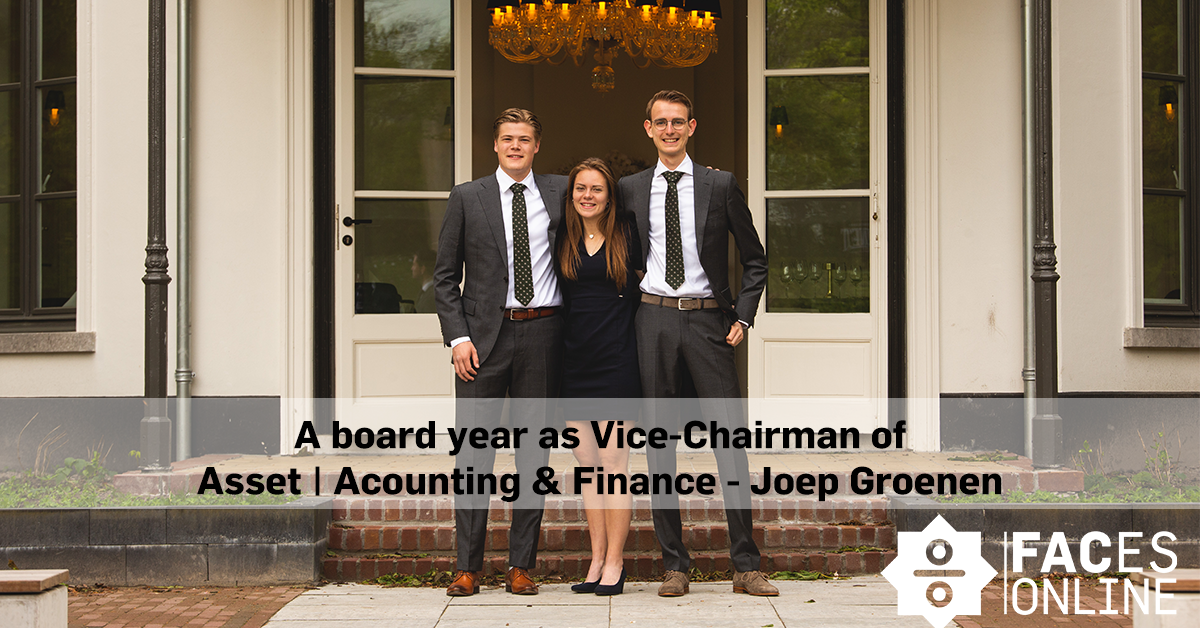
A board year as Vice-Chairman of Asset | Accounting & Finance – Joep Groenen
For the Dutch version, click here Who am I? I am Joep Groenen, 21 years old and living for 21 years in the beautiful city of Tilburg. Since November 2020 I have moved into my room and I like it. Currently, I am in year three of the bachelor Business Economics. This means that in February I will start with the last three courses and my thesis. After finishing my bachelor’s I would like to do a master’s in finance or accountancy, but I am not sure yet which of the two I prefer. Before my board year, I was still convinced about an accountancy master, but since I started, I have become more interested in finance. Luckily I still have some time to figure it out! Within A&F, I started with the Activities Committee, after which I joined the Accounting Expedition Committee, just like my buddy Myron. After this fun committee, I decided to become a board member. Why did I decide to do a year on the board? If I’m honest, I hesitated for a long time to become a board member. Of course, it is important to consider your choice carefully. I have talked to many people, but also looked at myself and what I wanted. What finally convinced me were a few things. First, I wanted to study for at least one more year. I didn’t see myself working at the age of 22 and I wanted to fill in an extra year in a way that would help me now, but especially in the future. I also noticed that I was ready for a break from study life. Secondly, I wanted to develop myself. I noticed that I tended to develop myself not only in the educational field. I especially liked the development in planning and prioritization. I also wanted to develop myself socially, in a board year you work very closely in a team and you deal with many different people. Because of this, you learn to deal with everyone. This is also the reason why I initially started doing a committee at A&F. I wanted to distinguish myself. There are plenty of people who want to do a master’s in Accountancy or Finance, but how can I make sure that I stand out? With a year board year, this works pretty well! Besides making your CV stand out, you also learn an incredible amount that you would never learn at university. You learn various soft skills, such as keeping a diary. Before my board year, I never used an agenda, but now I can’t live without one. As a result, my days are much more organized and I know better what my priorities are. Of course, a board year is also great fun. You have a lot of drinks with other board members and you work at the rooms every day, where a DoMiBo is not missing! How do I feel about starting in winter? At first, starting in the winter scared me a bit, because of course mid-academic year I’m taking a sort of gap year, while of course, I don’t have a degree yet. In the end, this is not so bad. Through my conversations with Martine, who chose the same time, I learned that it could be an advantage. When I enter semester two of year three, I still have half a year to settle into my study life. In general, the load of a bachelor is quieter than a master. So I won’t start my master’s until I have completely picked up the study rhythm again. Furthermore, I still have that half year of bachelor’s to think carefully about the choice of my master! What does a Vice-Chairman do at all? The question is if I perform anything at all in a day I get mostly from friends and family. The answer is yes, I definitely perform something every day and no, it’s not just breaking out and lying on the couches! As Vice-Chairman, I am responsible for several fixed things. For example, I am the sparring partner of the president. This was first Richard and now Lotte. With Lotte, I have a weekly Vice/Vo meeting to talk about the various issues within A&F and Asset Tilburg. Furthermore, we always go through the General Board agenda together and see what our opinions are on the various topics. I will also take over several tasks from the chairman when he/she is absent. “The contact with so many different students is not only fun but also very educational. “ I also have my tasks, of course. For example, I am responsible for the internal policies of A&F. This includes filling the committees in the winter and the summer and being responsible for not only active but also passive members. I arrange study support in the form of guidelines, CoEE, and various training sessions. However, since last winter I share these tasks with the Education Committee. Furthermore, I organize the introduction activities for the master Accountancy and Finance, twice a year the board training and the Audit Activity together with our secretary Renate. Finally, within A&F I also make sure the website is up to date. I do this by uploading events, news, and pages. Personally, I enjoy doing this. Within Asset Tilburg I also have enough tasks. I am in three Asset organs: the Public Relations meeting, the Webmaster meeting, and the BE cluster. The Public Relations meeting is a weekly meeting with the Vice-Chairman of each department. Together we organize all informal events from Asset Tilburg. Think about the Welcome back party or the Grand Opening of the Asset Cafe. I have also helped to paint the walls of the Asset Cafe. Together we are responsible for Asset during the TOP week. For example, I have personally managed the Asset TOP party and the Asset TOP mentorship. I am the Vice of the PR meeting, which means I have to take over the meetings in the absence of Shaye
Interview with Patrick van Zwieten – Ambassador for the NBA
For the Dutch version, click here Patrick van Zwieten is Senior Accountant at BDO and also an ambassador for the NBA. In this interview he talks about his experiences in the accountancy profession, the importance of the NBA and gives his vision on the future within Accountancy. Can you tell us something about yourself? My name is Patrick van Zwieten and I have been working in the field of Accountancy for four and a half years now. I have a higher vocational education background, after which I followed the part-time master’s program at the University of Amsterdam. Within BDO, I work in the Audit & Assurance department where I primarily serve clients in the corperate segment. Why did you choose Accountancy? I found this a very difficult choice at first. I initially worked at ABN AMRO in the investment department for a while. This was more finance-related and that’s why I actually wanted to do a master’s in finance. I then decided to look around for more information by, among other things, taking part in various trial days at accountancy firms. I discovered that I didn’t really know what accountancy entailed and after the trial days I realized that I had a completely different idea of what accountancy actually entailed. The profession requires analytical skills, but also social skills and you have to be able to deal with deadlines. After this, I finally made the choice to go in this direction. What are the biggest differences between Finance and Accountancy? If I compare it to the RA audit practice in Accountancy, we have a project every five to six weeks and we visit the client. This concerns the audit of the financial statements and we speak to all layers of employees within the organization. This makes it very diverse and fun, something that is less applicable in Finance. In addition, you see many different companies, for example, last week I was at the office of a pharmaceutical company and next week I will visit a large clothing retailer. What does an average accountant’s work week look like? Actually, every week is different. It also varies a lot what function you have within the office. If you are just starting out, then you will often be working on an executive level. After a year or two or three, you often get more responsibility and start supporting and guiding starters. The longer you work in the company, the more you are allowed to lead the smaller teams and act as manager, while with the larger clients you still mainly have the executive task. This ensures a good balance. Besides the ‘standard’ work at BDO, we sometimes have a padel tournament with the office. This ensures that we can also meet up outside of work hours and build up a good relationship with colleagues. In addition, we are actually at the client’s office every working day. The audit consists of two parts: the interim part and the year-end part. During the interim part, we visit the client to gain knowledge of the client and the company’s process in order to analyze risks, but also to find points of departure for our audit. In the second year, which often starts around January, we really look at the figures. Using various techniques, we then check whether the annual accounts are actually correct. How has combining work and study worked out for you? In the beginning I found it quite hard. I started working full-time and also had a part-time master’s degree to complete. Especially in the first year I was searching for the right planning. I noticed that over time I could find my feet and things went better. This was also because everyone around me was going through the same process, both my colleagues and my fellow students. The office also helped me a lot, we get an extra day off before exams and we can ask for help if we find a course difficult. What are the opportunities after getting your master’s in accountancy? I think there are many possibilities once you have your degree. In the path of RA, you could grow within the office to partner, but in addition you also see that someone with an RA title is popular in the business, you are then Accountant in Business (AIB). This is for example in large companies to work in the finance department. Another possibility is to become CEO or CFO. So outside of the accountancy field, it offers a huge amount of opportunities in the job market. Can you tell us a little bit about NBA? The NBA is the Dutch Professional Organization of Accountants. There are over 22,000 registered accountants in the Netherlands today. These are both Chartered Accountants (RA) and Accounting Consultants (AA). They are all listed in the NBA register. This organization promotes the professional practice of accountants. They do this by drawing up rules of conduct, testing the knowledge of accountants and providing education. At the end of the practical training, there is a final exam that tests whether you are capable of acting as a starting professional practitioner. However, before that happens, you must first complete your theoretical training as a Chartered Accountant before you can complete the practical training as a Chartered Accountant. What is the role of the NBA within the field of Accountancy? The NBA plays a big role. On the one hand, it is the NBA’s job to monitor us and check whether the firms are meeting the quality requirements. But in addition to that, the NBA is in talks with the Ministry to draw up an accountant protocol. The offices will then be presented with guidelines with which they can check whether, for example, last year’s NOW scheme was rightly obtained. What does the NBA ambassadorship entail? There is a fair amount of shortage on the labor market within Accountancy and through the NBA ambassadorship they want to try and give a better insight into the profession of accountant

A board year as External Affairs of Asset | Accounting & Finance – Myron Boere
For the Dutch version, click here Who am I? My name is Myron Boere and I am 23 years old. I am from Benschop, a small village in the province of Utrecht. Last year in December I received my Bachelor degree in Business Economics and in September I started with the Master Accountancy (zachte knip). I am now living in Tilburg for 4 years and since 2 years active at Asset | Accounting & Finance. My time at Asset | Accounting & Finance started with the Orientation committee, then the Accounting Expedition and later on I decided to do a board year. Why a board year? I had been wondering for a long time whether I would like to do a board year, but I also doubted whether it would suit me and whether I would be willing to put all my time into one organization for a year. In the end, there are a number of factors that make me very happy that I decided to do it after all. A board year has many advantages: You get to know a lot of new people, both formally and informally, you develop yourself through the year in various areas because you are leading an association, you have a lot of conversations with partners and, ofcourse, members. There are also some things you have to give up like: you have little or no time to study, a little less time for friends/family and a day of chilling on the couch is also less likely. I had already applied for a board year at A&F previous summer. Unfortunately, I did not get through the application procedure. After this, I actually had the idea of continuing my studies, finishing my master’s and applying again the following year. During my master’s I quickly noticed that the motivation for studying was completely gone. This was mainly due to Covid-19 situation; sitting at home and having to open my laptop every day and work on school projects was pretty hard for me. During that time I started to consider doing a board year in the winter. I often talked about it with Richard, who is a good friend of mine and was also on the board at the time. From those conversations, I finally decided to take on the challenge of starting a board year in the winter. How was my time on the board? I kicked off my board year during the period with the worst corona measures. In the beginning it took some time getting used to doing a lot from home. This was especially difficult with the transferperiod, because I had to learn everything from Evelien in a short time and I also spent some time in quarantine. Furthermore, with the constantly changing measures it was constantly a challenge how we could make our events happen. These issues were also a daily topic of conversation which led us to test a lot of online platforms. You could almost say that I became a real Zoom pro, with all the break-out rooms, online drinks and formal online events. In the beginning it was still very difficult to find out exactly what my function entailed and what my tasks were. Partly thanks to Evelien and Simo, I quietly rolled into my role as External and got the hang of it, if I do say so myself. An External Affairs function basically entails the following: First, you are responsible for a business portfolio of about 30 -35 companies with whom you have to maintain contact. With some partners you have a lot of contact, because they participate in events and also have exposure opportunities with us. Secondly, it is important to recruit new companies for events and to look for potential long term partners. As an external you also have a weekly meeting with all the other externals of Asset, where I was also allowed to fulfill the role of Vice the last half year. This means that I was often sparring with Wout (Acquisition Coordinator) about partnerships, university related issues and of course various issues within Asset. I am also responsible for our social media and update the board monthly on the numbers (reach, clicks and likes) and the three events that fall under my responsibility: namely the Banking Days, the Financial Business Dinner and the Finance Expedition. For the last two events, I also coordinate a committee, with which you have weekly meetings to ensure the best possible event. In the beginning I was a bit reluctant to do this, partly because I am not really a leader by nature and prefer to do a lot of tasks myself in the background. However, I was always told that I had to outsource tasks, because the committee also has to learn all the important tasks and as a board member you are already busy enough with all the other tasks. Furthermore, I have become the chief design officer of my board. So I use Indesign a lot and it appears that I have mastered the tricks of the trade. Simo and also my other fellow board members have often used this. “You could almost say that I became a real Zoom pro, with all the break-out rooms, online drinks and formal online events.” Finally, you have the general duties that you share with your board. Every Monday we have our board meeting. Here we discuss the state of affairs within A&F and Asset broadly. Other tasks we share are discussing our vision on various developments within A&F and what our opinion is in discussions, being present at our (in)formal events, speaking to members when they are in their rooms or when something is not clear and of course helping my other boardies when they can’t figure something out or needs my opinion. How did I grow personally during my board year? In general, I am a quiet person who likes to wait and see and doesn’t take the initiative easily. During a board year
