


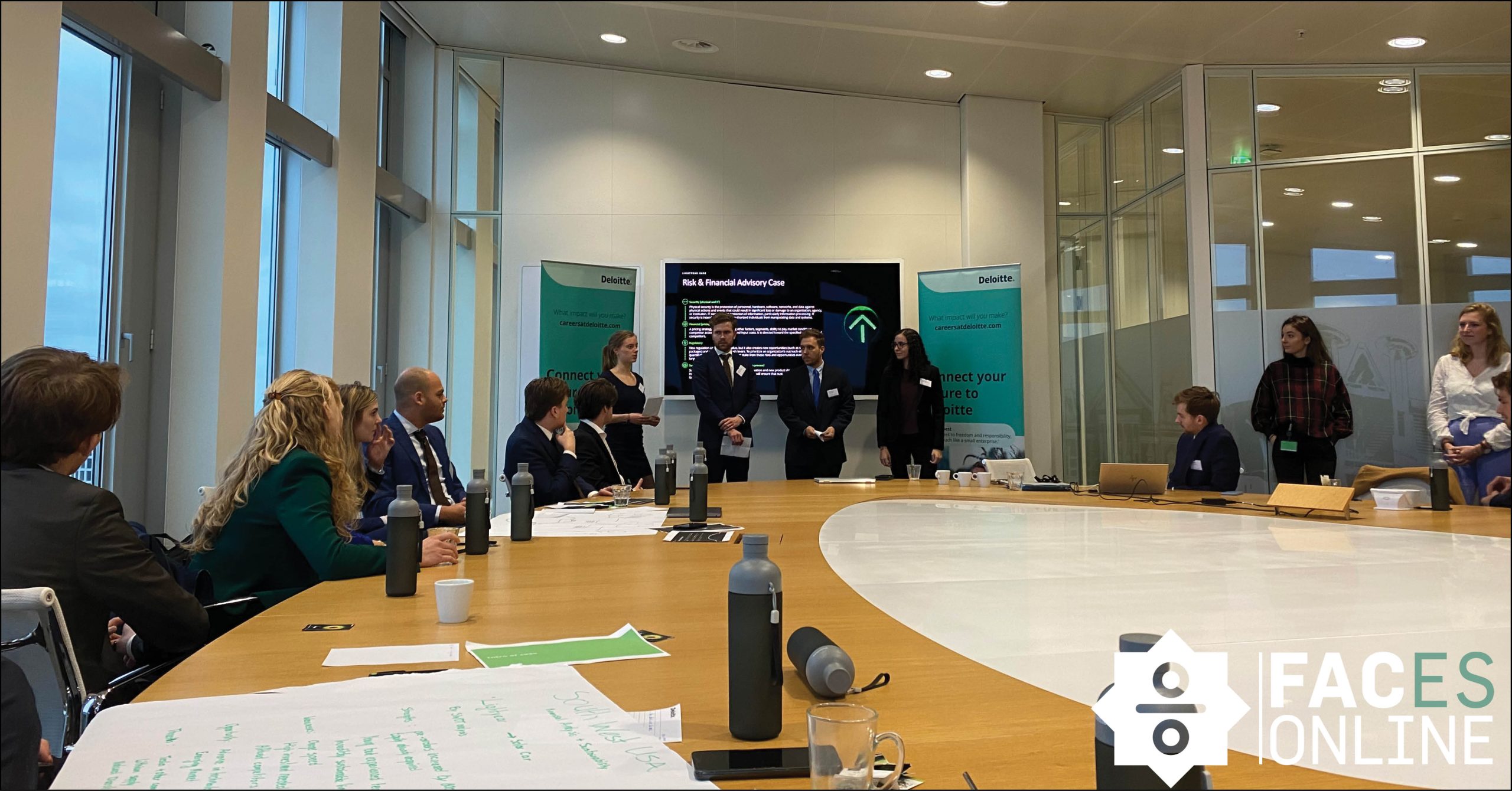
For the Dutch version, click here. After 2 years when we had to organize the Finance Expedition online because of Covid-19, this year it was finally time again. On November 7 we left for Amsterdam again for the Finance Expedition. Over a period of 3 days, 24 students visit 2 companies each day within a particular pillar of Finance. This event is organized by Asset|Accounting & Finance in cooperation with Asset|Econometrics Ready with all the goodie-bags, suitcases and healthy excitement, the committee was waiting at the back of the station. Gradually the students arrived and well on time we left, in the beautiful Willem II bus, for Amsterdam! Once we arrived at the Holiday Inn on the Zuid-as, there was, after everyone had quietly gone to their rooms, the opportunity for the enthusiasts to have a drink in the bar to get to know each other better. Unfortunately, we had to go to bed fairly early because the wake-up call was set for 7 o’clock. Day 1 On Tuesday, November 8, we visited BDO and Oaklins, both specializing in the Mergers and Acquisitions branch within Corporate Finance. First up in the morning was BDO. Upon arrival at the office we were welcomed by the staff and were immediately pampered with coffee, tea and a little sweet. The program started with a short introduction about BDO and the opportunities that students have within BDO. After this, we were given a case in which we, as BDO employees within the Due Diligence process, had to determine the EBITDA (Earnings Before Interest Taxes Depreciation Amortization) of a sizeable company as best we could. At the conclusion, each group had to present their thought process and final EBITDA. The morning ended with a delicious lunch that presented the opportunity to personally interact with BDO employees. After lunch we had to quickly move on to Oaklins. Thanks to a grumpy bus driver who didn’t want to wait 10 seconds for us, we arrived at Oaklins 5 minutes late. Fortunately, no problem. Again we were welcomed with coffee and tea at Oaklins and after a short presentation about Oaklins as a company we started the 2nd case of the day. In this case, we as participants had to advise some employees of Oaklins whether or not they should take over a company in the travel industry. For this, we were given an extensive information memorandum and the opportunity to speak with both the “CEO of the company” and an “industry expert”. We had 1.5 hours to arrive at our advice. After a presentation in which everyone pitched their advice, it was time for dinner. Oaklins had arranged sushi and after dinner took us to ‘De Blauwe Engel’, a cafe on the Zuid-as where we enjoyed a small drink with some of the employees. Day 2 On Wednesday, November 9, as usual the alarm clock went off at 7 a.m. and this time we visited ING and a.s.r., this day was all about Asset Management. Arriving at the ING headquarters at the Bijlmer, we were given an introductory presentation on the future and vision of ING as a bank mainly within the Netherlands. ING discussed the case in the whole group and it consisted of analyzing a loan process that ING had provided to a transporter of fresh vegetables. We discussed the case with 2 employees who actually participated in this process and we covered the whole loan process, from initial application to, unfortunately, eventual bankruptcy. After the case, we also got a presentation from the CIO (Chief Investment Officer) of ING, he explained to us how portfolios are selected and built. After all the very interesting presentations, we unfortunately had very little time for lunch that ING had arranged. Although we had to eat quickly, it was again very tasty and in no time we were on our way to a.s.r. in Utrecht “The event was created to give students a bridge between theory from undergraduate school, what companies are actually doing with that knowledge and how it is applied.” Arriving at a.s.r., most people noticed one thing: how big the office is! Truly a huge, and beautiful office with a lot of glass allowing a lot of natural light to enter. During the introductory presentation we were shown the rich history of a.s.r. as an insurer. Also discussed was their recent acquisition and future vision of Aegon. After a short coffee break, it was time for the case. We were divided into groups and were given the task to even-out a.s.r.’s balance sheet during a variety of times of economic uncertainty. A news event was shown affecting an asset and/or liability and it was up to us to manage our insurance, equity and real estate portfolio in such a way that we as a.s.r. continued to make a profit. I thought it was a very original case as it combined Asset Management in the setting of a trading game often played at Market Makers at in-house days. After the case, it was time for drinks and pizza! Day 3 The last day had arrived and once again we were out of bed early! Thursday, November 10 was all about Risk Management, we visited RiskQuest in the morning and Deloitte in the afternoon. Arriving in the beautiful canals of Amsterdam, the relatively small office of RiskQuest was located in a beautiful canal house. After an introductory presentation, we were given a short tour of the office. The highlight was the office of one of the partners. In the ceiling of his office were several beautiful paintings from the time of Rembrandt, together with the beautiful view over the Amsterdam canals and the enormously comfortable office chairs. I am amazed that people still get work done! During the case, we were divided into groups and pretended to be employees of RiskQuest hired by a Luxembourg bank to recalibrate their Probability of Default Model. We then had to present our findings and a new credit risk model.
Working at EY
For the Dutch version, click here. Who are you and how did you end up at EY? I am Bas, 22 years old, originally from a small village in Limburg, but since the start of my student days I have been living in Tilburg. After finishing my Bachelor in International Business Administration (including an exchange to Melbourne, Australia), I started the Master Accountancy, which I completed last summer. During my Master I oriented myself considerably on the life that would follow after my studies and this led me to a thesis internship at EY Eindhoven last February. Why did you choose to combine writing your thesis with an internship? When I started my Master I felt the pressure of adult work life slowly approaching. At the time, I had doubts whether a future within Accountancy was really my ambition. My friends and fellow students advised me to get in touch with companies in order to find an internship. I took part in several events of the study association ‘Asset | Accounting & Finance’ and that’s also how I came into contact with EY. A thesis internship felt like a safe choice to get a better idea of what work life is like this way, but at the same time still have enough time for my studies. Did this give you an advantage over your fellow students? My internship definitely gave me an advantage over fellow students without an internship. I had time available every week for my thesis, since the days I spent writing it counted toward my thesis internship. This motivated me to actually work on my thesis. In addition, I was assigned a “buddy” and “mentor” at EY. My buddy helped me with daily tasks and general questions. This was very accessible because he had also completed a thesis internship not long ago. My mentor, on the other hand, had been with EY for some time. Therefore, he was able to give me good career perspective and advice, as well as substantive support for my thesis. Were you able to achieve your personal goals during your thesis internship? I quickly noticed that I could achieve the most if I took a proactive approach and clearly stated what exactly I wanted to get out of my internship. It was recommended to spend 2 weeks with a team, but flexibility in that was possible. In total, I interned for 5 to 6 weeks myself, because my main reason for a thesis internship was to experience what the real-world work was like. Before I started as an intern, I was hesitant about whether I would be able to do my work well because I had no practical experience within Accountancy. During these internship weeks, these doubts quickly disappeared. Due to a warm welcome from the team and good supervision, my learning curve was fast. I realized that it was perfectly normal that I did not know everything yet, and everyone was open to help me where necessary. Partly because of these weeks, I discovered that I found the work extremely interesting, which suddenly made me a lot more confident about a future in Accountancy. “In my opinion, the best way to orient yourself is through a (thesis) internship or work-study.” Why did you choose to stick with EY? In fact, I was so sure about my future in Accountancy that I started as a Staff Audit at EY Eindhoven last September! Like many students, I was in doubt for a long time whether I wanted to extend my student time or was ready for a job. Since I liked the work and the atmosphere in the office so much, I decided to take the plunge and start working. During my internship, regular activities were organized (e.g. lunches, drinks and training sessions), which allowed me to get to know more and more people within EY. The switch from student to working took some getting used to, but in the end I am very happy that I took this step. Moreover, I am currently still following the Post-Master Accountancy on Fridays, so I still feel a bit like a student. You mentioned that you have now started, how have the first months been? So far, the work has suited me well. During my internship period, the corona measures were stricter than now, which made it difficult for teams to go to clients together. For that reason, I find it extra nice that this is now possible again. Over the past few months I have been able to see and learn a lot. Every day I learn new things and I am definitely not finished with my personal and professional development. Moreover, through both my internship and the two-week starter induction in September, I have been able to build a good relationship with my ‘year layer’ of EY starters, whom I can now also call colleagues. I am surrounded by people who have also made the step from intern to employee, with similar experiences, and this is very nice. What else would you like to tell students? I hear many doubts from students: “Am I going to do Accountancy, or Finance, or something else altogether?” In my opinion, the best way to orient yourself is through a (thesis) internship or work-study. During this period you will find out what work involves and what it is like within a sector. One last tip from me: go to (Accountancy) events, talk to fellow students, or send a message to a campus recruiter. A (thesis) internship can really help you clear your doubts! If you have any questions, you can always send me a message on LinkedIn.

Hedging against inflation, is it possible?
For Dutch, click here. Current inflation has not escaped anyone’s notice, and among students there is great concern about its height. The first estimate from CBS indicates that inflation in the Netherlands in October was 16.8% based on preliminary figures. This is a slight decrease from September’s inflation rate of 17.1%. Nevertheless, this is an exorbitantly high rate, and assets are going up in smoke. Current inflation The average student, of course, does not have a large amount of assets. The price increases will therefore most likely lead to a higher debt with DUO for a number of students, and in addition, the interest rate on the debt has risen to 0.46%. Inflation is driven by factors beyond an individual’s control. Still, there may be other ways to combat inflation. Some popular ways to preserve purchasing power are examined in this article. Perhaps there are some ways to allay concerns. Gold Holding gold is seen by many investors as a good hedge against inflation. For example, Peter Schiff said “gold will shine in an inflationary environment.” To see if gold is indeed a good way to preserve value, we will look at the results of a few scholarly articles. Ghosh et al. (2004) examined whether gold is an effective inflation hedge. Through an empirical analysis, the article reveals that over a long time horizon gold can indeed act as a hedge against inflation. However, the nominal price of gold is dominated by short-term influences. So over a short time horizon, it can be very detrimental to invest in gold. For example, an investor who would have invested in gold in January in 1982 and held it through December 1999 would have lost 59% in real value. Beckmann and Czudaj (2013) reach the same conclusion in their study that gold can partially hedge inflation in the long run. In particular, consumer prices can be hedged in the long run by investing in gold. In the short term, however, it is not possible for an investor to hedge a portfolio against inflation by investing in gold. The characteristics of an economy during a given period mainly determine how gold responds to inflation. However, the scientific research by Hoang et al. (2016) indicates that gold is not a hedge against inflation in the long run. In the United Kingdom, the United States and India, gold does form a hedge against inflation in the short term. The contradictory result of this article compared to the other articles can be explained by the introduction of nonlinearity. This article proves that the relationship between gold and inflation is not a linear one in a number of countries. For example, a nonlinear relationship is visible in more developed countries, and a linear relationship is visible in developing countries. Thus, gold might be better used with the goal of building a more diversified portfolio. Based on the results of academic articles, I would advise against using gold as a hedge against inflation. The results are contradictory. Moreover, some articles do argue that gold can be used as an inflation hedge in the long run, but this requires a very long time horizon. Real Estate Another way often mentioned to combat inflation is to invest in real estate. An accessible way to invest in this is through a Real Estate Investment Trust (REIT). This is a company that owns real estate and generates income on it. Thus, by purchasing a REIT, it is possible to invest in real estate indirectly. Rubens et al. (1989) examined how a number of portfolios consisting of, among other things, different real estate types fared with respect to inflation. Each portfolio formed at least a partial hedge against inflation when it came to expected inflation. When inflation was unexpected, all portfolios formed no hedge against inflation. Thus, the type of inflation largely determines whether real estate can be used against inflation. Current inflation is high, and it is expected to remain high in the short term. Currently, therefore, real estate could be a way to hedge against inflation provided the expected inflation is similar to the eventual actual inflation. The portfolio consisting of financial assets and residential real estate from the article has the highest Sharpe ratio. Thus, with current expected inflation, it would be most attractive to invest in a REIT that focuses on residential real estate. Another scholarly article by Park et al. (1989) focuses specifically on hedging inflation through REITs. Equities typically perform poorly during times of high inflation. Although REITs have real estate income as an underlying asset, it could be that, like stocks, they still do poorly when there is high inflation. The study finds that REITs actually perform similarly to stocks, and thus are not a good inflation hedge. However, it does show that when distinguishing between expected and unexpected inflation, REITs can be partially used as an inflation hedge when inflation is expected. Thus, this is partially consistent with the findings of Rubens et al. Inflation-related bonds Another way commonly mentioned to hedge against inflation is to invest in inflation-related bonds. Here the coupons and principal are linked to current inflation. This therefore directly protects the bond against inflation. However, an inflation-linked bond does not protect against inflation in the short term. The price of an inflation-linked bond goes down when yields go up, just like a regular bond. When the consumer price index is compared with the yield of inflation-linked bonds over 1-year periods, it is apparent that there is little correlation between the metrics. So in the long run, an inflation-related bond protects against inflation, but not in the short run. Another important aspect of these bonds is that expected inflation is priced into the price of the bond. So an inflation-linked bond protects against unexpected inflation. Therefore, if actual inflation is lower than expected inflation, a negative result is achieved on an inflation-linked bond. So is it possible to hedge against inflation? It is possible to hedge against inflation, but obviously this is
A board year as External Affairs of Asset | Accounting & Finance – Thomas Mols
For Dutch, click here. Who am I? I am Thomas Mols, 22 years old and from Tilburg. A year ago I became active at Asset | Accounting & Finance in my third year of the bachelor International Business Administration. After six months of doing committee work for the Finance Expedition, I became more familiar with A&F. I participated in almost every activity, getting to know a lot of people and making great memories. Besides studying and A&F, I spent my free time in the gym and mostly among other people. Why did I choose the function external? In the third year of my bachelor’s degree, the corona measures got lessened and I felt working life was already approaching. I had the urge to get more out of my college days so I joined A&F. By joining events often, I quickly got to know the association. I always ruled out a board year because I would have to take a break from studying. After a good conversation with some of the board members, I finally saw the value of a board year and decided to apply. What interested me most was the practical work a board member does. After several years of working in theoretical subjects only, I needed a change. In addition, I was unsure of which master’s degree I wanted to pursue, and I thought it would be useful to get a better idea of the possibilities offered by different masters during the year. The external affairs position specifically attracted me the most because you have contact with many companies and can get an inside look at everything. At the same time, I believed I could learn the most with this position. What does it deliver? The most important thing is that you are one board together. Within the board, everyone has a function with delineated responsibilities, so everyone looks at situations with their own perspective and gives their input from there. Decisions are often made together. During a board year you learn to work together very well. Not only within A&F, but also together with the other Asset departments as you will engage in consultation or discussion. You will learn how to identify interests, work and perform under pressure and how to present your opinion or strategy. In addition to the role within the board and within A&F, as external affairs you have a major role towards the outside world. You translate the wishes of companies into the opportunities the association can offer. How you want to position the association as a board is translated by the external to companies and students in the contact you have on a daily basis. So during the board year you learn to communicate in a changing context. By being in contact with so many people, both students and business people, you’re bound to build a huge network. A very useful extra for the future! What do I do as an external? As winter external affairs, you start up the Financial Business Dinner and Finance Expedition committees at the beginning of your year. You make sure the committee members know what their tasks are and guide them through the rest of the year in the work they do. In addition, you are responsible for all social media channels. This means you will help shape the policies that are written by the board during the summer. In the summer, you also help write this policy. In any case, with social media you focus on increasing the reach of the channels. During the year you will occasionally help organize other events and activities. These activities ensure the development you go through in collaborating and communicating. An important task that you perform at different times during the year is doing acquisition for collaborations with companies. The challenge in this is that you have different ways of entering into a conversation. The trick is to get a grip on the interests of the other party, to understand the context and to respond appropriately. As I mentioned earlier, you are also part of a board. You sometimes take over tasks from each other and jump in where necessary. In addition to managing your own department, you form “task forces” with other directors who take on tasks together. These range from organizing Master Experience Days to coming up with new Asset Member Card deals. In organizing events and the regular tasks you have, you don’t have unlimited time. Therefore, it is important that you prioritize and work efficiently. Because of the range of tasks you have, you will learn responsibility and develop time management skills. Conclusion All in all, a board year is a great opportunity to develop yourself and gradually make some amazing memories along the way. And to top it all off you get to help build the greatest study association that Tilburg has to offer!
A board year as Vice-Chairman of Asset | Accounting & Finance – Jonas van Voorst
For the Dutch version, click here. Who am I? I am Jonas van Voorst, 21 years old and come from beautiful Den Bosch. In February 2020 I started living in my room and I really like it. I am now in the third year of the bachelor International Business Administration, and am taking a number of courses in preparation for the MSc. Economics. Before my board year, I was convinced to follow the Accountancy master, but since I started, I am more oriented and have gained a strong interest in Economics. Furthermore, I started within A&F with the Activities Committee a year ago, I really enjoyed it and therefore decided to do a board year. My choice to do a board year. The choice for a year on the board was actually made pretty quickly. I was not very convinced about my choice to do a master’s degree yet, and because of corona my student life had been put on pause for a while, so I wanted to extend it. When Joep called me if I was interested in applying, I figured this was a good opportunity to discover where my interests lay, and thus extend my student life. Furthermore, I noticed that I was very chaotic in my studies. A year on the board has given me a fixed rhythm and a much more organised way of working. For example, I have an agenda where I put my appointments and a notebook where I keep track of my tasks. Among other things, these are important soft skills that you develop during your board year. I also wanted to develop myself socially, for this reason I also joined A&F. As a board member, I work with 6 people every day, and you speak to a lot of people within A&F and Asset, so you learn to deal with many different types of people. In addition, my resume was very empty, and I thought a board year was a very good way to change that. Of course I also do it for fun, besides the tasks I have, I regularly do fun things with my board in the rooms or at someone’s house, because of this I have a good bond that will continue after my board year. I also attend almost every party, and have regular get-togethers with other boards, through which I have also made many friends! What a Vice-Chairman does all day long The to-do list of a Vice-Chairman is very vague, which is why I often get asked by friends if I do anything all day besides being hungover and playing a game of Mario Kart. As Vice-Chairman, I am responsible for several things. Since I’m in the rooms almost all day, I have a good sense of what’s going on, and here I occasionally talk about it with the chairman, Luc. I also take over the chairman’s duties when he is not here. I also still have my own duties. I am responsible for the internal policy of A&F. This includes filling the committees, informal promotion and I am also responsible for the active and passive members. I arrange the study support in the form of guidelines, CoEE and various trainings. Furthermore, I organise the introduction activities for the Master of Accountancy and Finance, board trainings, the Citytrip Replacement Activity and the Audit Activity together with our secretary, Lars van Maris. Finally, within A&F I also make sure that the website is up to date. Think of events, news, partner pages. This is another side to being informal so I find that a very nice change. Within Asset Tilburg, I also have plenty of duties. I sit on four Asset bodies: the Public Relations meeting, the Webmaster meeting, the BE cluster and the Study Support meeting. The Public Relations meeting is a weekly meeting with the Vice-Chairmans of each department. Together we organise, among other things, all informal activities from Asset Tilburg. Think of the Kick-Off party or the Pre-Carnival party. We are also responsible for most of the promotion of Asset Tilburg. I am responsible for the budget of the promotion and activities. I also attend the Webmaster meeting with every Asset board member who manages the website of his/her own department. Together we manage the website of Asset Tilburg, we are also busy redesigning the site. I also join the BE cluster every Thursday. Together with S&L, SBIT and Marketing we are responsible for the committees and activities for first- and second-year Business Economics students. I coordinate two committees: the Date Dinner Committee and the Accounting Insight Committee. Starting next year, the Vice-Chairman is also going to coordinate the Citytrip Committee, but unfortunately it will not happen this year. What is the most enjoyable aspect of the Vice-Chairman position? I really like different aspects of the Vice-Chairman position. When I applied, I knew that the Vice-Chairman position appealed to me by far the most of the positions. I regularly saw what my predecessor, Joep, was doing and this excited me. What I like most is that through the conversations with active members you get a picture of each member, and for the active members you are also a point of contact, so at activities you are quickly addressed and you quickly get to know everyone. This contact is not only a lot of fun, but also educational because you get to interact with different types of people Would I recommend a board year? I would definitely recommend a board year! It is a great consideration, so don’t be afraid to talk to a current board member. This can be very helpful if you run into something or want a new insight. Ultimately, a board year is an investment in yourself that you are going to benefit from for a long time to come through your development and connections, and beyond that you are going to be able to look back on this with a lot of joy!

Rise of student venture capital
For the Dutch version, click here. venture capital is often seen as the final step of your career within finance and investing. Typically, those who run venture capital funds have already been successful in their previous endeavors. Before someone takes on the venture capital industry, they have often been the founder of a successful startup or have an extensive career within the financial sector. Because of this, it is not a surprise that the average age of venture capital fund managers lie above 40 years old. For the longest time, no-one would question this description of those in the industry. However, in 2012 this changed when Josh Kopelman founded the Dorm Room Fund, the very first venture capital fund run by students. The status quo At first glance, having a venture capital fund run by students sounds like a terrible idea. Usually, students have no business experience yet, let alone the ability to run a venture capital fund. venture capital funds manage millions of dollars of external investors, which is invested in the high risk investment opportunities of startups. Because of this it is reasonable that these funds are expected to be run by experienced professionals, but not students. So why should a venture capital fund be run by students? To understand this we have to look at the kind of investments venture capital funds make. venture capital funds seek to invest in startups that have extraordinary growth potential. They want to invest in the startup stages of companies, where the risk is big, but the potential upside even bigger. If we narrow down to early stage venture capital funds, those who are the first investors in startups, we see that they invest in startups within 2 years of their inception. If we then also look at those who would found these startups, the advantage of student-run venture capital funds becomes clear. The value of students Mark Zuckerburg, founder of Facebook, Larry Page & Sergey Brin, founders of Google, Evan Spiegel, founder of Snapchat, and too many more to name. All of these incredibly successful entrepreneurs all started their respective companies while they were students. And who do you think would have heard about their idea first? The ~40 year old fund manager, or the students who know them personally. Of course it is going to be the students that know them personally, their friends, their classmates, and their teammates. Simply put, student-run venture capital is way better suited to find the next big thing before it is popular than any other venture capital fund. But it doesn’t stop there, because of the personal connections between the student startup founder and the student-run venture capital fund, they are also able to determine whether the student entrepreneur is actually building something incredible, or just chasing clout. After the creation of the Dorm Room Fund, other student-run venture capital fund would also start to pop up in the United States. One example is Rough Draft Ventures, which was also founded in 2012. Both the Dorm Room Fund and Rough Draft Ventures were associated with other venture capital funds, First Round Capital and General Catalyst respectively, which are still run by typical fund managers. Generally, the other student-run venture capital funds in the US were set up by universities, where the universities see these funds as a way to provide students with real-world hands-on experience while simultaneously supporting student entrepreneurs. While the funds originating from the universities remained relatively small, both the Dorm Room Fund and Rough Draft Ventures have grown immensely. Combined they have invested in hundreds of startups. Europe follows suit Compared to the United States, Europe was a little later to the party. The Dutch Student Investment Fund was the first student-run venture capital fund in Europe in 2016, but was soon followed by Campus Capital which was founded in the UK in the same year. In the years after, more and more student-run venture capital funds were created; First Momentum in Germany in 2017, Amsterdam Student Investment Fund in the Netherlands in 2017, or S2S ventures in Switzerland in 2021 to name a few. In the future, this trend will continue. The rise of student-run venture capital funds is not limited to the rise in the number of funds there are, but also the rise in professionalism. Most student-run venture capital funds remain limited to an associated university, operating on a small scale and not doing much specializing, but a few student-run venture capital funds are being created independently, for example, Graduate Entrepreneur and Round One Ventures. Both operate fully independently, and at a larger scale, and do more than just investing. Looking back at the United States, we also see that The Dorm Room Fund has also become independent in 2021, and more will follow suit. What will the future hold The advantage of students within venture capital is not overlooked by the established players within the venture capital industry such as Sequoia. These funds have recognized the potential of students and are now also trying to capitalize on them by setting up student ambassador programs, so that they too can have that personal connection with student entrepreneurs. All in all, the people who believe that students have no place within the venture capital industry should think about reconsidering this. Furthermore, any students who want to enter the industry but think that they need the experience first, should reach out to student-run venture capital funds, or better yet start their own.
