

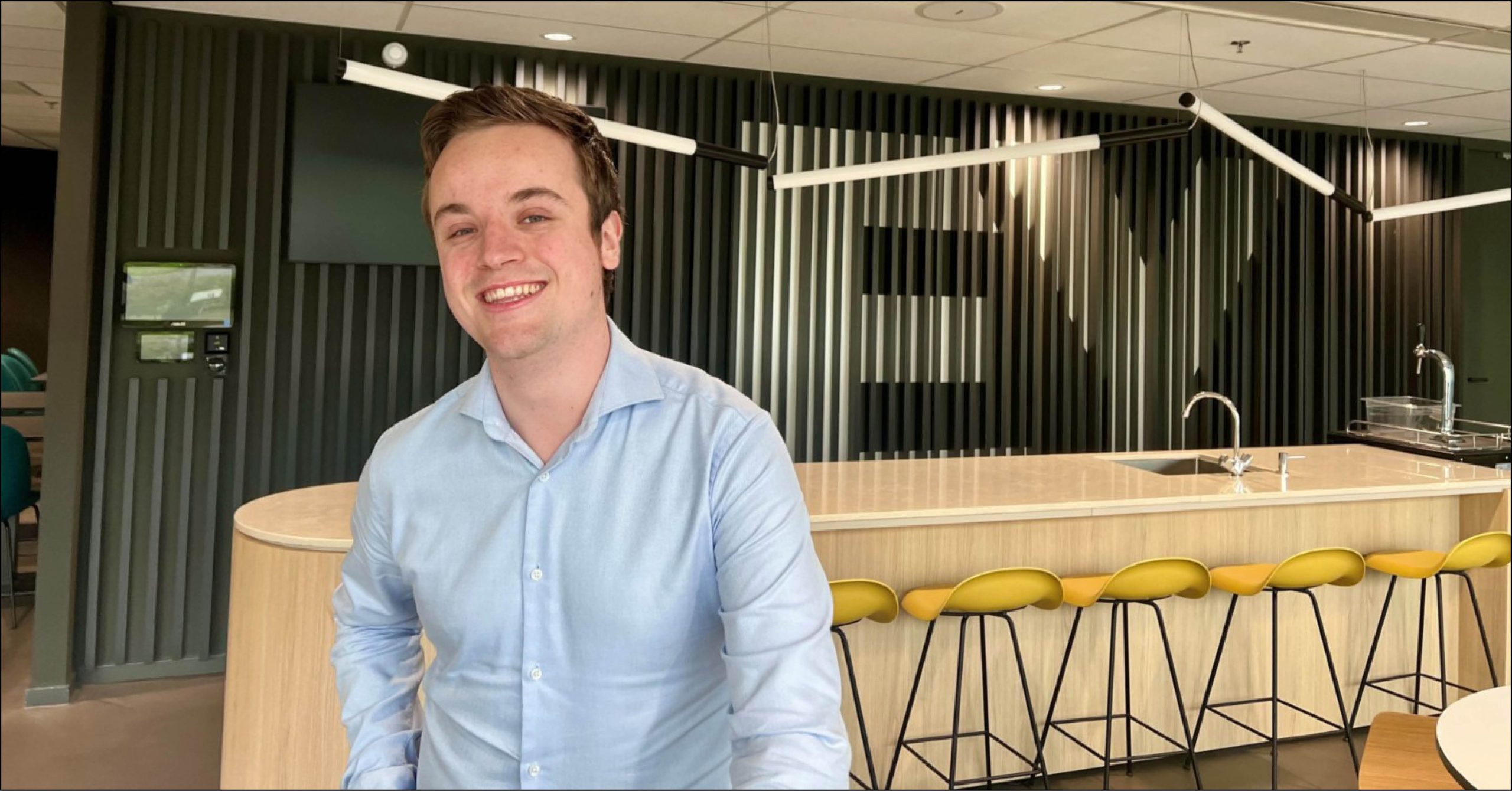
For the Dutch version, click here. Who are you and how did you end up at EY? I am Bas, 22 years old, originally from a small village in Limburg, but since the start of my student days I have been living in Tilburg. After finishing my Bachelor in International Business Administration (including an exchange to Melbourne, Australia), I started the Master Accountancy, which I completed last summer. During my Master I oriented myself considerably on the life that would follow after my studies and this led me to a thesis internship at EY Eindhoven last February. Why did you choose to combine writing your thesis with an internship? When I started my Master I felt the pressure of adult work life slowly approaching. At the time, I had doubts whether a future within Accountancy was really my ambition. My friends and fellow students advised me to get in touch with companies in order to find an internship. I took part in several events of the study association ‘Asset | Accounting & Finance’ and that’s also how I came into contact with EY. A thesis internship felt like a safe choice to get a better idea of what work life is like this way, but at the same time still have enough time for my studies. Did this give you an advantage over your fellow students? My internship definitely gave me an advantage over fellow students without an internship. I had time available every week for my thesis, since the days I spent writing it counted toward my thesis internship. This motivated me to actually work on my thesis. In addition, I was assigned a “buddy” and “mentor” at EY. My buddy helped me with daily tasks and general questions. This was very accessible because he had also completed a thesis internship not long ago. My mentor, on the other hand, had been with EY for some time. Therefore, he was able to give me good career perspective and advice, as well as substantive support for my thesis. Were you able to achieve your personal goals during your thesis internship? I quickly noticed that I could achieve the most if I took a proactive approach and clearly stated what exactly I wanted to get out of my internship. It was recommended to spend 2 weeks with a team, but flexibility in that was possible. In total, I interned for 5 to 6 weeks myself, because my main reason for a thesis internship was to experience what the real-world work was like. Before I started as an intern, I was hesitant about whether I would be able to do my work well because I had no practical experience within Accountancy. During these internship weeks, these doubts quickly disappeared. Due to a warm welcome from the team and good supervision, my learning curve was fast. I realized that it was perfectly normal that I did not know everything yet, and everyone was open to help me where necessary. Partly because of these weeks, I discovered that I found the work extremely interesting, which suddenly made me a lot more confident about a future in Accountancy. “In my opinion, the best way to orient yourself is through a (thesis) internship or work-study.” Why did you choose to stick with EY? In fact, I was so sure about my future in Accountancy that I started as a Staff Audit at EY Eindhoven last September! Like many students, I was in doubt for a long time whether I wanted to extend my student time or was ready for a job. Since I liked the work and the atmosphere in the office so much, I decided to take the plunge and start working. During my internship, regular activities were organized (e.g. lunches, drinks and training sessions), which allowed me to get to know more and more people within EY. The switch from student to working took some getting used to, but in the end I am very happy that I took this step. Moreover, I am currently still following the Post-Master Accountancy on Fridays, so I still feel a bit like a student. You mentioned that you have now started, how have the first months been? So far, the work has suited me well. During my internship period, the corona measures were stricter than now, which made it difficult for teams to go to clients together. For that reason, I find it extra nice that this is now possible again. Over the past few months I have been able to see and learn a lot. Every day I learn new things and I am definitely not finished with my personal and professional development. Moreover, through both my internship and the two-week starter induction in September, I have been able to build a good relationship with my ‘year layer’ of EY starters, whom I can now also call colleagues. I am surrounded by people who have also made the step from intern to employee, with similar experiences, and this is very nice. What else would you like to tell students? I hear many doubts from students: “Am I going to do Accountancy, or Finance, or something else altogether?” In my opinion, the best way to orient yourself is through a (thesis) internship or work-study. During this period you will find out what work involves and what it is like within a sector. One last tip from me: go to (Accountancy) events, talk to fellow students, or send a message to a campus recruiter. A (thesis) internship can really help you clear your doubts! If you have any questions, you can always send me a message on LinkedIn.
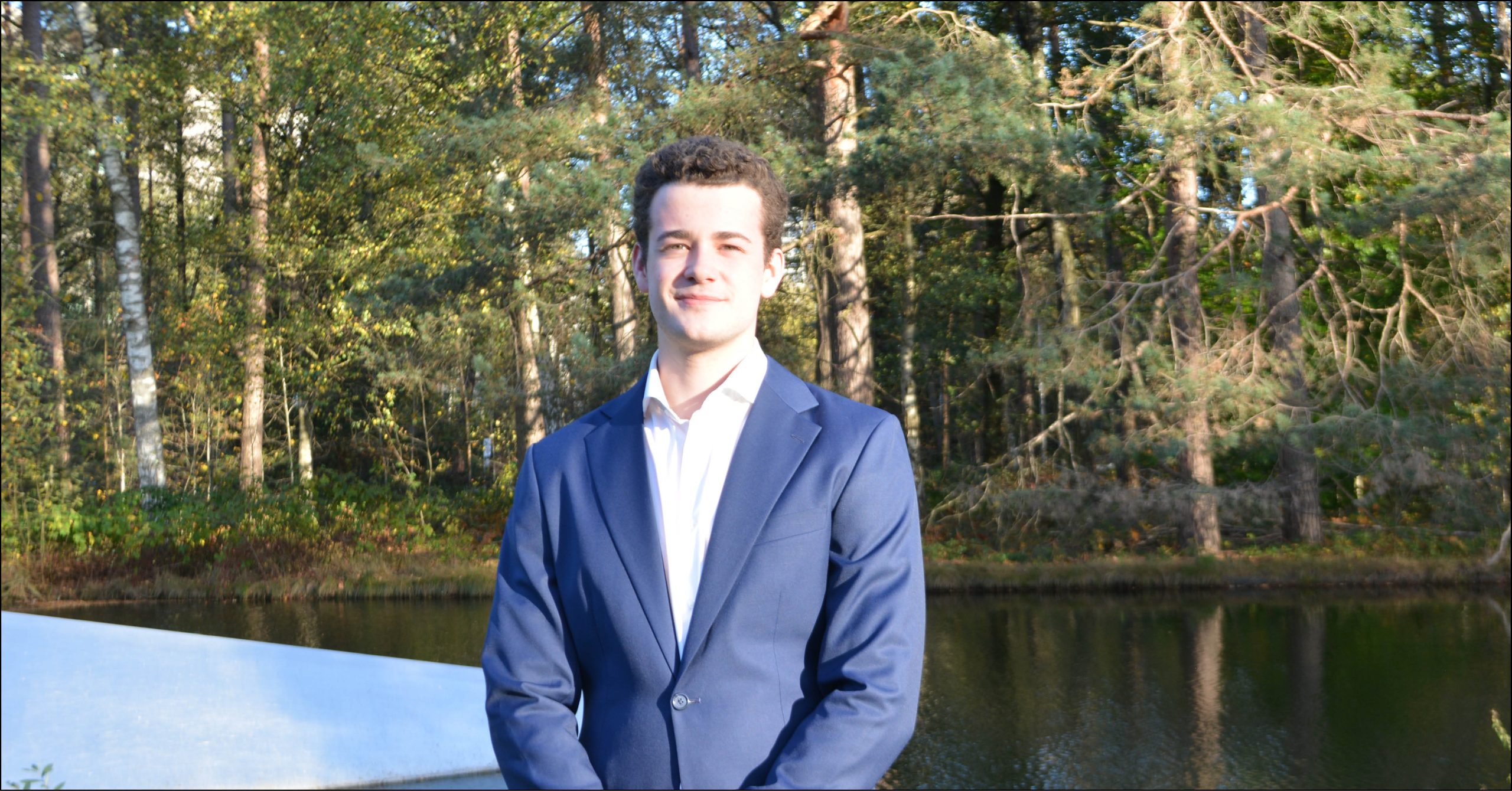
A board year as External Affairs of Asset | Accounting & Finance – Thomas Mols
For Dutch, click here. Who am I? I am Thomas Mols, 22 years old and from Tilburg. A year ago I became active at Asset | Accounting & Finance in my third year of the bachelor International Business Administration. After six months of doing committee work for the Finance Expedition, I became more familiar with A&F. I participated in almost every activity, getting to know a lot of people and making great memories. Besides studying and A&F, I spent my free time in the gym and mostly among other people. Why did I choose the function external? In the third year of my bachelor’s degree, the corona measures got lessened and I felt working life was already approaching. I had the urge to get more out of my college days so I joined A&F. By joining events often, I quickly got to know the association. I always ruled out a board year because I would have to take a break from studying. After a good conversation with some of the board members, I finally saw the value of a board year and decided to apply. What interested me most was the practical work a board member does. After several years of working in theoretical subjects only, I needed a change. In addition, I was unsure of which master’s degree I wanted to pursue, and I thought it would be useful to get a better idea of the possibilities offered by different masters during the year. The external affairs position specifically attracted me the most because you have contact with many companies and can get an inside look at everything. At the same time, I believed I could learn the most with this position. What does it deliver? The most important thing is that you are one board together. Within the board, everyone has a function with delineated responsibilities, so everyone looks at situations with their own perspective and gives their input from there. Decisions are often made together. During a board year you learn to work together very well. Not only within A&F, but also together with the other Asset departments as you will engage in consultation or discussion. You will learn how to identify interests, work and perform under pressure and how to present your opinion or strategy. In addition to the role within the board and within A&F, as external affairs you have a major role towards the outside world. You translate the wishes of companies into the opportunities the association can offer. How you want to position the association as a board is translated by the external to companies and students in the contact you have on a daily basis. So during the board year you learn to communicate in a changing context. By being in contact with so many people, both students and business people, you’re bound to build a huge network. A very useful extra for the future! What do I do as an external? As winter external affairs, you start up the Financial Business Dinner and Finance Expedition committees at the beginning of your year. You make sure the committee members know what their tasks are and guide them through the rest of the year in the work they do. In addition, you are responsible for all social media channels. This means you will help shape the policies that are written by the board during the summer. In the summer, you also help write this policy. In any case, with social media you focus on increasing the reach of the channels. During the year you will occasionally help organize other events and activities. These activities ensure the development you go through in collaborating and communicating. An important task that you perform at different times during the year is doing acquisition for collaborations with companies. The challenge in this is that you have different ways of entering into a conversation. The trick is to get a grip on the interests of the other party, to understand the context and to respond appropriately. As I mentioned earlier, you are also part of a board. You sometimes take over tasks from each other and jump in where necessary. In addition to managing your own department, you form “task forces” with other directors who take on tasks together. These range from organizing Master Experience Days to coming up with new Asset Member Card deals. In organizing events and the regular tasks you have, you don’t have unlimited time. Therefore, it is important that you prioritize and work efficiently. Because of the range of tasks you have, you will learn responsibility and develop time management skills. Conclusion All in all, a board year is a great opportunity to develop yourself and gradually make some amazing memories along the way. And to top it all off you get to help build the greatest study association that Tilburg has to offer!
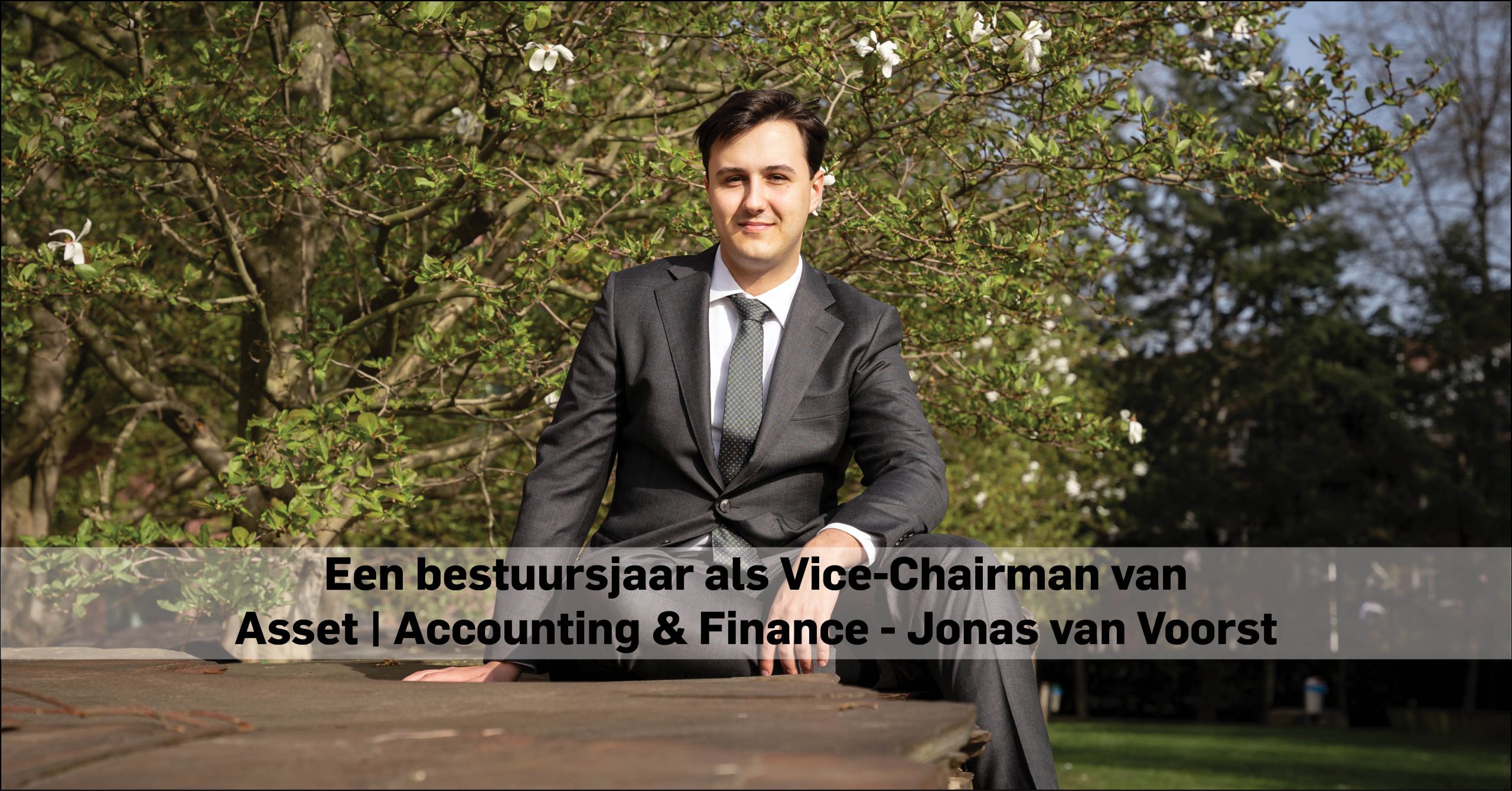
A board year as Vice-Chairman of Asset | Accounting & Finance – Jonas van Voorst
For the Dutch version, click here. Who am I? I am Jonas van Voorst, 21 years old and come from beautiful Den Bosch. In February 2020 I started living in my room and I really like it. I am now in the third year of the bachelor International Business Administration, and am taking a number of courses in preparation for the MSc. Economics. Before my board year, I was convinced to follow the Accountancy master, but since I started, I am more oriented and have gained a strong interest in Economics. Furthermore, I started within A&F with the Activities Committee a year ago, I really enjoyed it and therefore decided to do a board year. My choice to do a board year. The choice for a year on the board was actually made pretty quickly. I was not very convinced about my choice to do a master’s degree yet, and because of corona my student life had been put on pause for a while, so I wanted to extend it. When Joep called me if I was interested in applying, I figured this was a good opportunity to discover where my interests lay, and thus extend my student life. Furthermore, I noticed that I was very chaotic in my studies. A year on the board has given me a fixed rhythm and a much more organised way of working. For example, I have an agenda where I put my appointments and a notebook where I keep track of my tasks. Among other things, these are important soft skills that you develop during your board year. I also wanted to develop myself socially, for this reason I also joined A&F. As a board member, I work with 6 people every day, and you speak to a lot of people within A&F and Asset, so you learn to deal with many different types of people. In addition, my resume was very empty, and I thought a board year was a very good way to change that. Of course I also do it for fun, besides the tasks I have, I regularly do fun things with my board in the rooms or at someone’s house, because of this I have a good bond that will continue after my board year. I also attend almost every party, and have regular get-togethers with other boards, through which I have also made many friends! What a Vice-Chairman does all day long The to-do list of a Vice-Chairman is very vague, which is why I often get asked by friends if I do anything all day besides being hungover and playing a game of Mario Kart. As Vice-Chairman, I am responsible for several things. Since I’m in the rooms almost all day, I have a good sense of what’s going on, and here I occasionally talk about it with the chairman, Luc. I also take over the chairman’s duties when he is not here. I also still have my own duties. I am responsible for the internal policy of A&F. This includes filling the committees, informal promotion and I am also responsible for the active and passive members. I arrange the study support in the form of guidelines, CoEE and various trainings. Furthermore, I organise the introduction activities for the Master of Accountancy and Finance, board trainings, the Citytrip Replacement Activity and the Audit Activity together with our secretary, Lars van Maris. Finally, within A&F I also make sure that the website is up to date. Think of events, news, partner pages. This is another side to being informal so I find that a very nice change. Within Asset Tilburg, I also have plenty of duties. I sit on four Asset bodies: the Public Relations meeting, the Webmaster meeting, the BE cluster and the Study Support meeting. The Public Relations meeting is a weekly meeting with the Vice-Chairmans of each department. Together we organise, among other things, all informal activities from Asset Tilburg. Think of the Kick-Off party or the Pre-Carnival party. We are also responsible for most of the promotion of Asset Tilburg. I am responsible for the budget of the promotion and activities. I also attend the Webmaster meeting with every Asset board member who manages the website of his/her own department. Together we manage the website of Asset Tilburg, we are also busy redesigning the site. I also join the BE cluster every Thursday. Together with S&L, SBIT and Marketing we are responsible for the committees and activities for first- and second-year Business Economics students. I coordinate two committees: the Date Dinner Committee and the Accounting Insight Committee. Starting next year, the Vice-Chairman is also going to coordinate the Citytrip Committee, but unfortunately it will not happen this year. What is the most enjoyable aspect of the Vice-Chairman position? I really like different aspects of the Vice-Chairman position. When I applied, I knew that the Vice-Chairman position appealed to me by far the most of the positions. I regularly saw what my predecessor, Joep, was doing and this excited me. What I like most is that through the conversations with active members you get a picture of each member, and for the active members you are also a point of contact, so at activities you are quickly addressed and you quickly get to know everyone. This contact is not only a lot of fun, but also educational because you get to interact with different types of people Would I recommend a board year? I would definitely recommend a board year! It is a great consideration, so don’t be afraid to talk to a current board member. This can be very helpful if you run into something or want a new insight. Ultimately, a board year is an investment in yourself that you are going to benefit from for a long time to come through your development and connections, and beyond that you are going to be able to look back on this with a lot of joy!
Working at Deloitte
About me I am Joost van Kommer and I have been working at Deloitte since September 2019. At the time, I started as a working student at the end of my bachelor. I am currently 24 years old and live in Tilburg. I followed the bachelor Business Economics and master Accountancy at the university. Currently, I am following the post-master Accountancy to Chartered Accountant at Tilburg University. My introduction to Deloitte I first came into contact with Deloitte during the Economic Business Weeks Tilburg. Here, a day was organized to get acquainted with all Big 4 firms. During this day I had the opportunity to talk to all offices and get an idea of the work and the mutual atmosphere. A golf workshop was followed by a drink where I quickly ended up at a table at Deloitte. There were colleagues from different cities present so it was also possible to get an idea of the various offices. It turned out to be a very successful event, which immediately gave me a good feeling about the people of Deloitte. This feeling was mutual, because after the party I was invited to visit the Eindhoven office. The click with the other colleagues was also good, so my choice for Deloitte was quickly made! My experiences at Deloitte Since September 2019, I have been working at Deloitte as a working student and thesis intern, among other things. As a working student, you get the chance to work as a full team member on an audit. The team gives you a lot of room for guidance and your own development. My very first client turned out to be a first year audit, which can rightly be called a ‘baptism of fire’. I experienced it as very instructive to learn how an audit is planned from the very beginning. The work-study position offered a great opportunity to get a taste of the work and to get to know colleagues in my teams. This made me feel completely at home in the department during my thesis internship. During the writing of my thesis, I also had the opportunity to work for different clients. The focus during this period is also on getting to know the many colleagues and discovering the opportunities that Deloitte offers. “At Deloitte, there is room to spend part of your time on social projects”. At any point in your career at Deloitte, you are fully included in the group. As a working student I went on a skiing trip to Austria and during my thesis internship I was taken to the Private Day at the Efteling amusement park. Next week a festival will be organized at Thuishaven and on behalf of the Eindhoven office we will participate in an international indoor football tournament in Prague. Enough opportunities to relax! A lot is possible within Deloitte. During your introduction program you will be made aware of all the initiatives within the organization. For example, there is room to spend part of your time on social projects (Deloitte Impact Foundation) and there are sports programs and apps available where you can even save for free goodies! Deloitte is a large organization and you can really notice that. Besides the drinks and parties there are also a lot of opportunities at work. You can indicate to your coach which clients you prefer. Would you like to take a look at a listed company? Or would you like to see a client in a certain sector? There is always more possible than you think! Even if you want to develop yourself outside of audit, there is room for this. You can take on a role where you specialize in, for example, IT, data analysis, sustainability or culture so you can help your colleagues with these topics in their work. There is a lot of knowledge and expertise available at Deloitte that you can always call upon! What I want to give to students As an accountant, the nature of the work will not easily differ between the various offices. Therefore it is mainly good to get an idea of the atmosphere at an office. Do you already know someone who is doing an internship or works at an office? Ask if you can join them or drop by the office! Often career events are organized in which the big accounting firms participate. It is always a good idea to make use of these events as they also give you the opportunity to get to know each other in a more informal setting. Often recruiters or colleagues will be able to tell you a lot of great stories that you might not see on LinkedIn or their own website. Make sure you use these moments! Also take a look at the LinkedIn feeds of the offices to see what they are doing. You can get a good idea of how they respond to social issues or new laws and regulations. This can also help you to see if the organization suits you! Deloitte is an incredibly nice employer that I will recommend to every graduate accountant. Are you excited too? Or would you like to get acquainted to see what Deloitte has to offer? Don’t hesitate to send me a message via LinkedIn (https://www.linkedin.com/in/joost-van-kommer/) or to contact our recruiter Emily Ng (+31 6 36425847).
Working at Bol Adviseurs
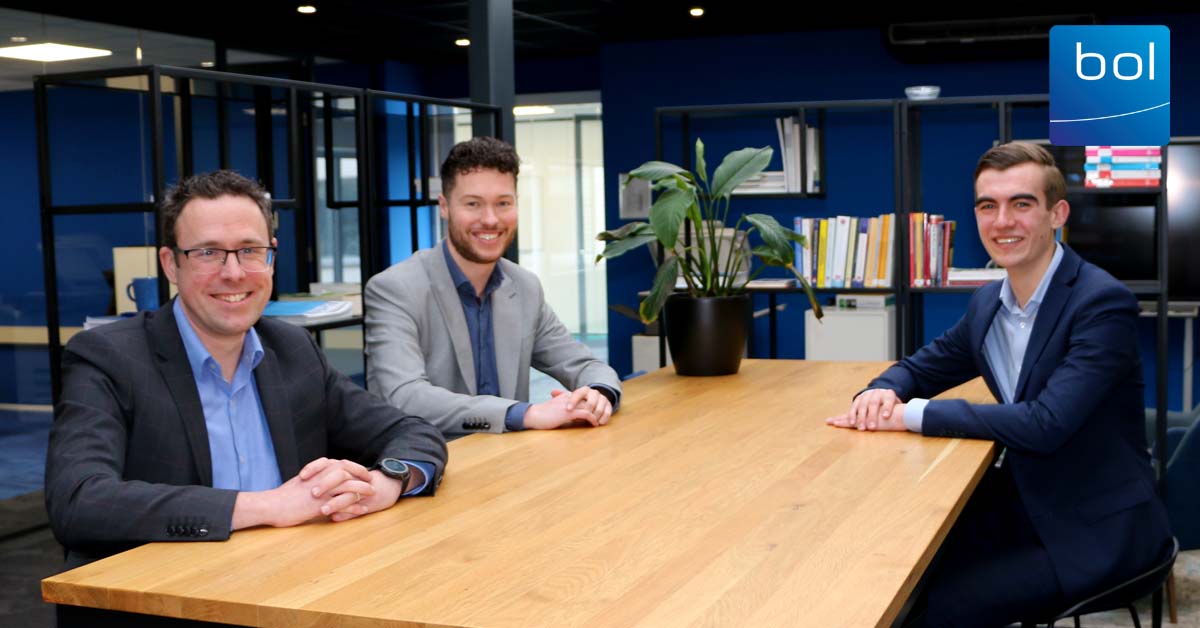
“At Bol Advisors, you determine your own development path.” The world of Assurance is fascinating. At least, that’s the conclusion we draw after talking to three specialists from Bol Advisors. Where does their passion come from? They mainly want to make a difference. Through control, guidance, advice and the use of the latest IT tools, they assist entrepreneurs. The Assurance profession has many faces, as we find out when we talk to Thijs Peeters (IT auditor), Daan Reijnen (control manager) and Robin Vreeswijk (junior assistant accountant). We asked the three about their experiences, personal motivation and ambition. Daan, can you tell us something about your job? “In a nutshell: as an audit supervisor, I provide entrepreneurs with assurance about the figures included in their annual accounts. Think of checking the balance sheet and profit and loss account, the AO-IB, tax matters, sparring with the customer, you name it. In other words, it concerns company-wide audit activities. It is technical work, but very enjoyable. Why does that work appeal to you so much? “Because you make a scan of an entire company, as it were. With your findings, the client closes the financial year, but much more importantly, you create a glimpse of the future. To do that, you have to know your client, with all its processes and systems. You also need to be able to assess risks. Based on all that, we determine the next step.” Thijs, you are active as an IT auditor. What does that entail? “We see that business processes are increasingly digitized. Where you used to take a folder of invoices out of the cabinet and check whether they were signed, nowadays you dive into the systems. It is my job to assess whether these digital processes are correct, have been set up properly and lead to the right output.” Can you give an example of that? “I don’t necessarily look at the accuracy of the figures themselves; I am much more concerned with the digital processes behind the figures. I open the bonnet, as it were, and investigate. Which IT systems are being used? Who has which user rights? Are the authorisations applied correctly? In other words: I look into the digital black box of a company.” Why is that important? “Through our work, we help clients become more mature when it comes to managing IT risks. This has a lot of overlap with topics such as cyber security, which allows us to advise our clients in that area as well. This is important for the continuity and investment power of the company. Think, for example, of stakeholders such as banks or investors. Before they invest, they want to know for sure that the IT infrastructure has been set up properly and is operating effectively.” “Through our work, we help customers become more mature when it comes to managing IT risk.” Robin, you most recently joined Bol Advisors. What appeals to you? “I like the fact that I can develop in all directions. At secondary school, I was mainly interested in Management & Organisation and Economics; I like working with figures. At the same time, it is very interesting to see which digital route financial documents take. That means you go further than checking the output; you also explicitly look at what happened beforehand. Is that a field you aspire to? “Absolutely! I started out as an assistant accountant in the Assurance department, but I would definitely like a role as an IT auditor. I have also indicated that I do so; I get all the space to develop myself in this role. I’m already involved in various IT projects, which is super interesting.” To what extent are accountancy and IT auditing complementary? Thijs: “We undeniably need each other. Where the accountant provides assurance about annual accounts, the IT auditor does that in the field of the IT environment. What is the quality of the data? How does a company manage possible risks? How do they deal with things like password management or backup storage? You can imagine that all those things constantly influence each other.” Daan: “I always include the IT audits in the advisory meetings I have with the customer. That’s logical, because in order to make a good risk analysis, you also need to know how an organisation is structured in terms of IT.” Thijs, you have developed yourself into an IT auditor. Was there enough space to do so? “Before this, I worked for many years as a ‘traditional’ auditor. A few years ago I indicated that I wanted to discover the IT audit side and fortunately the company welcomed that. I have now been active as an IT auditor for four years and I am constantly given room to further develop myself.” Daan, do you see the same development opportunities? Certainly. If you want to develop yourself at Bol, there are plenty of opportunities; our company sees broadening knowledge as a benefit. And if the company doesn’t offer a course, there are almost always opportunities to take it elsewhere. Although I still enjoy auditing the annual accounts, I really enjoy taking the two-day IT course Thijs gives every year. You learn from it in terms of content, and you are confirmed in the knowledge that there are IT specialists you can call on if necessary. That helps me focus on my own work.” “If you want to develop at Bol Advisors, then there are more than enough opportunities.” Finally, why is your industry worth exploring? Robin: “The great thing about our profession is that you don’t look in the kitchen of one, but of several companies. As a result, you learn a lot about the companies themselves, but also about other companies in the same industry and from different industries. In addition, as accountants we fulfill a kind of gatekeeper role. We have a responsibility that others have to be able to rely on. I still find that playing field very interesting.” “The great thing about our profession
Working at EY
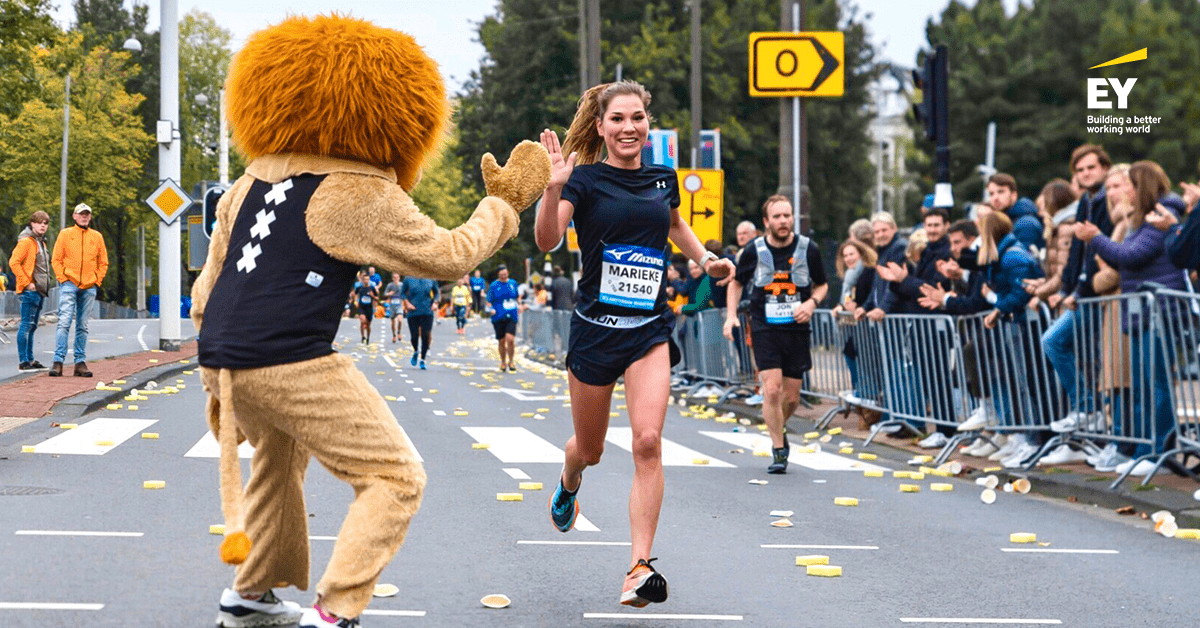
For the Dutch version, click here Vitality is a theme that is often put high on the agenda within large organizations, but where people do not always have a clear picture of the concept. EY is one such firm where, alongside Tech, Diversity & Inclusiveness and Corporate Responsibility, Vitality is referred to as one of the four main focus points and where personal career development is central. We talked to Marieke Brouwers to find out how this theme manifests itself in practice. Marieke Brouwers is Manager Audit at EY, but in November she also won the World Championship Duathlon! After 10 kilometers of running, 40 kilometers of cycling, and another 5 kilometers of running, she was not only the fastest of her age group but also the fastest overall. She traveled to Aviles (Spain) with the motto ‘participating in a World Championship is more important than winning’ and eventually took home the title of “World Champion”. Something that had not even occurred to her beforehand. Could you briefly share a bit about your career path and your current position within EY? In 2014 I completed my Master’s in Accountancy at Tilburg University and then started at EY Eindhoven in September. In the meantime, I have also obtained my Post-Master (RA) and I am a manager in the audit practice. During my first years, I served many different clients and gained experience in different sectors. In 2018 I worked in Tokyo for EY for six months, which was a hugely cool experience! Currently, I am working in the Amsterdam office where the biggest client in my client portfolio is one of the clients I served in Tokyo. How do you manage to combine this busy job with everything else you do besides work? One of the sayings I often make is “time, is priority”. I really enjoy exercising and find that it makes me a better person. If I didn’t prioritize sports, I’m sure it wouldn’t benefit my performance at work. Especially in busy moments, I find it very important and nice to clear my head by exercising. Despite having a busy job, in my opinion, there is no such thing as a large number of hours in the week that you can arrange yourself. There are colleagues who find it relaxing to then sleep in, “Netflix” or have a family that they invest a lot of time in but draw energy from. I live with my boyfriend, have a rich social life, and a busy job but I can arrange my own time in such a way that I do exactly the things that I need and get energy from. Sports is one of them. What does a day in your life look like? Actually, there is not really a standard day in my life. I train about 15 hours a week according to a schedule that I get from my coach. Each day is then indicated what I should do, which can vary from running to cycling to swimming or strength but also a combination of the aforementioned sports is quite possible. I always get this schedule on Thursday or Friday for the next week. However, I can indicate in advance if training on a particular day is not feasible because, for example, there are deadlines for work or client appointments outside the door. Also for work, I know what needs to be done each week. Based on this, I plan my week on Friday with a combination of work and sports. Of course, this is not set in stone but it gives me peace of mind that I basically don’t have to think about it anymore. “Within an organization like EY everything is possible, as long as you communicate clearly about it and indicate what you need.” Today, for example, I was at the gym at 7, was showered, and sat behind the laptop at 8:30. I will go for an hour run as soon as it gets dark and have to answer some emails after dinner. Tomorrow I go to the office and there is a 2-hour bike ride scheduled as training. So then I’ll try to get to the office nice and early so I’m not home too late to eat, let that sink in, and then get on the Tacx (indoor bike) to do my workout. What does the theme of ‘vitality in the workplace’ mean to you? In my opinion, vitality in the workplace is the right balance between work and other things that are important to you. Personally, I get a lot of energy from my work, but if I only worked that would no longer be the case. The balance you need between work and home is, in my opinion, important to be a happy person. Only when you are happy and pleased with yourself can you get the best out of yourself and others. So when my colleagues have found this right balance they can get the best out of themselves and other teammates and deliver the energy at work that they deserve. In my eyes you are then “vital” or “fit for the job”. For me personally, that is clearly sport and my social life, but there is no right or wrong here. Vitality in my eyes is therefore not directly related to sport. Why do you think this theme is so important? This theme is especially important in order to realize that more is not always better. Many people have the impression that the Big-4 firms are all about working long hours, but that is not the case at all. I also try to communicate clearly to my teams that balance is very important. For example, I would rather have a staff or senior indicate that he needs to do something for himself and is productive for 8 hours and recharges himself than work 10 hours but is only productive for 6. When someone is comfortable in their own skin they can function better which improves quality. It
