



Trang Tran Assurance Financial Services – Digital Accelerator For the Dutch version, click here. What exactly do you do at PwC? Besides being an accountant in the Financial Services Business Unit, I am also a Digital Accelerator where I help innovate and digitize the Assurance practice. What does your working day look like? In the morning I start up with the Digital Associates where we discuss the status of the projects and brainstorm where necessary on how we are going to build the digital solutions. We do this by drawing everything out on a jam board and constantly adjusting where necessary. Then the Associates get to work and I have meetings with audit teams to see where I can support them in terms of automating work. I then write out a digital approach per digital solution and guide the Digital Associates with building the digital solutions. When the Digital Associates are done building, I review the digital solutions to ensure we are meeting quality standards and audit guidelines where necessary. Then I schedule meetings with the audit team to hand over the digital solution. There are also major projects in between that I am also involved in. In addition to coming up with new tools that can help the practice, I also help roll out existing tools throughout the practice. And, of course, I also do regular audit work. Depending on the period we are in, I also spend several hours a day on audit work. During busy season then I do work on audits the whole period. Trang Tran | Senior Associate | Digital Accelerator What do you like about your work? That I can let my creative juices flow and that the possibilities are endless. And all within a field where everything seems so rigid. As a Digital Accelerator you are completely let loose within your own audit practice to rethink everything and see how we as accountants can do things differently and thus save time and at the same time increase quality and deliver more added value to the client and society. Tell us something about the Digital Accelerator program. What opportunities do you get here? And how do you apply these in your daily work? After an intensive but fun training where you learn technical skills such as basic coding and data analysis and visualization, you will help the audit teams to digitize. During your training you will also receive soft skills training where you will learn how to ”sell” change and the importance of being agile. These soft skills are very important if you want to bring about change within an audit firm. At my own clients, I try to automate all manual and repetitive work by deploying software that enables automation or by building robots, for example. This leaves more time for the really interesting topics such as fraud, continuity, estimating items and other topics that you as an accountant also want to spend your time on. What role do you think innovation/new technology plays within accountancy? Accountancy is changing and it is only a matter of time before much of our work is fully automated. This does not mean that we as accountants are no longer needed but this means that we as accountants are going to need a different skill-set and add value in a different way. Because of the amount of data that our clients have available today, we as accountants will have to learn how to analyze the data and how we can thereby replace our traditional auditing work by, for example, performing integral data analysis and zooming in on the outliers. This also means that we as accountants will only add more value in the future because by building smart algorithms into our data analyses, for example, we can detect fraud faster and through predictive analytics we can serve clients better. In addition, I also believe that we will move more towards continuous auditing which will allow accountants to actually add value at any time of the day and not just after the financial year. And perhaps soon we will all work on the blockchain and we as accountants will no longer validate the transactions but the blockchain itself. What role do you think innovation/new technology plays within PwC? Innovation is very high on the agenda at PwC and PwC invests a lot in upskilling its people. PwC also invests an awful lot in developing new tooling and making existing tools available. Often people think that innovation is not possible at a Big 4, but precisely because PwC is not a startup and there are sufficient resources available, we can innovate and make the impossible, possible.- Tell us something about your development/coaching/mentoring The way I develop myself is by making mistakes. The skills I need to build digital solutions, I teach myself by just doing it and gradually learning from my mistakes. And the moment I don’t know where to start or if I get stuck then google is my best friend. Google, Youtube tutorials, forums and asking others to think with me. These are the ways to learn the fastest. However, PwC does have enough training courses so that you have at least the basic skills. These are online courses through Udacity and internal courses where you are adequately guided in developing these new skills. “I can let my creative juices flow and the possibilities are endless.” What would you like to say to your future colleagues? We are the future and we are ultimately going to make a difference for generations to come. The world is changing, our clients are changing, and therefore we as a profession need to change as well. The technological revolution is happening right now at this very moment and that’s why it’s just incredibly cool to become part of this change right now.
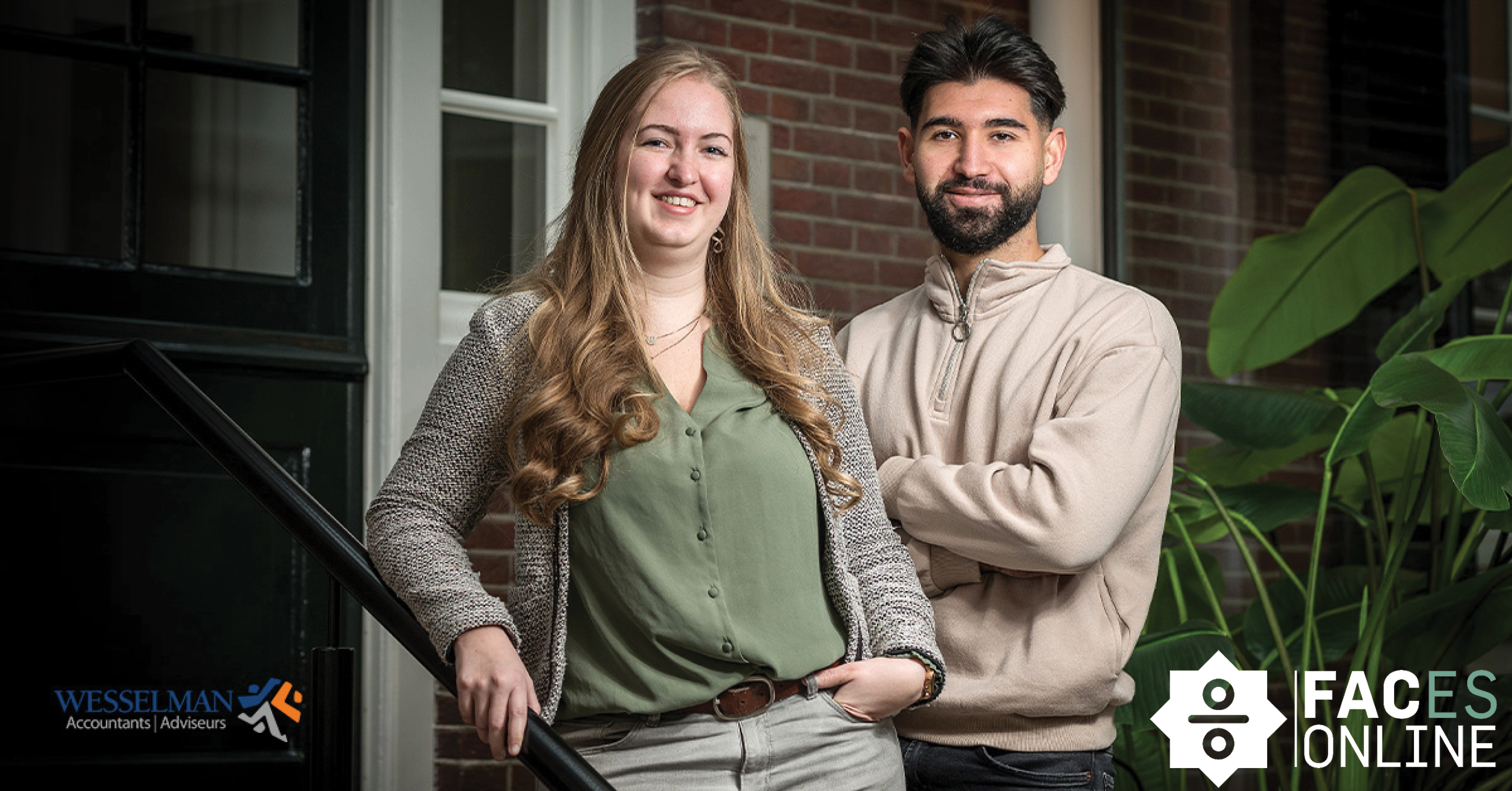
Working at Wesselman
For the Dutch version, click here. “You get every opportunity to pursue your dreams.” Mithat Yucel combines his role as Assistant Accountant at Wesselman Accountants | Advisors with a Master’s degree in Accountancy & Controlling at Maastricht University. “A tough study, but Wesselman takes this into account – even during busy periods,” he says. Lotte Elsenaar sits down at ‘De Berk,’ one of the stately meeting rooms of the monumental building on the Aarle-Rixtelseweg in Helmond. She decided, after studying Tax Law & Economics, she also wanted to obtain her RA title. “That decision didn’t happen overnight,” she explains candidly. “A study requires a lot of time and energy, and I wanted to combine it with my job as an Assistant Accountant.” Essentially different According to the duo, this is what sets Wesselman apart from other firms. “At Wesselman, you are listened to as a person. You get every opportunity to pursue your dreams,” Mithat answers. Lotte and Mithat also appreciate the small gestures from Wesselman. “Just a little present, a gift with your birthday or a bunch of flowers when you buy a new house. Happiness is in small things,” adds Lotte. “We have lunch together with our colleagues every Thursday. Very nice to be able to catch up,” says Mithat. “Definitely! These lunches are always super well taken care of,” Lotte adds to him. “Every week it’s a treat! We have – apart from this weekly lunch – a control lunch with the team once every two months; all personal and business highlights and successes are discussed and celebrated then!” Making big steps Lotte and Mithat talk about GROW conversations, which focus on personal development. Together with your manager, you look back on the past period and determine your learning goals for the coming period. “You get to determine your own path,” says Mithat. Goals and expectations are also mapped out during the pre-audit meetings. Everyone gets to indicate his or her development points. “I have learned a lot with regard to mentoring juniors,” adds Lotte. “My supervisor gives me regular feedback. That feedback allows you to develop further.” Never the same Every client is different; there are different risks involved everywhere. “That’s what makes it so much fun,” Mithat explains enthusiastically. “I pick up certain posts, chart developments and work through to-do’s.” The basics are good. “We start the day with the team,” Lotte explains. “Very nice, because that way everyone knows what’s going on. Sometimes you work in the office, other times on location. A nice variety and the perfect opportunity to discuss important matters with the client. The role of Assistant Accountant is very diverse!” Wise counsel Still, there is one thing the pair would like to give students. “Make careful considerations,” Lotte replies. “Look carefully at which firm suits you and don’t underestimate the pressure – of working as well as studying.” Mithat nods in agreement. “In addition, it is also important to look into the educational possibilities. I study in Maastricht because for me that was a finer and especially more practical choice than Nyenrode. There is no right or wrong and you should mainly do what feels right for you.” Would you also like to work at Wesselman? Then contact Milou Kutscha at hrm@wesselman-info.nl or 0492-54 85 55. Who knows, maybe we’ll have a cup of coffee together soon.
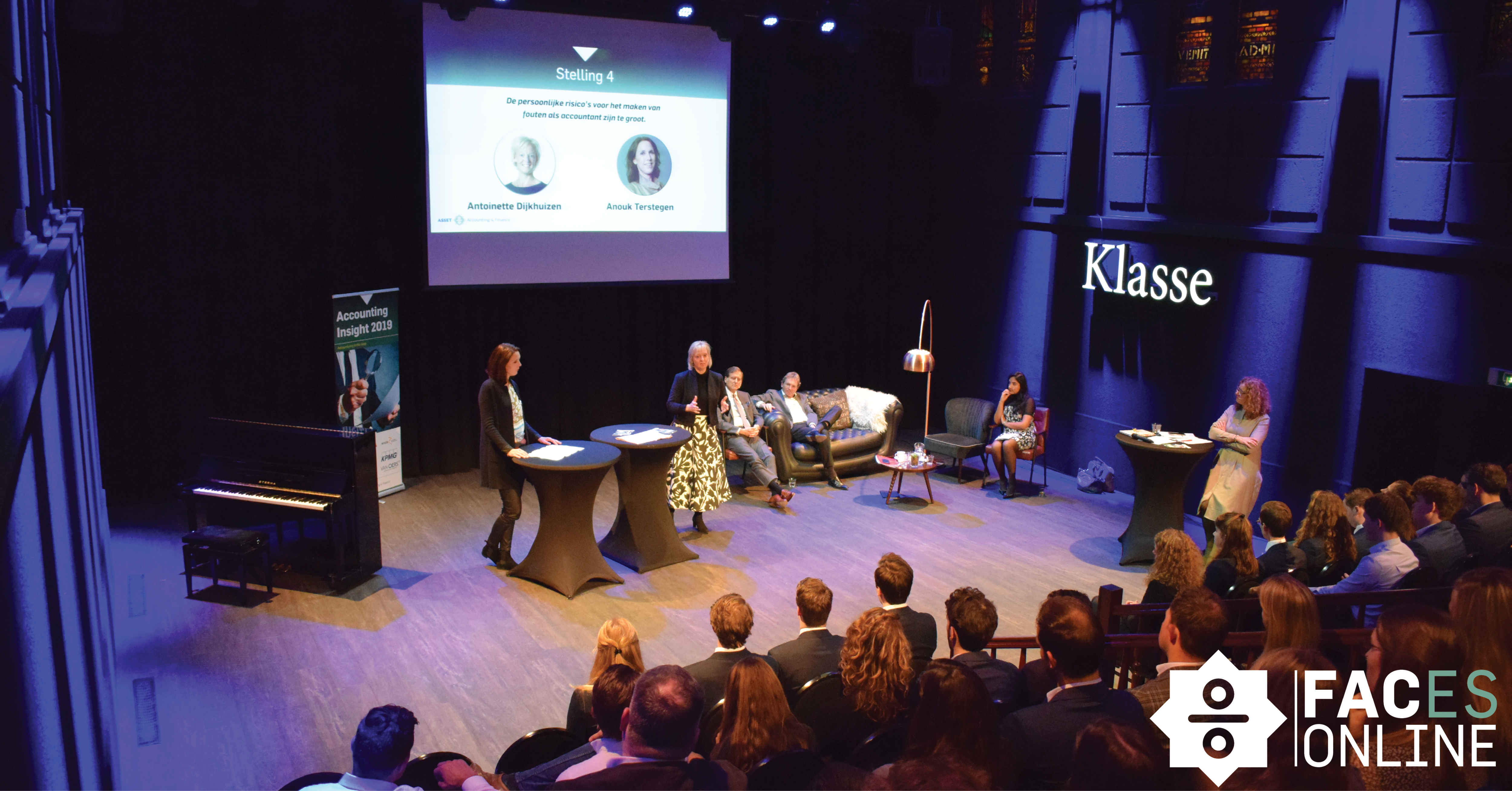
Accounting Insight 2022: Looking back
For the Dutch version, click here. On Wednesday, November 30, we were once again able to join the Class Theatre for the twenty-first edition of Accounting Insight. Starting at seven in the evening, the doors opened for guests. The guests, whether students, working professionals or professors, were able to meet here while enjoying a cup of coffee, tea or a soft drink. The themes of this evening were: Fraud, Data Analysis and Sustainability. After last year’s edition unfortunately could not take place due to measures, the themes were moved on to this year. Under the motto: ”Improve today to advance tomorrow” we asked our speakers to explain from the different themes how we can improve accountancy now, so that we can advance in the future. This edition was also the first edition of Accounting Insight to be held entirely in English. Fraud After the guests had half an hour to chat, it was time to enter the auditorium. With nearly one hundred guests, the room was quite full. After a word of welcome from the chairman of the committee, Bas Penders, and the introduction by the chairman of the day, Margreeth Kloppenburg, it was time for the first proposition: ”Auditors are not equipped with a critical mindset to detect fraud.” This proposition was explained by two speakers, Marianne van Kimmenade of the NBA and Don Raaijmakers of the AFM. Marianne has thirty years of experience at EY, having also been a partner there. After her brief retirement, she became a policy advisor on fraud at the NBA. Don Raaijmakers himself worked for fourteen years at KPMG, then five years at EY, where he was a college graduate of Marianne. After this, he has been working at the AFM as a team leader for fifteen years. Don and Marianne together came to the conclusion that auditors are sufficiently trained to detect fraud, but that the critical eye of especially young auditors is not used enough when conducting an audit. Therefore, they would like to see auditors take a critical look, and not let their biases be a factor in conducting an audit. Data analysis The second topic of the evening was Data Analysis, with the proposition: ”For a future accountant, it is better to study physics as opposed to business economics.” For this thesis, Theo-Jan Renkema and Ferdy van Beest were the speakers. Theo-Jan Renkema has worked at Rabobank for 24 years, currently as Chief Innovation and Technology Auditor, and is also a professor at Tilburg University. Ferdy van Beest has been working at Nyenrode Business University for seventeen years, where he is currently Associate Professor. He also works at Flynth as Director of Data Propositions and Integrated Reporting. So two experts in the field of Data Analysis. Theo-Jan Renkema argued that auditing uses more and more data and its analysis, so that in the future he indeed sees mathematicians as auditors, instead of business economists. Ferdy responded that yes, data is being used more and more, but that the auditor is a bridge between the audit and the business, requiring the human touch that business economists have. Together, the speakers agreed that business economics still remains important within Audit, but that there is going to be more and more specialization, with a lot of help from mathematicians. After this substantive discussion it was time for and break, during which guests could discuss afterwards while enjoying drinks and snacks Sustainability After the break, it was time for the third and final topic of the evening, Sustainability. The thesis of this theme was, ”The Chief Financial Officer (CFO) of the future is the Chief Value Officer.” Under this theme, Nicolette Loonen and Ferdy van Beest discussed. Ferdy van Beest has already been introduced at the previous theme. Nicolette Loonen worked at KPMG for 15 years, after which she held all different jobs. She is a co-founder of Tribe of Sustainability Change Agents (TOSCA). The discussion began with Nicolette explaining that the CFO needs to change to the CVO, because there is a need to look more at the long term, and then also how to do business responsibly. Ferdy disagreed, because he thinks that the duties of a CFO are going to be different in the future, and this includes a long-term view. He doesn’t think the position should be renamed for this. In the end, the speakers agreed that the CFO should think about the long-term vision of a company, but the disagreement was mainly in the name of the position. Business Market After another great edition of Accounting Insight, the speakers and partners were thanked by the chairman of the committee, and the chairman of the day closed. After this the guests could have a drink at the company market, where KPMG, EY, PwC and ABAB had set up a stand, all our other partners were fortunately also present. While enjoying a beer, soda, and plenty of snacks, the participants were able to get to know each other, or their future employer, for a while. Also inspired by my story and would you like to be the person responsible for Accounting Insight 2023? Then quickly become an active member at Asset | Accounting & Finance. You can sign up via: Info@Asset-AccountingFinance.nl

How to build a career in Venture Capital
For the Dutch version, click here. The venture capital (VC) industry is an exciting and fast-growing field that provides individuals with the opportunity to make an impact in the business world, which can be highly rewarding if you’re willing to put in the work. If you’re looking to break into the VC industry, you’ll need to demonstrate a combination of skills and knowledge that can be developed through a variety of avenues. This article will provide a comprehensive guide on how to start your career in venture capital and the skills you need to succeed. 1. Develop Your Knowledge of the Industry The VC industry is a complex environment, and it’s important to have a detailed understanding of the industry before you jump into it. You will have to have a thorough understanding of how VC funds add value, how VC investments are structured, and the different stages of the venture capital cycle. Additionally, it’s important to understand the regulations and legalities of the venture capital industry, as you will need to know the boundaries you are required to operate in. In order to develop your understanding of the VC industry, you could best read industry publications and blogs by leading VC funds, attend conferences and seminars (for example from the NVP), and network with other professionals in the industry. 2. Develop Your Analytical Skills A major part of a venture capitalist’s job is to conduct due diligence and financial analysis on potential investments. First, it’s important to have the ability to assess a company from a financial perspective. Here, you have to be able to determine the valuation of the company with limited information, understand how the investment will create value in the future, and be able to evaluate whether the financial forecasts of the company make sense. Next to this, you also have to be able to analyze the market to understand how the company compares to its competition, how the market is segmented, and to be able to evaluate its product/service positioning. To develop your financial skillset, you should dive into some finance and accounting books and articles, take economics and financial analysis classes, and practice analysing financial statements. For market analysis skills, you’ll have to do the same things, read up on the topic, take classes, and practice. 3. Develop Your Network Having a strong network within the VC industry is essential to finding the best deals and staying abreast of the latest trends. Networking is in essence talking to people, but finding the right people is easy said than done, so here are a few tips: Attend networking events, join industry associations, connect with professionals on social media platforms like LinkedIn, and ask for introductions from people you already know. If you show a willingness to learn and a genuine interest in the people you reach out to, you’ll be amazed by their willingness to help you out. 4. Develop Your Negotiation Skills Venture capitalists need to be skilled in sales and negotiation to be successful. In the end, the valuation of a company and all other terms in the deal come down to the negotiations between the VC fund and the company. When it comes down to negotiations within venture capital, you need to know where the other party is coming from. While it may seem that a VC investment is purely financial, for the founders of the company that you are investing in, a lot of emotions are at play. It is therefore important to understand that venture capital is a people’s business, where building long-term relationships is essential. Being able to explain why certain terms are included in a deal and being able to defend your valuation of their fund without offending them is key to making a deal go smoothly. While you could develop these skills by practising presenting, you can only truly learn these skills through experience, which brings us to our last point. 5. Get Experience Gaining experience tops all other points in the VC industry. There are two ways you can go about this. The first one is the long way around, namely starting and becoming successful with your own company with VC backing. This will essentially give you a ticket into the VC industry as then you will already have almost all the skills needed, but this way is not for the people who want to go directly into the venture capital industry. If you want to immediately start in the VC industry, you can start by doing an internship at a venture capital fund, become part of a student VC fund or start working as an analyst at a venture capital firm. If you’re not able to start this way, you can also work for startups and get involved in the entrepreneurial community. By following these steps, you can lay the foundation for a successful career in venture capital. Developing a career in venture capital is no easy feat, but with hard work, dedication, and a willingness to take risks, it can be a rewarding and lucrative path. By gaining experience, building a strong network of contacts, staying educated on the industry, and staying up to date on industry news, you can set yourself up for success in the venture capital world. Good luck!
Working at HLB Witlox Van den Boomen – by Floortje Schroeder
For the Dutch version, click here. Started as a Junior Assistant Accountant at HLB Witlox Van den Boomen in 2016 and never left. How did I end up at HLB Witlox Van den Boomen and what is the reason I stayed after my internship? I am happy to tell you all about it in my story ‘Working At HLB Witlox Van den Boomen’. Who is Floortje Schroeder? First of all, let me introduce myself to you. My name is Floortje Schroeder and I am 25 years old. I was born in Tilburg but have been living in ‘s-Hertogenbosch for 13 years now. I remember very well that during high school I had a guest lecture by an accountant. This caught my attention so after high school I started the HBO course Business Economics/Accountancy at the Avans Hogeschool in ‘s-Hertogenbosch. I completed this course in 2018. I was born and raised in Tilburg, which is why I wanted to study in the city I come from. I then chose to take the pre-master’s degree in Accountancy at Tilburg University. After obtaining the pre-master’s I started the master’s in Accountancy and as of September 2020 I started the post-master’s in Accountancy at Tilburg University. I am now in the third and final year of the post-master Accountancy. My path to HLB Witlox Van den Boomen My path to HLB Witlox Van den Boomen started in 2016. In that year, I signed myself up for the practical route that was offered at Avans University of Applied Sciences at the time. The practice route is a route that gives students the opportunity to get acquainted with practice for 1.5 years. When participating in this practical route, students must choose an accounting firm where the choices included a Big4 firm and HLB Witlox Van den Boomen. My preference went to HLB Witlox Van den Boomen and my choice at the time was substantiated by the fact that I considered myself to fit better within a ‘smaller’ organization where the lines of communication are short, there are sufficient career opportunities, there is close (multidisciplinary) cooperation, an informal atmosphere and a client portfolio that is very diverse. The practical route brought me to HLB Witlox Van den Boomen in 2016 as a Junior Assistant Accountant where I could get acquainted with the practice for 1.5 years 4 days a week. Following the practical route at HLB Witlox Van den Boomen gave me the opportunity as a student to get an idea of how things work in practice and what activities an assistant accountant performs. Besides contributing to the expansion of my practical knowledge, this period has also contributed to my personal development and made it easier for me to make my choices regarding my follow-up studies. Practice versus theory I completed my HBO education in 2018 and after this I immediately started the pre-master and master Accountancy at Tilburg University. During this period, I returned to HLB Witlox Van den Boomen as an Audit work-study student. Because of my positive experiences during the practical work placement, I wanted to continue to expand my practical knowledge and also continue to develop myself during my studies at Tilburg University. As a work-study student you are part of the team just like all the other colleagues and you carry out activities that correspond to those of an assistant accountant. This work mainly involves performing audit assignments for various clients, where we gain insight into the client, processes and risks and, based on this, create our approach to the audit of the financial statements. The only difference between an assistant accountant and work-study student is that as a work-study student, you are likely to work fewer days. As a working student, you can decide how many days you want to work in addition to your studies and can reduce the number of days in busier periods and increase them in quieter periods. This gives you the opportunity to gain practical knowledge on a flexible basis, learn to apply the knowledge from school and go through personal development. After completing my master’s degree in Accountancy, I started working as an assistant accountant at HLB Witlox Van den Boomen. HLB Witlox Van den Boomen gave me the opportunity during both my HBO education and my master’s to gain practical experience and to develop myself personally. Because of this, my decision to start as an assistant accountant at HLB Witlox Van den Boomen was quickly made. Why did I never leave after my internship? Of course I thought about taking a look at another accounting firm. But working at HLB Witlox Van den Boomen gave me more and more feeling for the motto: ‘Never change a winning team’. I’ll explain why. Now that I have been working at HLB Witlox Van den Boomen for a number of years, I have come to realize that my considerations at the time of choosing an accounting organization for the practice route internship correspond with the practice. I was looking for a firm where the lines are short, there are sufficient opportunities for advancement, there is close (multidisciplinary) cooperation, an informal atmosphere and a client portfolio that is very diverse. My client portfolio is very diverse and ranges from Retail companies and manufacturing companies to property developers. This diversity ensures that I get to take a look behind the scenes at all types of companies. This keeps my work diverse and challenging. In addition, every year I have influence on my client portfolio because I can indicate which clients I like to work for the most! The advantage of working with our clients is that you often sit at the table with the entrepreneur himself and therefore the relevance of your work is immediately tangible. I work in Rosmalen and our audit department consists of about 30/35 colleagues. This ensures close cooperation on a daily basis, as well as sufficient room to take and receive responsibilities, and to grow and develop. Because of the close cooperation, there

Change within European cyber laws: the approaching NIS-2 regulation and accountants’ unawareness
For the Dutch version, click here. A survey by SDU, a software innovation partner for the business community, and Lupasafe, an organization of cyber experts who focus on the financial and insurance world and previously performed ethical hacks for Achmea and Rabobank, shows that 90% of accountants are unfamiliar with the approaching NIS-2 regulation and 84% even have insufficient knowledge about cybersecurity. However, with the approaching mandatory application for these new European directives as of 2024, it is worrying that only a small minority is aware of these European cyber laws. Despite the very minimal knowledge, it appears that the implementation of NIS-2 still matters. The reasoning of the decision to change the current NIS-1 regulation and what this NIS-2 regulation entails will be discussed in this article. AEDs and DSPs Before discussing the NIS-2 regulation further, and as the name suggests, currently the NIS-1 regulation has been in operation since 2016. At the time of its introduction, it was the first European legislation specifically aimed at increasing cybersecurity across Europe. Remarkably, the NIS-1 regulation was flexibly drafted to enable national lawmakers to apply their own interpretation, and therefore it served primarily as an overarching design to motivate countries to tighten their cybersecurity regulations or sometimes create their own. The NIS-1 regulation consists of the following three main categories: security requirements, notification requirements and information sharing. There is also a crucial distinction between AED (Providers of Essential Services) and DSP (Digital Service Providers), where unlike DSP, AEDs can be designated by national lawmakers. AEDs include companies that provide services critical to critical social entities and rely heavily on digital information systems such as energy providers. DSPs, on the other hand, are providers of digital services such as marketplace.com or the online search engine yahoo.com. To qualify as a DSP, however, the following two requirements are active, at least 50 employees and an annual turnover of 10 million euros. In the case of the Netherlands, the application of the NIS-1 regulation takes place through the WBNI (Wet Beveiliging Netwerk- en Informatiesystemen). Here, AEDs and DSPs must apply various adequate security measures and should an incident nevertheless occur, they are required to report it to the Computer Security Incident Response Team (CSIRT). New Rules However, a need has arisen within the European Parliament to extend the current NIS-1 regulation. The core reasoning behind this transition is the fact that cybercrime is growing tremendously in combination with increasing digitalization which means that smaller companies will also become more vulnerable to the threat of a possible cyber-attack in the future. Based on the World Economic Forum Global Risks Report 2020, cybercrime will even grow to become the second biggest risk for businesses within 10 years. To meet the new challenges, the NIS-1 regulation is being modified in five different aspects. First, significantly more sectors will be covered by the NIS-2 regulation that were previously considered too small to be at risk. Thus, medium-sized and large companies will be directly included in the NIS-2 regulation, and there is an option for individual member states to qualify smaller companies with a high security risk for the NIS-2 regulation as well. In addition, a mandatory minimum of basic security components will be introduced and the two different categories (AEDs and DSPs) will be abolished. Instead, there will be a qualification list where individual companies will be ranked according to their importance, resulting in different regimes being applied for each level. In addition, individual companies will also be expected to review their supply chains and supplier relationships and identify and address any security risks. And finally, the NIS-2 regulation will differ from NIS-1 since it will allow national authorities to impose stricter supervisory measures on companies. Conclusion Thus, the current NIS-1 regulation will be significantly broadened and strengthened. Especially the extension of the NIS-2 regulation compared to the NIS-1 regulation, among others accountants, will have to deal with this considerably more. And if a company is still not eligible for the NIS-2 regulation, there is a good chance it will be covered in the near future in the form of an NIS-3 regulation. With the increasing digitalization and associated cybercrime, it seems a matter of time until almost every company will have to deal with such a regulation, and the importance to delve into cyber security will only grow in the future.
