

The Accounting Expedition: A two day event during which students will visit four different accounting firms in the Netherlands
Controlling – Accounting’s long lost brother
For the Dutch version, click here For the accountancy students among us, it’s a familiar ritual by now; as soon as the future comes up, the majority of students hear the all-too-familiar song: first, complete the master’s program Accountancy, then start the postmaster CPA while at the same time, starting to work for example at Deloitte, EY, KPMG or PwC. There is, of course, nothing wrong with this road. After all, the CPA title is very valuable and as long as people have not been replaced by technology, we will also need enough inflow into the audit practice, and the financial sector in general. In addition, working in auditing can also be fun, provided that this is where your interests lie. The demand for the CPA title is therefore growing every year. However, the ever-growing demand for CPA students also has a downside: when people talk about accountancy these days, we only think about Chartered Accountants. However, there is another branch within accountancy; Controlling. What exactly does a controller do? Generally, a controller assists the board or management in understanding and maintaining the financial affairs of a company. The controller oversees a company’s finance department and often leads this team as well. The controller also deals with financial planning and reporting for the benefit of management. Simply put, a controller is concerned with the quality of the entire financial process and ensures that the results and planning are optimally communicated to management, in order to support decision-making. For a career as a controller, you generally don’t need additional training like a CPA. However, these courses do exist. The executive master: Register Controller (RC). If you complete this program, you will be listed in the NBA register, just like a CPA, as an additional quality stamp on your resume. Why RC or CPA? The big question now, of course, is why anyone should choose RC or CPA. One is no better than the other. Both have extensive knowledge of financial data, and both are post-master educated. So the difference does not lie in the level of education. In my opinion, it will mostly be where your interests lie. Of course, your interests lie in finance, otherwise, you wouldn’t even think about throwing yourself into the world of financials. The big difference is whether you like to evaluate a company internally or externally. As a controller, internally you will be mostly concerned with the processes within the finance department and steering for growth and results. As an accountant in the audit practice, you will mainly focus on the correctness of the external reporting and compliance with laws and regulations. The question is therefore what you yourself find most interesting. It’s worth noting that there is a trend where we see a lot of chartered accountants choosing to switch to a controlling position in the business world after a number of years in the audit field. For example, many controllers and CFOs at large Dutch companies used to be CPAs. Think of the CFOs of Adyen, ASML, and Unilever. For those students who already know that they have the ambition to eventually hold a position as CFO: there is also another path than becoming a CPA. The road to RC is about as long, but if we are to believe the universities, you are slightly better prepared for the position you will eventually hold. Boxes The advice I would like to give current and future Accountancy students: do not immediately put yourself into the box of the chartered accountant. Of course, it’s a good profession with good prospects, but there are many other interesting jobs that are just as well suited to financial education. In my opinion, that is also the beauty of training in financial disciplines; at the basis, we all understand financial matters, and eventually, you can end up in plenty of amazing places. Even without a CPA title, you have a degree in your pocket that guarantees your ability to critically think in a certain field. And that piece of paper will get you there.
Interview with the NBA
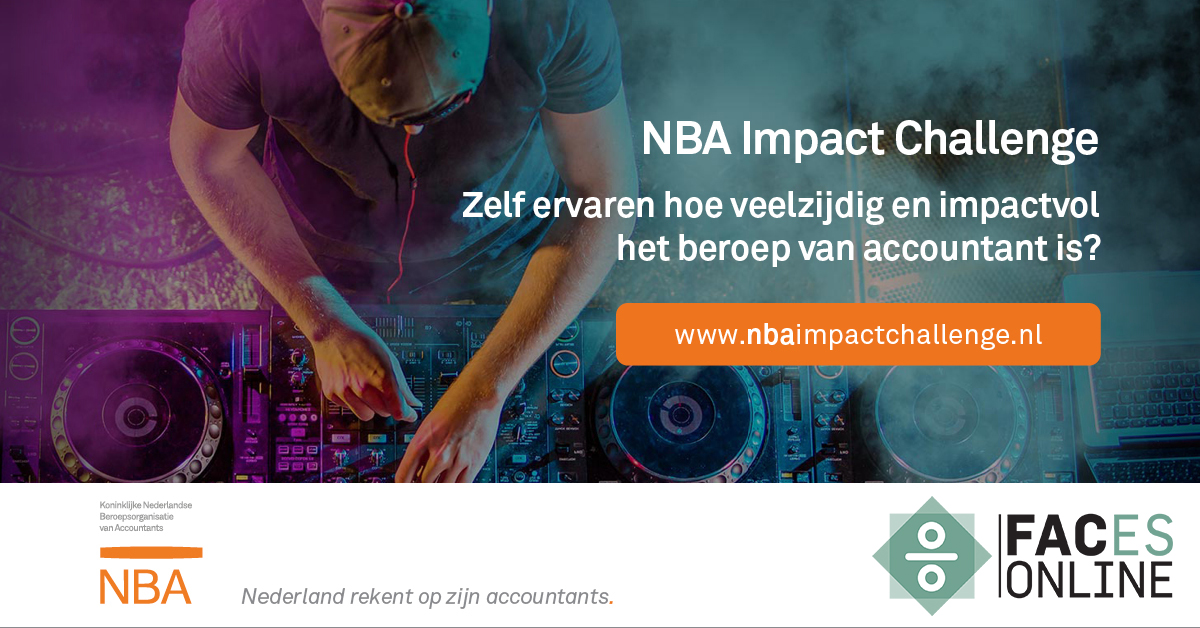
For the Dutch version, click here Krenar Berisha is a self-employed auditor and an ambassador of the NBA. In this interview, Krenar tells us about his experiences in the audit practice and how important the NBA is for auditors. Can you tell us something about yourself? I am Krenar Berisha, born and raised in the most beautiful town of Noord-Brabant: Tilburg. Despite the fact that many (former) colleagues have tried to convince me that there are more beautiful cities in Brabant (especially colleagues who live in Breda), they haven’t been able to convince me. I started my student career at VMBO, then moved on to HAVO, and finally started HBO Accountancy at Avans University of Applied Sciences in Breda. In my final year of study and during my orientation phase, I came in contact with Baker Tilly in Breda through a (former) fellow student. Because of the positive stories about Baker Tilly, I became enthusiastic and started working there at the end of 2016. At the same time, I started the pre-master Accountancy at Nyenrode. After my first year at Baker Tilly, I decided to make the switch to KPMG. KPMG, a so-called big four office, is active in the highest segment of the market, which offers a lot of challenges. This challenge finally made me decide to make the switch. In addition to the challenges that an office such as KPMG offers, I also found the personal guidance very pleasant. In your early years, you will receive intensive guidance so that you get to know the profession well. In addition to my job and studies, I have also carried outside activities in recent years and I have been an ambassador for the NBA since 2019. After a few years at KPMG, I decided to start working as a self-employed person. Entrepreneurship has always been my ambition. This eventually made me decide to continue as a self-employed person. I also had the ambition to start working as a teacher. Since last summer I have been a teacher at the Fontys University of Applied Sciences in Eindhoven. I do this in combination with my current work at the municipality of Roosendaal and GR de Bevelanden. Many vacancies in our sector nowadays require extracurricular activities such as a board year, did you do something like this besides your studies? No. I did not perform any relevant curricular activities during my studies. A tip I can give here is: start setting up a network. A study association such as Asset can be of great value here. You can build up a network, which you can benefit from during your career. A tip I would like to give you is to use LinkedIn. This is a social media platform to maintain your business contacts/network. You just told me that you are an ambassador of the NBA, can you tell me something about the NBA? The NBA is the Dutch Professional Organization of Auditors. There are currently more than 22,000 chartered accountants in the Netherlands. These are both Auditors (RA) and Accountant-administration consultants (AA). They are all registered in the register of the NBA. This organization promotes the professional practice of the accountant. They do this by, among other things, drawing up rules of conduct, testing the accountants’ knowledge, and providing education. At the end of the practical training, there is a final exam in which the ability to act as a novice professional is tested. However, before you can complete the practical training to become an auditor, you first need to complete your theoretical training as a Chartered Accountant. With our ambassadorship, we try to make the profession attractive for students of higher vocational education (HAVO/VWO) and students of higher vocational education (HBO/WO) in their first or second year. We try to introduce students to the accountancy profession at an early age. As ambassadors of the NBA, I have given guest lectures and made promotional videos. We do this with the NBA Impact Challenge: a case in which the young people will advise a starting DJ as an auditor. Furthermore, I expect the profession to look completely different again in 10 years’ time, especially looking at current technologies and developments. The field of accountancy is very broad, which allows you to grow in all directions in the financial world. This is also something we want to demonstrate with the NBA Impact Challenge. You don’t often see that people of immigrant background are engaged in the accountancy profession, then it’s certainly nice that you volunteer with the NBA to show that side of things. That is (still) true. Nowadays you notice that, especially in the suburbs, the target group of immigration background is getting bigger and bigger. There is a new generation emerging with many different backgrounds. But regardless of background or origin, applies to everyone: you just have to do your stinking best, and then you’ll get there. Personally, you will never see me use my background as an excuse. I will always do my best and this can only work to your advantage. To what extent does the NBA give you the freedom to fill in the ambassadorship? We get a lot of freedom. The general idea from the NBA is: ‘you have been students and know what students think and want to know, so engage in dialogue with the students and show them what you think of the accounting profession. The NBA thinks along with you about the activities in an advisory role, but apart from that, we have the freedom to fill in the ambassadorship. Our goal is to give a clear and honest opinion about a day in the life of the auditor. Do you think the NBA has an essential role in sketching an accurate picture of the accountancy profession, or do you think the Big4 should play a greater role in this? Of course the NBA, as the professional organization of accountants and auditors, is indispensable to the profession. However, every auditor, whether registered or working, has

Working at PwC
For the Dutch version, click here My name is Steffie Nuijts, I am 23 years old and I live in Tilburg. Since September 2018 I have been working as an Associate Accountant at PwC, the same place where I have written my thesis before finishing my studies. Next to working I am also busy with the Post-Master Accountancy at Tilburg University. After receiving my VWO-diploma in 2014, I chose to study Business Economics in Tilburg. I went to live in a house with different students and became member of a student association. During that time, I was still unsure about what kind of job I wanted to do, the only thing I knew then was that I wanted to do something with business and that I was good with numbers. Despite the busy student life, my bachelor’s in business economics went well and after a semester abroad in Sydney the moment to choose a master’s degree came closer. I decided to attend different activities from A&F and EBT and got to learn more about the different topics to study and about different types of companies. I applied together with a friend for the PwC Women’s Event in Amsterdam and this was the first time I got acquainted with PwC and its culture.At the event we got to know the people who work there in accounting as well as the recruiters. I immediately got to know people who could tell me exactly what a job in Accountancy is like and what you can expect from it. I stayed in contact with one of the people I met at this event and in little time I applied for an internship opportunity to write my thesis at PwC in Eindhoven. ”I knew pretty fast that I wanted to work for a Big-4 accounting company, the reason for this is because you get the opportunity to learn a lot and also a lot of opportunity to keep growing within the company.” During my internship at PwC I got to know a lot of people who also started the same year at PwC as me. What really got my attention during my internship was the informal atmosphere at the office, I liked this a lot. Thus, I decided to work for PwC immediately after my internship. Why PwC? I knew pretty fast that I wanted to work for a Big-4 accounting company, the reason for this is because you get the opportunity to learn a lot and also a lot of opportunity to keep growing within the company. The reason why I chose for PwC was eventually based on my instincts. I matched with the people who I got to know during my internship. The atmosphere and the culture were exactly what I hoped to get for my future job. My first year at PwC In September 2018 I started as an Associate at the Assurance department at PwC in Eindhoven. You start immediately with an introduction during the first two weeks where you get to meet all the others who are also starting at the same time at PwC from your office as well as from other offices in the Netherlands. Besides learning a lot here, you also get to know your colleagues in an informal way really fast. These first two weeks are also the start of a so-called Associate Academy: a 2-year training program where you will develop yourself with the help from a coach, a lot of working experience, internal trainings and social events. After the somewhat scary stories about working at a Big-4 firm, my fears were especially focused on the fun stuff that I was going to miss forever from my time as being a student. Fortunately, the opposite was true. Of course, people work very hard now and then, but I still have enough time for my busy social life and there are a lot of fun activities organized by PwC. Last year I went on a ski trip with PwC and we often have activities, drinks or sport events together for the whole office and the Christmas party is always a fun activity. Furthermore, the bond that you create with the others in the Associate Academy really becomes a strong one. We often go for a drink after classes on Fridays and we also go out often after a busy period at the university or work. My tips for Students What I want to especially advise you all as students: orientate yourself broadly enough! Attend as many activities that are organized as possible and get to know the organizations that you meet well. Talk to the people who are already working there and ask them for their opinions. Lastly: follow your instincts!

Working at PwC
My name is Jordi de Oude, I am 24 years old and live in Eindhoven. I have been working at PwC for 2 years now, first as an intern, and later as an Associate in the Assurance department within PwC Eindhoven. Simultaneously, I am finishing my last course of the Post-Master Accountancy in Tilburg. Next to my studies I enjoy spending my weekends with family or riding my motorcycle. After high school, in 2012, I moved from Apeldoorn to Tilburg to study for a bachelor in Business Economics. Despite the fact that I was an active member of Asset | Marketing, I quickly discovered that Accountancy-related courses inspired me the most. Crunching numbers and the story behind the figures I found most interesting. This interest became extra clear because of the Inhousedays of several accountancy firms I enjoyed. As a result, I started with a Master in Accountancy after graduating in the Bachelor Business Economics. During my Master I did an internship with PwC and wrote my thesis here. Why PwC? During my studies I had the opportunity to look around several offices, both in the Big-4 and smaller offices. Ultimately, I chose to join one of the Big-4 office, because I believed I could develop myself optimally there. Of course, that led to the question: Which office? I decided based on my gut feeling. I have been to a lot of events, like the Inhousedays, BBQ-nights and case-days. As a result, I became more familiar with 3 of the 4 major offices. Therefore, I went into job interviews with multiple offices, but during these talks my preference for PwC became clear rapidly. “Go to as many of the events organized as possible to get a good impression of the culture at the companies.” I immediately felt at home, connected with my colleagues and experienced the most informal vibe here. Also, I had the impression that PwC was really willing to invest in me, in order for me to develop myself. In addition, you are placed in a 2-year development program of Pwc, The Associate Academy, where you get to develop yourself with the assistance of a coach, a lot of work experience, training and social events. Experience so far Within PwC I am in the final phase of the Associate Academy. During this program I had the opportunity to gather experience within almost every department, something that distinguishes PwC from the other firms. Next to that, I had the opportunity to develop myself within the program because of the great guidance of a coach, the multiple trainings that are organized, and sparring during the training days with other Associates of my year. In addition to the work and training, a lot of activities are organized where you can get to know your colleagues in a different way. For example, I went on a weekend trip to Cologne with fellow Associates of the office in Eindhoven, every year we go on a ski trip, and multiple team outings are organized, which vary from a diner to a trip to the Efteling. In addition, sports events are regularly organized, like an indoor football- or tennis tournament. Soon, PwC will be having its 125 anniversary and to celebrate there will be a big party for all the offices in the Netherlands. In short, a lot of opportunities to get to know colleagues in an informal way. In conclusion, PwC offers you the room to develop yourself in other areas than Accountancy, as I am involved in the recruitment team of the south region of the Netherlands within PwC, and I am part of the Connected Running. Through Connected Running me and a couple of colleagues organize jogging work-outs for colleagues and clients. My tips for students Go to as many of the events organized as possible to get a good impression of the culture at the companies. Ultimately, all the offices have the same type of clients and same working activities, and the difference is made by the type of people that work there and the culture of the firm. It is a search for the place that makes you feel at home. In addition, I made the right choice to write my thesis at an Accountancy firm. This kind of experience offers the opportunity to have an insight in a company where you might end up working, a look at the kind of activities you might be performing, and most of all, to get to know the people. I can recommend you to do this. Try to join a team during an internship, so you get a good impression of the work.
Working at EY
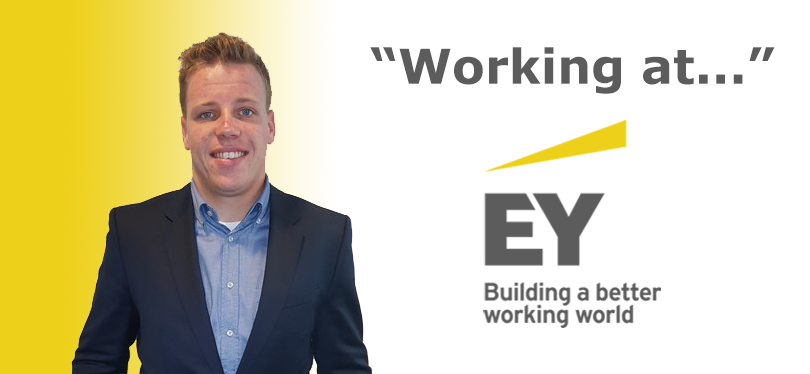
Where do you come from and what did you study? My name is Bram van Corven and I was born 22 years ago in Tilburg, where I have also been raised. Do you remember those booklets which you had as a child and in which all of your friends wrote that they wanted to become a professional soccer player, an astronaut or a professional ballet dancer? Quite quickly I started to fill out that I wanted to become a CFO. In the fifth year of my secondary education I had the opportunity to do an accounting course at university to find out if I liked it, sooner than most other students had this opportunity. Without mentioning all the details; I chose Accounting 1: Financial Accounting. Judged by the enthusiasm Bob van den Brand brought to his lectures, I could hardly choose something else right? Notwithstanding, I did visit the open day to see if I would rather start in a law program. Accounting 1 had brought me some doubt as its course material could be quite dry at times; I missed some applications in all the theory from the lectures. In the end I discovered that law was even drier than accounting and I decided to start in the Bachelor of Business Economics. After a minor in Accounting and getting in contact with the Big-4 (and some smaller firms), I concluded that accounting is far less dull than I expected. Next to verifying the numbers, we also audit the internal control procedures of companies. In order to do this we spend a lot of time interviewing our clients and outlining a firm’s business processes. Why did you choose for EY and how did you get in touch with EY? When I finished the minor in accounting I decided that this field was sufficiently interesting to continue in it. I started to orientate myself towards the kind of office I wanted to work for: Big-4, Middle Market (BDO, Baker Tilly Berk, etc…) or small. As I participated in the Accounting and Controlling Expedition organized by Asset | Accounting & Finance I realized that the Big-4 was speaking to my mind. This was mainly caused by the professionality Big-4-offices carried out. In my leisure time I like to play soccer, so the parallel I like to make is: if I were to choose a soccer club which I need to play for, I’d rather play soccer at the absolute top. As a citizen of Tilburg I enjoy Willem II performing well, however, when I need to choose between playing soccer for Willem II or a club like Real Madrid or Barcelona (or change this to any random other European top-class club), my choice is quickly made. When this choice was made, four firms were still left: PwC, Deloitte, KPMG and EY. By participating in a variety of formal and informal activities like the Inhousedays and the Accountancy Orientation Day in the Economic Business weeks Tilburg (EBT), I found out that the combination of the informal work environment and the goal-oriented approach of EY fits best to my personality. After this conclusion I decided to do a traineeship at EY for three days by joining. When I also liked that a lot, I decided to apply for an internship with the opportunity of writing my thesis at EY. The latter is very much recommended. It more or less forces you to work on your thesis, and if you get stuck you can brainstorm with the other interns who are working on their thesis. Eventually in May I got offered to start working at EY in September of this year. However, not as an intern, but in the position of first-year staff audit. When you’re at work, what do you do and what does a normal day look like? To give an example of one typical day as an accountant is really hard. Clearly there are patterns, but the contact with clients, seniors and managers, ensures that no day is the same. In addition I should mention that an audit has two phases: the preliminary audit and the year-end audit. In the preliminary audit, as described above, you review the internal control procedures a company has implemented to make sure that information that will end up in the balance sheet is validly, accurately and completely captured. You normally do this by interviewing one or multiple employees, and consequently conducting a walk-through procedure. To give an example: in the human resource process you take a look from the beginning (start of employment) until the end (termination of employment) and everything in between (e.g. salary raises). To demonstrate that the process functions well, you can review the contract of the new employee, his first paycheck and the bank statement that shows that salary has actually been paid. What people often think is that accountants are calculating some numbers all day long, however the opposite is closer to the truth. In the year-end audit, when we audit the realized numbers, here and there we need to calculate a bit, but to give an idea; I am hardly spending 5% of my time calculating stuff. Needless to say in the year-end audit you do spend a lot of time inspecting numbers. If you have to verify the working capital, you might look at bank statements to equate the ending balance of December 31st with the opening balance of January 1st. Due to the strict deadlines by our customers, in this period it is not irregular to have days on which you work long hours. As a future accountant, therefore, one should definitely not develop a nine-to-five mentality. On the other hand it is important to free up some time for your hobbies. Myself, I like to play soccer a lot. When I want to go to practice on Monday evening I discuss this with my senior and most of the times I can leave a little earlier. Obviously, I try to help the team at EY by
