


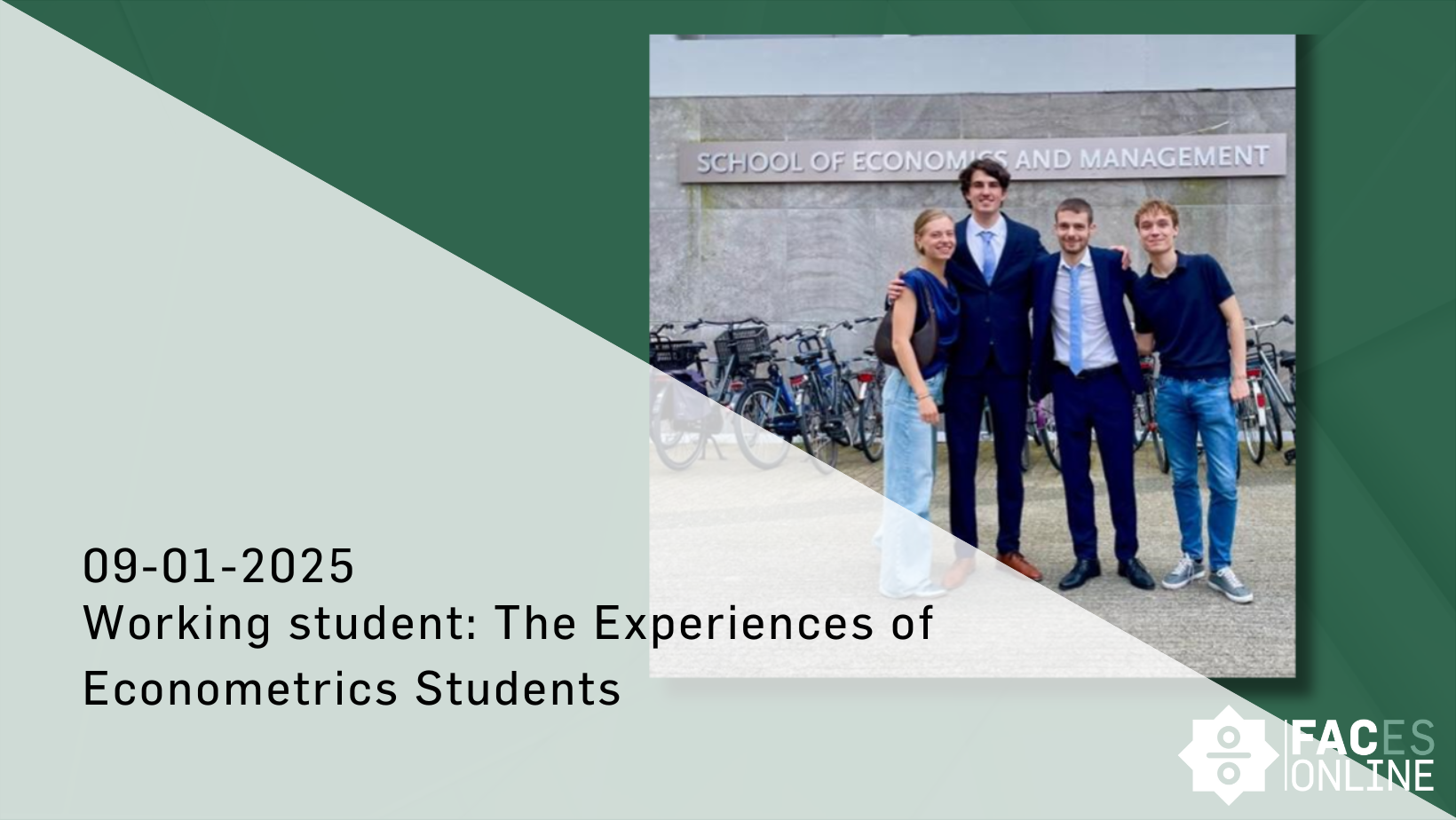
Working student whilst studying Econometrics: the Experiences of Students
Interview Marnix Rosendaal – Head IPB Deutsche Bank the Netherlands
Deutsche Bank is a German global financial institution headquartered in Frankfurt. It is one of the world’s largest banks and operates internationally with operations in more than 70 countries. Deutsche Bank offers a wide range of financial services, including investment banking, asset management, retail banking and private banking. The bank has a long history and is involved in a variety of financial services, including advising businesses and high-net-worth individuals. Like many large banks, Deutsche Bank is subject to strict regulation and plays an important role in global financial markets. What did you study and how did the study help with the job you have now? I did several different studies and quite a detour. My first study was HEAO CE and IM, now known as HBO commercial economics. I then went on to study management and organizational sciences in Tilburg, now called business administration. Remarkably, after that study I started working as a stock trader, despite my non-financial background. Some understanding of math was an advantage for that position. I only did that for a year, as that company went bankrupt within a year. The owner, who had lived through the 1987 stock market crash, speculated daily on another stock market crash. Despite successful transactions for clients and a lucrative partnership with an American company, the company went bankrupt because of its own risky positions. During my time there, I had the opportunity to pursue several studies, including a master’s degree in finance in Tilburg. During my career, I also took leadership courses at INSEAD and most recently at the London Business School, all of which contributed to my development. I held several positions, including private banker and later as head of private banking and branch director in Eindhoven. The whole private banking world and its structure changed significantly during this period. In my early days, all administrative and support functions were organized locally, but this is now all centralized, partly due to automation. At Deutsche Bank Netherlands which now employs about 550 people where it was double that 10 years ago. Automation has led to the disappearance of functions, and the financial sector as a whole has become significantly smaller. When I started, the banking sector was one of the largest sectors in the Netherlands. If you looked at the AEX index and talked about financial companies. At that time, they formed a significant part of the total market capitalization of the AEX. Think of companies like ABN AMRO, ING, AEGON. Tech companies, however, have now added a new emphasis to the composition of the AEX. Is that due to do with the fact that many large companies are setting up in London? Physical bank branches like they used to be, are now gone. You may remember when you could simply walk into any town and find all the major banks located there, complete with full-service options, such as arranging mortgages with a mortgage broker or consulting an advisor for SMEs. That’s all a thing of the past. Most services are now done online, and the few remaining branches are mostly found in larger cities, where you can’t even just walk in without having an appointment. So, the barriers have become higher. The number of employees has decreased significantly, and call centres are on the rise, not only in the Netherlands but also abroad, such as in India. In short, there has been a profound change in the industry that has had a significant impact on employment. How could a student who wants to get into banking, prepare for it? The way it looks now, there have been some changes and some things have remained the same. The basics of a bank and the revenue model, whether financing or saving. A bank like Deutsche is a good example of this. A large international bank that serves it from multinationals to SMEs, to very wealthy individuals and families, and financial solutions for all these audiences. For a student it is attractive to work at an internationally operating bank that serves many customer segments with a great diversity of work and thus career opportunities. So why am I working at Deutsche and not more at a Dutch bank? This is mainly because of its international character and the versatility it offers. When I look back at what I’m doing now and why I like it so much, and why young people should consider it, is because of this audience, which I find particularly interesting. I also left the bank for a while. For six years I had my own business focused on the segment of very wealthy families, the so-called ultra-high net worth individuals (UHNWIs). During my own time as an entrepreneur, I helped these high-net-worth families internationally to consolidate their wealth positions and provide insight through a digital platform. In 2020, that company was sold to an American party. After which I rejoined the bank. The reason why I chose Deutsche Bank and not a Dutch bank stems from the specific needs of this target group. They have sophisticated financial needs because of their global businesses and banking. Whether it is an operating company in a specific country, investing in real estate in New York, or acquiring another company, all of these diverse needs translate into financial solutions. The more international the bank can facilitate these clients, the more attractive you are as a bank to these types of clients. If you look at Deutsche Bank, it has not only private banking but also other services such as investment banking. Does that have an advantage over parties that only offer private banking? That’s a good question and exactly why I started working at Deutsche Bank. This is mainly because of the opportunities available within this bank. In addition to private Bank, there is also an investment bank and a corporate bank. This is different from most Dutch banks. Certain clients need this combined expertise. What makes private banking so interesting is the fact that you always communicate with the

Interview with David Simons – Executive Director at Morgan Stanley
For the Dutch version, click here David Simons graduated in econometrics at Tilburg University in 2008. Now, 13 years later, he is an Executive Director in the Investment Banking Division at Morgan Stanley in London, one of the largest investment banks in the world. In this interview, David talks about his career path, motivations behind it and transition from his student life to the corporate world. Can you tell us a bit more about your background? In 2001 I started studying econometrics at Tilburg University. At the same time, I fully jumped into student life, which was not the perfect combination. Towards the end of my bachelor’s degree, I started working as a working student at NN in their Risk Management department in Rotterdam. As a working student, I was mainly involved in project work, where I was often the link between the technicians and managers. Partly due to this job, I decided to do my master’s in Rotterdam, which I completed in one year. I then moved on from NN to ING’s corporate development department, partly because NN was part of ING Group at the time and ING was looking for insurance expertise. As an analyst in this team, I was given major responsibilities, which allowed for a steep learning curve in M&A. After this, I worked on the NN IPO for 12 months before it finally came to fruition in June 2014. During this project, I worked closely with the major investment banks, including Morgan Stanley. The discussions with advisors made me eager to work at an investment bank myself. Just after NN’s IPO, I continued my career at Morgan Stanley and started as a second year Associate within the Finance Institutions Group, the team that advises financial institutions. I have been working here for almost 7 years now, and still enjoy it every day. What choices that you have made during your time as a student have had a significant impact on your eventual career? The main subject you study steers you in a certain direction in the Netherlands, perhaps more than in the UK. I think my eventual choice to go to Rotterdam, both as a working student and for the Master’s degree, made a big impact. The change of environment, people and routine had a tremendous effect on me. In addition, by settling in a different environment and a bigger city, you automatically have a better connection to an international career. Which transition had the most impact on you, the shift from being a student to entering the corporate life, or the transition from a Dutch corporate to one of the largest investment banks in the world? The transition from student life to corporate life was mentally the hardest. If you are still living in a student house, completing your studies and also sitting on a train at 7 a.m. two days a week, feels like quite a step. In the transition to London you are thrown into the abyss as soon as you arrive, but the setting fits that life; your roommates are likely to live a similar lifestyle, as they also come to London to work hard, and hence you face most of the same issues. Both these changes of scenery had a good effect on me, it’s remarkable how quickly these new environments become part of your comfort-zone though. You have been working for Morgan Stanley in London for almost 7 years now, so aren’t you starting to run into the same problem again, that you need a change of scenery? To the contrary, if you find a place where your work is so dynamic, then you can last a very long time. The projects are always different and you end up with a variety of clients you try to help with their ambitions or problems. The core of what you do remains the same but your role in it changes over the years as you become more senior. If I were to do this work for a competitor, it would mainly cost a lot of energy to get to know all the new people, processes, etc. So for now, I certainly have no plans to make any changes in this regard. Can you elaborate on what a regular working day looks like for you? I mainly speak to clients, both when it comes to pitches and for projects. This could be around a company that wants to go public where you discuss the when, why and how that should occur. Hopefully your ideas happen to enlighten or spark the client’s mind. Not a single day is the same and besides client conversations there are plenty of analyses we perform for our clients (either for pitches or projects) which I generally outline, control, and assist with. In addition, there is quite a bit of legal work that comes to the forefront when you are working on projects. In short, as an investment bank you feel overall responsible for supporting your clients in achieving their desired outcomes. What are the motivations for an economics/finance student to pursue a career in investment banking? First of all, it depends entirely on your ambition. If your ambition is to see if you can hold yourself together in a world that is faster, more complex and perhaps a little more aggressive versus the one in Tilburg, the world of investment banking may suit you. If you have the right business sense and motivation, you could have an incredibly interesting career. And if after all it’s not for you, the experience you’ve gained will only make it easier for you to look for an interesting job in the Netherlands or somewhere else. “As an analyst, you mainly need to be accurate, fast, and do many processes at the same time and although we men are not natural multitaskers, this is something that you will learn fast.” What skills that you’ve developed during your studies are the most useful now? As a junior you mainly benefit from your
Shifting Economical Perspectives: Interest Rate Risk in the Banking Book
Introduction With the lengthy policy of quantitative easing of the ECB, it is no surprise that interest rates have become unprecedentedly low, even trending to become negative. These macroeconomic conditions are very favorable for investments and the world economy is booming. But is this sustainable? Does it not resemble the situation in the pre-crisis of 2007-2009? With such an excessive lending how vulnerable are financial institutions in case of stagnation and an interest rate rise? What would the consequences be? With all of that in mind, the Basel committee (primary global standard setter for regulation and supervision of banks) has issued a new standard, implemented as of 2018. It demands that banks use standardized methods to measure their exposure to interest rate risk, instead of bank-developed methods, which was the case before. Standardized methods are always good from a simplicity and comparability point of view, but are they actually accurate enough to capture the risk at stake? Or do we trade off quality of measurements for simplicity with this new implementation? То investigate this question, we looked at the methodology of proper risk management under the guidance of Prof. Dr. M. Folpmers, and compared the outcomes with the newly proposed standardized version. Background To start, it is crucial to get a good understanding on how banks operate. A bank’s balance sheet includes both their assets, liabilities and equities. Many components on this balance sheet are financial instruments. These are priced on the balance sheet at their present value (discounted against the interest rate over time). Because of this, the value of these items on the balance sheet, and the balance sheet as a whole, are heavily dependent on the interest rates. Hence, banks are exposed to a certain level of interest rate risk. Banks use tools like duration and PV01 to calculate this risk exposure, either for the whole portfolio, or per maturity bucket (set of cash flows/ instruments with similar maturities). Duration calculates both the weighted average time until return of the cash flows and the percentage change in value of this cash flow if the interest rate would change by 1 percentage point. PV01 does a similar calculation, however per maturity bucket, following a change of 1bp (which is 0.01 percentage point). The bank’s asset side contains, for a large part, loans they provided, like retail mortgages, which are rather long term. In the contrary, their liability side contains loans they received, like from consumer savings, which are more in the short term (see figure 1). As the accounting equation dictates; equity = assets – liabilities. For banks this implies that the value of equity depends on the combination of long term interest rates, over their assets, and short-term interest rates, over their liabilities. Similarly, their profits depend on receiving, in general, higher rates over the long term, while paying generally shorter rates in the short term. Interest rate risk in the banking book (IRRBB) consists out of two parts; interest rate risk: the risk incorporated within interest rate/yield shifts, and in the banking book: applied to banks, the financial corporations who work specifically with loans and interest, that is their business model. Interest rate risk can be decomposed into two main approaches. The first approach is the earnings at risk approach: The risk the bank has on its earnings because of changing interest rates. The second approach is the value approach: because of specific interest rate shock and stress scenarios, economic value measures make a change in the net present value of the bank’s assets and liabilities. This approach can be decomposed into two questions: 1. Is the interest rate sensitive to risk? 2. If this is true, how large are these swings in the interest rate? Field evidence Building upon the above explained fundamentals, we continued with field evidence in the form of interviews with both Mr. Versendaal, who is ALM manager at ABN AMRO, as well as Mr. Baalhuis, who is the senior pricing analyst at de Volksbank. This to ask them about their insights on Basel standard #368. Firstly, we asked them which IRRBB approach they used more; earnings-based approach or value-based approach? They both stated that they use both approaches, yet the value-based approach is used on the long-term, whereas the earnings-based approach is used on the shorter term up until three years. Secondly, both J. Versendaal as well as J. Baalhuis mentioned that the instant shock of 200 bps, as stated in Basel standard #368, is realistic on a one-year horizon. However, it is unrealistic on a shorter term such as one day or as an instantaneous shock. Lastly, they both indicated that the six standard shock scenarios, which are introduced in the new Basel guideline, are good for comparability between banks, however are not representative for real-life scenarios. Principal Component Analysis In order to answer the problem definitions; whether Basel III captures the interest rate behavior well enough, one could apply the principal component analysis (PCA). This mathematical data analysis finds the underlying structure of the data, which are in this case the typical movements of the yield curve. The data used is weekly US Treasury yield curves with maturities from 1 to 30 years from 1986 until 2017. As the yield curves for different maturities are heavily correlated, we find that 98% of the variation in interest rates can be explained using only 3 movement types (shocks). Since each movement can be either positive or negative, six basic scenarios are obtained. Basel III proposes exactly these six scenarios, capturing 98% of the interest rate variation over the last 31 years. Next to that, plotting the three movements on a timeline gives the time period with which a 200 basis point shock would normally correspond. It turns out that a 200 basis point shock corresponds to a quarter of a year and an instantaneous 200 basis point shock is therefore unrealistic. Data analysis To test the appropriateness of the Basel standards even further, we carried out data analysis on historical
