

For the Dutch version, click here The new academic year began this week, so it’s high time to look back at the past Faces-Online semester. Many weekly zoom meetings later, and after publishing 48 articles, it’s time to take stock: what did we write for you, and which articles scored historically well? Here are the top 3 articles of Faces-Online 2020-2021: Women’s quota: time to say goodbye to the male stronghold Our vice, An Harinck, delved into the world of top women in the accountancy sector. She spoke with Marieke Hormann-Buiting, top woman at PwC. They talked about Marieke’s experiences within the accountancy world, gender diversity, and what she can recommend to future female accountants to ensure that prejudices in the sector do not become truths. Curious to read the entire article? Click here! Interview with David Simons – Executive Director at Morgan Stanley Boris de Bie and Richard van der Vlist, respectively former chairman of Faces-Online and chairman of Asset | A&F, recently landed an interview with David Simons of Morgan Stanley. They talked about David’s time as a student in Tilburg, and about life in investment banking at one of the largest investment banks in the world. You can find the article here. Interview with Roger Dassen – CFO of ASML I myself had the opportunity in December 2020 to speak with Roger Dassen, CFO of ASML, for about an hour. We talked about our roots, which are both in Kerkrade, and about how he experienced the move from the south to the Randstad, and then to the US and Asia. We also talked about his role in the Ahold scandal in 2002, and the consequences he experienced through 2016. Read the article though this link. This is just a small sample of all the publications we have done in the past college year. We’ve had an awful lot of great conversations with a variety of interesting people from both the accounting and finance industries. We also wrote some nice pieces on sustainability, start-up jobs, and investing. Would you like to write articles, columns, or interviews about all possible subjects within accountancy, finance, or student life? Please let us know. During the year we are continuously looking for reinforcement on the editorial board of Faces-Online! A nice bonus is that you will also be (or remain) an active member of Asset | A&F, with all its benefits. If you would like to know more about Faces, please feel free to contact me, one of our editors, or one of our board members! Interested in joining the Faces Online team? Send an email to info@asset-accountingfinance.nl! Jari Heijnen Chairman Faces-Online
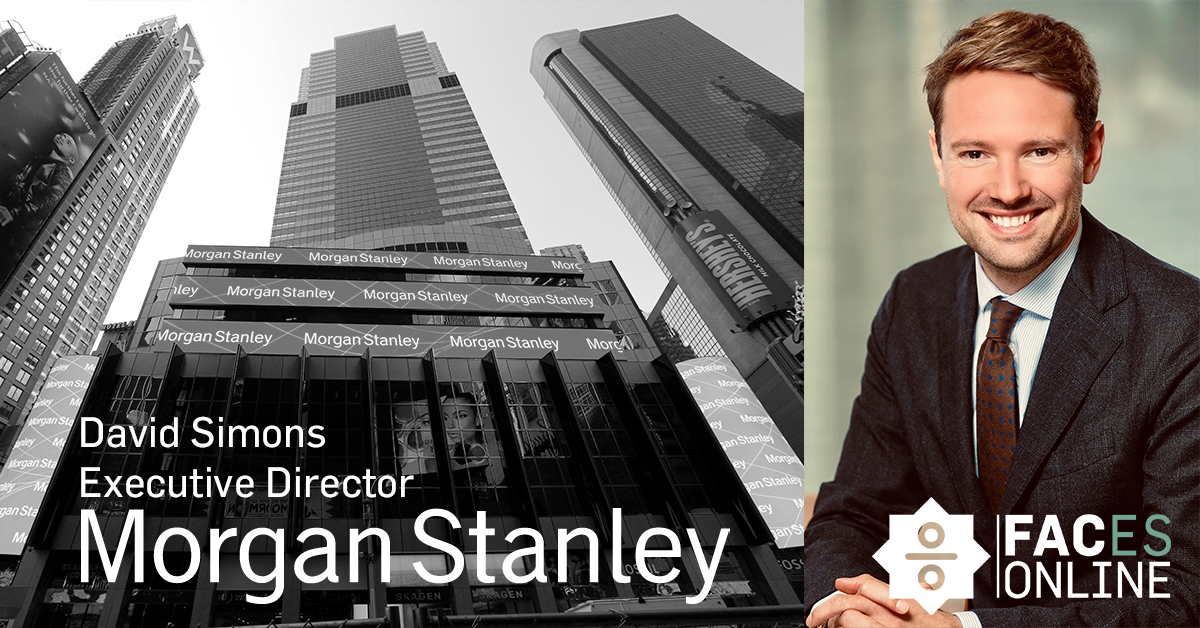
Interview with David Simons – Executive Director at Morgan Stanley
For the Dutch version, click here David Simons graduated in econometrics at Tilburg University in 2008. Now, 13 years later, he is an Executive Director in the Investment Banking Division at Morgan Stanley in London, one of the largest investment banks in the world. In this interview, David talks about his career path, motivations behind it and transition from his student life to the corporate world. Can you tell us a bit more about your background? In 2001 I started studying econometrics at Tilburg University. At the same time, I fully jumped into student life, which was not the perfect combination. Towards the end of my bachelor’s degree, I started working as a working student at NN in their Risk Management department in Rotterdam. As a working student, I was mainly involved in project work, where I was often the link between the technicians and managers. Partly due to this job, I decided to do my master’s in Rotterdam, which I completed in one year. I then moved on from NN to ING’s corporate development department, partly because NN was part of ING Group at the time and ING was looking for insurance expertise. As an analyst in this team, I was given major responsibilities, which allowed for a steep learning curve in M&A. After this, I worked on the NN IPO for 12 months before it finally came to fruition in June 2014. During this project, I worked closely with the major investment banks, including Morgan Stanley. The discussions with advisors made me eager to work at an investment bank myself. Just after NN’s IPO, I continued my career at Morgan Stanley and started as a second year Associate within the Finance Institutions Group, the team that advises financial institutions. I have been working here for almost 7 years now, and still enjoy it every day. What choices that you have made during your time as a student have had a significant impact on your eventual career? The main subject you study steers you in a certain direction in the Netherlands, perhaps more than in the UK. I think my eventual choice to go to Rotterdam, both as a working student and for the Master’s degree, made a big impact. The change of environment, people and routine had a tremendous effect on me. In addition, by settling in a different environment and a bigger city, you automatically have a better connection to an international career. Which transition had the most impact on you, the shift from being a student to entering the corporate life, or the transition from a Dutch corporate to one of the largest investment banks in the world? The transition from student life to corporate life was mentally the hardest. If you are still living in a student house, completing your studies and also sitting on a train at 7 a.m. two days a week, feels like quite a step. In the transition to London you are thrown into the abyss as soon as you arrive, but the setting fits that life; your roommates are likely to live a similar lifestyle, as they also come to London to work hard, and hence you face most of the same issues. Both these changes of scenery had a good effect on me, it’s remarkable how quickly these new environments become part of your comfort-zone though. You have been working for Morgan Stanley in London for almost 7 years now, so aren’t you starting to run into the same problem again, that you need a change of scenery? To the contrary, if you find a place where your work is so dynamic, then you can last a very long time. The projects are always different and you end up with a variety of clients you try to help with their ambitions or problems. The core of what you do remains the same but your role in it changes over the years as you become more senior. If I were to do this work for a competitor, it would mainly cost a lot of energy to get to know all the new people, processes, etc. So for now, I certainly have no plans to make any changes in this regard. Can you elaborate on what a regular working day looks like for you? I mainly speak to clients, both when it comes to pitches and for projects. This could be around a company that wants to go public where you discuss the when, why and how that should occur. Hopefully your ideas happen to enlighten or spark the client’s mind. Not a single day is the same and besides client conversations there are plenty of analyses we perform for our clients (either for pitches or projects) which I generally outline, control, and assist with. In addition, there is quite a bit of legal work that comes to the forefront when you are working on projects. In short, as an investment bank you feel overall responsible for supporting your clients in achieving their desired outcomes. What are the motivations for an economics/finance student to pursue a career in investment banking? First of all, it depends entirely on your ambition. If your ambition is to see if you can hold yourself together in a world that is faster, more complex and perhaps a little more aggressive versus the one in Tilburg, the world of investment banking may suit you. If you have the right business sense and motivation, you could have an incredibly interesting career. And if after all it’s not for you, the experience you’ve gained will only make it easier for you to look for an interesting job in the Netherlands or somewhere else. “As an analyst, you mainly need to be accurate, fast, and do many processes at the same time and although we men are not natural multitaskers, this is something that you will learn fast.” What skills that you’ve developed during your studies are the most useful now? As a junior you mainly benefit from your

Growing stress among students due to COVID-19
For the Dutch version, click here Since the beginning of last year, life has been at a standstill. Where normal life first started up again at a snail’s pace, within no time everything ground to a halt again. Everyone has experienced lesser moments. For example, for some, social life has largely fallen away and the pressure at school is difficult to keep up with from home. In this article, we further explore how students from Tilburg University experience stress due to current conditions. Also, this article reflects the experiences of fellow students who are members of Asset | Accounting & Finance. Last year Worries about now and the future, everyone knows them. For some, it is easier to deal with them than for others. Everyone has different worries, which weigh in differently for each person. One person braves crisis after crisis and another needs a hand to get back on his feet. The situation started and everyone deals with it in their own way. A press article from Tilburg University reveals an increase in psychological complaints, particularly among students. A group that is normally socially very active, who have experienced many changes due to the measures. A group of people who often have a different outlook on life than, for example, full-time workers. For many people, attending lectures helped with discipline, a fixed routine with work, school, and private life. A routine that now takes place mainly in student rooms, because the lecture banks and libraries are no longer accessible. Furthermore, there are people who have lost a nice side job, because practicing their job is not possible within the current measures. The imbalance is a major cause of stress for many. Fortunately, there are several ways to make it a little easier on yourself. Experiences of A&F members How are members of Asset | Accounting & Finance (A&F) experiencing this strange period? In response to this issue, a number of A&F members were interviewed who are currently pursuing the Bachelor of Business Administration, Master of Finance, or Accountancy. Bo Janssen, MSc Accountancy, gives her experience about switching from physical to online classes. “The online lectures were fine although it was harder to really interact with other students. The second semester I found it a little more difficult. The only interaction left was through online Q&A sessions and usually not a lot of questions came up there.” Sem van den Berg, MSc Accountancy, briefly talks about the effects the current period had on his motivation. “I did notice that my motivation for attending lectures deteriorated. In the end, my school performance did not suffer. I am normally used to completing subjects without much interaction and personal guidance.” Thus, it can be concluded that studying in the ‘new normal’ has its advantages and disadvantages. For example, one person generally experiences online classes as pleasant, but the lack of interaction proves to be an obstacle for another. An obstacle that some people cope with better than others. The role of Tilburg University What role did the university have in the transition to the new normal for students? Has the university handled this positively or negatively? In the end, every organization has had to make drastic decisions due to the current measures. The school shows an upward trend in terms of application measures that apply in education according to Bo Janssen. “Furthermore, I think that they are now trying to look at how a certain subject can best be arranged online instead of just transferring the lectures that are normally given physically to online (for example, by making videos available at any time).” “For many people, attending lectures helped with discipline, a fixed routine with work, school, and private life. A routine that now takes place mainly in student rooms” Similarly, there were also students who took a critical view such as Ahlam Kodade, MSc Finance. “I understand that these are special times for all of us. That we have to be creative and flexible with solutions, but I got the feeling that little consideration was given to international students like me. An important group for the education sector.” Some students felt that things were unclear like Jari Heijnen, MSc Accountancy. “There was a lot of ambiguity from the university, in that respect, they can still learn a lot. Also, there is an expectation that students are always available for an online lecture and that is not possible for many working students.” Lack of clarity is a recurring thought in Tilburg University’s course of action. The university is actively working on it and adapting its new teaching methods as time goes on. Lessons will certainly be learned from this new form of teaching and the policies of the educational institutions and national government for years to come. Tips from A&F members How have members of Asset | Accounting & Finance kept themselves mentally and physically fit this year? A few members will briefly explain the positive habits they have adopted. Perhaps this will provide inspiration for maintaining a healthy attitude. Discipline and daily routines can be supportive in times of studying at home, says Joep Groenen, Bsc Business Economics. “First of all, I think it is important to keep a good daily routine: get up on time, shower right away, etc. That way I fill in my day much more effectively and I have more motivation. I also like to go outside regularly because I am indoors a lot.” Thus, sporting activities can also contribute to your health according to Sem van den Berg. “I mainly focused on going to the gym. In addition, I used to run in the summer. I notice that sports can have a positive influence on your mental state.” Others have been able to get a lot of peace of mind from being home with family as described by Ahlam Kodade. “I spent six months in my home country. I think this was very valuable since I had no courses at the time. It was nice to
Working at Deloitte
For the Dutch version, click here The step from studying to working is a big one. You have to get used to working hours and obligations, learn a lot and gain new experiences. That was no different for Femke de Boer when she started working at Deloitte Audit over a year ago. Still, she thought it was not so bad. Thanks to the pleasant guidance of experienced colleagues, but also because Femke already knew the office very well from her board experience at study association Asset | Accounting & Finance. “During my master Accountancy I was a board member External Affairs at our study association in Tilburg”, Femke explains. “A position in which I was responsible for acquiring partners, maintaining contact with existing partners, setting up events and recruiting students for those events. A tough task, but the perfect way to get to know the finance and accountancy firms up close. In addition, I applied for a business course from Deloitte at the end of 2017. We went to Budapest with a select group of 25 students and Deloitte employees. An amazing experience and again a great way to get to know the office.” Femke obviously made a well-considered choice to work at Deloitte. “In accountancy, apart from the size and type of clients, the work doesn’t differ much from office to office. It is therefore all the more important that you experience whether a company suits you. Colleagues are a big part of your job. If it doesn’t click, it can make your work boring or obnoxious. I therefore mainly made the choice for Deloitte based on the people. This is a place where I can be myself. Of course, the other offices are also good employers, but Deloitte suits me.” It turned out to be an excellent choice. Femke is now a second-year staff member at Deloitte Audit and very enthusiastic about it. “I therefore mainly made the choice for Deloitte based on the people.” My work is very broad, Femke explains. “From auditing the annual accounts to testing internal control. You get to know the process and the customers from A to Z. Very educative. In addition, like my colleagues, I follow the postmaster to become a chartered accountant. I now learn to link theory and practice. The step is from studying to working is a big one. Also for me. Fortunately, as a starter at Deloitte you get good guidance from experienced colleagues. He or she walks you through your work and explains why we do the things we do. You simply have to learn to understand why you have to perform these checks as an accountant. Time and space is made for your postmaster and there is always someone who can and will help you if you have any questions.” Because Femke enjoyed the guidance of her colleagues, she herself also started looking for ways to assist others. “Everyone who is promoted will coach a colleague. For me that will take a short while, which is why I recently asked recruitment if I can already contribute. I now guide students who are making the choice for an employer. A lot of fun to do. Of course, I would like to persuade them to come and work at Deloitte, but the main thing is to be transparent. I am very positive about Deloitte as an employer. But the point is that a company has to suit you. That is why I advise everyone to do as much research as possible into the different employers. Go to the events of your study association and get to know the companies. It cannot be done from a flyer at the University Library, you really have to experience it. It takes a little effort, but wouldn’t it be a shame if after years of study you did not discover your optimal future employer just because you did not put in the extra effort?”
Being an active member at A&F Investments
For the Dutch version, click here A&F Investments is the largest individual committee of Asset | Accounting & Finance. It is an investment group run by students of Tilburg University to broaden their knowledge in investing and asset management. Why do students choose to join? What extra knowledge do you get? These are some of the questions that are frequently asked by interested students. In this article current and past members provide us with details about their experiences, ranging from their reason to join, to how it is having an impact on their future career. Why choose to join and how much time does it take up next to your studies? There are many different reasons why students choose to join. Most students want to gain a more practical experience in addition to their finance related studies. In addition, you will come into contact with students who share the same interests. For Burak Coskun, currently MSc Financial Economics student at University of Oxford and alumni member, the reason to join was that he aspired to become an investor with a rigorous, analytical approach but had no idea where to start. Regarding the input time he said: “The preparation prior to a pitch to the committee takes about 10-15 hours, but on average you spend 3-4 hours a week on committee work. I learned more from A&F Investments than from any of my courses, so the time spent was well worth it.” Iris Heuten, currently a BSc Business Economics student at Tilburg University and active member, chose to join because she wanted to get a better insight in the financial world and use this to help her decide whether this is what she would like to do later. “On average it does not take a lot of time, when I have to make a stockwatcher report it takes 2-3 hours more than for a regular meeting. And when I have to pitch it depends on the topic that is being covered.” The reason why Tim de Jong, currently MSc Finance student at Tilburg University and active member, stated he joined was that he wanted to learn more about investing and wanted to achieve this on a larger scale. “If you invest with a group you can buy larger stakes than when you invest by yourself and you also learn a lot more together. The amount of time you have to put in is easy to combine with your studies, the 2 hours every other week on Wednesday does not take almost anything away and you learn a lot from every pitch.” What kind of impact has A&F Investments had on your current studies or future career? Burak: “My experience at A&F Investments solidified my decision to stick with finance and investing both as an intellectual pursuit and a career path. I found it so fulfilling that I spent my semester after Tilburg in an uphill battle to start an investment club of my own back at my home university. I’m also managing a mid six-figure fund on behalf of several investors, which has allowed me to pay for my degree and make a decent living on the side. The skills I gained as a result of my time at A&F Investments undoubtedly contributed to the market beating track record I’ve managed to build up and my ability to raise capital.” Iris: “When I joined, I only completed the first year of Business Economics, so I was a bit inexperienced. But I quickly learned a lot of new things and it helped me to better understand the theory and apply it in practice. Everyone is always really nice, and helps you whenever you don’t know something for sure or have a question. New members are always grouped with more experienced members so that you always have others to help you out.” Tim: “Especially when you want to go into the direction of investing for your future career it helps a lot when applying for jobs. It is always very good to do extracurricular activities and in my experience also good for your resume. Even if you don’t pitch at all meetings, by asking good questions you also learn to be critical.” “One can learn how to run a discounted cash flow or comparables model anywhere, but convincing a room full of intelligent and informed investors is a completely different ball game.” What are the best highlights that you have had with this committee? Burak: “The time I convinced the investment team to get rid of the club’s cash position and put it all into a global index fund in what was then the largest transaction to date. Besides that speculating on Pandora’s stock at the end of the night with a few beers have also been one of the fondest memories of my time at A&F Investments and Tilburg University.” Iris: “The drinks after the meetings are a great way of getting to know everyone better in a more informal way. You make a lot of new friends during your time at A&F Investments.” Tim: “Whenever you pitch something for the group and convince them to buy it and later on see the whole group benefitting from it, you always get a good feeling looking back at that.” What have you learned the most from A&F Investments? Burak: “How to articulate investment ideas. One can learn how to run a discounted cash flow or comparables model anywhere, but convincing a room full of intelligent and informed investors is a completely different ball game. Through observing dozens of pitches, I got an understanding of what works well and what doesn’t when pitching an investment thesis. If one day down the line, I become a noteworthy investor, A&F Investments will go down as ‘the place where it all started’. Anybody remotely interested in investing should definitely try it out.” Iris: “I learned how to look at financial figures and make valuation of companies. Besides, I understand now what those numbers actually mean. Furthermore, I
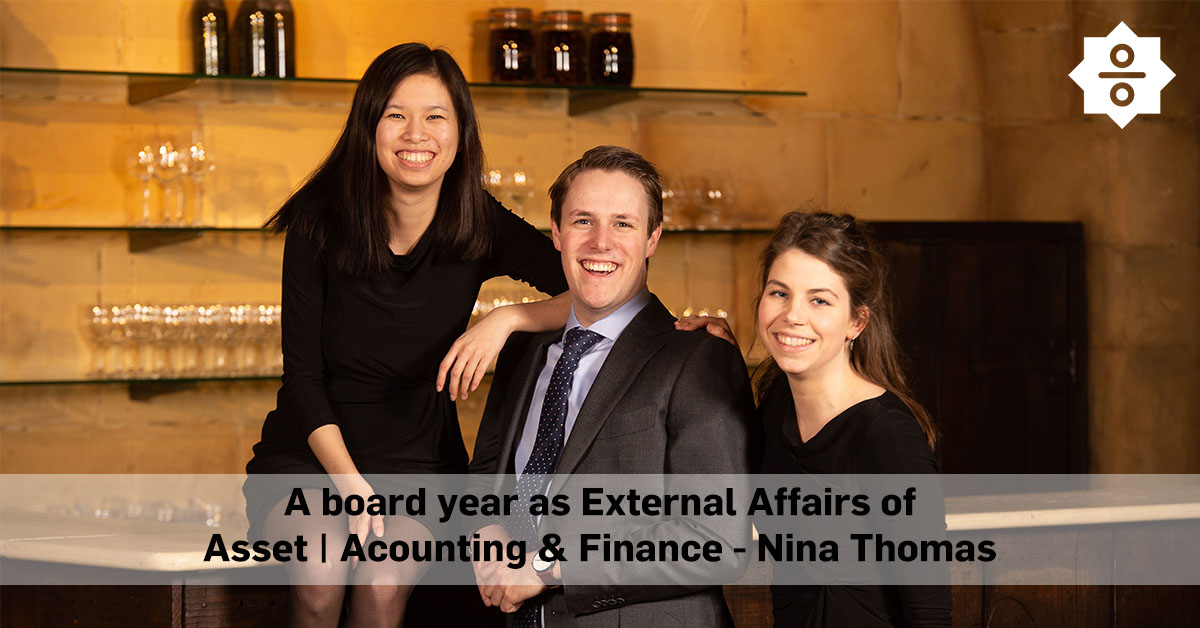
A board year as External Affairs of Asset | Accounting & Finance – Nina Thomas
For the Dutch version, click here As External Affairs, Nina is responsible for the contact with current and future partners of Asset | Accounting & Finance. In addition, she coordinates the Accountancy Cycle, Accounting Expedition and Orientation committee. In this article, Nina explains her function and her experience as an External Affairs of Asset | Accounting & Finance. Why did you choose for a board year at Asset | Accounting & Finance? As a committee member of Asset | Marketing, I organized a fantastic trip to Malaysia during my second year of my bachelor. However, I did not think about a board year back then; I wanted to go on exchange and finish my bachelor’s in Business Economics. Only during my exchange in Sydney, I began to think more seriously about it. I’m not sure whether the reason was my carefree student life which suited me well or my personal development growth, but a board sounded more and more attractive. This feeling became stronger during my time as a member of the Financial Business Dinner committee of Asset | Accounting & Finance (A&F), which felt very comfortable. Another reason which contributed to my choice was the difficulty of choosing the right master. However, as someone who is known for doubting a lot, it is not a surprise that I was in doubt about this decision as well. After several conversations, my doubts turned out to be unnecessary which led me to the well-considered decision to apply. The only decision left for me was which function within the board I wanted to fill. Firstly, I was thinking about becoming Treasurer of the board, as I had an affinity with numbers and making budgets. However, a board year is meant to step out of your comfort zone. Therefore, I decided to apply for the position of External Affairs (External). What does your year look like and how do you like it? The year began with a full agenda. During the day, I visited our partners to discuss our cooperation. During the evenings, I was busy with Announcements or dates with other boards and in between, conveyance and policy sessions were planned. I got to know the organizations and recruiters, which improved our collaboration during the year as well as my perspective on different sectors. The Financial Business Dinner took place at the end of September, and soon the events which I coordinated as part of my board position took place. This resulted in greater a responsibility, but also a feeling of being proud of the committees as well. The peak of ‘my’ events happened in February/March. As summer External, I was responsible for the organization of the Finance Day, Master Experience Days and Accounting Expedition. These events all took place within the period of one month, which tested my time management and list of priorities. It is, therefore, gratifying to see that students appreciate our events and use them to build their network. In the end, that is what our association stands for; connecting students with their potential employer. Because there is always something to do, time flies by. Beforehand, I was wondering how I could be busy for seven hours a day; right now, I ask myself how it could be that the day flew by so quickly. Even weeks flew by quickly, and I feel like we have just begun the board year. I think it is difficult to summarize my experiences within 1000 words or to give just one answer. ‘Good’ is not sufficient, as a board year is something you have to experience. Therefore, I am very happy with my choice. And my doubts… those have been replaced by doubts regarding the choice of a menu (it is still a learning process). What are your tasks as External Affairs? As External, you are the first contact for companies. You work together closely with the other External in order to provide companies in their needs. The conversations during the summer form the basis and these are supplemented with new partners. Via either physical appointments or appointments by phone, you determine whether there exists a match between what companies search for and what A&F offers. Sometimes, you have to say ‘no’ and there will be no match. This can change, therefore maintaining a good relation is essential. The same holds for existing partners, you want to keep those satisfied. You are building a network which could be important later on in your career. “Here, it does not really matter whether you are a quiet person in general or someone who prefers to step forward. As long as you are social and open-minded, it is alright.” It is great that my position within the board emphasizes the importance of soft skills. Keeping contact with A&F partners improves your communication skills and it allows you to learn how to present yourself and A&F well. You will learn these skills quickly enough. Here, it does not really matter whether you are a quiet person in general or someone who prefers to step forward. As long as you are social and open-minded, it is alright. Also, you do not have to be a professional in small talks. Moreover, you should not be afraid to bring or receive less positive news. These could be tough conversations, and it is your task to resolve these in the right way. Solutions will differ, yet each situation requires flexibility and rationality. Although you will be the point of contact, fortunately, you are not alone. My skills regarding crisis management have clearly improved and I am proud when looking back at how I solved certain situations. What does your average day look like? An ‘average’ day does not exist, yet there are recurring occasions such as committee or board meetings, keeping social media channels up to date or adding vacancies on Career Platform Tilburg. In addition, I spend quite some time keeping my mailbox up-to-date and making phone calls (or receiving voice mails). However, this is just a