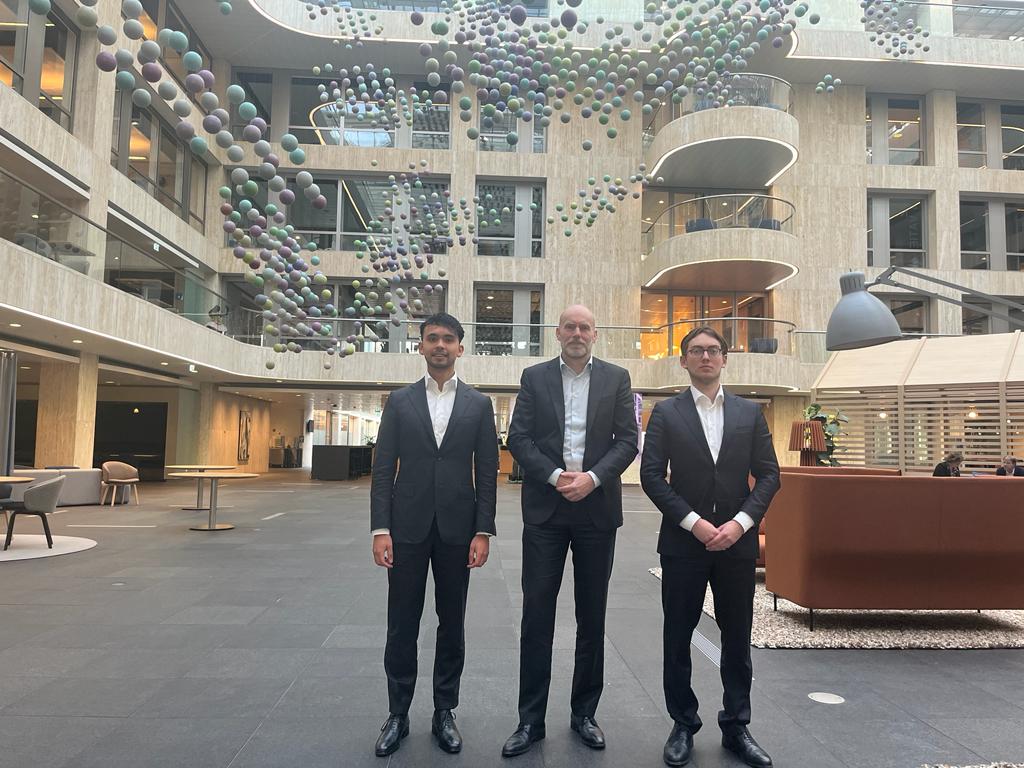
Aegon Asset Management is Aegon’s asset manager and offers a wide range of investment services. The company is committed to sustainable investment solutions and integrates environmental, social and governance considerations into its investment process. Aegon Asset Management has offices in Europe, the US and Asia and employs around 1,200 people. Assets under management and advice amount to around EUR 280 billion. Aegon Asset Management’s clients are mainly pension funds, insurance companies, banks, asset managers, family offices and foundations. What did you study and how did you come to this choice? I followed several studies and developed my interest in equity investing as early as secondary school. My choice of study was more or less already made during that school period. I started at Havo and then chose the banking and insurance differentiation at HEAO. After completing that, I entered military service, which was compulsory at the time. After my service, I started applying for jobs and looked for a job in an industry that appealed to me, such as equity investing or asset management. It was a challenging time then and quite difficult to find work. My first job was at Van der Hoop Effektenbank, a bank that no longer exists. There were as many as 1,500 applicants for the position I applied for, and in the end, only two trainees were hired. During my career, I did several courses, including the VBA (Association of Investment Analysts) course. That may not be as well-known now, but you probably know the CFA training. The VBA is the Dutch variant, more focused on Dutch/European laws and regulations. CFA is more international and mainly focused on the US. I also studied Business Administration and Financial Law at Erasmus University. What had you done compared to the other 1,500 men to be chosen? I don’t think there was anything special about my approach. As they always say, just be yourself. But of course, I prepared well for it. In military service, I was given space and time to conduct job interviews. In the team I was on, all the guys had college or university degrees. They were all applying for jobs and it was not always smooth, but you could learn a lot from each other, for example how to write a good cover letter. That made it easier to get through the first round. After several interviews at different companies, you also became more adept at interviewing Did you benefit a lot from the financial law course in your career? I apply daily what I learned during financial law course. Financial law is about financial supervision, risk management, compliance, and everything around it. It is a good background, especially if you work with clients, but of course, it depends on your interests and the position you hold. If you focus on portfolio management, for example, you might need it a little less. Would you recommend students to do the CFA? Because in the Master Finance at Tilburg University, you can choose to do a CFA track. If you really want to go in the direction of asset management, it seems that it is mostly valued in the ‘front office’ (such as portfolio management and similar functions). I can imagine that if you are an accountant working for an asset manager, a CFA is not that relevant. But if your focus is really on the front office, then a VBA or CFA definitely have added value. I remember that for my position at a previous employer, Van Lanschot, it was even mandatory. It was not then a matter of ‘it’s handy if you have it’, but really a requirement that someone had to have a CFA or VBA certification. What else has your career looked like? I started at Van der Hoop Effektenbank where I worked for eight years. I held various positions there; started as a trainee, and then you look around a bit in different departments. Then I did analyst work for a short time. After that, I did advisory work for private clients, asset management for institutional clients, and eventually became responsible for asset management for private clients. After that, I joined Kempen Capital Management. Now you have Van Lanschot Kempen, but back then Kempen was still independent. I then joined Van Lanschot. At the time Van Lanschot Kempen took over, I also got an offer to work at BNG Bank in The Hague (Bank Nederlandse Gemeenten). BNG Bank only provides services to parties serving the public interest such as municipalities, provinces and housing associations. It is one of the largest banks in the Netherlands with a balance sheet total of over €100 billion. At the time, BNG wanted to start an asset management company. Previously, companies such as Vattenfall (Nuon), Eneco and Essent were mainly owned by municipalities and provinces. Then came the liberalisation wave and those companies had to be sold. And BNG bank knew that market well and so the logical idea arose ”let’s start an asset management company” to manage the funds that became available. Well, I thought that was a very nice challenge and it worked out very nicely. Because from scratch, assets under management have grown to around €6 billion. Then a.s.r. came along. BNG Bank wanted to return to its core business and divest asset management, whereas a.s.r. wanted to set up asset management for third parties. Because a.s.r. did not yet have the infrastructure in place, BNG Asset Management was bought. Then at the end of 2022, it was announced that Aegon Netherlands was sold to a.s.r., leaving all of Aegon’s other businesses outside; such as Aegon USA, Aegon Asset Management, etc. Aegon Asset Management has a real ambition to grow further. They invest a lot in new teams, products, services and systems. For example, Aladdin (front office system for portfolio management, risk management etc.) was recently purchased from BlackRock and is currently being implemented. Part of the a.s.r. transaction was that a number of investment teams (and the associated assets under