


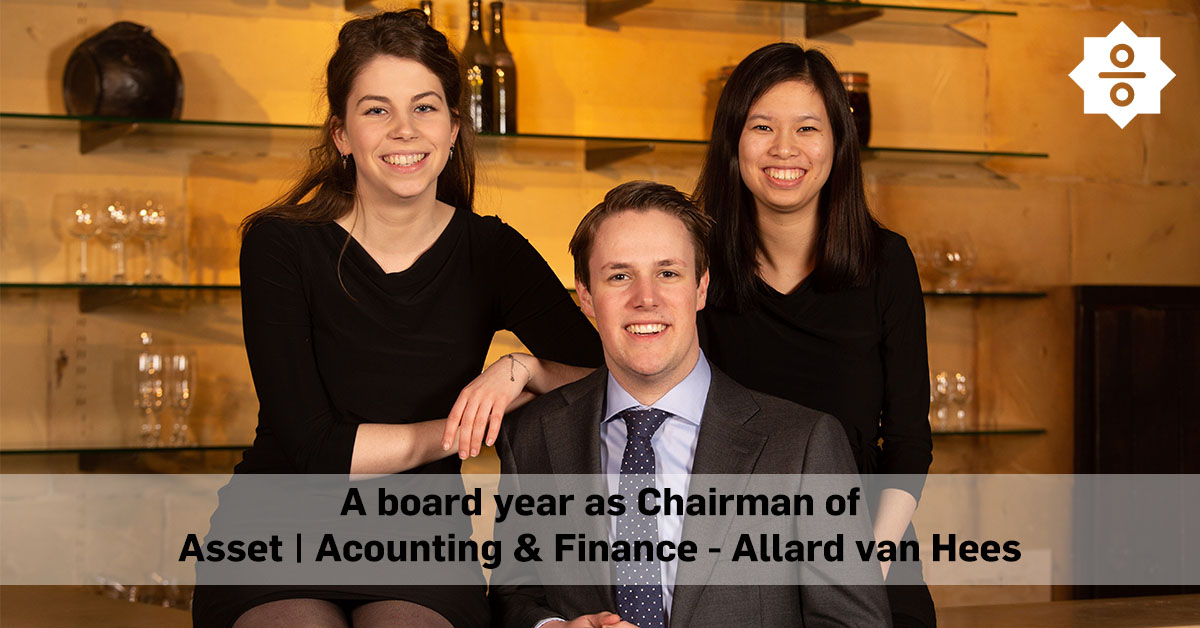
For the Dutch version, click here As Chairman, Allard is responsible for the policy of Asset | Accounting & Finance and external communication to parties such as Asset and the University. He also coordinates A&F Investments and the CityTrip committee. In this article, Allard explains what his position entails and how he experiences a year as Chairman of Asset | Accounting & Finance. Why did you choose to do a board year at Asset | Accounting & Finance? When I joined Asset | Accounting & Finance in my first year I never thought I was going to do a board year. At the time, I was much more concerned with getting my BSA than thinking further about my future. As I progressed in my bachelor Business Economics and I became more active at Asset | Accounting & Finance, for me it seemed more and more fun to do a board year and to view the association from a different perspective. In addition, you also learn a lot from a board year. You learn what it is like to run a kind of company and thus gain a kind of management experience that you can hardly gain with, for example, an internship. I chose to do a board year at Asset | Accounting & Finance (A&F), because after this year I will study Accountancy and can, therefore, come into contact with various companies in this sector. At first, I had the ambitions to become a treasurer, but as the application procedure progressed, I nevertheless chose to become Chairman. “You learn what it is like to run a kind of company and thus gain a kind of management experience that you can hardly gain with, for example, an internship.” What does your year look like and how is the experience so far? The applications started in April, which resulted in me becoming the Chairman for the academic year 2019-2020. At first, I was quite reluctant to become Chairman, because Chairman sounds like something very serious and with a lot of responsibility, but after a number of conversations with other board members I was assured that I could do it. From July onwards I fully participated, first under the wings of my predecessor Stijn, who immediately took me everywhere from the beginning. The conveyance period is a fun, but above all educational time in which many impressions come at you and many things are done. In July, you will also write the policy for the upcoming academic year together with the other board members, which I have to present at the General Members Meeting. After the General Members Meeting, you can quickly join the flow of the year. Many events come your way, fun drinks and tough meetings. Before you know it, you already talk about the successors of Twan, Daniek and Steyn in the weekly board meeting. That makes you think about how fast a year actually flies and what you have experienced up to that point. As Chairman you also have the board of Asset where you take a seat. That makes the position of Chairman fun and challenging, because you are not only dealing with the position of A&F, but also with the position of other departments and Asset as a whole. You have to be able to look from different perspectives to make the right decision. Since I have an affinity with financial data, I chose the position of treasurer there. This fulfils the ambitions of treasurer, which I had when initially applying for a board year. What are your tasks as Chairman and what does your average day look like? As Chairman you are responsible for leading the weekly board meetings, policy meetings, General Members Meeting, and the meeting of the Advisory Board. In addition, you are also on the board of Asset and you are responsible for a portfolio within that board. The Chairman is responsible for writing and complying with the established policy. An average day is difficult to describe since every day is different, but almost every day there is a meeting on the agenda. Beyond that, you have to read and write a lot of updates, prepare for meetings, and help fellow board members where needed. I also attend the meeting of A&F Investments, our investment team, every other week. In this meeting, I learn a lot about the stock market and how you can value companies based on the available figures. Although A&F Investments did not immediately suit my personal interests, I did appreciate the team for the high degree of professionalism and enthusiasm of the members. I think the CityTrip meetings are one of the best meetings of the week. This is because I love to travel and this edition was the first edition of the CityTrip. Do you have any tips for your successor? Don’t forget to enjoy all the things you do in your board year. A board year is over before you know it, and you want to be able to look back on it with a lot of joy! If you would like to know more about my board year after reading this article, feel free to bring a visit to room E1.07 and ask your questions during a cup of coffee! In addition, you can get to know more about the specific division of roles within the board via this link.
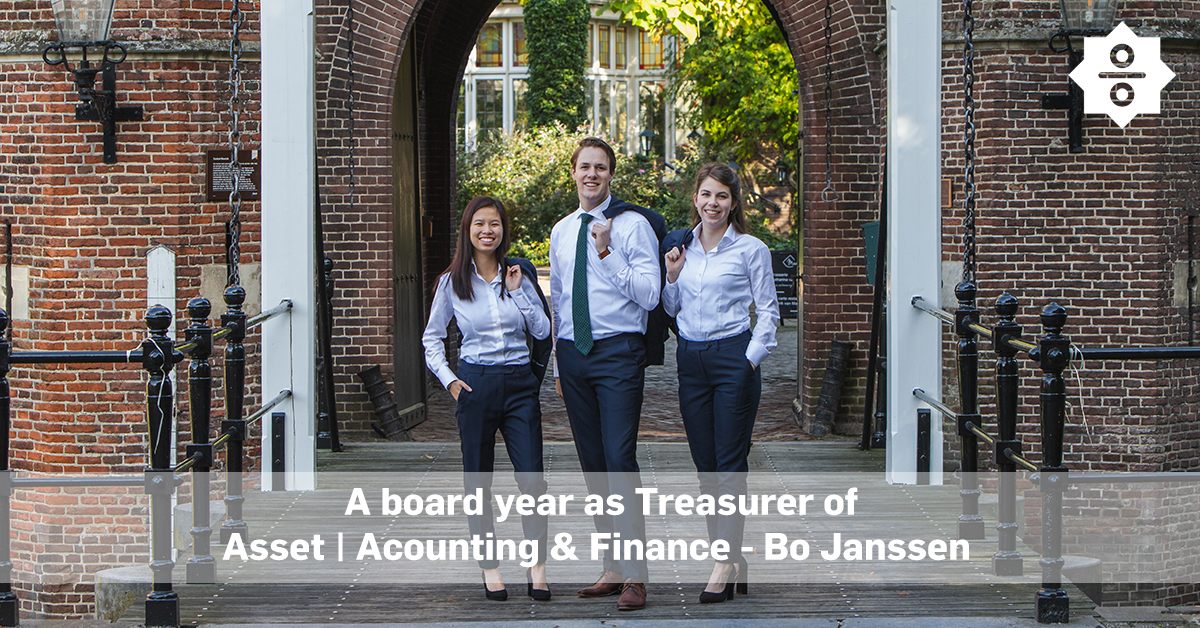
A board year as Treasurer of Asset | Accounting & Finance – Bo Janssen
For the Dutch version, click here As Treasurer, it is Bo’s responsibility to control the finances of Asset | Accounting & Finance. Besides that, she coordinates the Activities, Alumni, CityTrip, and Investment Night Committee. In this article, Bo describes what it means to be the Treasurer of Asset | Accounting & Finance and how she has experienced her board year so far. Why did you choose to do a board year at Asset | Accounting & Finance? When I started with my Bachelor Business Economics in Tilburg, I didn’t know a lot of people here. Because of that, I decided to become Active at Asset. I started by joining a committee at Asset | Marketing and because I enjoyed this a lot, I decided to join Asset | Accounting & Finance (A&F) as well. I considered doing a board year for quite some time, as I really enjoyed my time at A&F and wanted to boost my CV. Although I had not fully decided yet on which master I wanted to follow, Accounting and Finance seemed very interesting fields to me. To orientate better on which master to follow and to get in contact with firms in these fields, I decided to apply for the position as Treasurer of the board of A&F. What does your year look like and how is the experience so far? This year really feels like it’s flying by and when I look back, I already have great memories of the things we’ve done so far. The application procedure for the summer positions started in April. When I found out I was going to be the new Treasurer, the announcement couldn’t come soon enough for me and it was really hard to keep my plans for this year a secret. After the announcement, the transition period started in which I learned what tasks I was going to have as Treasurer. Because most departments within Asset switch boards in the summer, you start with a large new group in the Esplanade building in August. During the Announcement and Constitution Drinks, you will get to know your fellow board members of other departments, which will create a nice atmosphere at the rooms of Esplanade. When my board year started in the summer, I was still very busy organizing the studytrip to South Korea together with the StudyTour Committee. With the start of my new function, my responsibility and the number of tasks increased considerably and for some time I questioned if I could sufficiently do all tasks simultaneously. Eventually, this turned out fine and it came in quite handy that as Treasurer I had the overview of all the expenses and credit card usage during the StudyTour. However, I had to watch out for keeping the A&F card and my personal card apart while doing this. After a couple months already, the application of new board members was a discussion topic in our weekly board meetings. I felt like we had just started, so the idea of a new group coming was not on my mind yet. Therefore, it felt quite strange to me to look at a new Candidate Board with whom we were going to form the new board. Now that we have just started with the new board members, I realize how quick this year is passing by. Half a year has already passed, and suddenly we are the ‘older’ half of the board and soon we will start to look for the people who are going to replace us. Nevertheless, I do like this semi-annual board switch. The new board members bring in fresh ideas and I’m convinced we will make the upcoming semester a great success! What are your tasks as Treasurer of A&F and what does your day look like? As Treasurer you mainly focus on the financial situation and the administration of the association. To do this well, you must be able to communicate well with your fellow board members and the treasurers of the various committees. As Treasurer, you also meet with the auditing committee every quarter. They audit your financial administration and advise you about the financial situation of the association. This range in different tasks makes it quite difficult for me to describe what an average day looks like. Something that takes place every day is the fulfillment of my task list. At the start of every week, I set up a list of things I want to achieve the upcoming week and most of the days I start with the tasks that are on this list. What did you learn so far in your board year? Besides the responsibilities I have as a Treasurer, I also coordinate several committees. I really like brainstorming with the committees about setting up certain events and then working towards them. In this enjoyment I notice that it is quite hard for me to only coordinate the committee without taking on tasks myself as well, but I am currently working on finding my balance in this. Because you’re focused on various events, you’re always working on several tasks simultaneously. To keep these various tasks running, you must have a good overview of this. Additionally, I find it important to remain my own social life besides my board activities. Although it can be quite hard to plan this out, I think I’m getting better at it. Moreover, I am still undecided about which master to pursue. Initially I thought I had made up my mind, but lately I’ve started to doubt again. Therefore, I am happy that I postponed my masters’ choice and still have some time to orientate to find out what I find interesting. The events that A&F organizes significantly helped me with this. Due to these events, I met several companies and got a much better overview of the job possibilities that lie ahead. What is your greatest accomplishment? My committees! I enjoy working on our events with my committee members and I enjoy seeing everyone again at

Working at PwC
For the Dutch version, click here My name is Steffie Nuijts, I am 23 years old and I live in Tilburg. Since September 2018 I have been working as an Associate Accountant at PwC, the same place where I have written my thesis before finishing my studies. Next to working I am also busy with the Post-Master Accountancy at Tilburg University. After receiving my VWO-diploma in 2014, I chose to study Business Economics in Tilburg. I went to live in a house with different students and became member of a student association. During that time, I was still unsure about what kind of job I wanted to do, the only thing I knew then was that I wanted to do something with business and that I was good with numbers. Despite the busy student life, my bachelor’s in business economics went well and after a semester abroad in Sydney the moment to choose a master’s degree came closer. I decided to attend different activities from A&F and EBT and got to learn more about the different topics to study and about different types of companies. I applied together with a friend for the PwC Women’s Event in Amsterdam and this was the first time I got acquainted with PwC and its culture.At the event we got to know the people who work there in accounting as well as the recruiters. I immediately got to know people who could tell me exactly what a job in Accountancy is like and what you can expect from it. I stayed in contact with one of the people I met at this event and in little time I applied for an internship opportunity to write my thesis at PwC in Eindhoven. ”I knew pretty fast that I wanted to work for a Big-4 accounting company, the reason for this is because you get the opportunity to learn a lot and also a lot of opportunity to keep growing within the company.” During my internship at PwC I got to know a lot of people who also started the same year at PwC as me. What really got my attention during my internship was the informal atmosphere at the office, I liked this a lot. Thus, I decided to work for PwC immediately after my internship. Why PwC? I knew pretty fast that I wanted to work for a Big-4 accounting company, the reason for this is because you get the opportunity to learn a lot and also a lot of opportunity to keep growing within the company. The reason why I chose for PwC was eventually based on my instincts. I matched with the people who I got to know during my internship. The atmosphere and the culture were exactly what I hoped to get for my future job. My first year at PwC In September 2018 I started as an Associate at the Assurance department at PwC in Eindhoven. You start immediately with an introduction during the first two weeks where you get to meet all the others who are also starting at the same time at PwC from your office as well as from other offices in the Netherlands. Besides learning a lot here, you also get to know your colleagues in an informal way really fast. These first two weeks are also the start of a so-called Associate Academy: a 2-year training program where you will develop yourself with the help from a coach, a lot of working experience, internal trainings and social events. After the somewhat scary stories about working at a Big-4 firm, my fears were especially focused on the fun stuff that I was going to miss forever from my time as being a student. Fortunately, the opposite was true. Of course, people work very hard now and then, but I still have enough time for my busy social life and there are a lot of fun activities organized by PwC. Last year I went on a ski trip with PwC and we often have activities, drinks or sport events together for the whole office and the Christmas party is always a fun activity. Furthermore, the bond that you create with the others in the Associate Academy really becomes a strong one. We often go for a drink after classes on Fridays and we also go out often after a busy period at the university or work. My tips for Students What I want to especially advise you all as students: orientate yourself broadly enough! Attend as many activities that are organized as possible and get to know the organizations that you meet well. Talk to the people who are already working there and ask them for their opinions. Lastly: follow your instincts!
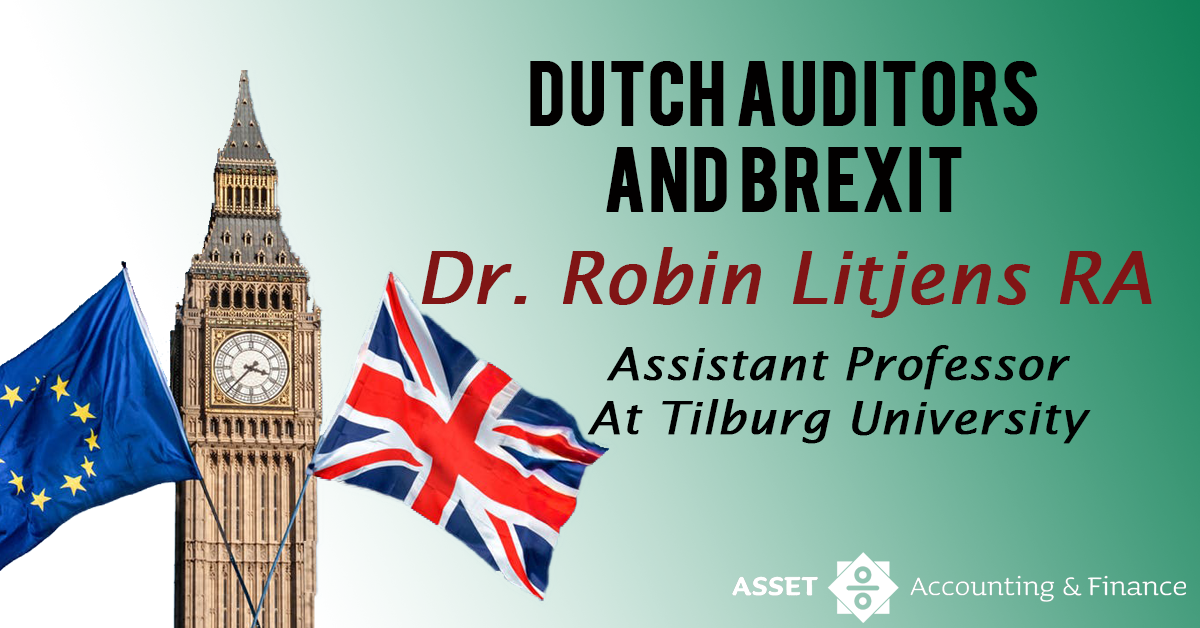
Dutch Auditors and Brexit
1. Introduction Obviously, Brexit could have a variety of non-client related effects for Dutch auditors. For instance, the auditor labor market in the United Kingdom (hereafter: UK) might be affected significantly, thereby changing supply of audit labor in the Netherlands. Or after Brexit, UK audit firms might not be able to operate in the Netherlands and vice versa (article 3A of the Audit Directive). This might affect competition in the Dutch audit market. Also, some audit firms could be jointly owned with UK owners. Dependent on the type of arrangement between the EU and the UK these ownership structures need to change. As these non-client engagements effects are broad, difficult to quantify, and depend on the terms under which the UK leaves the EU, I use the framework of an audit engagement to discuss some effects of Brexit for Dutch auditors. In paragraph 2.1, I start with a discussion the potential overall magnitude of Brexit. In paragraph 2.2 I turn to Brexit related audit risks. Paragraph 3 concludes. 2. Brexit and audit engagements 2.1 What is the potential overall magnitude of Brexit? When assessing the potential audit risks the auditor needs to understand the client and its environment (ISA 315 para 11). To understand the potential effect of Brexit, I first turn to a broader understanding of the total potential magnitude of Brexit on Dutch firms. At first glance, the scope of Brexit effects appears relatively clear. The UK is (after Germany and Belgium) the third biggest trade partner of the Netherlands. The Netherlands exports 40 billion euros to the UK and imports 20 billion euros (CBS 2018).(1) This is 8.0% of total export and 3.4% of total import. It goes without saying that to a varying degree, Brexit likely affects many firms commercially and operationally. Table 1 presents a top-5 of industries that have the most export to and import from the UK in value and percent of output. From table 1 can be concluded that industries affected in terms of value are different industries then the firms affected in relative terms. Moreover, the relative impact to industries is more homogenous then the value impact as indicated by the coefficient of variation for all the industries (not tabulated). This implies that to a certain extent each industry is affected. Also, firms that do not export to or import from the UK could be affected. For instance, a significant drop in export could lead to more domestic competition and accompanying margin pressures. To sum up, the product market for certain industries in the Netherlands will be severely affected by Brexit. “The scope to which Brexit can affect financial markets in a direct and indirect way is currently not clear.” However, the interconnectedness of the UK and the Netherlands is broader than product markets.(2) Firstly, services could be particularly affected by a no-deal Brexit. For instance, airlines and the hospitality sector where margins are small and volume drives profits (i.e. tight cash flow businesses) are directly threatened in both the short and long-term. Secondly, less is known about the impact of Brexit on financial markets. I give some examples. In the top-100 of investments of ABP (the Dutch pension fund for Civil Servants) the fourth largest investment are fixed-income investments in the UK, the second biggest currency risk is the British pound.(3) It is not clear what the effect of Brexit will be for pension funds. Similar exposures are expected with banks and insurance companies. Another example. London is the global leading financial center for over-the-counter derivatives.(4) OTC transactions (such as credit-default swaps, interest-rate swaps and currency-swaps) with a UK counterpart are probably affected by Brexit. This could be due to a lower creditworthiness of the UK counterpart or the value of UK-linked collateral. However, the scope is much larger than one initially would expect. As a vast majority of OTC contracts are governed by English law, resolution is subject to English courts. It is likely that even OTC contracts without a UK counterpart is therefore affected by Brexit. The big issue is that OTC contracts vary significantly, and it is difficult to renegotiate these contracts as the terms of the Brexit agreement, if any, is not clear. Taken together, the scope to which Brexit can affect financial markets in a direct and indirect way and it is currently not clear. Table 1 presents the top-5 import and export industries (2-digit SIC code) to the United Kingdom for 2018. More information at opendata.cbs.nl. The value of output is the total value of export to and import from the United Kingdom. Percent of output is the total value of export to and import from the United Kingdom relative to total value of that 2-digit SIC industry. 2.2 Brexit-related audit risks Auditing services are highly regulated to ensure a non-zero audit effort by auditors.(5) Therefore it obvious to analyse potential effects for auditors based on this regulation. ISA 315 requires auditors to understand the business of the audit client.(6) A client business risk reflects the possibility that an organization will experience adverse outcomes as a result of economic conditions, events, circumstances or management action/inaction (Knechel and Salterio, pp. 67).(7) Business risks are important to auditors as they inform the auditor on the effectiveness of the client risk management and the impact on financial statements. Brexit to a varying degree likely affects the economic, regulatory and business environment of audit clients.(8) Auditors need to assess whether clients have appropriately assessed, concluded and, disclosed relevant risks and uncertainties on Brexit. In table 2, I provide some examples of Brexit-related audit risks that are subsequently discussed below. “I believe it is key for auditors and audit firms to develop a consistent audit approach in response to Brexit.” I believe the first order economic effects of Brexit to firms is an increase in transaction costs and impaired market access. Firstly, a clear and direct impact of Brexit on import and export activity is an increase in transaction cost. Increases in tariffs, duties and a higher administrative burden are expected. In turn this
What happened last quarter? Q1: a recap
The first quarter of the new academic year is already in the past. In these first few months, multiple activities took place, related to both Accounting and Finance. This article will look back on these activities, with the chairman of each committee telling their story. They will discuss their personal experience on the process of these activities, from the start, the preparations, to the end, the actual event. Financial Business Dinner – September 26, 2019 *By Pieter Coenen* After working hard for the last 9 months, the Financial Business Dinner took place on September 26. The most important job for the committee was to find 15 firms that were eager to be a part of this dinner. Besides finding the firms, looking for an appropriate location for the dinner was necessary. After taking multiple locations in consideration, our choice fell on the same location as last year, restaurant “Hofstede de Blaak”. In order to prepare the students for the dinner, we offered an etiquette workshop prior to the dinner at Bonheur. After we confirmed the location, the firms and the workshop, we were ready to start the promotion. To promote the event in a different way than just giving out flyers, we extended a goodie together with each flyer. Besides the goodies and flyers, we had to design a poster. Once this was finished, the registrations were ready to be opened. After a period of intensive promoting, we were able to get many applicants for the dinner. When the registrations closed, we were ready to send the CV’s of the students to the firms. We received the firm’s preferences of certain students and then we had to figure out how to match these in the four courses of the dinner. When we finally solved this puzzle, the students and firms received the email with all the information about the dinner. ”The most important job for the committee was to find 15 firms that were eager to be a part of this dinner.” The day started at half past three with the workshop in etiquette. This taught the students the specific etiquette rules regarding a dinner. After this workshop, the committee welcomed all the students and firms and we were ready to start with the dinner. After each course a bell rung as a sign for the students to move tables, to eat the next meal with another company. After the dessert, I gave an expression of gratitude as the chairman of the committee, and Allard van Hees, the chairman of Asset | Accounting & Finance gave his speech of thanks afterwards. The evening ended with a closing drink, where the students got the opportunity to speak to the firms that caught there eye. Looking back on the Financial Business Dinner I feel proud on this successful edition of the event. I want to thank the fifteen participating firms, Accuracy, Achmea, DAF, Eiffel, Fagro, First Dutch Innovations, FrienslandCampina, Johnson&Johnson, Jumbo, Mars, Parcom, Pepsico, Rembrandt Fusies & Overnames, Van Oers Corporate Finance, and Zanders. Beside the firms, I want to thank my fellow committee members, and in particular the coordinator Steyn van Poppel for their help. Audit Activity – September 30, 2019 *by Wouter Janssen* After a little more than eight months of preparation, the very first Audit Activity took place on September 30, 2019. After careful consideration, the committee decided to organize a cocktail workshop. We thought this was the perfect way to be active in an informal way and to be able to network in the meantime. In addition, it was decided to end the evening with a dinner at Bistro St. Sjaak. In the meantime, the day of the Audit Activity was approaching, the goodie was being designed, the participating companies were announced, the promotional material was made, and the students were informed in advance about this new event. The participating companies during this edition were: De Beer, Govers, Mazars and Bakertilly. ”After a little more than eight months of preparation, the very first Audit Activity took place on September 30, 2019.” In the afternoon of September 30, the committee, followed by companies and students, gathered at Café Stoffel, where the cocktail workshop would take place. The enthusiastic CoCo employees taught us all sorts of interesting facts about cocktails, while the participants in the meantime enjoyed a welcome cocktail. After this, the students were divided between the four companies and the workshop started. A taste and smell test was carried out in succession, after which the participants could make and taste their own shots. After everyone had finished their shot, it was time to make their own cocktail. This turned out to be a test between the teams, as the team that could make eight cocktails the fastest could win a prize. The winning team eventually left with eight shake cups. After the workshop it was time for a dinner at St. Sjaak. Here too, the participants had the opportunity to network with the participating companies. During three courses, the participants enjoyed dishes such as shrimp croquettes and black halibut. After the dinner there was a short drink and the evening ended around 9 p.m. In retrospect, as chairman of the committee, I look back on a successful afternoon and evening. Hereby I would like to thank my fellow committee members Shanti and Thomas as well as the coordinators Daniek and Nina for their effort in recent months. I also want to express my gratitude to De Beer, Govers, Mazars and Baker Tilly. Finally, I want to thank the participating students for their presence. Perhaps until the next event!
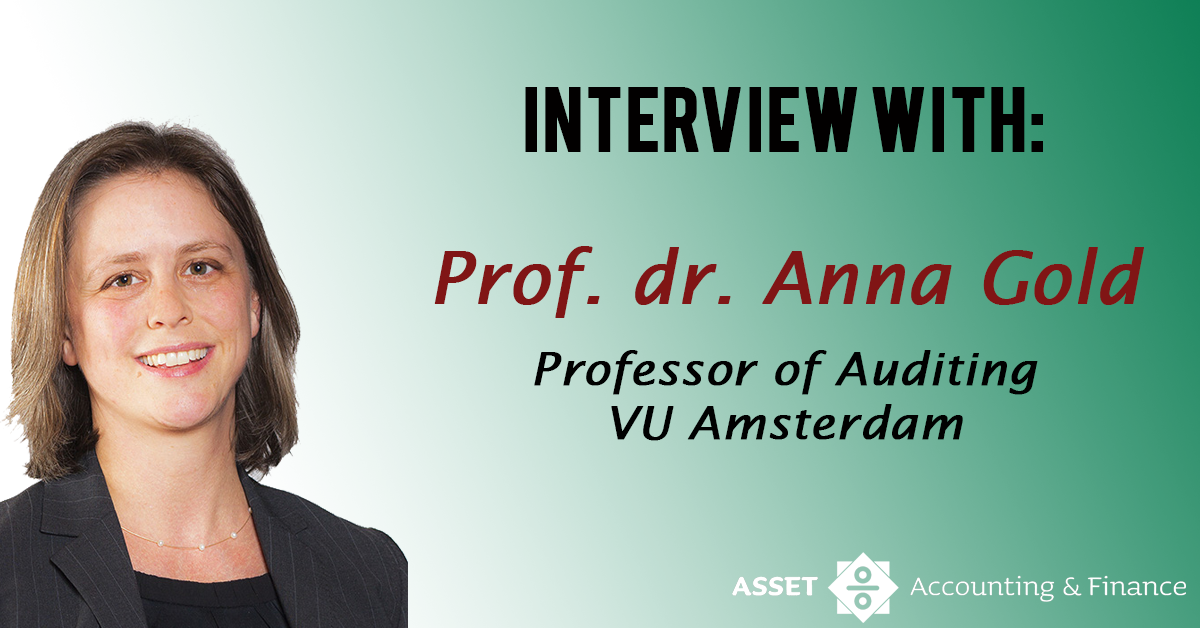
Interview with prof. dr. Anna Gold
In the article “Auditor Errors: Avoid Like the Plague or a Learning Opportunity?”, Anna Gold writes together with Oscar van Mourik, Philip Wallage and Arnold Wright about how auditors and audit firms deal with errors and the extent to which they learn from them. Can you tell something about yourself, your current position and your career? I am currently a professor at the Vrije Universiteit Amsterdam, where I teach auditing courses to third year-bachelor’s and master’s students. I also keep myself busy with research. I try to include research topics in my lectures, by trying to find a balance between theory and scientific research. Generally, I am interested in the behavior of auditors, which is influenced by multiple factors. For example, I am currently investigating the triangular relationship between auditors, client management, and the audit committee. Some of my research focuses on how auditors deal with errors. In the article “Auditor Errors: Avoid Like the Plague or a Learning Opportunity?” you say there is a difference between making an error and committing a violation. Do you think it is possible for accounting firms to clearly distinguish between someone making an error and someone committing a violation? There is certainly an important difference, but this distinction is, unfortunately, not always made. An error is a situation in which the person wanted to reach the goal, but failed to do so due to an unintended action. A violation, on the other hand, is an act that is intended. It is not always possible to make a clear distinction. In very extreme cases, auditors may even cover up violations by labeling them as errors. However, I don’t believe this happens very often. And I don’t think that’s the biggest problem. A much more common problem is that an auditor, unknowingly, misapplies the rules or standards in practice. From a legal point of view, this is a violation. However, since the violation was unintended, it should be seen as an error and something the individual and the organization can learn from. This does of course create a “gray area”. “Making mistakes is human. It is important that we dare to talk about errors and learn from them.” Then there is another area of potential confusion: the concept of “error” versus the concept of “risk”. A large part of the audit process is about risk assessment. How high is the risk of a material misstatement in a given account? Such assessments are made on the basis of information that is currently available. With hindsight and new obtained knowledge, the risk should perhaps have been assessed much higher. In the case of an oversight inspection by the AFM, the audit file will be reviewed often months or even years later, and then, with hindsight, interprets the inadequate risk assessment as an “error” or even a violation. This example shows how difficult it is to clearly distinguish between the concepts of risk, violation, and error. Do you believe that there is a risk for accountants to be overly penalized for committing an error that is considered a violation, but where there has never been any intentional act? Can you explain this? The expectation that you will be punished for making mistakes, determines your course of action and openness to admitting errors. The sector is still too deep in the mindset that a mistake is something bad. There are many preventive measures, but there is little understanding for the human aspect of the profession. It must be possible to admit an error without the organization or the regulator immediately considering it as a violation. The moment you are afraid of the consequences of making a mistake, you are willing to do everything you can to cover up this mistake. This prevents the possibility of learning from errors, since you tend to ignore or even cover up your shortcomings. Moreover, you prevent in all respects the possibility of also learning from errors at the organizational level. Only if you are open about it, a company has a chance to analyze the root causes of the error, and correct any systematic errors. Unless this happens, others will not learn from the error you made. This is an important message that nowadays is starting to get through to organizations who are becoming increasingly aware of the importance of a learning culture. Do students at the start of their accounting career have to fear making mistakes in the workplace? How should they handle this? Our research shows that as a trainee or assistant accountant you hardly have to be afraid of making mistakes. You are still in a learning process and that is also recognized by your environment. However, you get promoted to supervisor quite quickly. As you get promoted, it becomes more risky to make mistakes. Then, it is looked at with less understanding. At the same time, the higher the rank, the more you need to give a good example: a manager or partner should talk openly about his or her mistakes in order to keep the threshold for admitting errors low. After all, making mistakes is human and it is important that we dare to talk about errors and learn from them. So, what is especially important as a starting accountant, is that you have to be aware that everyone makes mistakes and, above all, you have to talk about your mistakes. Errors can be a useful lesson for the future, not only for yourself but also for others. You may not immediately run to a partner of the firm in the event of a mistake, but talking to colleagues also creates a culture where mistakes are permissible. As long as you will make a learning moment of your mistake, the environment will respond positively. Are you interested in actual topics in the accountancy sector? Do you want to meet your potential future employer? Register yourself for Accounting Insight 2019!
