


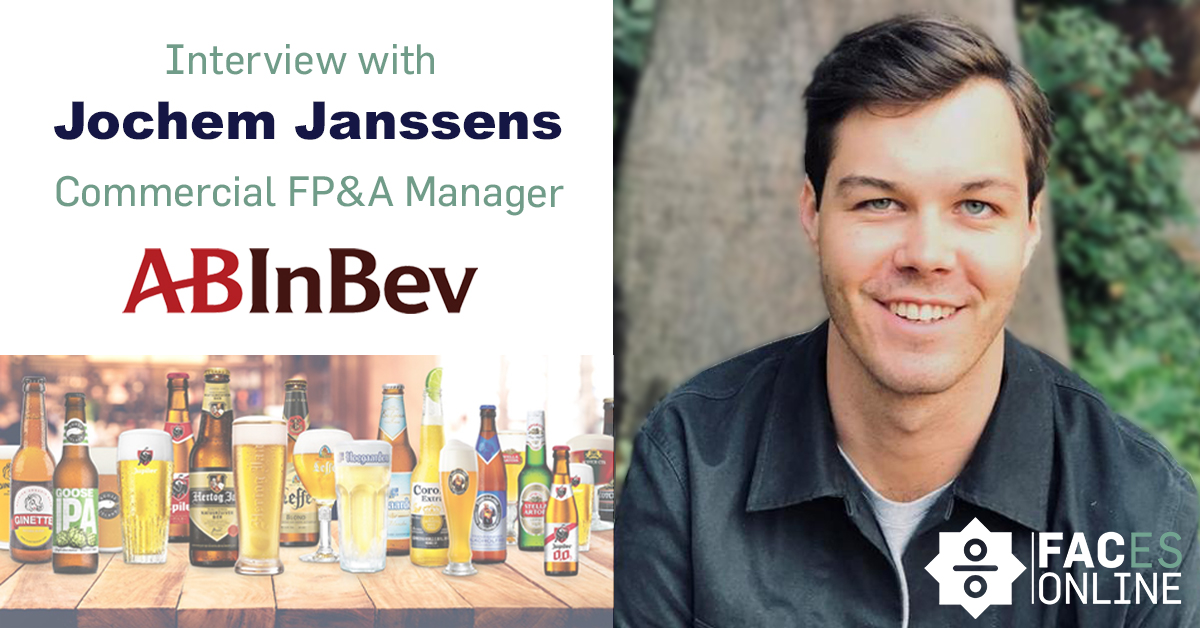
For the Dutch version, click here Jochem Janssens has been Commercial Finance, Planning & Analysis Manager at Brewery AB InBev for the past six months. AB InBev is one of the world’s largest players in the field of beer brewing, mainly known for many famous brands, including Hertog Jan, Jupiler and Corona. In this interview, he tells more about his career and the impact of COVID-19 on AB InBev. Can you tell something about your career? I was born in the Netherlands, but when I was two months old, I moved abroad with my family. Most of my life I have lived abroad, including Singapore, Dubai and England. I lived in Singapore for eight years and spent my high school life there. After that, I moved to Canada for three and a half years to earn a bachelor’s degree from McGill University. During my Bachelor of Commerce I got the opportunity to do three different internships in three summers. First at Unilever, then at IndusInd, a bank in India, and my third internship was at BBDO, at a Canadian branch of the American marketing company. After these internships, I joined AB InBev in 2018 as a Global Management Trainee What kind of impact did growing up in many different countries have on you? Meeting many different people from different cultures has brought me the most value. However, nowhere in the world does it feel like home and your friends are spread all over the world, which makes it socially more difficult. Living abroad has its pros and cons, but I gained a lot from the many life experiences. I know who I am, what I want and which norms and values I want to apply in my life. How did you experience the transition from studying to working? The biggest difference was that as a student you have much more control over what you do with your time. When you start working for a company you have to adapt to the norms and values that prevail in a company. Some organizations are much more flexible than others. I am a social and interactive person, that is why I like team sports. I have the same feeling in my work, working together with a large team on a subject, I like that a lot. The special drinks you produce, which people enjoy very much in a social environment. That’s one of the best things about working for a beer company. What attracted you to do a traineeship at AB InBev? The traineeship I did at AB InBev is an intensive ten-month program, where you learn a lot about the different departments in the company. You do projects in supply, sales, marketing and e-commerce. That was a fantastic learning experience for me, because it gives you the opportunity to see various sides of a company up close and you see how all the departments come together. “The special drinks you produce, which people enjoy very much in a social environment. That’s one of the best things about working for a beer company.” What does your work as a Commercial Finance (FP&A) Manager look like? In my role as Commercial Finance Manager I’m actually the spider in the web. I’m certainly not the central point of the company, but mainly the person who brings everything together. My specific role is financial planning & analysis, which means that I am responsible for reporting the financial figures of the Dutch company. My role consists of two parts. I work in a cycle that starts in the first week of the month with booking all costs and revenues of the previous month. After that, I start analyzing the performance of the previous month. Then I switch to the forecast part, in which I work together with the hospitality industry and retail sales directors to determine their forecast for the rest of the year. Then you bring together the analysis of the past month and the forecast for the upcoming months, with which you will build a forecast together. This forecast shows you what the company can expect for the coming year and this will be adjusted every month. In order to make the forecasts as accurate as possible, data from different departments is needed, in other words, a good collaboration. What effect will the current crisis with COVID-19 have on Beer Brewery AB InBev? We are a company that works with two major channels, namely the hospitality industry and the retail industry. Those two are always the balance for us in the company. The impact of COVID-19 has mainly affected the hospitality industry, where a lot of restaurants and bars had to close down. This means that people have only limited opportunities to consume beer. This is very painful for us, because the hospitality industry is a segment on which we rely very much in terms of performance. One ray of hope, however, is that a lot of consumption from the hotel and catering industry has flowed on to retail. For us, it was important to find ways to support entrepreneurs in the hospitality industry during the crisis. This often concerns an individual, namely an entrepreneur who has set up his own business. Approximately 10% of our hospitality relationships have a rental construction with us. Besides, we are not owners but intermediate tenants, we do not own any premises ourselves. To accommodate our tenants during this crisis, we have offered them a discount on their rent. In addition, we offered them to return the already sold tank and cask beer and to credit them on their next order. Who are AB InBev’s main competitors? Not only in the Netherlands, but also in the rest of the world, that is of course Heineken. Certainly when it comes to beer, but I think it is always nice to work as an AB InBev employee in our competitor’s largest home market. You are the underdog and you have to compete against the bigger brewer. I think, if you

A successful application: what does a recruiter pay attention to?
For the Dutch version, click here Nowadays it is very important to make a good impression with your resume. How do you make your resume and motivation letter stand out? Which activities are recommended to do next to your studies? Three recruiters, Lisa (WVDB Adviseurs Accountants), Lisette (Nielen Schuman) and Wouter (PwC) share their views. What do they pay attention to? And to what extent do their opinions differ? Find out in this article! What makes a resume good? Both Lisa, Lisette and Wouter find clarity very important in resumes. First of all, Wouter indicates that many students nowadays have fancy resumes with colors and visuals, but sometimes at the costs of the clarity of the resume. “A recruiter actually wants to be able to see at a glance who you are and what you have done,” says Wouter. Wouter’s advice is to look at LinkedIn to see how your digital resume is presented. However, Lisa thinks that you should present a resume in an unusual way. “You have to make it personal and eye-catching, but keep it businesslike. You can think of color, icons or symbols”. According to Lisette, it’s the trick to find the balance between telling what’s important, but also keeping it clear and organized. “Think about what skills, knowledge, and experience are important for the specific job and let these be highlighted on your resume.” Lisa adds that you should, if relevant, briefly point out what your tasks and responsibilities were and what successes you have achieved. “Possibly supplemented with a short profile sketch and a representative photo.” Both recruiters do indicate that you should be careful not to make your resume too long, i.e. no longer than 1 or 2 pages. “Also, not superfluous: check your resume on layout, spelling, and grammar”, Lisette adds. However, Lisa and Lisette have different opinions about the chronological order of your experiences in your resume. According to Lisa, a clear structure of experiences consists of years in chronological order. However, Lisette has a different opinion about this: “Write things like your education, internships, work experience and/or extra-curricular activities per section in a-chronological order, so your most relevant experience at the top”. “It’s not just about the experiences, but also about the choices someone has made.” What makes a CV distinctive? According to Wouter, it is important that you put things on your resume that have added value to your current individual profile. “Make sure you are critical about this, because too much information might cause a recruiter to be distracted from the things that really add value. You could describe what you have done in addition to your studies, what extracurricular activities you have participated in, whether you have studied abroad and whether you have done any volunteer work”. Lisette believes that a resume/CV stands out when you see that someone is interested in the field. It’s not just about the experiences, but also about the choices someone has made. A resume can already give a nice insight into whether there is a fit with the organizational culture. For example, you can look at the kind of organizations where you have worked or done an internship, but also what hobbies and interests you have. How you come across in your motivation letter also counts. In addition, she expects at least one relevant internship, side job or participation in a committee, investment club, case day or other matters that show the interest in corporate finance, if you want to apply at a company like Nielen Schuman. It is therefore important that your choices show that you are interested in the field, have specific experiences, and have developed relevant skills. What does a good motivation letter contain? Lisette thinks a good resume is important, but she indicates that a good motivation letter is just as important. If your letter does not show a strong motivation or if it is badly written, you may still be rejected. According to Lisette, your letter should show that you’ve really thought about why you’ve chosen a field of study and what interests you specifically about the company you’re applying for. In addition, she thinks it is important that you further explain what you have done so far in order to develop the right skills for the open position. Again, check your letter for spelling and grammar. It is advised to ask someone to read your letter and give feedback. “Your future employer is particularly looking for a student who has made choices for a reason, with a certain goal. So, think carefully about what YOU want and why you want it.” What are good extracurricular activities to do next to your studies? At the beginning of the bachelor’s phase, Lisa recommends that you first strike the right balance between study and private life. “Often at the start of your academic year, you have to get used to a new environment, a (possible) student residence, and a lot of new information.” As you come to the end of the first academic year, or have just started your second year, she would advise you to orientate yourself further and further and look for a possible continuation of your studies in the direction that suits you best. Wouter advises you to be active during your studies at a study association in order to further explore your network, but also your field of study. “Be even more active in the final years of your bachelor studies, because that can be decisive for your future internships during your master’s degree. Go to as many events as possible from Asset | Accounting & Finance, the university or to organizations that organize events themselves. Ask a lot of questions and experience where you feel at home.” If possible, Lisa would definitely recommend a board year. “During a board year you develop personal skills and get in touch with various offices. This provides a good basis for forming a picture of the diversity of possibilities after graduation”. According to Wouter, however, it is very important to
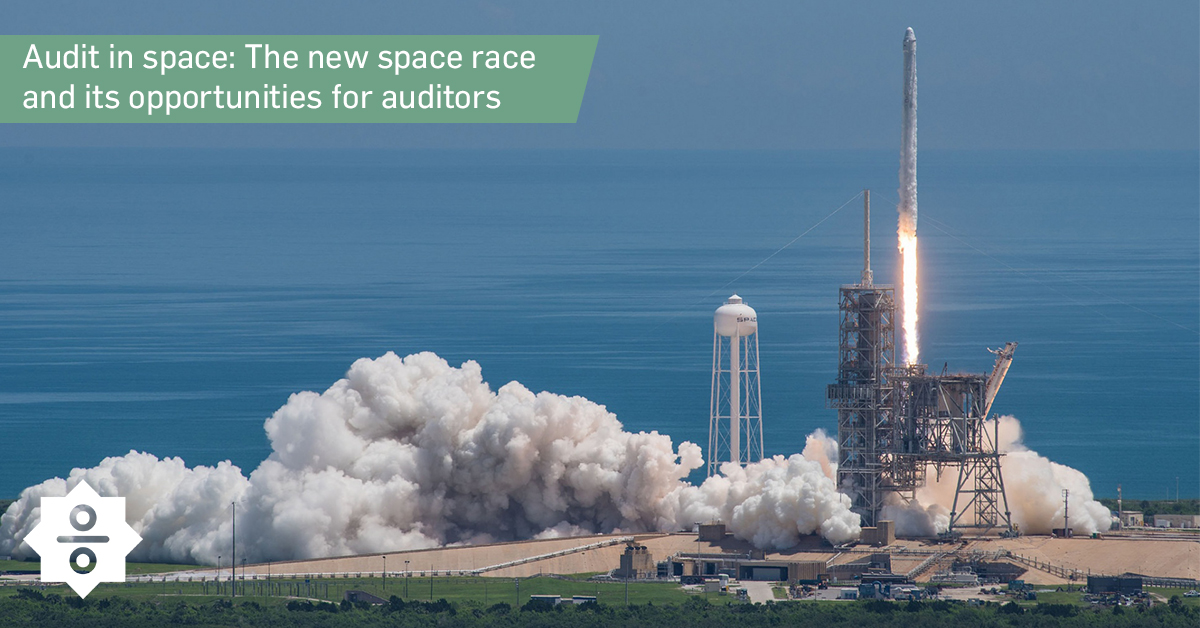
Audit in space: The new space race and its opportunities for auditors
For the Dutch version, click here Over the last couple of years, more and more private entities are getting involved in the space industry. The commercialization hereof, new interests from different countries, and further innovation are spurring on new demand to explore the space industry. This demand only keeps increasing while the resources in space are limited. Because of this, a new space race is set to be taking form [1]. The emergence of this industry not only brings opportunities for new technologies, but it will also have a large impact on other industries such as accounting, taxation, and finance, to name a few [2]. Within all these industries an interesting one to look at is the auditing industry. One of the main roles an auditor is known for, is to independently give an opinion about whether companies’ financial statements are constructed with a certain level of confidence, according to the standards that it should follow. The combination of auditing and the space industry leads us to multiple questions. How will auditing look like in the future space industry; what obstacles does it face; and how likely is it that an auditor of today, with no prior experience in the space industry, will have to audit a space company in the future? But first of all, is there demand for audit in space? The current space industry is said to be worth around $330 billion USD. In addition to that, the future growth rate is expected to be immense. Bank of America predicts that in 30 years this industry will be worth $3 trillion USD [3]. This figure is a result from many different sub-industries in the space industry. Aside from the popular resupply missions to the International Space Station (ISS), other sub-industries have also been around for some time and new ones are still being born. A current large sub-industry is the transportation business for satellites and other devices. This business segment uses rocket launches to take care of transportation for the satellite and communications industry [4]. This is currently dominated for U.S. launches by SpaceX (founded by Elon Musk) and United Launch Alliance (a joint venture between Boeing and Lockheed Martin) [5]. Next to this, some new markets are; space tourism (Virgin Galactic founded by Richard Branson and Blue Origin of Jeff Bezos), space manufacturing, the creation of new space stations, and mining in space [6] [7] [8]. “If future investors are willing to invest in the mining of asteroids, how would they know with certainty that these asteroids exist if most people do not even own a telescope?” All of these ambitious projects cannot happen without facing some hurdles. To be able to bring these projects to life would require a large amount of capital from investors, and a lot of trust from clients. An important thing for investors would be to have as much trustworthy information as possible about a firm, before making an investment. Also clients such as governments from different countries would want to be sure that they are dealing with a responsible company. Both of these challenges can use an auditor to help solve them. So the auditing profession does seem to have opportunities in space commerce. Now that we know there are opportunities, what challenges can we expect these opportunities to bring with them? How do large distances and audit independence play a role in this setting? Firstly, a great challenge for auditors is that they are not able to easily conduct work physically in space (yet). This is due to the high costs that this incurs [9]. If future investors are willing to invest in the mining of asteroids, how would they know with certainty that these asteroids exist if most people do not even own a telescope? Since we cannot see these asteroids in person, there could be discussions whether to treat these asteroids as a non-physical asset in the audit process. Thus, the auditor would not be present to see the asset personally. The feat of auditing non-physical assets is a challenging one, and cases such as the Wirecard fraud can certainly prove this [10]. “ Just one launch may be the decisive factor of a space company being very successful or disappearing for good.” Secondly, the audit independence will also be a great complexity, because there are not many people with industry specific knowledge in the space industry [11]. Thus, it will be hard to find someone to independently judge certain operations and who does not work for the same company. When it comes to counting inventory in space it will be expensive to send an independent auditor to do this in the first years. Because of this, more reliance will have to be put on modern technology and the integrity of astronauts. However, to get more confidence in this situation in the future, more accurate sensors and technology would have to be developed to count the assets and inventories in space. This will lead to a greater reliance on highly technical instruments that auditors will have to trust and audit as well. This will in return also push auditors to expand their knowledge in areas outside of their current field. What role does the risk factor play when auditing in space? If there was one thing that makes the space industry so different from an accounting perspective, it would be the amount of risks that it carries. Some consider it to be the riskiest and most difficult industry to operate in [12]. Just one launch may be the decisive factor of a space company being very successful or disappearing for good [13]. Also, just one small error with a bolt can lead to a whole rocket exploding [14]. This brings even more challenges for the audit industry to tackle. Because of the high risks, quality control is of utmost importance. To have a good overview of quality control a good internal control needs to be in place. This will prevent unauthorized personnel from making unauthorized actions and minimizing mistakes. Besides
MSc Accountancy: Master File vs. Thesis – what’s the difference?
For the Dutch version, click here Over the years there have been many debates about whether a thesis at the end of a graduate’s education actually helps him/her in becoming a better employee in practice. Many have argued that a thesis can improve the skill set of the student and enhance his/her capabilities, while others have argued that it adds no extra value to what they will eventually end up doing. This has been the case in the accounting sector. Tilburg University has responded to this by taking a different path than other universities when it comes to writing a thesis. They have looked to improve the link between students and their future job. This has led the MSc Accountancy at Tilburg University to introduce the MSc File Accountancy, better known as the Master File, to replace the thesis of the graduate accounting students since the academic year of 2019-2020. Master File You might ask yourself, what is the Master File; and what makes it so special? The Master File is a more practice-oriented thesis but with a clear academic basis, and consists of three parts, namely a Business Application, a Replication Study and a Research Note. The Business Application focuses on a real-life problem experienced by a selected company. This company is then given advice through the use of published academic research of which the findings are applied to your individual case. Hence, this covers more of the ‘literature research’ that you would have ought to do in a ‘regular’ accountancy thesis. In the Replication Study students have to select an already published research paper which they will have to replicate with a well-motivated variation in the context and/or time of the study. This part of the Master File is meant to cover and train your data analytics skills which are tested in the latter part of a regular thesis. The Research Note, the third report, approximates a traditional thesis as most of us know. However, it has a shorter length than the traditional thesis as it is meant to be briefer. The goal of the Research Note is for the student to come up with a creative idea for a new research and to develop a plan on how this would be executed. Hence, the entire research should not be conducted, but the plan should be substantiated with literature research and the student should assess the appropriate data analytics that ought to be used. These three components form together the Master File. The first two components each weigh 25% of the final grade and the third component weighs 50% of the final grade. Furthermore, it is important to mention that each component links to a different field within accounting. For example, you can conduct your Business Application in the setting of Management Accounting; your Replication Study in the setting of Financial Accounting; and your Research Note in the setting of Auditing. Main Differences Nevertheless, after conducting all three components, it is hard to try to find a clear difference between a regular thesis and the Master File. The main differences lie in the context that it is given in and in the skills that they focus on. The Business Application brings you in direct contact with the practical world as students will have to solve a real-life problem solely based on academic literature. This makes it clear that the Business Application pushes students to get in direct contact with the practical world, which is not the case for the regular thesis. The Replication Study focuses more on the replication of a study as to where a regular accountancy thesis would at least need an add-on and a clear contribution to the academic field and/or the practical field. As for the Research Note, since you are not conducting an entire thesis, with that meaning that the execution of empirical tests are limited, (though they must be planned out), the main difference lies in the execution of the project. Pros and Cons After having interviewed several students¹ that have completed the new Master File and other students that have completed the ‘old thesis’, they have named several pros and cons to the new Master File towards the ‘old’ thesis. One pro that has often been accredited by the interviewees was the set-up of the Master File. Most students can agree that conducting the Business Application and the Replication Study before the Research Note has helped them a lot. The reason for this is because they were able to apply the skills that they have learned in the first two components of the Master File on to the third component. Next, students were keen to mention that they appreciated the more practice-oriented setting that the Master File has brought. “Furthermore, almost every student interviewed also mentioned that a big pro was having to learn three different accounting subjects against just one.” Furthermore, almost every student interviewed also mentioned that a big pro was having to learn three different accounting subjects against just one. This contributes to a broader knowledge within the field of Accountancy and has also contributed to increasing their expertise in all three areas as opposed to just one. Also, one student conducting the ‘old thesis’ mentioned that she was particularly jealous of the students following the new Master File. “The skills that they have gained while conducting the Replication Study was much more profound than mine. I felt like they really had less obstacles when conducting the Research Note compared to me when I was conducting my ‘old’ thesis”. Lastly, some students really liked the idea of spreading the workload over the entire year. However, this also contributes to a con of the Master File since not all students really appreciated this. “Having your workload spread-out throughout the entire year may have its benefits, but it can sometimes get really busy when you have to follow your regular courses next to it.” Moreover, students have mentioned that they would have appreciated more guidance during their second assignment, which was

Auditing in the Caribbean: An opportunity of a lifetime
Introduction On an island 8000 kilometers away from the Netherlands, where the sun always shines and where the average rainfall is less than 20 inches a year, there is a place called Aruba. Aruba is an island that forms part of the Dutch Caribbean and is part of the Dutch Kingdom. Many people are familiar with this island due to its beautiful beaches and friendly people. An ideal vacation destination that one of your acquaintances or relatives always talks about. Though, for some people, this place is considered home, which means that ‘real-life’ jobs also exist here. Reading the word auditing in the title may stir some confusion. What does this island have to do with auditing? What in the world would people audit on such an island? Coconut shacks? Jet ski rentals? Not quite. Aruba is known for its tourism industry and hence has a lot of commerce business on the island. Consequently, this stimulates the need for auditors on the island. On Aruba, the profession of auditing is mostly stimulated through endogenous incentives. Banks are the ones that are the most likely to ask for an audit to be conducted, however, there are also shareholders that require this sometimes. All of the hotels and activities that a person makes use of as a tourist have to be audited as well. Though, what is so different about auditing on the island of Aruba especially if one were to work there? In this article, Mr. Edsel Lopez RA and Dr. Robin Litjens RA guide us through the world of auditing on Aruba. Not only do they talk about the differences in the field of auditing, but they also talk about their experiences as an auditor there. One with a local background, and the other as an expat. The Setting on Aruba Mr. Lopez, current partner at Grant Thornton (former partner at PwC), is a well-known accountant on the island with more than 20 years of experience working on Aruba. He has been in the field of auditing ever since he completed his studies at Tilburg University. Lopez started his career in audit at Coopers & Lybrand in Amsterdam after completing a master’s degree in Administrative Information Science, at Tilburg University. Afterwards, he proceeded to obtain his post-master Accountancy degree at Tilburg University as well. Later, after working for a couple of years in the Netherlands, he then moved back to Aruba to proceed with his career. “As an auditor, you become much more of a generalist because you ought to audit many industries with minimum companies to compare with.” Looking out of his office right outside to the main road on Aruba with coconut trees waving after experiencing a heavy gust, Lopez mentions that the auditing scene on Aruba is to be looked at from a helicopter point of view. “There aren’t many companies in each sector on Aruba, for example, we barely have two complete hospitals on the island.” “As an auditor, you become much more of a generalist because you ought to audit many industries with minimum companies to compare with.” Lopez states that an auditor on the island of Aruba experiences a lot more from a bigger standpoint than the average auditor in a bigger city. Also, with minimum people to carry all the workload, the auditor tends to be placed at a much higher level very fast compared to if he/she were in a bigger city. However, there are other factors that are an outcome of a small island. One must note that there are approximately 120.000 people living on the island. So, one thing that becomes really important is your soft skills. How are you going to deal with a situation where you might meet your engagement client in the supermarket? Are you going to ignore his questions about the engagement and try your best not to create a social bond with him to keep your audit independence? Or are you going to deal with this differently? Hence, you are encountered with challenges that you are less likely to encounter in a big city or a big country where there are millions of people living. A different setting brings its challenges. However, coming from a point of view from someone who has spent a big part of his career on the island can be a bit biased. So, how did an expat experience this? Experience from an Expat During a cold winter day in the Netherlands, where the weather is all grey and it hasn’t stopped raining for the past couple of hours, sits in his office at Tilburg University, none other than Dr. Robin Litjens RA. Litjens is an assistant-professor at Tilburg University at the department of Accountancy. Though, before starting his career in academics, Litjens had been an auditor in practice. After completing his studies, and while he was already working for a couple of years, Litjens looked back at never having the opportunity to go abroad during his college years. “During my time studying, it was not so common for a student to go on exchange. Things didn’t go as easy back then.” This had left Litjens with the desire of moving abroad for his career someday. After going on vacation to Aruba, Litjens spoke with some people about the opportunities there. He immediately knew that this was the place to be. “It was not only the atmosphere that has made me attracted to Aruba, but also its people. I was on vacation and asking strangers about opportunities and people were already offering me positions as a business controller in the then newly opened telecom company Digicel.” However, Litjens wanted to remain in the auditing scene and got to transfer from KPMG Netherlands to KPMG Aruba. “To my surprise, I was almost immediately in a position where I had to make decisions on a higher level than which I had to make in the Netherlands. Some of these decisions entail decisions on what was feasible for the engagement(s) and what could
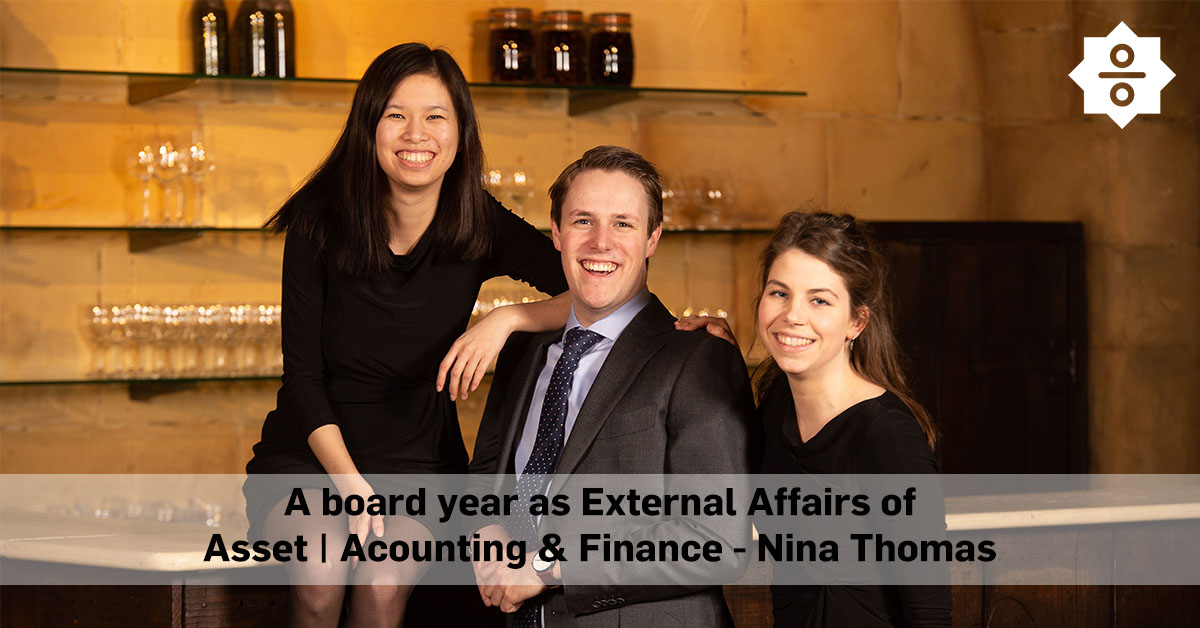
A board year as External Affairs of Asset | Accounting & Finance – Nina Thomas
For the Dutch version, click here As External Affairs, Nina is responsible for the contact with current and future partners of Asset | Accounting & Finance. In addition, she coordinates the Accountancy Cycle, Accounting Expedition and Orientation committee. In this article, Nina explains her function and her experience as an External Affairs of Asset | Accounting & Finance. Why did you choose for a board year at Asset | Accounting & Finance? As a committee member of Asset | Marketing, I organized a fantastic trip to Malaysia during my second year of my bachelor. However, I did not think about a board year back then; I wanted to go on exchange and finish my bachelor’s in Business Economics. Only during my exchange in Sydney, I began to think more seriously about it. I’m not sure whether the reason was my carefree student life which suited me well or my personal development growth, but a board sounded more and more attractive. This feeling became stronger during my time as a member of the Financial Business Dinner committee of Asset | Accounting & Finance (A&F), which felt very comfortable. Another reason which contributed to my choice was the difficulty of choosing the right master. However, as someone who is known for doubting a lot, it is not a surprise that I was in doubt about this decision as well. After several conversations, my doubts turned out to be unnecessary which led me to the well-considered decision to apply. The only decision left for me was which function within the board I wanted to fill. Firstly, I was thinking about becoming Treasurer of the board, as I had an affinity with numbers and making budgets. However, a board year is meant to step out of your comfort zone. Therefore, I decided to apply for the position of External Affairs (External). What does your year look like and how do you like it? The year began with a full agenda. During the day, I visited our partners to discuss our cooperation. During the evenings, I was busy with Announcements or dates with other boards and in between, conveyance and policy sessions were planned. I got to know the organizations and recruiters, which improved our collaboration during the year as well as my perspective on different sectors. The Financial Business Dinner took place at the end of September, and soon the events which I coordinated as part of my board position took place. This resulted in greater a responsibility, but also a feeling of being proud of the committees as well. The peak of ‘my’ events happened in February/March. As summer External, I was responsible for the organization of the Finance Day, Master Experience Days and Accounting Expedition. These events all took place within the period of one month, which tested my time management and list of priorities. It is, therefore, gratifying to see that students appreciate our events and use them to build their network. In the end, that is what our association stands for; connecting students with their potential employer. Because there is always something to do, time flies by. Beforehand, I was wondering how I could be busy for seven hours a day; right now, I ask myself how it could be that the day flew by so quickly. Even weeks flew by quickly, and I feel like we have just begun the board year. I think it is difficult to summarize my experiences within 1000 words or to give just one answer. ‘Good’ is not sufficient, as a board year is something you have to experience. Therefore, I am very happy with my choice. And my doubts… those have been replaced by doubts regarding the choice of a menu (it is still a learning process). What are your tasks as External Affairs? As External, you are the first contact for companies. You work together closely with the other External in order to provide companies in their needs. The conversations during the summer form the basis and these are supplemented with new partners. Via either physical appointments or appointments by phone, you determine whether there exists a match between what companies search for and what A&F offers. Sometimes, you have to say ‘no’ and there will be no match. This can change, therefore maintaining a good relation is essential. The same holds for existing partners, you want to keep those satisfied. You are building a network which could be important later on in your career. “Here, it does not really matter whether you are a quiet person in general or someone who prefers to step forward. As long as you are social and open-minded, it is alright.” It is great that my position within the board emphasizes the importance of soft skills. Keeping contact with A&F partners improves your communication skills and it allows you to learn how to present yourself and A&F well. You will learn these skills quickly enough. Here, it does not really matter whether you are a quiet person in general or someone who prefers to step forward. As long as you are social and open-minded, it is alright. Also, you do not have to be a professional in small talks. Moreover, you should not be afraid to bring or receive less positive news. These could be tough conversations, and it is your task to resolve these in the right way. Solutions will differ, yet each situation requires flexibility and rationality. Although you will be the point of contact, fortunately, you are not alone. My skills regarding crisis management have clearly improved and I am proud when looking back at how I solved certain situations. What does your average day look like? An ‘average’ day does not exist, yet there are recurring occasions such as committee or board meetings, keeping social media channels up to date or adding vacancies on Career Platform Tilburg. In addition, I spend quite some time keeping my mailbox up-to-date and making phone calls (or receiving voice mails). However, this is just a
