


For the Dutch version, click here A common problem you may run into; “You just graduated, now what? ”. This article discusses different options, through an overview and with the help of experts who have faced the same problem. I will tell you more about the considerations you can make and give tips on making a good decision. The world is developing at a rapid pace and tasks are increasingly performed by computers. In addition, the opportunities for newly graduated young professionals are also increasing. Some starters, without a clear direction, storm onto the job market. Others, on the other hand, follow a strategically mapped out path. With countless options, such as following an internship, a starter job, a traineeship, or a work-learning program (RA/RC), there are many options. Ultimately, there is only one aspect of the decision-making process that is really important: the decision must feel right to you. But what do you base it on? I have listed several points for you through various interviews. Internship After all, an internship, a less obvious choice is something you do during your studies, right? Of course, that is an option, but what if you skipped that step and still want to gain some extra experience. Or even more interesting; you know very well what type of job you are looking for, but don’t know yet at which company. You can then look at an internship, where you hand in part of your salary. For that amount you ‘buy’ a piece of flexibility, allowing you to sample and gain experience in several places. Piet-Heyn Goedhart completed his MSc. Finance in the summer of 2020. Despite his extra-curricular activities at De Kleine Consultant and other internships, it was not yet entirely clear to him which company he wanted to kick off his career at. Now working at a fast-growing strategy consulting firm in Amsterdam called Metyis, he briefly recounted the important points for him when choosing a job: “I knew for a while that I wanted to work as a strategy consultant. Now the question: where? In any case, the company had to have a working environment in which I could develop myself well. This meant that I was looking for a position where I would be continually challenged and would look up to colleagues. In addition, it was important to me that the firm had inspiring and large clients so that I got to know those companies as well. Finally, it was important to me that the average age was not too high and that I would have a good connection with my colleagues.” So, are you looking for a specific job, but do not yet know at which office. Then definitely consider an internship, because it gives you a good impression of different companies in a relatively short period of time. Work-based learning (CPA) As a (nearly) graduated MSc. Accountancy student, you have probably seen this option before. With a work-learn program, you develop yourself in a short time to a full-fledged accountant. During a period of 3 years, you will be challenged by following a university theoretical study, which in many cases is paid by the employer. In addition, you will work as an auditor and you will slowly become familiar with the audit field. A great advantage of this track is the tasting of different companies. For example, audits are carried out at large multinationals and regular SME companies, so you get a good picture of different companies and their activities during your work. Guido van Gerwen started his career with such a program at Deloitte. After following his studies (HBO Accountancy & MSc. Accountancy) he was convinced that audit was an interesting field for him and continued his path with an RA study. He briefly explains the most important points for him when looking for his first job: “On the one hand, I was looking for an ambitious organization in which I can develop myself well. On the other hand, I think it is important to have the right click with the people who work there”. If you are looking for a position where the title of ‘chartered accountant’ is a requirement, this is a very good option! “I’ve been able to orient myself well to work that suits me, gain a lot of substantive knowledge, and meet many new people!” Traineeship Whereas the work-based learning program is linked to a training institute, the traineeship is more focused on a ‘fit to purpose’ principle. This means that the training and courses are largely focused on professional knowledge and people skills. Think for example of courses in giving feedback, planning, or more of an update on new regulations. The main goal of a traineeship is to provide the new employees with a large set of skills in a short period, that you can use in the execution of their future management functions. An additional advantage of a traineeship is the rotation in roles. During the traineeship, you will be introduced to the organization in various locations, which enables you to build up a large network. During the last rotation, you will often have to rely on your network to get your next position after which you will be placed in the most suitable position for you in consultation with human resource management. After completing his MSc. Finance, Tom van Arendonk started as a Deals trainee at PriceWaterhouseCoopers (PWC). After his rotations, he now works for the Financial Restructuring Department and tells briefly about his motivations for choosing such a position. “When orienting myself, I was looking for a position where I could continue to feed my broad interest in Mergers & Acquisition. Through different rotations within a traineeship, you get a good look behind the scenes at what’s possible. In addition, you build a good relationship with your fellow trainees and this sociable aspect still appeal to me greatly! All in all, I am very happy with my choice. I’ve been able to orient myself well to work
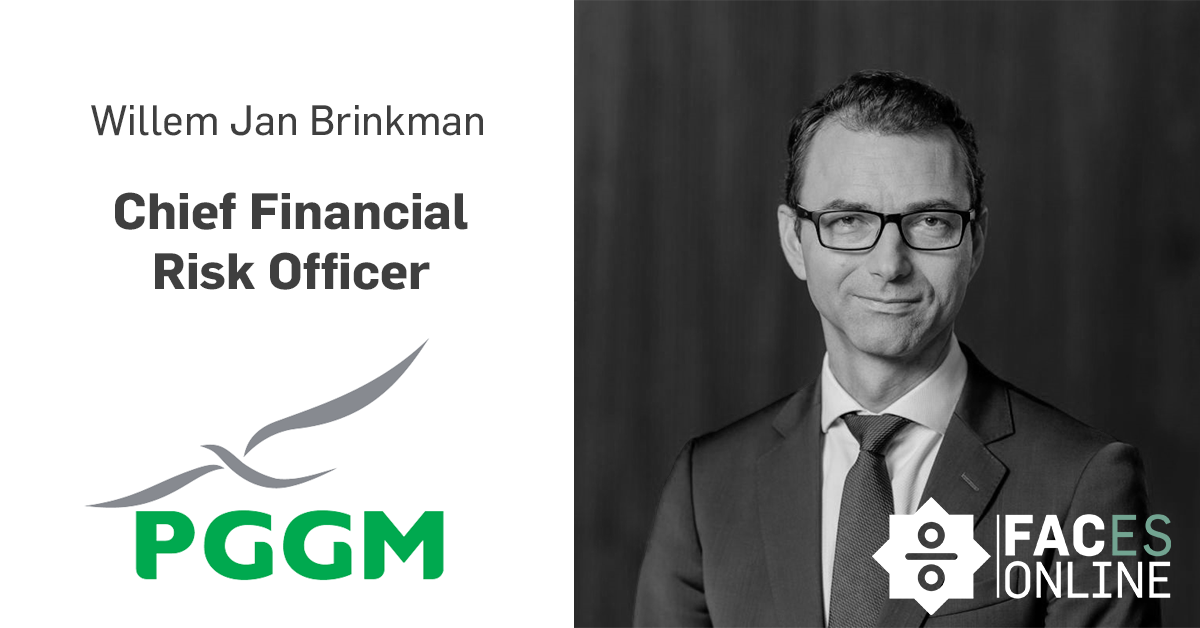
Interview with Willem Jan Brinkman – CFRO at PGGM
For the Dutch version, click here Since 2019, Willem Jan Brinkman has been CFRO of pension fund service provider PGGM. In this interview, he talks about his career and provides more insight into his work as CFRO. Besides, Brinkman shares his future vision of responsible investment within PGGM and how the affordability of pensions will develop in the upcoming years. You studied Economics at the University of Groningen. Can you outline what your time as a student was like? The study lasted five years in total because there was no split between the Bachelor and Master. I was active at the rowing club Aegir in Groningen. At the beginning of my studies, I was a very fanatical rower, but this became less so as I further progressed in my studies. During my studies, I did an internship at the headquarter of the Gasunie in Groningen. I finished my student years with a traineeship at PriceWaterhouse in the united states, a predecessor of PriceWaterhouseCoopers (PwC). I was able to do this traineeship through AIESEC, an organization that is still active today. How did you experience the transition from studying to working? The traineeship at PriceWaterhouse had a positive impact on my transition from studying to working. I ended up in the tax consultancy department advising rich people. You just had to work really hard there. For me, it was a huge transition to go from studying to working in a company. This traineeship also helped me to get a good idea of what working there actually entailed. In my student days, I found it difficult to form a good idea about this. In 2015 you made the switch from KPMG to PGGM. Can you explain why you made this move? At KPMG I was a partner in the M&A department, focusing on the financial sector. These were mainly transactions between banks, insurers, and asset managers. This transition was a nice switching point in my career. You’re in your early 40s and you ask yourself the question; ‘are you going to keep doing what you’re doing now or are you going to make a real change?’ The social mission that PGGM has appealed to me in particular, promoting the interests of employees in the care and welfare sector. The focus on responsible investment and SRI, for which PGGM is known, also appealed to me. Moreover, the scale of PGGM and the fund behind it (PFZW) means you can achieve a lot. From my work at KPMG, I already had some contacts at PGGM. I had PGGM in my sights, but there had been no reason to actually start working there. The reason came from PGGM’s involvement in the Dutch Investment Institute, a new initiative for investing in the Netherlands. As PGGM was looking for someone who could contribute to this, I decided to make the switch. Can you describe your day-to-day tasks as PGGM’s CFRO? How does your role differ from that of CFO? I am CFRO, a combination of Finance and Risk. Therefore, I have two different perspectives in which I operate within the company. Together with the CEO, I form the board of directors. This means that every issue that involves board-level decision-making comes to my desk. Almost every issue contains a financial or risk component. This can be about the financial results, the risks related to the company, or about investigations taking place. Hence, my tasks are enormously diverse, and I really enjoy that, but all from a managerial role. However, it’s not my intention to get lost in all kinds of details. My job is to maintain a birds-eye view of the total process. “I, therefore, expect people to look more closely at their pensions in the future.” The difference between CFO and CFRO is a development in the market. Previously, it was common for a firm to have a CFO and a CRO who supervised. Currently, these two positions are often combined into CFRO, although in larger companies you still see this split occasionally. At PGGM we have two separate departments that exist side by side but report to me as CFRO. Generally, pension funds focus on long-term affordability. To what extent do you focus on short-term financial instruments? We are the pension administrator, which means that the pension funds are our clients. They have a certain policy with regard to the fund’s investments. PGGM is the party that implements this policy for the pension fund. So, you look at the coming years: what needs to be paid out and what is coming in? A lot of liquidity is needed to be able to pay out money or make payments. The short-term part is then mainly taken care of by the treasury department of our asset management. This means that stock market-listed investments are held for shorter or longer periods, such as equities and credit. While investments in private markets are often really long-term, and for which we have built up large internal investment teams with a lot of specialist knowledge. An example is our team of forty people that make large investments in infrastructure, like for example the purchase of a water purification company that takes care of a city’s water supply. We usually hold these types of investments for a longer period of time, and they yield us a nice, stable dividend every year. We also do “structured investments,” such as what is known as Credit Risk Sharing transactions. Here we actually invest in the loan books of banks. These investments run for about 3 to 4 years. To properly reflect affordability, we look at the coverage ratio. This is the ratio between the present value of the amount to be paid out and the money that is currently available. The value of the coverage ratio is very much influenced by the interest rate. When interest rates are low, your liabilities’ value is very high, which causes the coverage ratio to fall below 100 percent. Because of the impact of COVID-19 on the economy,
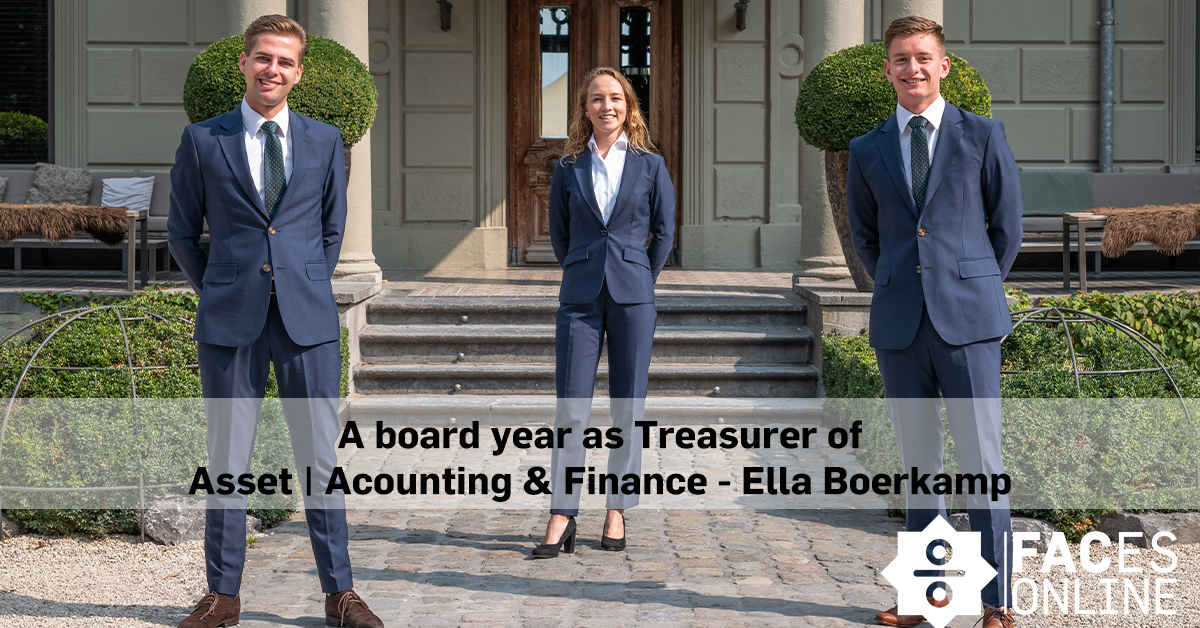
A board year as Treasurer of Asset | Accounting & Finance – Ella Boerkamp
For the Dutch version, click here As Treasurer, you are responsible for the finances of Asset | Accounting & Finance. In addition, you coordinate the Activities, CityTrip, and Investment Night Committee. In this article, I describe my experiences as Treasurer of Asset | Accounting & Finance. Why did I choose to do a board year at Asset | Accounting & Finance? During the first three years of my student life, I wanted to get my credits as quickly as possible. After three years, I obtained my bachelor’s degree and started with the Master Accountancy. I realized that after one year I would probably be finished with studying and therefore also with my student life. This made me doubt. After all, I was only 21 years old. Then I started thinking and came to the conclusion that I wanted to do something else. Therefore, I started to find out how I could prolong my student life a bit and meanwhile gain experience within my interests. As of my third year of study, I have been an active member of Asset | Accounting & Finance and I always had a good time. For me, that was the main reason that I applied for a board year. I wanted a fun and above all enjoyable year. A board year at A&F was therefore the perfect choice. After all, I already knew most of the members, completed the Master Accountancy and I could come into contact with a variety of companies. “What do you do all day?” That is a question I often receive from many friends. Actually, it is difficult to explain what you do all day to people who have not done a board year. When I started my board year, I knew it would be a busy year with many responsibilities, but what it would look exactly was also not clear to me. On Monday morning, we always have our board meeting. When I saw the agenda for the first time, I was flabbergasted. The agenda contained a lot of different topics, such as our formal and informal events, articles that need to be written for Faces-Online, acquisition, etc. As a board member, you are doing a lot of different things, because everything needs to be well-organized and nothing should be forgotten. In short, besides having drinks with fellow students, you have a lot of responsibilities as a board member. At the moment of writing this article, I am thinking again: “What did I actually do last week? The week always flies by!” Is the position of Treasurer exactly what I expected? Before I started my board year as Treasurer, I expected to be busy with the bookkeeping of A&F: paying invoices and declarations, requesting quotes, keeping track of the budget, and sending out invoices. In the first few weeks, I was indeed very busy with this. Twinfield, our accounting software, was not really my best friend at the time and it took me a while to understand and work efficiently with the system. Every week, I mean every day, I contacted my predecessor with questions about Twinfield. After a while, I became more and more proficient and I started to understand what my predecessor meant by ‘Twinfield is just like gaming’. “That as a board member of A&F, you are working in a mini-company with 120 employees and you will never get these responsibilities at your first job.” In contrast to the beginning of my board year, I am currently spending much more time coordinating my three committees. This results in variety in my work. The Activities Committee organizes various events for active members so that they can get to know fellow students despite the few physical contacts that are currently possible. I also coordinate the Investment Night Committee. Investment Night is a symposium that will take place on May 12. Organizing this is a very fun and exciting challenge. Furthermore, I am the coordinator of the CityTrip Committee. I am very happy with this, because last year, I was a member of the StudyTour Committee that organized the trip to South Korea. Even though traveling is not possible at the moment, we still organize fun activities! Besides coordinating my committees, I am also busy with helping other board members, the weekly meetings of all Treasurers of Asset, the quarterly Audit of Accounts, the bookkeeping of the Alumni Association Financials, and the Financial Association Netherlands (FAN). What are you most proud of? I am proud of the fact that, with all the board members, active members, and partners, we have made it an inspiring and instructive year so far. As a board member in this crazy period, we have to make sure that we keep all our partners and members happy. We ensure that events continue and that requires us to be proactive and creative in finding solutions. Hence, our problem-solving skills were highly demanded this year. I am also happy about and proud of the fact that all our events have taken place this year, despite the various Covid-19 restrictions. As a result, fellow students still had the opportunity to develop themselves and get to know other students. Would I recommend a board year to others, even in these strange times? Definitely! When I started my board year in the summer of 2020, I knew that my board year would be different from a ‘normal’ board year. Nevertheless, it has been a fantastic period so far! My board year cannot be compared to any other board year. I hope, of course, that this unique board year will not become normal. During this year, we had to do the best we could to remain successful as a study association. Every event needs to have a plan b and c, which are usually a physical plan and one or two online plans because the rules are constantly changing. For this reason, we are constantly searching for the best option. Looking back at what I have learned, I dare to say

Working together with the FIOD: what is the role of the accountant in beating corruption?
For the Dutch version, click here How corrupt are the Netherlands? Transparency International addresses this question annually and publishes the Transparency International corruption index, based on interviews with experts and business people in relevant countries. In the most recent evaluation the Netherlands scores reasonably well, with an eighth place in the top ten least corrupt countries [1]. Nevertheless, we in the Netherlands must remain critical. Although corruption has been largely eradicated in our own country, Dutch companies are repeatedly guilty of bribery abroad. The OECD Working Group on Bribery, the organization responsible for monitoring and reporting on the anti-corruption efforts of participating countries, concludes that companies or individuals in the Netherlands rarely go to court and the number of foreign bribery cases that are concluded with sanctions is relatively low [2]. Furthermore, the Netherlands lacks a legal framework for self-reporting, making it difficult for companies to assess the consequences of reporting internal corruption practices, leading to uncertainty and reluctance. However, the OECD Working Group on Bribery also mentions positive developments in the fight against corruption. One of these is the establishment of the Anti-Corruption Center (ACC) in 2016, a unit within the Fiscal Intelligence and Investigation Service (FIOD) aimed at combating corruption in the form of official and non-official bribery abroad and non-official bribery in the Netherlands. In addition to conducting corruption investigations, the ACC focuses on sharing knowledge in the area of corruption, entering into cooperation with various parties and professional groups, and increasing awareness of corruption and identifying it by means of ‘Awareness-raising-activities’. I spoke with Desiree van der Hoorn, chartered accountant and project leader at ACC, about how this unit operates, why they could really use the help of accountants in reporting signals of corruption, and the pilot project between the NBA, FIOD, and accountants. How does reporting of corruption signals work? The ACC starts a corruption investigation after receiving one or more signals, coming from different sources. These signals can come from the other government departments such as the tax authorities, revelations from whistleblowers in the media, such as the Panama papers and Luanda leaks, but also from reports by accountants. Accountants are part of the so-called gatekeepers, public and private organizations that, on the basis of the Money Laundering and Terrorist Financing (Prevention) Act (Wet ter voorkoming van witwassen en financieren van terrorisme, Wwft), are legally obliged to report unusual transactions that they identify to the Financial Intelligence Unit-Nederland (FIU-Nederland). Other examples of gatekeepers are institutions such as banks, trust offices and payment service providers, but also lawyers, appraisers and civil-law notaries. For accountants, both subjective and objective indicators have been developed for reporting unusual transactions. For example, a transaction of €10,000 or more paid in cash, checks, or prepaid cards must be reported at all times. After reporting the unusual transaction, FIU-the Netherlands can declare the transaction suspicious, after which it becomes available to the investigative, intelligence and security services. Reports by accountants A total of 2,462,973 unusual transactions were reported to FIU by the various institutions and professional groups in 2019, of which 3,424 were reported by accountants [3]. This represents a small portion of the total number of reports, although it should be noted that payment service providers, mostly through the objective indicators made over 1.9 million reports. Despite the small number, these reports are very valuable to FIU-Netherlands and FIOD/ACC, according to van der Hoorn. “An accountant is much closer to a company and has a good idea of what happens within a company, what is usual, but also what is unusual. In addition, before the accountant makes a report, some things are done. At large accounting firms, several consultations often take place prior to a report. This means that several experts have already had a look at the case and the transaction has been analyzed in detail. As a result, the reports that are made are often of high quality”. “If you look at the relationship with your client, then it is logical that you want to keep it good. But ‘keep it good’ to me would also mean good in terms of content, so you also want a client to act with integrity and that you, as an accountant, can put him on that integrity track, insofar as he is not already on it.” The considerations of reporting Despite this, accountants remain reluctant to report signs of corruption and the investigative services are seen more as the enemy than as a party to cooperate with. How can this be? In addition to his social responsibility in judging the truthfulness of the financial statements, the accountant also has a direct responsibility to the client. This combination can create a conflict of interest that hinders reporting. However, this does not outweigh the fact that failing to report an unusual transaction or reporting it too late is punishable by law. It can be punishable by substantial fines [4, 5], but an accountant can also be held liable under criminal or disciplinary law. In addition, van der Hoorn believes that if an accountant acts correctly, he will not easily find himself in a situation with major dilemmas or risks. “Despite the fact that, as an accountant, you are not allowed to tell your client that you have reported an unusual transaction to FIU-Netherlands, you do want to discuss the problem you have found with the client. Together with the client you want to resolve the issue, prevent it from happening again in the future, and possibly discuss the extent to which it makes sense to deal with the past and actively report the bribery yourself, so-called self-reporting. If you’re in such an open relationship with your client, you don’t actually get to a point where the risk is effectuated at all. “ In addition, conflicts of interest are often mentioned as a possible reason for not reporting an unusual transaction, but according to van der Hoorn, an accountant acting in the interests of his client would want to raise precisely possible corruption
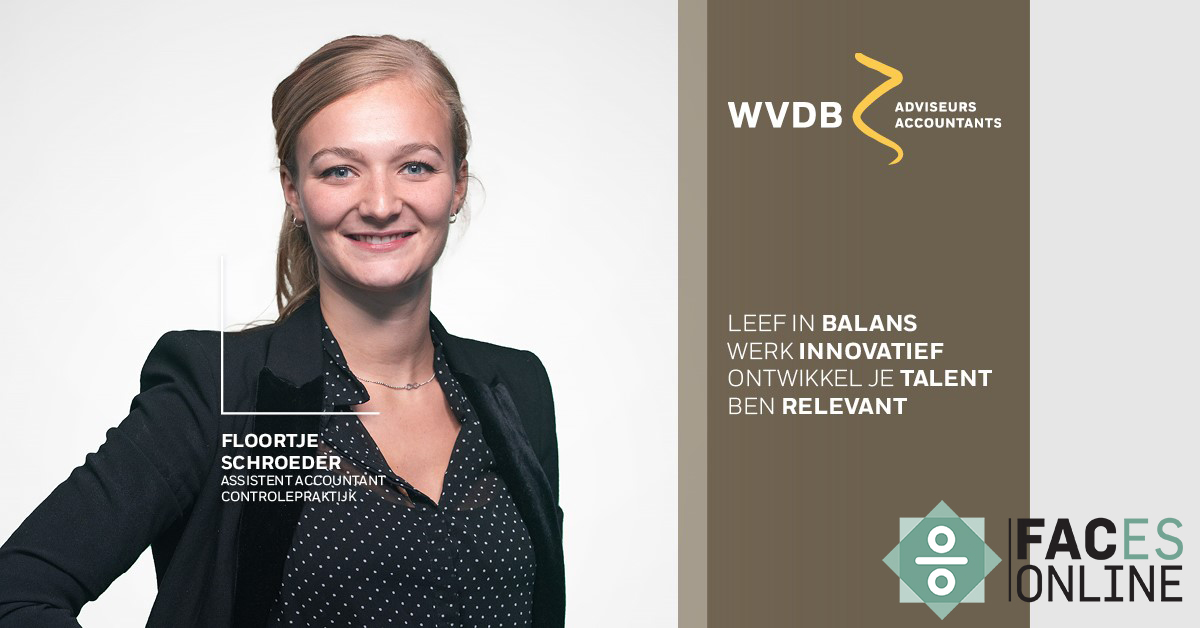
Working at WVDB
For the Dutch version, click here Who is Floortje Schroeder? My name is Floortje Schroeder and I am 23 years old. I was born in Tilburg and have lived in ‘s- Hertogenbosch since I was 11 years old. After high school, I started the hbo study Business Economics/Accountancy at Avans University in ‘s-Hertogenbosch. I completed this program in 2018. Since I wanted to study in the city where I come from, I chose to follow the Pre-Master Accountancy at Tilburg University. After completing the Pre-Master I started the Master Accountancy and consequently, I started the Post-Master Accountancy at Tilburg University in September 2020. My path to WVDB My path to WVDB started in 2016 when I signed up for the ‘practice route’. The practice route was a part of my hbo Accountancy studies at Avans Hogeschool and allowed students to get acquainted with the audit practice. To be able to participate in the practical route, a choice of an accountancy firm had to be made. The choice consisted of a Big 4 firm and WVDB. My preference went to WVDB because I believe I fit better in an organization where the lines are short and therefore everyone in the department knows each other and works with each other. In addition, I saw that a medium-sized organization would offer me the opportunity to be given responsibilities and to grow more quickly. WVDB caught my attention because it is a multidisciplinary office where different disciplines work together and because WVDB has a diverse client portfolio. The practical route brought me to WVDB as a junior assistant accountant. The practical route had a duration of 1.5 years where I worked 4 days as a junior assistant accountant at WVDB and followed my studies on Fridays. This allowed me to get an early idea of how everything works in practice. During my working period as a junior assistant accountant, WVDB introduced me to the accountancy profession. They gave me the opportunity to carry out various activities for both the compilation and the audit practice. In this way, WVDB gave me the opportunity during this period to get an idea of the practice and to develop myself. As a result, it was easier for me to make my choices regarding a follow-up study (AA / RA). “During this interim period, I started as a working student in the audit practice at WVDB. Working a few days a week during my studies allowed me to apply all the theoretical knowledge I had gained during my studies and to maintain and expand my practical knowledge.” After finishing the Pre-Master, an interim period follows, and then the Master Accountancy starts. During this interim period, I started as a working student in the audit practice at WVDB. Working a few days a week during my studies allowed me to apply all the theoretical knowledge I had gained during my studies and to maintain and expand my practical knowledge. This gave me an advantage over my fellow students in terms of practical experience. Because of the above, after completing my Master’s in Accountancy it was not difficult to choose where I wanted to work. WVDB has given me the opportunity to gain practical knowledge and develop myself during both my hbo and my Master’s studies. I have always found this time to be very pleasant. Because of this, I chose to stay at WVDB and I started as an assistant accountant audit practice at WVDB on September 1, 2020. My role and activities I have now been working as an assistant accountant for the audit practice at WVDB for several months. I have benefited greatly from the knowledge I have acquired during the practical training and my work-study, as I can now work independently. As an assistant, I am involved in carrying out audit assignments for various clients. WVDB has a very diverse client portfolio, which allows me to gain experience with the different sizes of clients and the sectors in which they operate. The diversity of the work with different clients and the cooperation with multiple disciplines make it challenging to work at WVDB. In addition, there is room for guidance, management, personal development, lots of customer contact and every team member is ready to help each other. There is also a friendly informal atmosphere at WVDB where it is pleasant for everyone to work. Usually, staff parties and outings are also the focus. However, due to COVID-19, these have not been able to physically take place this past year. Of course, WVDB would not be WVDB if we did not replace these outings with virtual ones. We now have the virtual after work drinks on friday, the control practice pub quiz, and the (Christmas) bingo! What do I want to give you? What I would like to pass on to you is that if you have the opportunity to take an early look at the practice to grab this chance. It facilitates your (study) choices in the future, gives you a head start on your fellow students, ensures your personal development, provides extra preparation for the start of your career and WVDB is open to help you with this! I would also like to suggest you take a good look around and see which office suits you best. Go and have coffee at different offices and talk to starting employees so that they can share their experiences with you. This will give you a taste of the atmosphere at different offices. Don’t follow the most popular route, follow your own route!
Working at Deloitte
For the Dutch version, click here The step from studying to working is a big one. You have to get used to working hours and obligations, learn a lot and gain new experiences. That was no different for Femke de Boer when she started working at Deloitte Audit over a year ago. Still, she thought it was not so bad. Thanks to the pleasant guidance of experienced colleagues, but also because Femke already knew the office very well from her board experience at study association Asset | Accounting & Finance. “During my master Accountancy I was a board member External Affairs at our study association in Tilburg”, Femke explains. “A position in which I was responsible for acquiring partners, maintaining contact with existing partners, setting up events and recruiting students for those events. A tough task, but the perfect way to get to know the finance and accountancy firms up close. In addition, I applied for a business course from Deloitte at the end of 2017. We went to Budapest with a select group of 25 students and Deloitte employees. An amazing experience and again a great way to get to know the office.” Femke obviously made a well-considered choice to work at Deloitte. “In accountancy, apart from the size and type of clients, the work doesn’t differ much from office to office. It is therefore all the more important that you experience whether a company suits you. Colleagues are a big part of your job. If it doesn’t click, it can make your work boring or obnoxious. I therefore mainly made the choice for Deloitte based on the people. This is a place where I can be myself. Of course, the other offices are also good employers, but Deloitte suits me.” It turned out to be an excellent choice. Femke is now a second-year staff member at Deloitte Audit and very enthusiastic about it. “I therefore mainly made the choice for Deloitte based on the people.” My work is very broad, Femke explains. “From auditing the annual accounts to testing internal control. You get to know the process and the customers from A to Z. Very educative. In addition, like my colleagues, I follow the postmaster to become a chartered accountant. I now learn to link theory and practice. The step is from studying to working is a big one. Also for me. Fortunately, as a starter at Deloitte you get good guidance from experienced colleagues. He or she walks you through your work and explains why we do the things we do. You simply have to learn to understand why you have to perform these checks as an accountant. Time and space is made for your postmaster and there is always someone who can and will help you if you have any questions.” Because Femke enjoyed the guidance of her colleagues, she herself also started looking for ways to assist others. “Everyone who is promoted will coach a colleague. For me that will take a short while, which is why I recently asked recruitment if I can already contribute. I now guide students who are making the choice for an employer. A lot of fun to do. Of course, I would like to persuade them to come and work at Deloitte, but the main thing is to be transparent. I am very positive about Deloitte as an employer. But the point is that a company has to suit you. That is why I advise everyone to do as much research as possible into the different employers. Go to the events of your study association and get to know the companies. It cannot be done from a flyer at the University Library, you really have to experience it. It takes a little effort, but wouldn’t it be a shame if after years of study you did not discover your optimal future employer just because you did not put in the extra effort?”
